

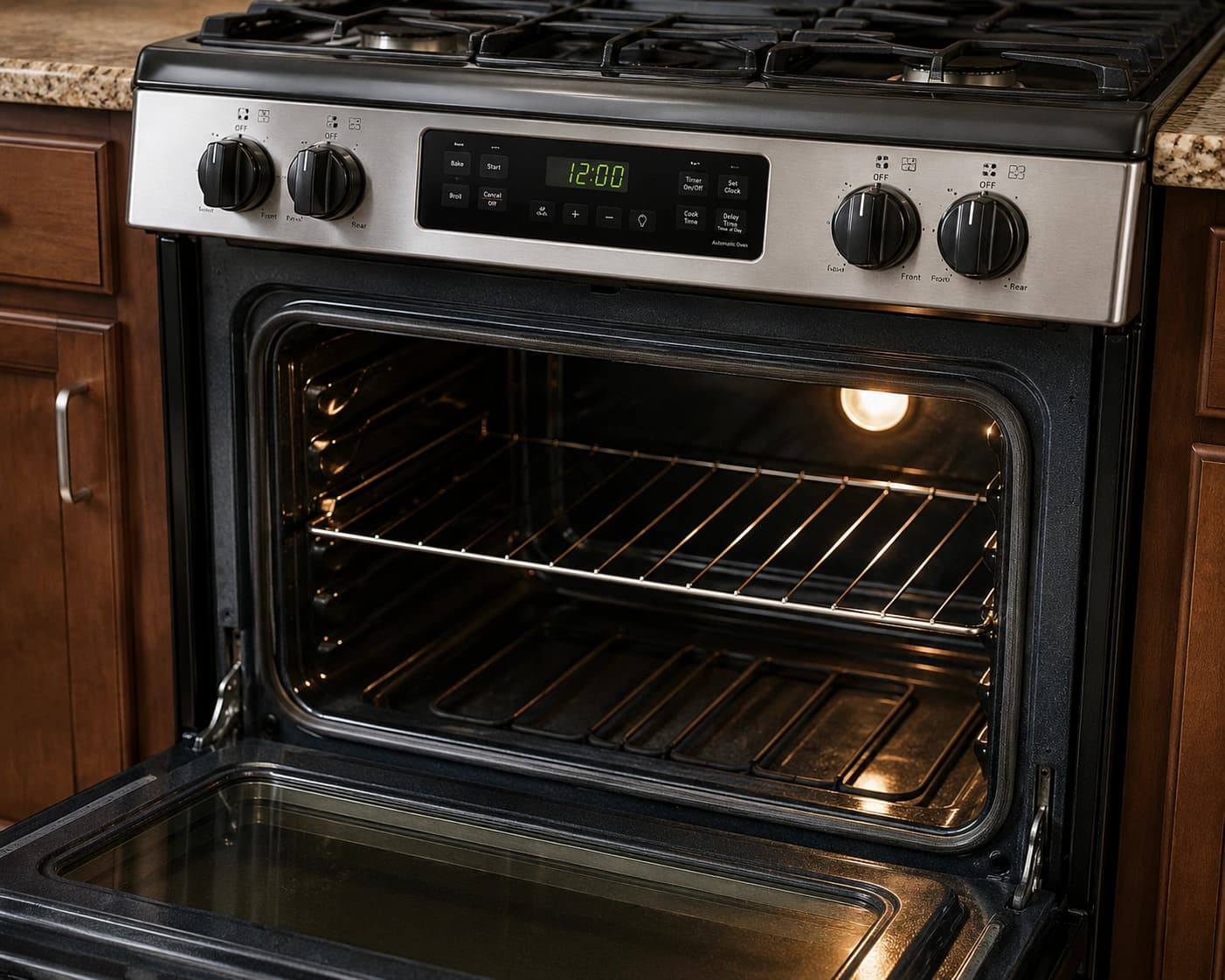
If you smell gas or a carbon-monoxide alarm sounds, leave the building immediately with everyone in the home and call 911 from outside. Do not operate oven controls, switches, phones, lights, windows, shutoffs, or flames, and do not go back inside. Stay outside until the fire department or gas utility says the property is safe. When a gas oven won't light, that emergency boundary comes before any discussion of the appliance.
Jeneral Plumbing is based in Westford, MA and is owner-operated by a Licensed Master Plumber (MA #9628831-PL-M) with 20+ years in the trade, including seven with a gas utility. I handle licensed gas piping and appliance-connection work, not internal oven repair. This gas oven won't light guide separates those scopes and applies all diagnosis after a gas-odor event only to an already-evacuated, already-reported, officially cleared property.
Gas Oven Won't Light and You Smell Gas? Leave First
If the oven fails to ignite and you smell gas, leave the building immediately and call 911 from outside. Do not touch the oven again, operate anything electrical, use a phone inside, operate windows or shutoffs, search for the source, or try another ignition cycle. Stay outside until the fire department or gas utility gives clearance. A gas oven won't light problem is plumbing or appliance work only after the life-safety response is complete.
If a carbon-monoxide alarm sounds, leave the building and call 911 from outside even when there is no gas odor. Carbon monoxide is colorless and odorless, and it can point to a combustion or exhaust problem rather than an escaping fuel-gas connection. Do not remain inside to compare flames, reset equipment, silence the alarm, or decide which appliance caused it. Equipment evaluation begins only after emergency responders clear the property.
If there is an active gas odor or carbon-monoxide alarm, leave the building and call 911 from outside. Jeneral Plumbing is not the first call; the fire department and gas utility handle emergency response, make-safe decisions, and clearance. After they say the property is safe, the next call depends on what their report identifies: a qualified appliance technician for oven internals, or a licensed plumber for customer-owned gas piping, the shutoff, connector, or appliance connection.
Two Oven-Failure Situations With Different Next Steps
If a gas oven won't light and there is any gas odor, leave the building and call 911 from outside before doing anything else. The strength or duration of the smell does not create a safe troubleshooting window. Do not return because the smell fades, and do not try to prove whether fuel is still flowing. Diagnostics discussed below begin only after the incident has been reported and the property has been cleared.
If a gas oven won't light but there is no gas odor and no carbon-monoxide alarm, do not make repeated ignition attempts or remove panels. Keep the oven unused and arrange evaluation by a qualified appliance technician. If an odor or alarm appears at any point, leave the building and call 911 from outside. A failed attempt with no warning present does not give a homeowner permission to test the ignition system or fuel components.
Intermittent operation still deserves qualified evaluation. An oven that lights on a later attempt has not explained why the earlier cycle failed, and successful operation during an appointment would not erase the reported condition. When a gas oven won't light only sometimes, record the model number and what happened from memory after the area is safe; do not reproduce the failure for a contractor.
Why a Gas Oven Won't Light Needs Appliance Diagnosis
After an odor incident has been evacuated, reported, and cleared, an appliance technician can diagnose why a gas oven won't light. Depending on the model, internal possibilities can involve an igniter, ignition control, flame-proving component, internal safety valve, power supply, wiring, burner assembly, or another appliance-specific part. This list is not a set of homeowner checks. Oven designs vary, and the technician follows the model instructions and safe service procedure.
Not every gas oven uses the same ignition design. Some equipment uses a hot-surface igniter, some uses spark ignition, and older equipment may use a pilot arrangement. A click, glow, or lack of either does not identify the failed component by itself. When a gas oven won't light, removing panels, cleaning an orifice, bypassing a safety, testing voltage, or manipulating an internal valve is appliance repair—not homeowner maintenance.
The technician also decides whether the oven should be repaired, left out of service, or replaced. Age can affect parts availability, but it does not create a universal replacement deadline. One ignition failure does not support a remote price or a guaranteed diagnosis. The decision follows the actual model, condition, repair history, and manufacturer information after the property is safe.
Gas Connection Work and Internal Oven Repair Are Different
Jeneral Plumbing handles the licensed fuel-supply side of a cleared gas oven won't light concern when the utility report or accessible conditions point there. My scope can include customer-owned piping, an accessible appliance shutoff, the approved connector, the connection point, pipe support, and permitted repair or replacement of the affected section. The gas-line repair path after official clearance explains how utility findings, testing, inspection, and restoration responsibilities fit together.
A qualified appliance technician handles the oven’s internal igniter, controls, safety valve, burner components, wiring, and model-specific operation. I do not represent a plumbing connection visit as internal oven diagnosis. If a gas oven won't light because of a component inside the appliance, the appliance technician owns that repair and the decision about whether the unit can return to use.
An electrician owns new branch-circuit, panel, receptacle, wiring, and other electrical work. That matters when a homeowner is considering a different cooking fuel or when an appliance technician identifies an electrical fault. A clear written scope keeps the plumber, appliance technician, electrician, delivery provider, and cabinetry contractor from assuming someone else handled a required step.
What I Review on the Licensed Connection Side
For an already-cleared gas oven won't light incident, I start with the fire-department or utility report, shutdown status, and the accessible customer-owned connection. I review the visible piping material and support, shutoff access, connector condition and routing, connection location, appliance input, and any permit, test, or inspection requirement. I do not ask you to restart the oven or recreate an odor.
A gas oven won't light report does not turn pressure testing into a homeowner task. A pressure test is a controlled professional procedure with defined isolation, equipment, pressure, duration, documentation, and inspection rules. It is not a household detector check and not permission to operate shutoffs or reconnect fuel. If the authority requires a test after a shutdown or repair, that step belongs to the licensed sequence. Service restoration and any appliance relight follow the utility, inspector, manufacturer, and written-scope requirements.
Planned replacement is different from a cleared repair. When a compatible gas range is being installed with no active warning or unresolved shutdown, I confirm connected load, line capacity, shutoff access, connector requirements, and the permit path before completing the approved connection. Jeneral Plumbing’s planned gas-line installation service covers new or extended piping, while the installation and upgrade service helps define plumbing responsibilities around a larger kitchen project.
Repair, Replace, or Change Cooking Fuel
When a gas oven won't light, an appliance technician should decide whether an internal repair is available and appropriate. The answer depends on the model, confirmed fault, condition, parts availability, and cost of the appliance work. I do not recommend a new range solely from age or a single description over the phone. A written appliance diagnosis gives you a better basis for comparing repair with replacement.
If you choose another gas range, the licensed connection still needs the selected model’s input, connection location, clearance requirements, existing line capacity, accessible shutoff, and approved connector reviewed. Delivery or appliance setup does not automatically include licensed gas work. When a gas oven won't light leads to replacement, each party’s responsibility should be clear before the old unit is moved or the new one is placed.
If you choose electric cooking, the change is not a cord swap. I handle the approved disconnection and capping or alteration of customer-owned gas piping within the plumbing scope, while a qualified electrician evaluates panel capacity and installs the correct 240-volt circuit and connection for the selected appliance. Cabinet or finish changes remain separate unless written into another contractor’s scope. The total project follows the selected appliance, electrical capacity, route, and site conditions, so each trade prices its own confirmed scope.
Do Not Assume the Stovetop Is Safe to Keep Using
If there is a gas odor or carbon-monoxide alarm, leave the building and call 911 from outside. After emergency officials clear the property, do not use the oven, cooktop, or another part of the range until the responsible qualified professional evaluates the appliance. Separate burners and the oven may use different components, but they still share one appliance and fuel supply. A working burner does not prove the oven fault is isolated, and it does not override a utility shutdown or appliance-tech restriction.
If a gas oven won't light without an odor or alarm, keep the oven unused until an appliance technician evaluates it. Do not keep testing the cooktop to infer whether the oven is safe. If gas odor appears, leave the building and call 911 from outside. The right reuse decision comes from the qualified evaluation, not from a blanket online answer.
Practical Prevention Without Do-It-Yourself Gas Work
Use the appliance only as its manufacturer directs and keep its model, serial number, installation instructions, and service history available. Do not clean internal gas orifices, adjust ignition components, bypass safeguards, alter connectors, or disassemble fuel controls. When a gas oven won't light, those steps belong to an appliance technician or licensed gas professional according to the component and scope.
Maintain carbon-monoxide alarms according to their manufacturer instructions and replace them at the stated end of life. If an alarm sounds, leave the building and call 911 from outside. If emergency officials later identify a gas water heater or heating appliance rather than the range, the cleared follow-up may fit Jeneral Plumbing’s gas water heater service or boiler-first heating service. Those service paths never replace the first life-safety call.
Plan connection changes before a delivery crew arrives. The model’s fuel, input, connection point, and installation requirements determine whether the existing setup fits. A nearby capped line or old connector is not proof of capacity or compatibility. If an active warning appears, leave the building and call 911 from outside before any service planning.
Owner-Operated Help From Westford
From Westford, MA, I serve Chelmsford, Billerica, Littleton, Groton, Pepperell, and other core communities across Middlesex & Worcester County and southern New Hampshire. For a cleared connection or piping concern related to a gas oven won't light report, I review whether the customer-owned gas scope fits Jeneral Plumbing. For an internal oven fault, I keep the boundary honest and direct that work to a qualified appliance technician.
For a regular-hours connection or piping assessment, Jeneral Plumbing charges an $80 dispatch fee — the cost of the visit, waived when you hire us for the work. I price approved plumbing repair and installation work at a flat rate, with the total price and any applicable fees disclosed for approval before work begins. Appliance repair, electrical work, and other-trade costs stay outside my quote unless expressly included in writing.
After emergency officials have cleared the property, call (978) 392-7789 if the report points to customer-owned piping, the shutoff, connector, or gas connection. I will confirm whether the gas oven won't light concern belongs with Jeneral Plumbing or an appliance technician. If you smell gas or a carbon-monoxide alarm sounds, leave the building and call 911 from outside before arranging any service.
Gas Oven Won't Light Questions
What should I do if my oven will not light and I smell gas?
Leave the building immediately with everyone in the home and call 911 from outside. Do not touch the oven, operate switches or phones inside, operate windows or shutoffs, search for the source, or try another ignition cycle. Stay outside until the fire department or gas utility says the property is safe. A gas oven won't light diagnosis begins only after that official clearance.
What should I do if my carbon-monoxide alarm sounds?
Leave the building immediately and call 911 from outside, even if you do not smell gas. Carbon monoxide is odorless, and the alarm is a life-safety event before it is an oven, boiler, or water-heater problem. Do not remain inside to test equipment or silence the alarm. Plumbing, heating, or appliance evaluation follows only after emergency responders clear the property.
What if my gas oven will not light but there is no gas smell?
If a gas oven won't light with no odor and no carbon-monoxide alarm, do not make repeated attempts or remove any panels. Keep the oven unused and arrange evaluation by a qualified appliance technician. The technician can diagnose model-specific ignition and internal safety components after confirming the situation is not an active emergency. If an odor or alarm appears, leave the building and call 911 from outside.
Can I keep using the stovetop if the oven failed?
If there is any gas odor or carbon-monoxide alarm, leave the building and call 911 from outside. After emergency officials clear the property, do not assume the stovetop is safe because its burners appear separate from the oven; use no part of the range until the responsible professional evaluates it. When a gas oven won't light without an active warning, an appliance technician should still decide whether other parts of the unit can remain in service. A general online answer cannot clear your specific appliance.
Do I call a plumber or an appliance technician?
If you smell gas or a carbon-monoxide alarm sounds, leave the building and call 911 from outside; do not call a plumber or appliance technician first. After clearance, an appliance technician handles internal oven components such as the igniter, controls, safety valve, burner assembly, and wiring. Jeneral Plumbing handles licensed customer-owned gas piping, the shutoff, connector, and connection when those items are in the approved scope. A gas oven won't light report may involve one trade or both, but their responsibilities should not be blended.
How is Jeneral Plumbing's gas-connection work priced?
For regular-hours service, Jeneral Plumbing charges an $80 dispatch fee — the cost of the visit, waived when you hire us for the work. After inspecting a cleared customer-owned piping or connection concern, I present approved plumbing work at a flat rate with the total and applicable fees disclosed before work begins. Internal oven repair and electrical work are priced by the professionals responsible for those scopes. Call (978) 392-7789 after clearance to discuss whether the gas oven won't light concern belongs with Jeneral Plumbing.
Written by Jeneral Plumbing.
This article was drafted with AI writing tools and edited before publication. AI tools did not inspect any job or validate technical conclusions.
Last updated .