
If you smell gas or a carbon monoxide alarm sounds, leave the building and call 911 from outside. Don't operate switches, phones, appliances or valves inside. Stay out until the fire department or gas utility clears the property; service follows that clearance.
"My boiler never shuts off" can mean several different things. The burner may be firing nonstop, the circulator may keep moving water, the display may stay lit while nothing else runs, one zone may stay warm, or the boiler may keep answering a hot-water demand. With a combi boiler, which heats the house and makes your hot water, those are different control paths. Figuring out which one is active comes before any part or setting changes.
First, what exactly is running?
Without opening the cabinet, you can note:
- whether the flame or burner indicator stays on, or only the screen is lit
- which thermostat or zone is calling for heat, and whether those rooms are still below their setting
- whether baseboards or radiators stay hot after every thermostat is satisfied
- whether a hot-water fixture, a recirculation system or a leak could be creating hot-water demand
- whether the display shows a current code, a stored code or only an operating mode
- whether it happens only in cold weather or at every outdoor temperature
Don't reset it repeatedly, open the cover, disconnect thermostat wires, move installer switches or touch the gas controls. Those steps can erase evidence or create a hazard.
When long run times are normal
A modulating condensing boiler can turn its flame down to match the load. On a cold day, a properly configured system may run for hours at low fire instead of cycling on and off. A long run alone doesn't establish a fault. It needs investigation when the burner keeps firing without a legitimate demand, the wrong zones heat, the house can't reach its setting, or a current code keeps returning.
The case: a new Navien combi that wouldn't stop
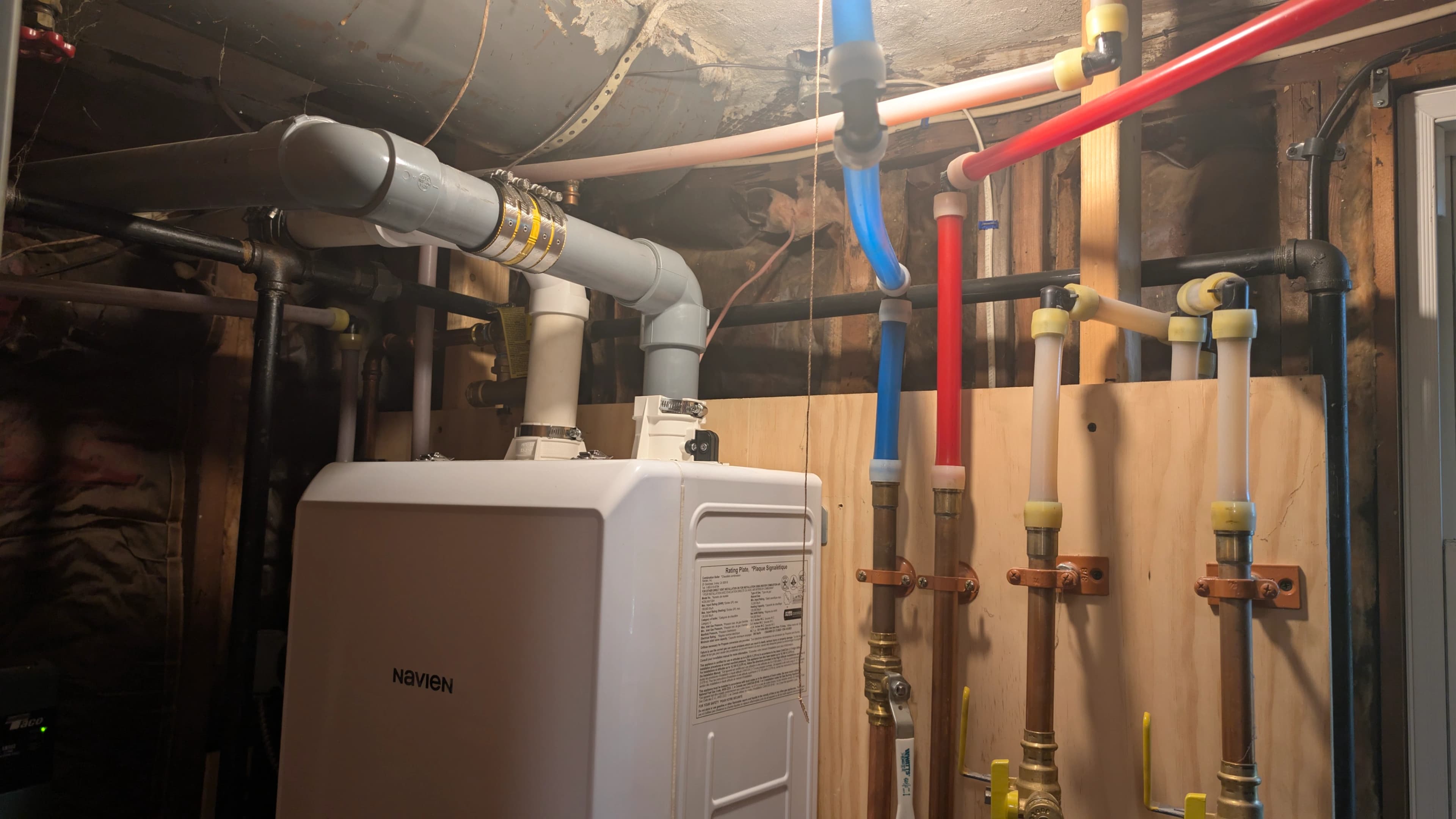
A homeowner called about a newly installed Navien combi boiler running constantly. The display hovered around 167 to 168°F with a 170°F setting showing, and switching to a basic two-wire thermostat hadn't changed anything. That small gap between reading and setting didn't prove a fault on its own.
On the visit, there was no outdoor temperature sensor installed, and the code history held an Error 351 dated only "July," with no year. The fill-water piping didn't appear to use the boiler's automatic refill function as designed, though confirming that takes the exact piping diagram and pressure readings.
Working with the manufacturer's technical support, we identified a model-specific configuration setting tied to the exhaust vent material. Correcting it changed the boiler's ability to reach its target. In a separate test, opening the thermostat circuit stopped the heat call. That pointed to the external control wiring rather than the boiler, but it didn't prove the thermostat itself was bad. The final readings from that visit aren't recorded, so we won't claim every contributing issue was solved. The home's town isn't recorded either, so this isn't presented as a Westford job.
How outdoor reset changes run time
Outdoor reset uses an outdoor sensor and a programmed curve. As it gets colder outside, the boiler aims for hotter heating water; in milder weather, cooler water. A lower target can mean longer, gentler run times, which is often part of the design. Outdoor reset doesn't start or end a thermostat call, and it doesn't set your hot-water temperature.
A missing sensor means outdoor reset isn't working where the setup depends on it, but it doesn't prove an installation defect or explain nonstop firing. Some approved control designs use other logic, so the exact model, its settings and the original design decide whether a sensor belongs there.
Thermostat signals that keep a call alive
The boiler follows the signal it receives. A stuck relay, a miswired zone valve, a damaged cable, an incompatible thermostat or a wrong input setting can hold a heat call open even when the rooms are warm. Some electronic thermostats on two wires draw a small current through the control circuit to power themselves, and depending on the boiler and any zone panel, that can create an unsteady or constant signal.
There's no universal fix. The answer might be corrected wiring, a common wire, an approved relay or a different thermostat, chosen from both manufacturers' wiring diagrams and measured control voltage. Don't jumper terminals or disconnect wires to test it yourself.
What Error 351 does and doesn't tell you
For example, Navien's NFC-H user manual lists E351 under automatic feeder-valve operation for the NFC-250/175H and NFC-250/200H. The case record doesn't identify its combi model, so that definition must be matched before applying it here. A technician may need to check the refill supply, valve and system pressure; the code alone doesn't establish a failed valve or a leak. A stored code can also describe an earlier event. It wasn't established as the cause of this home's constant running.
Automatic refill isn't a cure for a leaking system, either. Fresh water brings oxygen and minerals into the system, and adding water to a hot, low-water boiler without the right procedure can be dangerous. Our Navien error codes guide explains how to record a code before you call.
Installer settings aren't homeowner settings
The configuration fix in this case applied to one installation. The right setting depends on the exact model, the approved vent material and its route, and current Navien literature. A wrong setting can allow exhaust temperatures the vent isn't listed for, which is hazardous, so we don't publish switch numbers and you shouldn't change them. After a change like this, the boiler needs its model-specific checks, covering venting, condensate, ignition, safeties and combustion readings, for both heating and hot water.
Safety stops
Smoke, fire or flame outside the burner area also calls for evacuation and 911. For overheating or uncontrolled hot discharge, keep clear and seek urgent help; use the model's shutdown instructions only if safely accessible and don't restart it pending assessment. For unwanted heat or a returning code, stop repeated resets and arrange service. Long run time by itself doesn't determine the urgency.
A separate visit: an old water heater
A different household, on a separate visit, had a roughly 30-year-old electric water heater and leaking faucets, and we talked through replacement options. Age alone doesn't prove a tank has to go. That decision is covered in our water heater repair-or-replace guide.
Getting a controls-based diagnosis
Jeneral Plumbing is owner-operated by a Licensed Master Plumber (MA #9628831-PL-M) with 20+ years in the trade, including seven with a gas utility, factory trained by Navien and Navien Service Specialist (NSS) certified. Navien decides warranty claims under the terms for your model. We're based in Westford, MA, and serve homes within 20 miles across Middlesex & Worcester County, confirming your address, work and availability before booking. Gas appliance work is Massachusetts-only. During regular hours, a visit carries an $80 dispatch fee — the cost of the visit, waived when you hire us for the work. Repairs are priced at a flat rate for your approval before work begins. Call (978) 392-7789 with the model, a photo of the display and what's running, or see our combi boiler service.
Written by Jeneral Plumbing.
This article was drafted with AI writing tools and edited before publication. AI tools did not inspect any job or validate technical conclusions.
Last updated .