

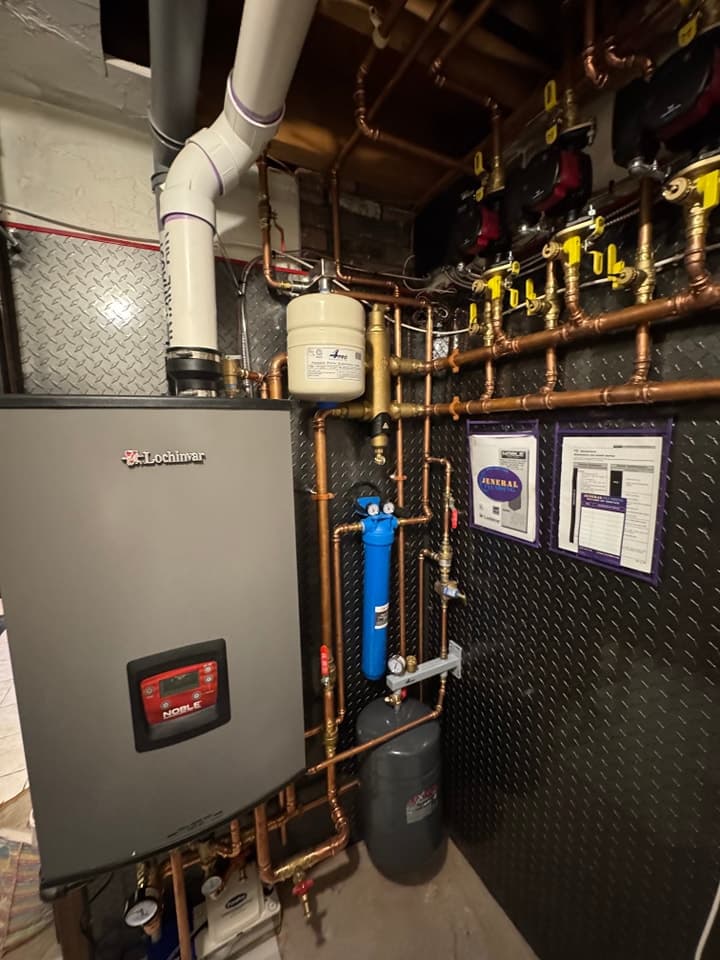
A 33-year-old oil boiler raises a fair question: replace it with another oil boiler, switch to propane, or connect to natural gas if it's available? A Lexington, MA family asked exactly that when they started looking at propane. The honest answer is that no fuel wins for every house. What decides it is the fuel available at the address, storage space, the existing heating system, venting and chimney condition, supplier or utility terms, and the full conversion scope, not a single price quote. Here, "gas" means natural gas.
Safety first
If you smell propane or natural gas, or a carbon monoxide alarm sounds, get everyone outside and call 911 from outside, and stay out until officials say it's safe. For an oil odor, staining or a suspected tank leak, keep people away, don't operate nearby equipment, and contact the oil supplier or the fire department.
Propane boiler vs oil boiler vs natural gas
A propane boiler vs oil boiler comparison, or one that includes natural gas, starts with three questions: how fuel reaches the house, how the chosen model has to vent, and who will service it. Oil and propane both rely on a supplier delivering to a tank on site, while natural gas depends on the utility confirming it can serve the address. Service differs as well: an oil burner needs a qualified oil-burner technician, and a propane setup relies on the supplier for the tank and its regulators.
| Oil | Propane | Natural gas | |
|---|---|---|---|
| Fuel supply | Delivered to a tank on site | Delivered to a tank on site | Piped in by the utility serving the address |
| What to confirm first | Tank condition, delivery access and supplier terms | Tank location, size, ownership or lease, and supplier approval | Service to the address, plus enough meter and regulator capacity |
| Venting | Usually a chimney or a vent listed for the model | Set by the model; condensing units often vent through a side wall | Set by the model; condensing units often vent through a side wall |
| Service needs | Burner, filter and combustion service by a qualified oil-burner technician, plus tank checks | Gas pressure, ignition, combustion, venting and condensate checks | Gas capacity, ignition, combustion, venting and condensate checks |
| Common planning mistake | Repeating the old boiler's size or overlooking the tank and chimney | Assuming a tank spot or winter supply works without the supplier's review | Assuming a nearby main means the house can connect |
All three can heat a hot water system when the equipment and the distribution match. Baseboard, radiators, radiant zones and circulators don't automatically need replacing when the fuel changes, but they do need a look. The water temperature a house needs affects whether a condensing boiler can run efficiently.
Comparing operating costs fairly
A price per gallon and a price per therm aren't comparable, because each unit holds a different amount of energy. A fair comparison converts each quote to the cost of usable heat after the chosen boiler's rated efficiency, then applies your home's estimated yearly heating load. Delivery charges, minimum-use terms, tank rental, utility fees and service belong in the same math. Fuel prices move, so a one-day quote can't support a guaranteed 15- or 20-year savings claim.
An efficiency rating such as AFUE is a standardized equipment rating, not a forecast of your bill. Oversizing, high return-water temperatures, short cycling and the house itself change real-world results. All three boiler types also need electricity for controls, and usually for pumps, fans and ignition, so fuel stored on site won't keep the heat on in an outage without a properly designed backup.
Choosing a propane or oil boiler when there's no gas main
Where natural gas isn't available, the choice usually comes down to a propane or oil boiler. Staying with oil can make sense when the tank is sound, delivery access works, the chimney or vent suits the new equipment, and a conversion would add a lot of work for little value. Propane can make sense when a supplier approves a workable tank location and delivery plan, the fuel piping and venting fit, and you want a gas-fired boiler, often a condensing one. Propane isn't automatically cheaper than oil, and automatic delivery isn't the same as unlimited supply, so compare delivered prices, tank terms, expected use and the full installation scope.
Oil burner service is specialized work. If you stay with oil, ask who will service the burner before you choose the equipment.
What propane gas boilers need
Propane gas boilers work on the same principles as natural gas models, but the setup differs. The boiler has to be listed for propane, or converted only where the manufacturer's instructions allow it, using the specified kit and procedure. That's never a homeowner adjustment. The supplier sizes and places the tank, sets up the regulators and confirms delivery access. Boiler input, other propane appliances, outdoor temperature and how full the tank is can all affect how well it supplies gas in cold weather, so that belongs in the supplier's plan.
Inside the house, the fuel piping is sized for the total connected load, and the job needs combustion air, venting, condensate handling for condensing units, permits, inspection and commissioning. Our propane and natural gas work is Massachusetts-only.
Staying with oil
Keeping oil deserves the same whole-project review as a conversion. During an assessment we note visible signs of tank corrosion, leaks, unstable supports or vulnerable piping, but pumping, removal and environmental work belong to a tank contractor. Oil shouldn't be chosen because it "burns hotter," either. Boiler output has to match the house, and too much input causes short cycling, not more comfort.
Converting to natural gas
A conversion starts with written confirmation from the utility that gas service is available to the address and can carry the load. It doesn't start with ordering a boiler. From there, the plan covers:
- a heat-loss calculation and a review of the radiators, zones, pumps and controls, so the old boiler's size doesn't become the new one's by default
- the utility's service and meter work, plus the house-side gas piping, pressure test, permit and inspection, which our gas line installation service handles
- an approved venting path, either a listed direct vent or a suitable chimney
- the chimney's future, since a retained chimney needs a condition review and other appliances may still depend on it
- oil tank pumping and removal by a tank contractor, marked as included, excluded or pending
- full commissioning: filling, purging, controls, leak checks, combustion analysis and safety checks
If the approved scope calls for a stainless chimney liner, relining by a chimney contractor runs $2,400 – $6,500. It isn't an automatic conversion charge; the chimney contractor evaluates the flue and any other connected appliances first.
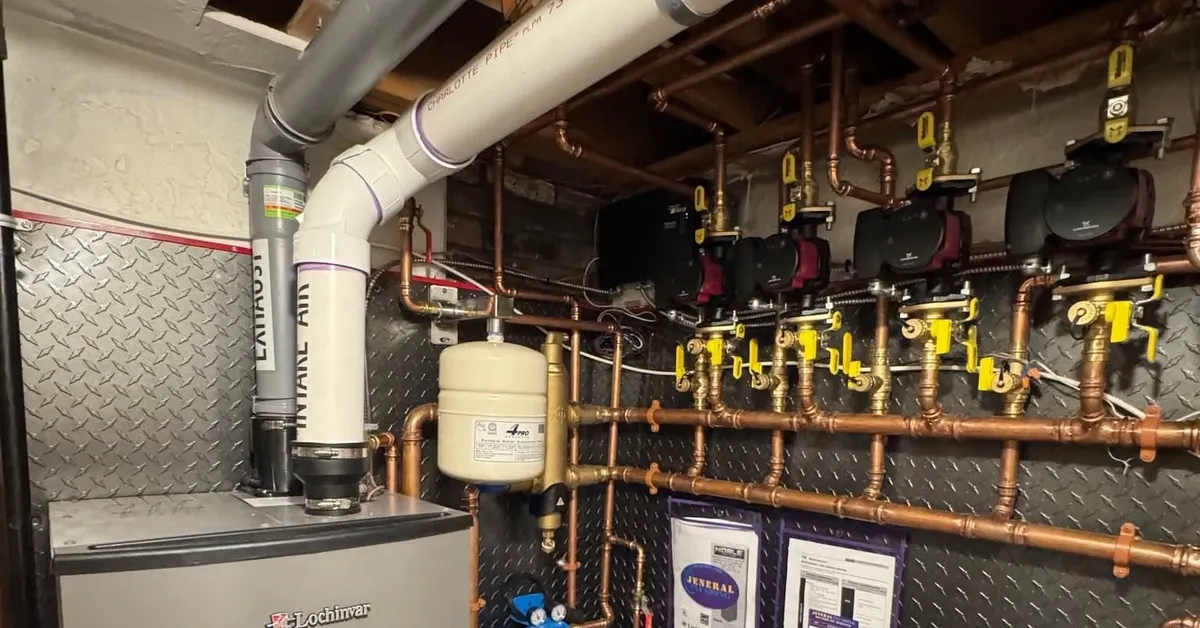
What the Lexington case shows
The family's 33-year-old oil boiler made a planned assessment sensible, but its age didn't prove propane was the answer. The fuels couldn't be ranked until the home's conditions were known: the heating load, the radiation and water temperature, zoning, the hot-water arrangement, the oil tank, the chimney or vent route, whether gas was available at the address, and whether a propane supplier could approve a tank and delivery plan. This guide covers that evaluation; the family's final choice isn't part of it.
Mass Save and fuel conversions
As of August 2026, Mass Save's boilers and furnaces page said broad rebates, incentives and financing were no longer available for natural gas, oil or propane equipment, with an exception for income-eligible households upgrading to qualifying high-efficiency models. Don't assume a general conversion rebate. Program rules change, so we recheck before any incentive appears in a written comparison.
Comparing your options
Jeneral Plumbing is owner-operated by a Licensed Master Plumber (MA #9628831-PL-M) with 20+ years in the trade, including seven with a gas utility, and factory trained by Weil-McLain and Lochinvar; Viessmann is also one of our heating partners. We're based in Westford, MA, and serve Lexington and other homes within 20 miles across Middlesex & Worcester County, and we confirm your address and the work when you call. During regular hours, a visit carries an $80 dispatch fee — the cost of the visit, waived when you hire us for the work. Repair and installation work is priced at a flat rate, with the total and any fees shown for approval before work begins. Call (978) 392-7789 to compare your options, or see how our boiler installation service scopes a replacement.
Can a propane boiler use my existing radiators or baseboard?
Often, but not automatically. We calculate the heating load and review the radiators or baseboard, the water temperature they need, flow, zoning, pumps, controls and piping condition. Those findings decide whether the new boiler can serve the system and whether a condensing model will condense in your system. The fuel alone doesn't settle it.
Written by Jeneral Plumbing.
This article was drafted with AI writing tools and edited before publication. AI tools did not inspect any job or validate technical conclusions.
Last updated .