

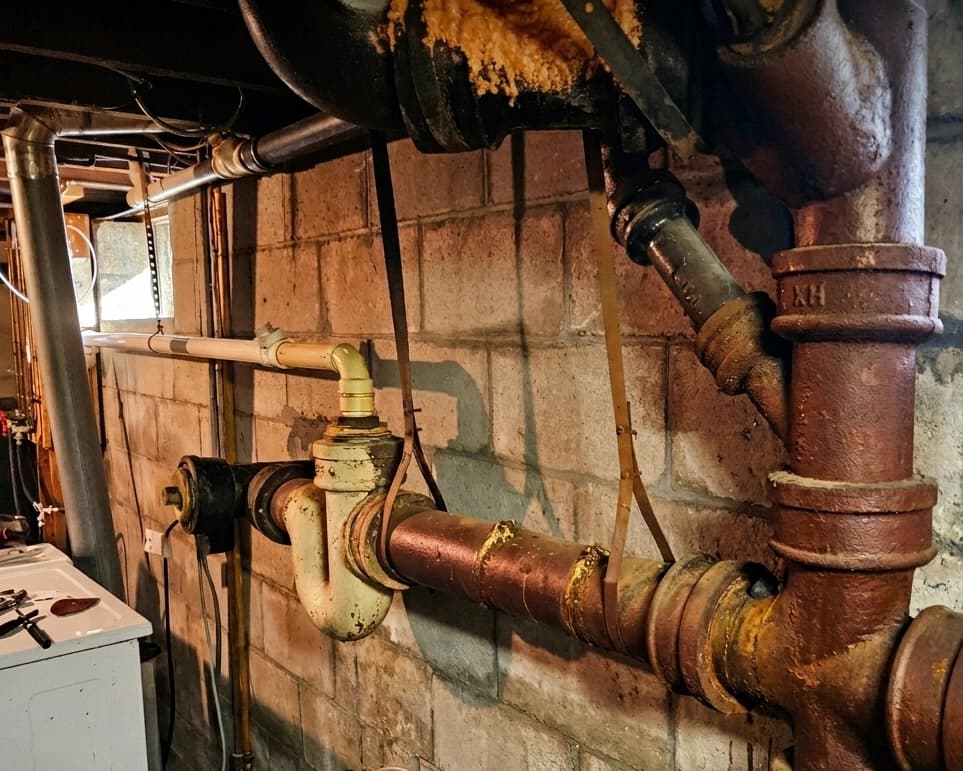
Water below an old drain does not mean every cast-iron pipe must be replaced. For homeowners in Westford, MA, the repair decision starts with what is visible: the leak's location, which fixture was used, the damage, and the access available.
In the case discussed here, a homeowner reported basement leaks and recurring blockages. Visible holes and leakage supported repair planning for accessible interior pipe. The blockage history still needed a separate assessment.
Signs That Support an Interior Repair
Water at a joint when an upstairs fixture drains, an exposed crack, a separated fitting, or an open hole can help identify a damaged section. Dry staining, surface rust, and age alone do not establish that a pipe has failed.
Timing helps narrow the path. Moisture that continues without fixture use may come from a supply line, groundwater, condensation, or another source. We inspect the accessible conditions before proposing accessible drain-pipe repair.
What the Local Drain Review Found
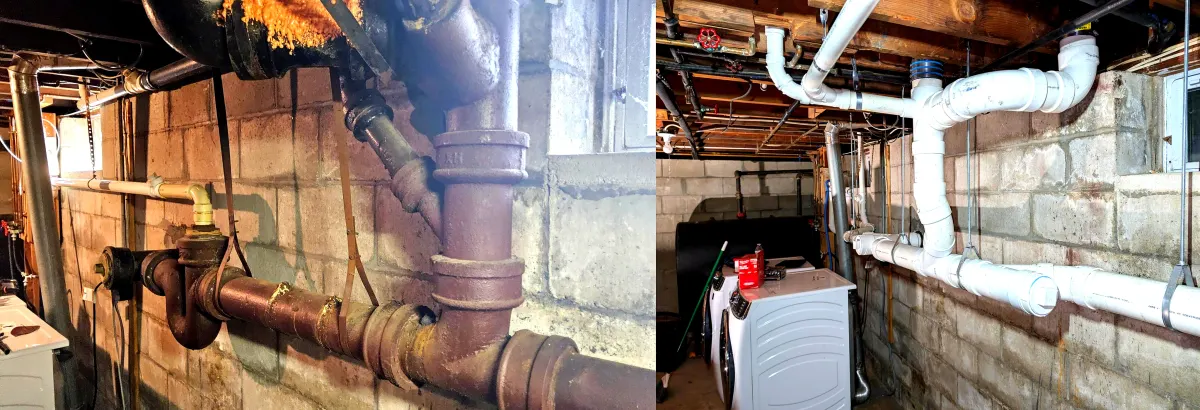
The visible cast iron showed pronounced deterioration, several leak points, and openings in exposed sections. Those findings supported an interior repair plan without establishing the condition of concealed or buried piping.
The layout also included an older whole-house trap and venting questions. These needed to be accounted for in the proposed work; their presence alone did not establish a failed pipe or a municipal code finding.
Why Age Alone Does Not Decide Replacement
One section may remain serviceable while another deteriorates. Joint condition, support, exposure, and past alterations all affect the repair options. Surface rust cannot tell us the remaining thickness of a concealed pipe wall.
We also map material changes. An older stack may connect to newer branches, and a renovation may have replaced only part of a run. The proposal should fit those actual connections.
A Recurring Clog Needs Its Own Diagnosis
A clog establishes interrupted flow, not the location or cause. An obstruction, fixture connection, shared drain, or downstream condition may produce similar symptoms. Clearing or specialist investigation may be needed before any replacement decision.
Keep people and pets away from wastewater, and avoid adding harsh drain chemicals. Stop using affected fixtures when they leak or back up; do not enter standing water near electrical equipment.
Spot Repair or a Larger Accessible Replacement?
A targeted repair may suit one failed section when the adjoining pipe can remain securely supported and connected. Several confirmed defects along the same exposed run may make a broader replacement more practical, especially if short patches would require repeated transitions.
- Repair now: active leakage, an open hole, a separated fitting, or another confirmed accessible defect.
- Plan with related work: a section that can be addressed while a renovation provides access.
- Monitor: stable accessible conditions without current leakage or confirmed loss of function.
Ask the proposal to identify what comes out, what stays, the support and transitions, and the fixtures affected. A failed section does not automatically condemn the rest of the house.
Where Interior Repair Ends and Sewer Work Begins
Jeneral Plumbing repairs confirmed defects in accessible fixture, branch, and building-drain piping inside the building. Drain cleaning, snaking, hydro jetting, camera inspection, root work, sewer-lateral or sewer service, excavation, and trenchless replacement are independent specialist referrals.
We do not perform or price those referral services. A specialist's findings can help identify where their work meets an interior plumbing repair, but a basement leak does not establish a buried-lateral problem.
Our cast-iron-to-PVC sewer-line replacement guide explains that separate replacement pathway. For a visible interior leak, call (978) 392-7789 to discuss the accessible pipe and affected fixtures.
What the Repair Plan Should Include
Before work begins, we identify the run, connected fixtures, access, transitions, and support for the heavy piping that remains. The plan also assigns responsibility for opening and restoring finished surfaces and for any structural or electrical work.
If a renovation creates the access, complete plumbing-system design can coordinate drain and vent routing with the larger layout. Licensed electricians handle electrical assessment and connections.
For covered plumbing work, we apply for the applicable permit and coordinate required inspections. Our assessment defines a private repair proposal; it does not replace municipal inspection or approval.
Plan the Fixture Outage
Fixtures that drain through an open section cannot be used during replacement. We identify them in advance and plan access, scheduling, testing, and return to service. The duration depends on the project.
Exposed basement piping and pipe above a finished ceiling need different access plans. Our plumbing installation and upgrade planning considers that disruption and any trade or inspection stages before the scope is priced.
What Determines the Price?
Repair length, access, pipe size, branches, transitions, support, permits, and testing all affect the scope. Finish work and specialist services must be identified separately. A price based only on pipe age or a generic cost per foot misses those differences.
A regular-hours visit includes an $80 dispatch fee — the cost of the visit, waived when you hire us for the work. After reviewing the accessible conditions, we present a written flat-rate price for approval before work begins.
Keep a Record of Pipe That Remains
Dated notes and photos can distinguish an old stain from new moisture. Record repaired sections and changes that follow fixture use. An annual visual plumbing review can document accessible conditions, but it cannot see through finishes or guarantee that hidden piping will not fail.
Jeneral Plumbing is owner-operated by a Licensed Master Plumber (MA #9628831-PL-M). We serve homes within 20 miles of Westford, MA, including nearby Middlesex County communities such as Chelmsford, Acton, and Littleton. See our service-area directory; we confirm the address, requested work, and availability before booking.
Before the Assessment
Can you decide from a photograph whether the whole run needs replacement?
A photo can show a visible defect, but it cannot establish concealed conditions, the full connection layout, or a support plan. Those details need an on-site assessment before a replacement scope is agreed.
What should I tell you when I call?
Describe where water appears, which fixture was running, whether several fixtures are affected, and which pipe is visible. Call (978) 392-7789 so we can confirm whether an interior repair assessment or an independent drain or sewer specialist is the appropriate next step.
Written by Jeneral Plumbing.
Last updated .