

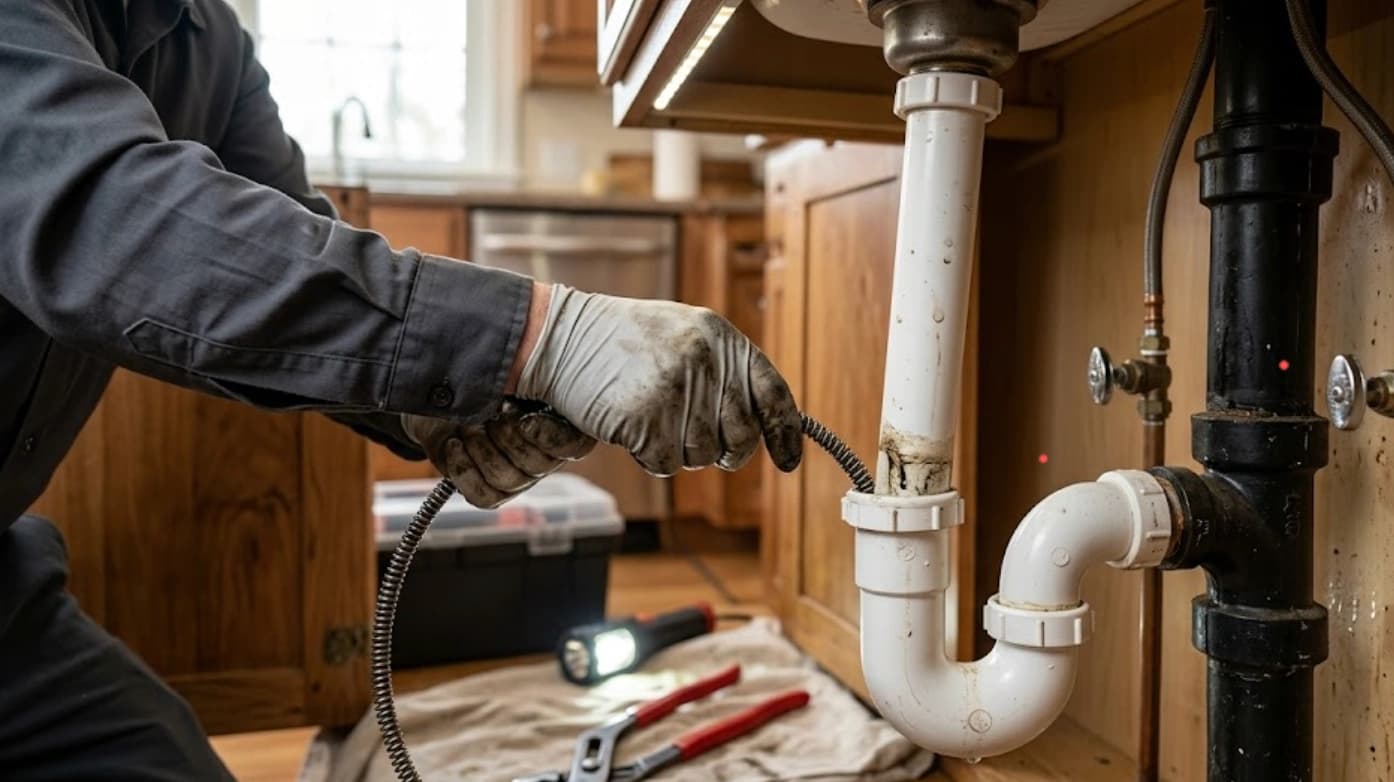
Recurring drain clogs tell a Chelmsford homeowner that the drainage symptom returned; they do not reveal the cause by timing alone. The repeat may involve new material collecting in the same place, an obstruction that was not fully resolved, a fixture or trap condition, damaged accessible piping, a vent interaction, or a shared downstream problem. The right next step depends on which fixtures change together and what evidence is accessible.
With recurring drain clogs, Jeneral Plumbing repairs only confirmed defects in accessible fixture connections, traps, trap arms, branch drains, and building-drain sections. I do not provide drain cleaning, snaking or cabling, hydro jetting, sewer service, sewer camera inspection, root intrusion work, septic service, excavation, or trenchless replacement. Those are independent referral services, and I state that boundary before scheduling whenever the reported pattern already points outside my work.
Jeneral Plumbing is based in Westford, MA and is owner-operated by a Licensed Master Plumber (MA #9628831-PL-M) with 20+ years in the trade, including seven with a gas utility. I use recurring drain clogs as a routing clue, not a remote diagnosis or a reason to sell work. My accessible drain-repair service begins only when the question is whether a confirmed, reachable pipe defect needs repair.
Why Recurring Drain Clogs Come Back
Recurring drain clogs come back for more than one reason. The same household use may keep loading hair, soap residue, grease, food solids, wipes, or another material into a vulnerable path. A prior clearing may have restored flow without changing the conditions that let material collect again.
The piping can also matter. A poorly supported or improperly pitched accessible section may hold solids or water where the path should drain. A rough, corroded, cracked, offset, or separated section may collect material, but recurring drain clogs do not prove any of those defects without inspection.
Recurring drain clogs can also reflect a shared downstream obstruction, buried sewer condition, septic problem, or root intrusion. Those possibilities require the appropriate cleaning, camera, sewer, or septic provider. Naming a possible cause is not the same as finding it, and Jeneral Plumbing does not perform that referral work.
There is no reliable fixed-day threshold, annual call-count rule, or Chelmsford house-age rule that turns recurrence into a pipe-replacement diagnosis. The interval is useful history because it shows how quickly the symptom returned. It cannot establish scale, roots, collapse, pipe material, or the repair method.
A Chelmsford Pattern Without an Invented Diagnosis
In one Chelmsford consultation, a homeowner reported recurring drain clogs at an upstairs bathroom drain over roughly three years. The homeowner said previous clearing attempts restored flow for months at first, then weeks, and eventually about 15 days. That account established a repeat pattern, not a universal rule.
No exact fixture component, pipe material, camera result, root condition, sewer defect, Jeneral Plumbing repair, or completed outcome was confirmed in the available case information. I do not turn the shortening interval into proof that a pipe was damaged or that replacement would have cost less. The recurring drain clogs history is useful only when it helps route the next investigation correctly.
For recurring drain clogs, useful notes include what was used before the symptom appeared, whether flow returned completely, how long improvement lasted, which other fixtures changed, and whether any water leaked outside the drain path. Those details help separate one fixture from a shared branch or downstream condition. They also help prevent an accessible leak from being mistaken for an obstruction.
One Fixture Versus Several Fixtures
One recurring sink, tub, shower, or other fixture suggests a local path, but it does not prove where the condition sits. The stopper area, fixture outlet, trap, trap arm, or nearby branch may be involved. Recurring drain clogs at one fixture can still require referral-only clearing before a pipe condition can be evaluated.
Recurring drain clogs that affect several fixtures together move concern toward a shared branch, building drain, sewer lateral, or septic path. A lower fixture receiving wastewater when an upper fixture runs is especially important to report. Stop adding water to the drainage system and contact the appropriate drain, sewer, or septic provider rather than continuing to test it.
Gurgling is a clue that air and water are interacting differently in the drainage or vent path. It can accompany a partial restriction or a vent condition, but the sound alone does not prove either one. This article keeps that clue subordinate because other posts in this cluster address gurgling and vent failures in depth.
Leakage changes the routing. Water that appears only when a fixture drains supports a waste-side investigation, while moisture that continues with fixtures off may involve pressurized supply piping. The latter belongs with accessible pressurized-pipe diagnosis and repair, not a clog referral.
Record the Pattern Before Anyone Opens the Pipe
A short event log can make recurring drain clogs easier to route. Record the date, affected fixture, what was running, whether another fixture reacted, how long drainage took, whether wastewater rose, and where moisture or odor appeared. Photographs of accessible leakage can help, but a photograph of standing water cannot show the obstruction location.
Also record prior work as history rather than a conclusion. Note whether a provider plunged, cabled, snaked, removed a local stopper obstruction, or inspected a downstream line, along with how long normal flow lasted. Ask for any written report or video instead of relying on a remembered diagnosis.
If a chemical drain product has been used on recurring drain clogs, write down the product and time and tell anyone who may open the trap or line. Do not mix products, add another chemical, or disassemble a backed-up trap after chemical use. Chemical exposure can burn skin and eyes and can put the next person handling the drain at risk.
Do not open or force an unfamiliar cleanout on a backed-up system. The cap can hold wastewater under pressure, and removing it may release sewage into the room. When sewage is present, keep children and pets away, avoid contact, and leave cleanup or restoration questions to the appropriate provider.
What I Can Inspect Within the Accessible-Repair Scope
My role with recurring drain clogs is narrow and physical. I review the affected fixtures and reported history, inspect accessible connections and piping, and reproduce normal drainage only when conditions allow it safely. I look for visible leakage, a failed connection, cracking, corrosion, joint movement, poor support, improper drainage direction, or a damaged accessible transition.
A slow drain by itself does not establish a broken pipe. If the line cannot accept normal water or the symptom points to an uncleared obstruction, I stop rather than forcing a repair diagnosis. Required cleaning or downstream evaluation goes to the independent specialist whose equipment and scope fit that work.
When moisture is part of the complaint, I compare when it appears with which fixture is used. An under-sink wet spot may begin at a fixture rim, faucet supply, disposal connection, slip joint, trap, trap arm, or wall fitting. If the confirmed problem stays with fixture hardware rather than drain piping, fixture repair may be the correct scope.
The written finding identifies what was visible, what test was performed, which section is implicated, and what remains unknown. It separates an observed defect from a proposed repair and a referral. Recurring drain clogs should never become a vague authorization for every kind of drain or sewer work.
Accessible Drain Piping I Repair
When recurring drain clogs lead to a confirmed accessible defect, Jeneral Plumbing repairs that drain section within ordinary residential plumbing scope. The work may involve a fixture drain connection, trap, trap arm, branch drain, or accessible building-drain section. The condition, access, material, transitions, support, testing, and finish responsibility define the actual repair.
- Failed accessible connection: a leaking slip joint, trap connection, fixture outlet, or other reachable joint is confirmed under normal drainage.
- Cracked or separated fitting: an accessible fitting or joint visibly leaks, moves, or no longer maintains the intended drainage path.
- Localized corrosion or thinning: an accessible cast-iron or galvanized waste section has a confirmed defect rather than an assumed age problem.
- Poor support or pitch: a reachable drain section has a confirmed support or drainage-direction problem that can be corrected within the written scope.
- Damaged accessible transition: a connection between compatible materials has failed and can be repaired without excavation or concealed-system work.
An approved repair can include removing and replacing the confirmed accessible section; that is different from buried sewer replacement, trenchless lining, pipe bursting, or excavation. I test the completed accessible repair under normal drainage and document any limit created by uncleared downstream conditions. I do not label a whole line repaired when only one reachable defect was addressed.
If several confirmed accessible defects require coordinated layout, support, or connection planning, complete plumbing-system design can define that in-scope work. It is not a route for adding sewer, cleaning, camera, root, or trenchless services to a Jeneral Plumbing project.
The Referral Work Is Not a Jeneral Plumbing Service
For recurring drain clogs, Jeneral Plumbing does not provide drain cleaning, snaking or cabling, hydro jetting, sewer service, sewer-main or lateral repair, sewer camera inspection, root intrusion work, septic service, excavation, trenchless lining, or pipe bursting. I do not advertise those services, dispatch them as Jeneral Plumbing work, add them to my invoice, or present another provider’s work as mine.
The homeowner hires the appropriate independent provider directly. A drain-cleaning provider handles obstruction clearing. A drain or sewer contractor handles camera work, roots, buried laterals, sewer repair or replacement, excavation, and trenchless methods, while a septic specialist handles septic-system conditions.
This boundary protects the diagnosis. An out-of-scope provider can price and perform its own work without a Jeneral Plumbing markup or promise. If that independent work later documents a confirmed defect in accessible house-side drain piping, the homeowner can return with the report and I can decide whether the remaining repair fits my scope.
A referral is not a subcontract and is not a guarantee of another company’s availability, price, findings, or work. I can name the provider type the evidence suggests, but the homeowner chooses, hires, and pays that provider. The independent provider remains responsible for its own diagnosis, permits, equipment, and results.
When Clearing or Camera Work Should Come First
Recurring drain clogs often need obstruction clearing before a repair can be defined. If water will not pass, a camera may not have a clear view and normal-drainage testing may not be possible. An independent drain-cleaning provider can determine its clearing method and whether a camera referral or sewer contractor is needed.
For recurring drain clogs, a specialist’s camera may help document visible roots, offsets, breaks, sagging or standing-water areas, material, or a foreign object after access and line conditions allow. It does not automatically prove the full pipe-wall condition, ownership boundary, repair method, or cause of every symptom. Ask for the video, measured distance, access point, observed material, marked location when appropriate, and a written explanation of what remained unseen.
Root intrusion is a buried-line or sewer issue, not an accessible-drain repair I perform. Roots can enter through a defect, but seasonal timing, nearby trees, or recurring drain clogs cannot confirm that cause. Camera inspection, root work, clearing, and any buried repair remain with the independently hired drain or sewer contractor.
Once required clearing is complete, accessible piping can be evaluated on its own evidence. A leaking joint, cracked fitting, corroded reachable section, failed transition, or poor support may justify a targeted repair. A clean line with no confirmed accessible defect does not justify replacing pipe to “prevent” the next clog.
Older Drain Materials Are Property-Specific
Some homes in Chelmsford and nearby Massachusetts communities may contain cast-iron or galvanized waste piping, while others use different materials or later alterations. A town, neighborhood, or apparent construction era does not establish the material inside a particular wall. Inspection or reliable records must confirm it.
Cast iron can develop scale, localized corrosion, cracking, thinning, or joint movement. Galvanized waste branches can corrode internally or at threaded connections. Those conditions may contribute to recurring drain clogs, but I do not claim that a pipe “shrunk,” lost a specific diameter, or failed because of age alone.
Newer material is not automatically defect-free. Poor support, an improper transition, physical damage, or an unsuitable drainage path can affect accessible plastic piping too. Material is one part of the finding; condition, geometry, access, and observed behavior decide whether there is an in-scope repair.
Reduce Avoidable Loading Without Calling It a Repair
Basic habits can reduce material entering drains and contributing to recurring drain clogs, but they cannot correct damaged piping or an established downstream obstruction. Use an appropriate hair screen where it fits, keep grease and food solids out of drains, scrape dishes, and place wipes and hygiene products in the trash. Follow the fixture or appliance manufacturer’s instructions for normal use.
Hot water and caustic chemicals are not universal treatments for recurring drain clogs. Hot water can create a scalding hazard, and chemicals can injure people or complicate later service. Do not use a stronger product as a test of whether the pipe is damaged.
A plunger may restore a simple fixture temporarily, but recurrence still needs the same pattern review. Avoid forcing cables or dismantling older or unknown piping without the right training and equipment. If the system is backed up or multiple fixtures are involved, stop using water and route the call rather than escalating a do-it-yourself attempt.
A Practical Scope Map for Recurring Drain Clogs
- One slow fixture with no visible pipe defect: a drain-cleaning provider may need to clear the local path before any repair question can be answered.
- Several fixtures changing together: stop adding water and contact the appropriate drain, sewer, or septic provider for the shared downstream path.
- Water leaking only while one fixture drains: I can inspect accessible fixture, trap, trap-arm, and branch connections for a confirmed repairable defect.
- Moisture continuing while fixtures are off: treat it as a possible pressurized-supply problem rather than assuming it is part of recurring drain clogs.
- Camera report showing a buried or sewer defect: the sewer contractor retains that repair, root, excavation, or trenchless scope.
- Cleared line with a confirmed accessible defect: I can write a separate flat-rate scope for the reachable pipe repair.
If wastewater is rising into living space, keep people and pets away and stop using household drains. Water near electrical equipment creates an added hazard. For urgent routing in Chelmsford, use Chelmsford emergency plumbing guidance and confirm availability by phone; that link does not turn drain cleaning or sewer work into a Jeneral Plumbing service.
Plan an Accessible Repair or the Right Referral
I discuss recurring drain clogs with homeowners from Westford through Chelmsford, Acton, Littleton, Groton, and Carlisle, serving communities across the 23-town core in Middlesex & Essex County. The first phone conversation should establish whether the report sounds like an accessible leak or pipe defect, a fixture condition, a clearing need, or a shared sewer or septic path. Clear routing can prevent an unnecessary visit.
For regular-hours accessible-piping visits, Jeneral Plumbing charges an $80 dispatch fee — the cost of the visit, waived when you hire us for the work. I price approved accessible drain repairs at a flat rate, with the total price and any applicable fees disclosed for approval before work begins. Referral work is priced, contracted, and warranted separately by the independent provider the homeowner hires.
Call (978) 392-7789 and describe which fixtures are affected, what triggers the symptom, whether wastewater rises elsewhere, when the clog last returned, whether chemical products were used, and whether accessible piping leaks. I will say plainly when recurring drain clogs belong with a cleaning, sewer, camera, root, septic, excavation, or trenchless specialist instead of Jeneral Plumbing.
Recurring Drain Clogs: Chelmsford Homeowner Questions
Why does the same drain clog return after it was cleared?
Recurring drain clogs can return because new material collects, the original restriction remained partly present, the local geometry retains debris, an accessible pipe defect contributes, or a shared downstream condition remains. Timing alone cannot choose among those causes. Record which fixtures changed and how long normal flow lasted. Cleaning or downstream evaluation may need to occur before an accessible repair can be defined.
Does Jeneral Plumbing clean or snake clogged drains?
No. Jeneral Plumbing does not provide drain cleaning, snaking or cabling, hydro jetting, or obstruction clearing. The homeowner hires an independent drain-cleaning provider directly for that work. I repair a confirmed defect in accessible fixture, trap, trap-arm, branch, or building-drain piping when a separate written scope supports it.
Who performs sewer camera and root work?
An independently hired drain or sewer contractor performs sewer camera inspection, root intrusion work, buried-lateral evaluation, sewer repair, excavation, and trenchless work. Jeneral Plumbing does not subcontract or sell those services. Ask the specialist for video, measured distance, observed material, location information, and written findings. A later accessible house-side defect is evaluated as a separate Jeneral Plumbing repair question.
Can old cast iron cause recurring drain clogs?
It can contribute when inspection confirms scale, corrosion, cracking, thinning, joint movement, or another relevant condition. The presence of old material does not prove that it caused the current symptom. Chelmsford homes do not all have the same drain material or alteration history. A confirmed accessible defect and an underground or obstructed condition lead to different providers.
What counts as accessible drain repair?
Accessible drain repair addresses a confirmed defect in a reachable fixture connection, trap, trap arm, branch drain, or building-drain section. Examples include a failed joint, cracked fitting, localized corroded section, poor support, or damaged transition. The written scope identifies access, material, repair length, testing, and exclusions. Cleaning, camera, roots, sewer, septic, excavation, and trenchless work remain referrals.
How much does an accessible drain-piping visit cost?
A regular-hours visit starts with an $80 dispatch fee — the cost of the visit, waived when you hire us for the work. Repair price depends on the confirmed defect, accessible length, material, fittings, support, nearby connections, testing, and finish responsibilities. I provide approved repair work at a flat rate and disclose the total and any applicable fees before work begins. Call (978) 392-7789 with the recurring drain clogs pattern so I can help route the call.
Written by Jeneral Plumbing.
This article was drafted with AI writing tools from Jeneral Plumbing job notes and source materials, then edited before publication. AI tools did not inspect the job or validate technical conclusions.
Last updated .