

If you smell gas or a carbon-monoxide alarm sounds, leave the building immediately and call 911 from outside. Do not operate switches, phones, windows, appliances, or shutoffs inside. Stay outside until the fire department or gas utility clears the property. A plumbing appointment comes after that emergency response.
Jeneral Plumbing is based in Westford, MA and is owner-operated by a Licensed Master Plumber (MA #9628831-PL-M) with 20+ years in the trade, including seven with a gas utility. This guide explains which water-heater concerns need urgent action, what an installation review may cover, and how repair and municipal inspection fit together.
Emergency Warning or Service Problem?
For a gas odor or carbon-monoxide alarm, do not stay inside to inspect the burner, check a pilot, touch a valve, silence an alarm, or search for the source. Do not return because an odor fades or an alarm stops; wait for official clearance.
Keep people away from standing water near electrical equipment. Do not step into water to reach a breaker, heater control, or shutoff. Smoke, fire, arcing, or an immediate threat to occupants calls for 911.
When there is no gas odor, CO alarm, or electrical danger, an urgent leak may fit the emergency plumbing path for Concord, with availability confirmed by phone. No hot water alone is usually a service symptom, not proof of an emergency or code violation. Do not repeatedly reset equipment or remove panels to identify the cause.
Safety Assessment and Municipal Inspection
A failed component can be unsafe without proving that the installation violates code. A missing required component can be a code concern even while the heater produces hot water. Age alone establishes neither.
We assess the equipment and accessible plumbing or gas connections, define the work, obtain applicable permits, complete the approved correction, and coordinate inspection. Concord’s municipal plumbing or gas inspector decides whether the permitted work passes. A service assessment is not municipal approval.
Electrical corrections belong to a licensed electrician and the electrical inspection process. Chimney condition or relining may require a chimney contractor. The work plan should identify these responsibilities before installation begins.
What a Water Heater Inspection May Cover
The review depends on the permit, heater type, fuel, location, manufacturer instructions, and property conditions. A replacement in the same location may involve different work from a fuel conversion or new tankless installation. Common areas include:
- Equipment and permit: the model, fuel, capacity, listing, and installed work.
- Access and clearances: service space and separation from combustible materials.
- Water connections: the cold-water valve and piping arrangement for isolation and service.
- Relief protection: the temperature-and-pressure relief valve and unobstructed discharge route.
- Thermal expansion: an approved way to manage expanding heated water where the system is closed.
- Drainage: a pan, drain, condensate route, or safe-waste connection where the equipment and location require it.
- Fuel and venting: the gas connection, shutoff, combustion air, and listed vent system for the appliance.
- Electrical work: applicable circuit, disconnect, grounding, and control requirements reviewed by the electrical trade and inspector.
This is not a homeowner test checklist. Do not lift a relief-valve lever, alter a vent, open a gas control, tighten a fuel fitting, or remove an electrical cover to prepare for a visit.
Gas Water Heater Venting and Combustion
After any emergency has been cleared, the appliance connection, combustion-air arrangement, vent system, and reported shutdown can be evaluated together. Vent material, diameter, route, support, joints, and termination must suit the appliance. Our gas water heater installation and venting guide explains why chimney-vented, power-vented, and direct-vent units are not interchangeable.
A displaced, corroded, unsupported, or mismatched connector may need correction, but a photo does not establish draft performance. Soot, heat damage, recurring shutdown, or an emergency responder’s finding needs qualified follow-up. Do not relight the heater or recreate the condition for a contractor.
Room volume, openings, nearby equipment, enclosure, and appliance design affect combustion-air requirements. The permitted plan determines whether correction involves the heater, vent, gas piping, room provisions, or chimney work.
Relief Discharge and Thermal Expansion
A storage heater’s temperature-and-pressure relief valve is a safety device. Its discharge path must remain unobstructed and use an approved arrangement. A cap, plug, shutoff, reduction, or improvised uphill route can defeat that protection.
Relief discharge does not prove the valve is the only problem. System pressure, thermal expansion, temperature control, or a valve defect can cause discharge. Replacing the valve without checking these conditions can leave the cause in place. Keep people away from hot discharge; do not operate or plug the valve as a test.
Expansion control depends on the water-service arrangement, including whether the system is closed. The assessment determines what approved control fits the installation; not every property needs the same component.
Leaks, Corrosion, and Electrical Work
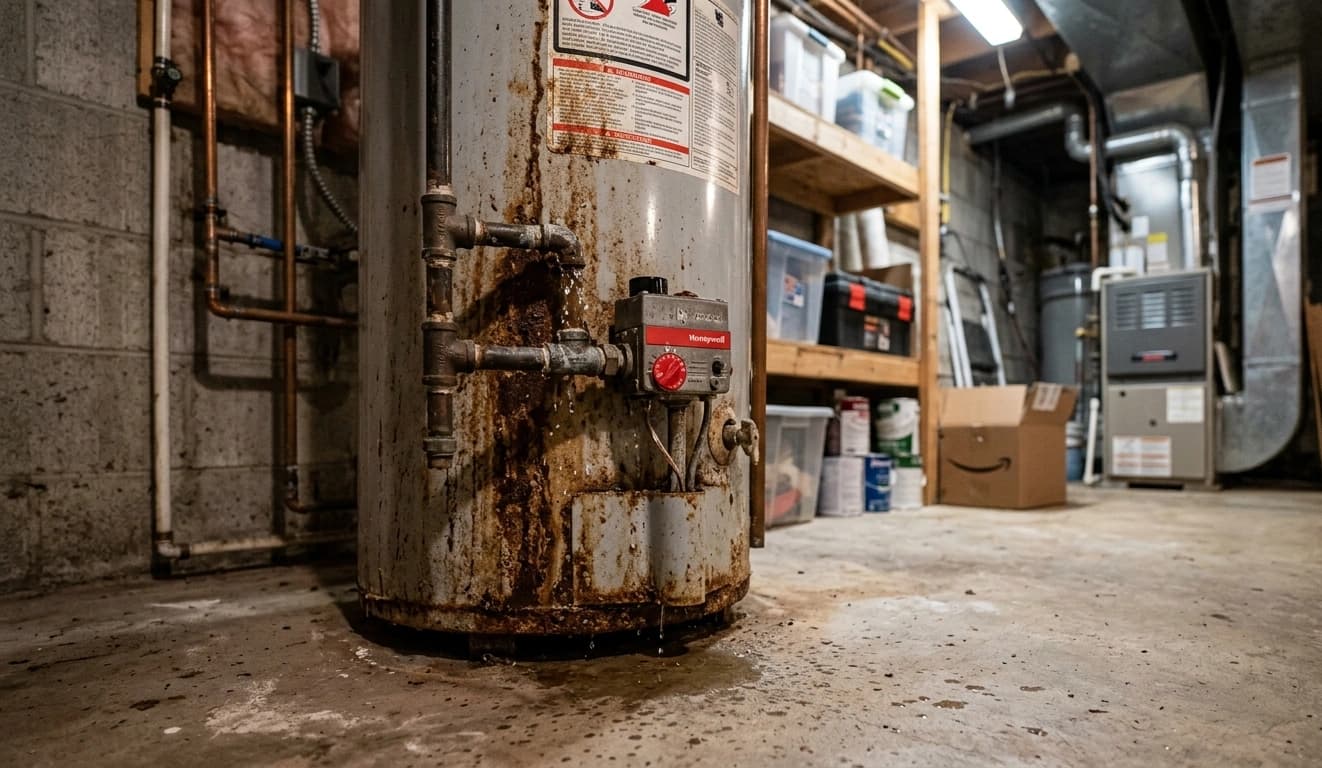
Once it is safe to assess the equipment, water around a heater may come from the tank, a fitting, a valve, relief discharge, condensate equipment, or nearby piping. A fitting may be repairable; a storage tank leaking through its body is not. Keep away from water contacting electrical equipment or gas controls.
Rust staining, damp insulation, corrosion, and repeated moisture deserve attention. A drain pan or leak detector may help protect the property, but neither repairs a failed tank or corrects an unsafe installation.
Electric and hybrid heaters have no combustion vent, but they still combine hot water and electrical equipment. Plumbing work covers the tank and applicable water, relief, expansion, condensate, and drainage connections. A licensed electrician handles circuit, breaker, disconnect, wiring, and electrical correction. See the electric and heat-pump water heater guide for installation planning.
Repair or Replace?
A confirmed fault in an accessible connection, valve, control, or other serviceable component may support repair. A tank-body leak requires replacement. Extensive corrosion, unavailable parts, vent changes, or overlapping defects can also affect the decision.
Replacement planning starts with hot-water demand, fuel or electrical capacity, venting, space, drainage, and required corrections. Our water heater repair and replacement overview compares the equipment options. A tankless water heater plan can add gas-capacity, venting, condensate, and electrical questions, so it is not necessarily a box-for-box swap.
Permitted work may need to remain visible until inspection. If the gas utility shut down equipment, service restoration follows the approved sequence.
Arrange a Water Heater Assessment
The recommendation depends on your equipment, permit history, accessible connections, and site conditions. We do not assume a home’s fuel, construction, or mechanical-room layout from its address.
Jeneral Plumbing serves homes within 20 miles of Westford, MA, including Concord and nearby Middlesex County communities. Check the service-area directory and confirm your address, the requested work, and availability before booking.
For a regular-hours assessment, we charge an $80 dispatch fee — the cost of the visit, waived when you hire us for the work. Repair and installation work is priced at a flat rate, with the total and applicable fees disclosed for approval before work begins.
After any gas-odor or carbon-monoxide event has been officially cleared, call (978) 392-7789 to discuss the remaining concern.
Questions Before the Visit
Should I reset or relight the water heater before you arrive?
Do not repeatedly reset equipment, relight it to reproduce a problem, or remove panels. If emergency responders attended, share their report after the property has been cleared.
Does Jeneral Plumbing perform the official code inspection?
No. We assess and complete approved plumbing or gas work, obtain applicable permits, and coordinate inspection. The municipal inspector makes the official approval decision.
Is a leak automatically a code violation?
No. A leak needs its source identified. Code compliance concerns the installation and required protections; a failure and a compliance problem can occur separately or together.
Can you assess an electric or hybrid heater?
We assess the water heater and plumbing connections. Circuit, disconnect, wiring, and other electrical corrections require a licensed electrician.
Written by Jeneral Plumbing.
Last updated .