

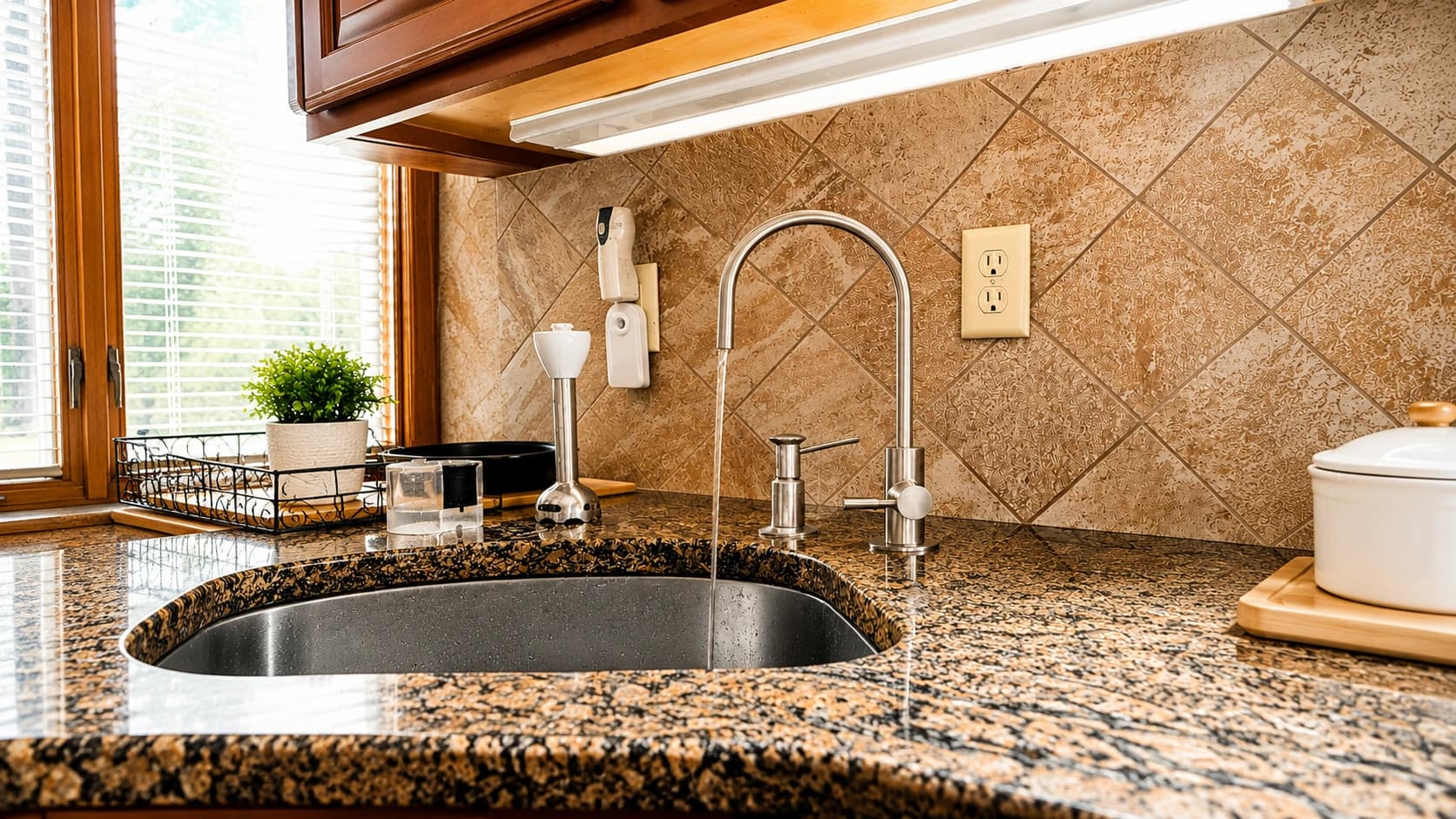
White spots are back on the glasses, the shower door is crusting over again, and you've read that some Chelmsford water has had PFAS problems. It's natural to bundle those worries together and look for one machine that fixes both. They're separate questions, though, and each needs its own evidence before anyone sells you equipment.
Two questions, two kinds of evidence
| Question | What can answer it | What can't |
|---|---|---|
| Is my softener still doing its job? | Raw hardness measured before the softener, treated hardness after it, and an inspection of the unit | A TDS reading, or the unit's age alone |
| Is PFAS in my water? | A certified laboratory, using its own bottles and sampling instructions | A TDS pen, a general test strip, or how the water looks and tastes |
Hardness is a mineral condition behind scale, spotting and soap that won't lather. PFAS are specific chemicals that need specific laboratory methods. One result can't stand in for the other.
One Chelmsford consultation
A Chelmsford homeowner raised both concerns, suspected hardness and PFAS, in the same consultation. Field TDS screening and a multi-parameter strip were reviewed alongside a possible softener. Those readings could shape follow-up questions, but they didn't document a softener failure, confirm PFAS or prove which treatment the home needed. No repair or installation outcome is part of this case, and one home's field readings don't describe Chelmsford water in general.
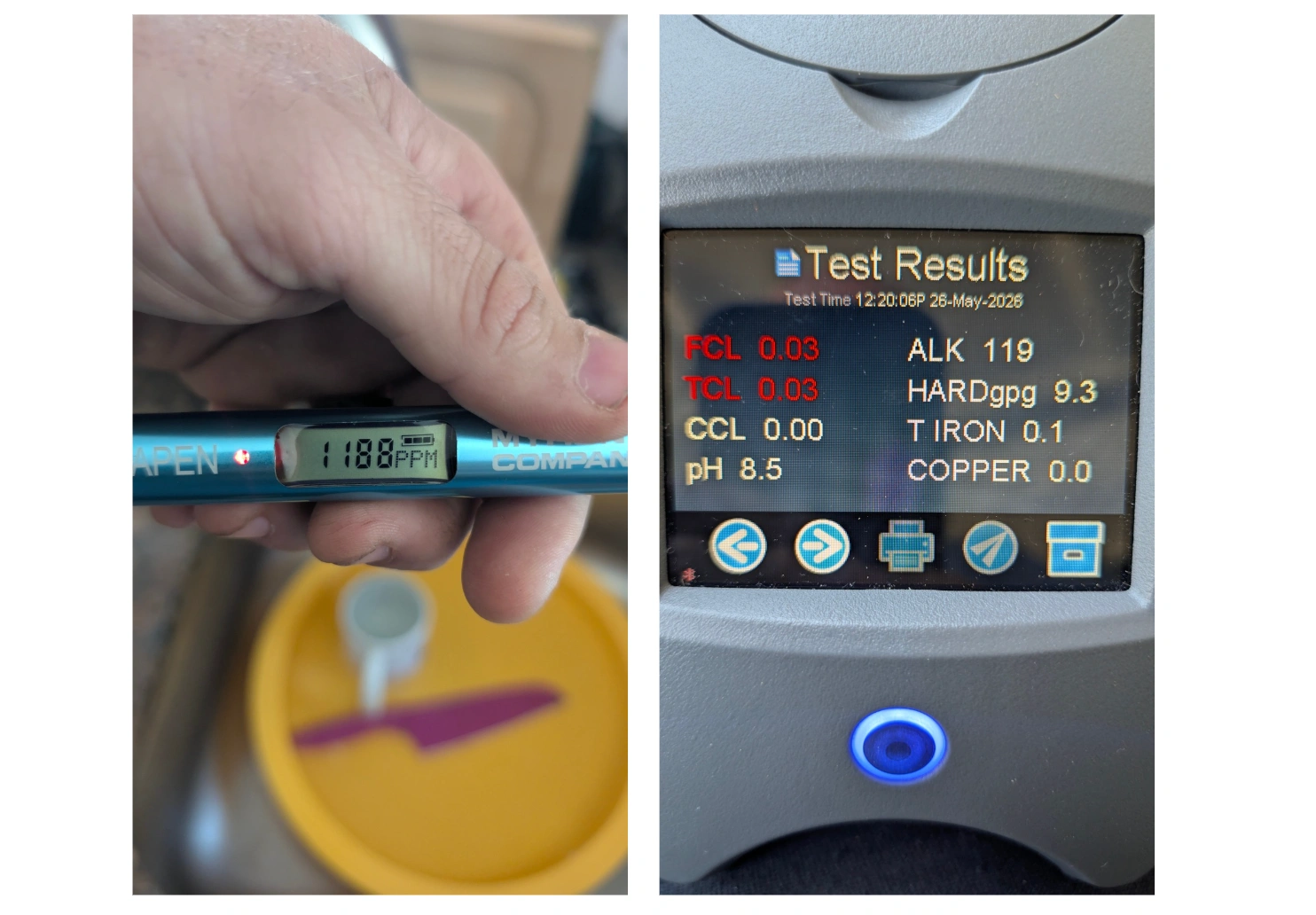
The useful lesson is the order of operations. Identify the water source, define the question, choose the right test and inspect any existing equipment. Only then choose among a repair, different treatment, more testing or no treatment at all.
Why a TDS pen can't settle either question
A handheld TDS pen estimates dissolved ionic content from electrical conductivity. It doesn't tell you which minerals or compounds produced the number, and it doesn't measure PFAS, bacteria, lead, arsenic or any other named contaminant.
It can't verify a softener either. A softener swaps hardness ions for sodium or potassium ions. It isn't designed to lower TDS, so the reading after softening may barely move. When the goal is softener performance, compare properly collected raw and treated hardness results instead.
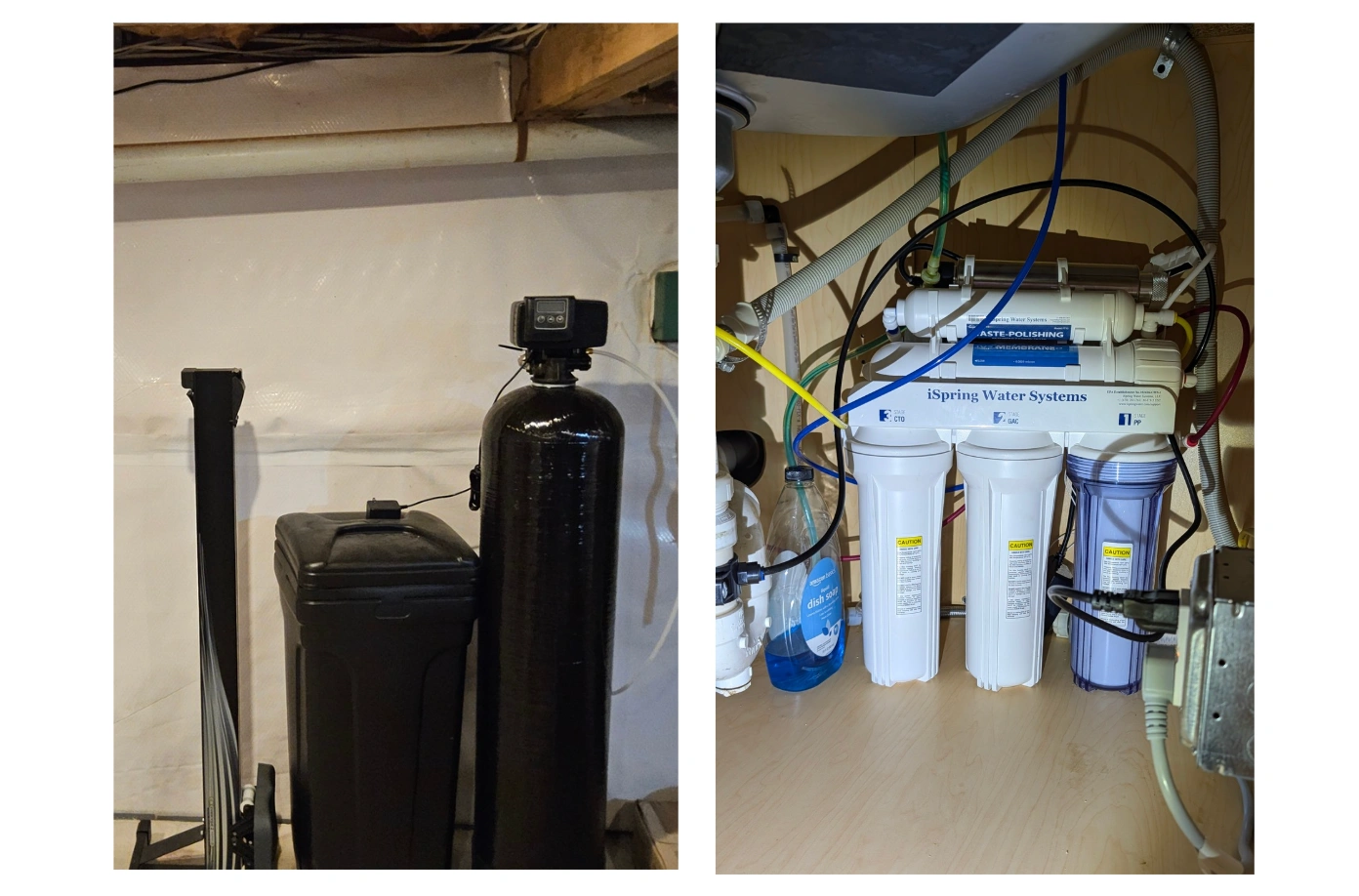
An ion-exchange softener handles hardness for the whole house. A point-of-use reverse osmosis unit treats drinking water at one tap and has its own pressure, pretreatment, membrane, storage, drain and maintenance needs. What the equipment looks like doesn't tell you which one a home needs.
Check which district serves you
Chelmsford has three independent water districts, so find yours on your water bill before reading a report. Their results aren't interchangeable.
- The Chelmsford Water District's 2025 Consumer Confidence Report reports violations of the Massachusetts PFAS6 drinking water standard during the 2025 report year. That applies to that district's customers and that period only.
- The North Chelmsford Water District's 2025 report lists no PFAS6 violation in its 2025 contaminant table. It separately discloses a lead-and-copper monitoring violation and an earlier lithium reporting violation.
- East Chelmsford customers can request their district's current report through the town's water-district contact directory. A neighboring district's report doesn't describe their supply.
MassDEP's PFAS drinking water page explains the state standard. A district report describes the public system, not the water at your faucet, and none of these reports is a hardness test for your home.
When the softener is the problem
Hard water returning can come from exhausted capacity, incorrect settings, a salt bridge, a restricted brine draw, worn valve seals, a leaking bypass, depleted or fouled resin, or household demand that has outgrown the sizing. That list is diagnostic territory, not a homeowner repair script.
An inspection starts with the complaint and the exact model: when the symptom began, whether it affects hot and cold water, what changed and what service was done. Then we check the bypass and service positions, the control, alarms and time settings, regeneration history, salt condition and brine level, the drain line, leaks and the plumbing connections, as the model allows. Those observations can point to a focused problem, but they don't replace hardness testing. If a leak turns out to be a house pipe rather than the softener, our Chelmsford pipe leak repair page covers that separate work.
Repair, maintain, replace, or leave it alone
No equipment age settles this. A focused repair makes sense when the unit is correctly sized, the hardness goal still exists, the failure is isolated and compatible parts are available. Maintenance may be enough when settings, salt condition, sanitation or a scheduled component caused the trouble. Replacement becomes the conversation when the unit can't meet the tested load, can't be maintained, or has several material problems.
The answer can also be no softener work. A raw hardness result may not support the original goal, or the symptom may belong to the water heater, a fixture or a pipe. That's why our water softener repair and filtration service starts with the symptom and the evidence. We price supported repairs and installations at a flat rate, with the total and any fees shown for approval before work begins.
Once a repair is done, confirm it with the same measurement that raised the question: suitable raw and treated hardness samples after the unit has run under the conditions its manual requires, along with a check of cycling, brine draw and refill, drainage and alarms. Maintenance intervals come from the model, the incoming water and household use, and our Water Care plan can keep that on schedule without replacing the manual.
If PFAS is the question
Start with a certified laboratory. It supplies the bottles, collection and preservation instructions, holding times, method and reporting limits. We can explain that path during a visit, but PFAS is never tested on site. Our water testing process explains the difference between field screening and laboratory analysis.
If treatment comes up later, the exact model has to carry a current third-party certification for the exact contaminant. NSF's overview of treatment standards is a good primer: Standard 44 covers softeners, 58 covers reverse osmosis and 53 covers health-related reduction claims. A standard number isn't a promise to reduce every contaminant, and a conventional softener isn't a PFAS treatment. When results call for more than one stage, our test-first water treatment process coordinates them.
Before you call
Jeneral Plumbing is based in Westford, MA and serves Chelmsford and the rest of our Middlesex & Worcester County service area. A regular-hours visit carries an $80 dispatch fee — the cost of the visit, waived when you hire us for the work. Have your water bill, the current district report, your softener's model, any earlier test reports, its settings and its service records ready. Call (978) 392-7789, and we'll tell you which evidence is still missing before we propose any work.
Written by Jeneral Plumbing.
This article was drafted with AI writing tools and edited before publication. AI tools did not inspect any job or validate technical conclusions.
Last updated .