
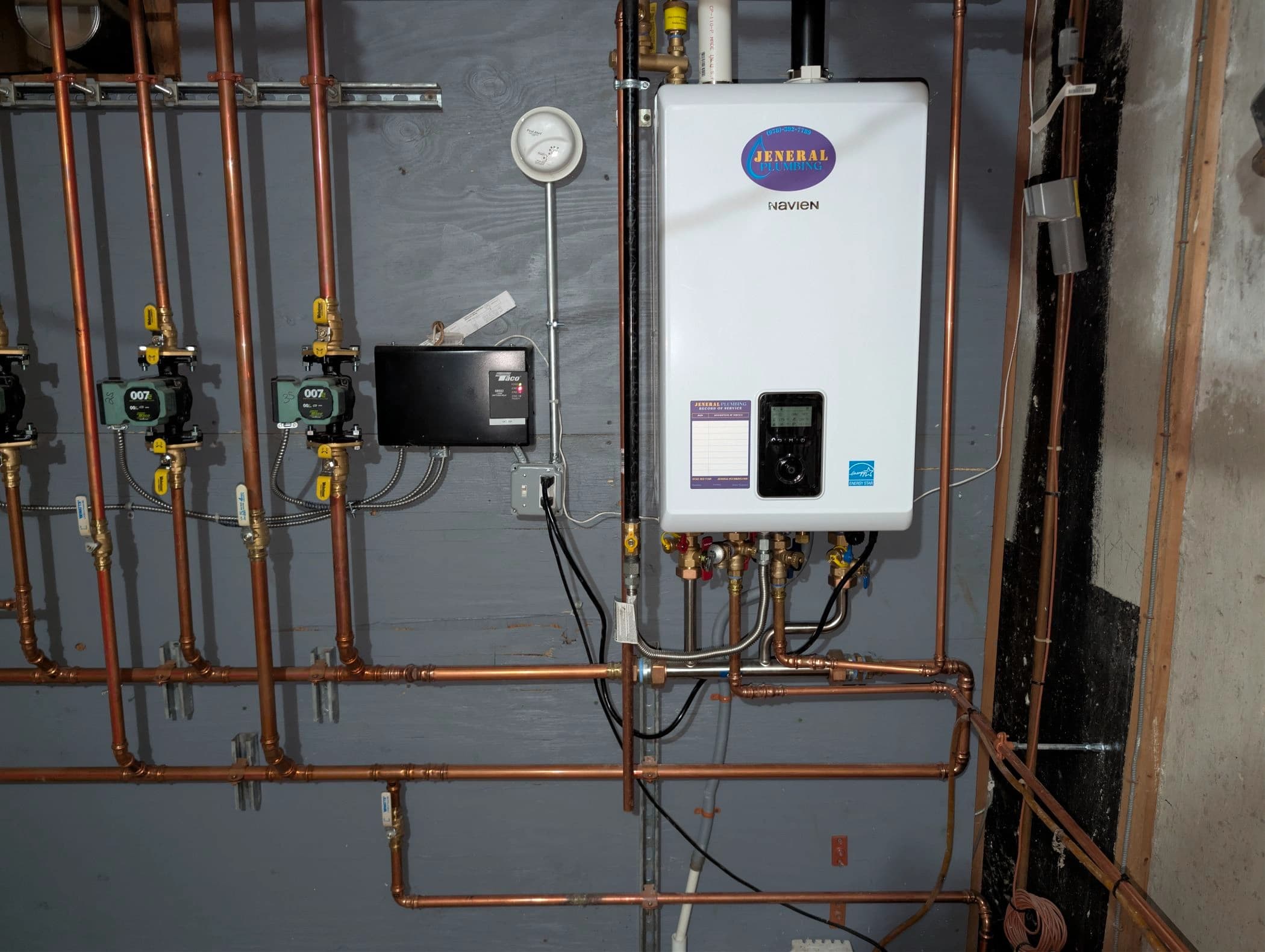
A documented Navien tankless repair in Westford, MA shows what happens when a young tankless unit develops an active heat-exchanger leak and the repair may involve a manufacturer claim. The case involved a Navien NPE-240S at a Westford home, described as about three years old, and included visible exchanger corrosion, active leakage, a 4.6-grain-per-gallon hardness result, warranty coordination, exchanger replacement, internal cleaning, and restored operation.
This Navien tankless repair Westford MA guide explains what the 4.6-gpg result means, what it cannot prove, and how Jeneral Plumbing can coordinate the claim without deciding Navien's warranty eligibility.
Quick Answer: The Four Questions in a Tankless Repair
A Navien tankless repair should separate four questions: what failed, what contributed, what the manufacturer covers, and what must pass before the appliance returns to service. In this Westford case, the exchanger was leaking and corroded, and Navien covered the exchanger part while labor remained separate. The 4.6-gpg hardness measurement was relevant to scale prevention, but it was not proof that hardness alone caused the corrosion or leak.
Safety When a Tankless Water Heater Is Leaking
For safety, stop normal use and arrange diagnosis when a tankless appliance is actively leaking. Do not open the cabinet, remove venting, touch wet electrical equipment, manipulate gas components, or repeatedly reset the heater. If there is no gas odor or suspected fuel leak, no sounding CO alarm or possible exposure symptoms, and no escaping flame, smoke, or fire, follow only the exact homeowner manual's user-level shutdown direction when the controls and surrounding area are dry and safely reachable.
If there is a gas odor or suspected fuel leak, everyone should leave immediately. Do not operate lights, switches, phones, appliances, windows, or shutoffs, do not plug in or unplug anything, and do not use flames inside; from outside, call 911 and the gas utility or propane provider, then stay out until officials clear the property. Carbon monoxide is odorless, so a sounding CO alarm or possible exposure symptoms require everyone to get into fresh air, call 911 from outside, and remain out until officials clear the property; escaping flame, smoke, or fire requires the same leave-first response.
What the Westford Case Record Establishes
Here is the Westford case in brief.
- Appliance and symptom: a Navien NPE-240S described as about three years old stopped providing hot water
- Observed condition: the heat exchanger was described as visibly corroded and actively leaking
- Water evidence: one recorded hardness result for this property was 4.6 grains per gallon
- Warranty path: Navien covered the exchanger part, and Jeneral Plumbing handled documentation, photographs, and coordination
- Recorded work: the scope included teardown, exchanger replacement, internal cleaning, and restoration of operation
- Not covered here: any claim letter, the final invoice, commissioning values, any treatment the homeowner chose, and long-term follow-up
That evidence supports a documented Navien warranty case in Westford. It does not establish that every visible deposit came from hardness, that the exchanger failed from one cause, or that the same coverage would apply to another serial number or installation.
Why 4.6 GPG Does Not Prove the Cause
Hardness measures dissolved calcium and magnesium expressed as calcium carbonate. Those minerals can form scale in heat-exchanger water passages, restrict flow, insulate heat-transfer surfaces, and affect maintenance needs. Hardness is not the same measurement as corrosivity, however, and a 4.6-gpg result cannot by itself explain visible corrosion in this case.
A complete failure analysis may also consider pH, alkalinity, chlorides or other relevant chemistry, pressure, flow, temperature control, condensate, venting, combustion, installation, maintenance history, freeze exposure, leakage origin, and component condition. pH, alkalinity, and total dissolved solids were described only in qualitative terms, without numbers or a test method, so those descriptions cannot clear or confirm a corrosion mechanism. That result also does not establish the water conditions that existed throughout the unit's service life.
For this case, the careful conclusion is narrower: moderate hardness created scale potential worth addressing in the prevention plan. The active exchanger leak justified repair, while the cause needed the broader evidence above. That distinction protects the homeowner from buying treatment based on a single number and protects the next exchanger from an unresolved installation or operating condition.
How the Warranty Claim Was Handled End to End
The differentiator in this case was not a promise that every claim would be approved. It was one coordinated path from field evidence to manufacturer review and approved repair scope. Jeneral Plumbing gathered documentation and photographs, coordinated with Navien, and completed the exchanger replacement after the part was covered.
1. Verify the appliance and document the failure
Navien claim documentation begins with the exact model, serial number, installation information, displayed or stored codes, leak location, visible condition, service history, and relevant water, venting, and operating evidence. Photographs and measurements describe what is present without assigning a cause before testing. In this case, the NPE-240S model and visible exchanger leak were documented.
2. Define covered and noncovered scope
The homeowner should know which component is being submitted, which diagnostic and connected work remains outside the proposed part claim, and what correction may be required before a replacement part is installed. Repair and installation work is priced at a flat rate, with the total price and any applicable fees disclosed for approval before work begins. No case labor total is stated here.
3. Coordinate with Navien
Jeneral Plumbing can provide the model and failure documentation, answer manufacturer questions, coordinate claim steps, and keep the homeowner informed. Navien reviews the evidence and decides eligibility under its current written terms. I do not promise approval, a delivery date, or coverage for work beyond the approved component.
4. Complete and document the approved repair
The work included exchanger replacement, internal cleaning, and restored operation. A complete repair handoff also requires exact-model reassembly and seals, water-leak checks and gas-leak checks using approved methods, vent and combustion-air review, condensate and electrical checks, ignition and flame proving, safety-control verification, model-specific combustion testing at applicable firing conditions, hot-water demand checks, and confirmation that codes or leaks do not return. Those readings are not reproduced here, so restored operation should not be read as a complete test sheet.
Navien Heat-Exchanger Coverage: Part and Labor Are Different
On coverage, Navien's current published NPE-S warranty table lists a 15-year heat-exchanger term for qualifying residential standard or controlled-recirculation applications. Other recirculation configurations and applications can have shorter terms. Exact model, serial number, installation date, proof or registration, application, recirculation, installation, maintenance, water conditions, failure cause, and the current written Navien terms control, and Navien decides the claim.
The outcome here was specific to this case: Navien covered this exchanger part and labor remained the homeowner's responsibility. That does not mean every Navien claim covers the part or leaves only labor. Diagnosis, labor, access, shipping, seals, other damaged components, venting, gas, water, condensate, treatment, permits, and connected corrections may have separate terms or remain outside coverage.
Jeneral Plumbing is owner-operated by a Licensed Master Plumber (MA #9628831-PL-M) with 20+ years in the trade, including 7 years with a gas utility. I am factory trained by Navien and Navien Service Specialist (NSS) certified. Those credentials support model-specific diagnosis, claim documentation, repair, and commissioning during a Navien warranty claim; they do not make Jeneral Plumbing the warranty decision-maker.
What I Recommended Going Forward
Maintenance, softening, inline filtration, and conditioning were discussed after the Navien tankless repair Westford MA work; which option, if any, the homeowner chose is not described here. A responsible prevention plan therefore begins with the measured concern and ends with verification rather than a universal equipment prescription.
- Maintenance path: use the exact Navien model instructions, water evidence, usage, recirculation, service history, and scale found during inspection to decide when descaling is due
- Hardness-reduction path: when current testing, observed scale, household goals, flow, and demand support it, evaluate a properly sized ion-exchange softener
- Filtration path: use sediment or other filtration only for its documented target; an inline sediment filter does not remove dissolved hardness
- Conditioning path: evaluate any conditioning equipment against its verified performance claim and the stated treatment goal rather than assuming every product softens water
- Verification path: retest the relevant treated-water sample point, confirm the target was met, and adjust service from measured results and observed accumulation
The test-first water-treatment guide explains how measured chemistry, flow, demand, plumbing, upkeep, and product documentation shape a recommendation. Treatment can reduce a confirmed risk; it cannot guarantee that a heat exchanger or another component will never fail.
Why Water Testing Matters More Than People Realize
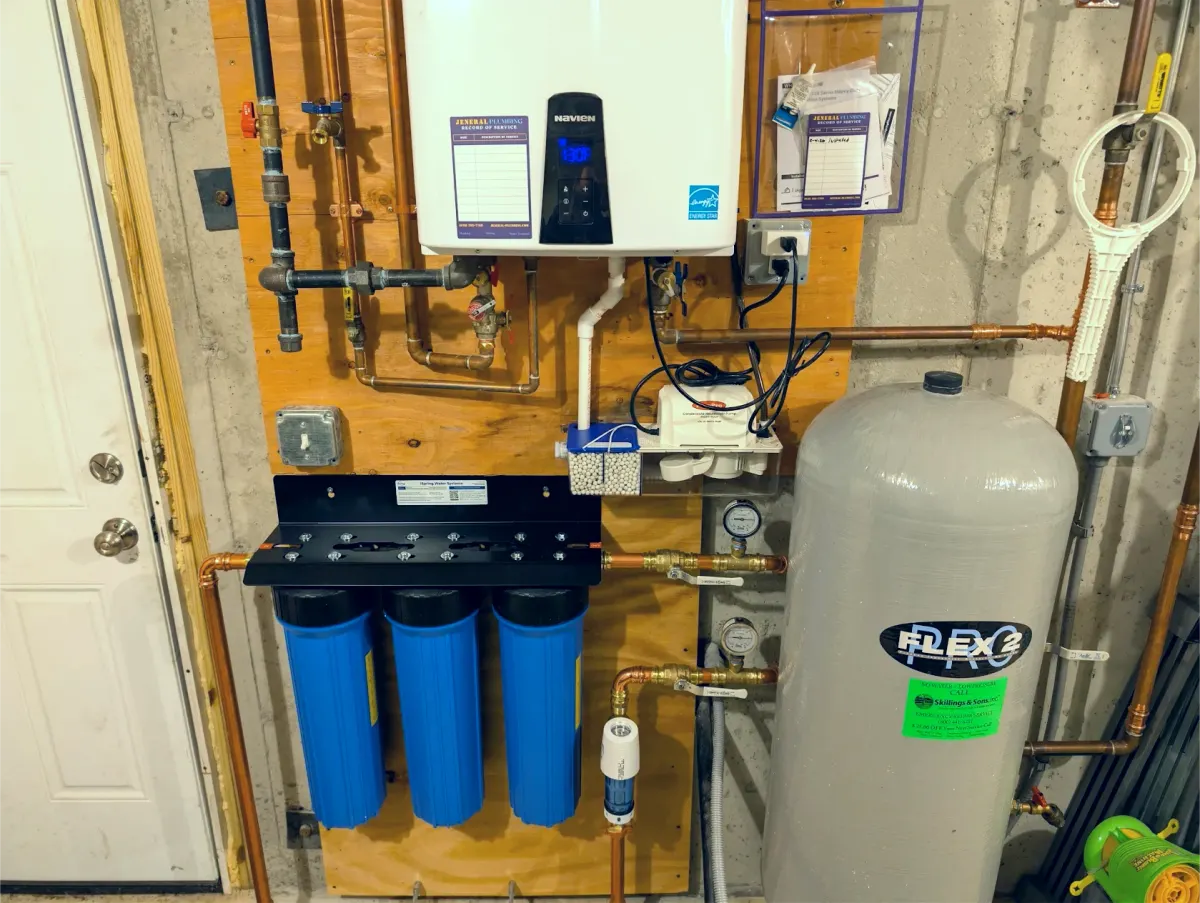
In this Navien tankless repair Westford MA case, the property had a 4.6-gpg hardness result. It is not a town-wide hardness claim, a complete laboratory panel, or proof of what every tap delivered over the preceding three years. Westford includes properties with different water sources and premise conditions, so a current property-specific water test should drive a new decision.
4.6-GPG Hardness Reference
- Soft: 0–3.5 gpg, approximately 0–60 mg/L as calcium carbonate
- Moderately hard: 3.6–7.0 gpg, approximately 61–120 mg/L
- Hard: 7.1–10.5 gpg, approximately 121–180 mg/L
- Above 10.5 gpg: above approximately 180 mg/L, the highest USGS classification band
- This case: 4.6 gpg, approximately 79 mg/L, falls within the moderately hard band
The ranges follow the USGS hardness classification. For repair and prevention decisions, the 4.6-gpg label supports a scale-potential and maintenance conversation. It is not a Navien failure threshold, an automatic treatment requirement, a warranty rule, or proof that scale caused this exchanger leak.
Prevention Must Follow the Test Results
Descaling can remove mineral scale from accessible water passages when the exact model procedure calls for it. It does not reverse corrosion, repair a leak, correct damaged venting, fix abnormal combustion, or guarantee that a replacement exchanger will last a certain number of years. For maintenance planning, annual service can be a practical review point, but the manual, measured water, usage, recirculation, service history, and scale found should determine the actual work.
If testing and observed scale support hardness reduction, prevention may include a correctly sized softener selected from chemistry, household demand, peak flow, plumbing, and upkeep. A softener exchanges hardness minerals; a sediment filter performs a different job. Post-treatment testing should confirm that the selected target changed without creating a new assumption about the whole house.
Prevention also means preserving installation and service records. Save the model and serial number, invoices, maintenance dates, water results, treatment settings, photographs, warranty correspondence, and commissioning record. Those materials make the next diagnosis and any future manufacturer review more specific.
The Venting Observation Was a Separate Diagnostic Branch
In this Navien tankless repair Westford MA case, the venting setup was described as needing improvement. That is an observed condition for exact-model verification, not proof of noncompliance and not proof that venting did or did not cause the exchanger failure.
A venting inspection should compare intake and exhaust material, diameter, joints, support, slope, equivalent length, termination, clearances, condensate behavior, and visible condition with the installed model's current instructions and applicable requirements. Combustion results and operating evidence complete that branch. The Navien Error 110 airflow and venting guide covers that separate diagnostic role without turning this warranty case into an error-code article.
Repair or Replace a Young Leaking Unit?
This case involved a young Navien unit, a covered exchanger part, completed replacement, and restored operation. Those facts supported repair in this case, but they do not create a rule that every covered exchanger should be replaced or that every young unit is economical to repair. A repair-or-replace decision should consider the confirmed damage boundary, parts availability, exact coverage, labor and connected corrections, installation suitability, repeated faults, service history, current demand, and whether commissioning can pass.
For more on Navien repairs, the Tyngsborough documented replacement follows the flagship repair narrative, while the Lowell procedural guide explains isolation, disassembly, reassembly, leak testing, and commissioning. Use those procedure-focused guides for the repair sequence and this Westford case for claim documentation and water-evidence boundaries.
Key Takeaways
- The case involved a roughly three-year-old NPE-240S, active exchanger leakage and corrosion, a 4.6-gpg result, covered exchanger part, replacement, and restored operation.
- Moderately hard water creates scale potential, but one hardness reading cannot prove why an exchanger corroded or leaked.
- A Navien warranty path can include Jeneral Plumbing's documentation and coordination end to end, while Navien retains authority over eligibility and coverage.
- A covered heat-exchanger part does not automatically cover diagnosis, labor, access, seals, connected corrections, or treatment.
- Descaling, softening, filtration, and conditioning are different tools; the exact test result and documented goal determine whether any belongs in the plan.
- Restored operation should be backed by model-specific leak, vent, combustion, safety, flow, temperature, and code checks.
Frequently Asked Questions
What does 4.6 gpg mean for a tankless water heater?
A 4.6-gpg result is approximately 79 mg/L as calcium carbonate and falls in the conventional moderately hard range. It means calcium and magnesium scale potential deserves attention in the maintenance plan. It is not a universal Navien failure threshold or an automatic requirement for a softener. The number should be considered with the exact model, water source, full relevant chemistry, use, service history, and observed scale.
Did hard water cause the Westford heat-exchanger leak?
Not on the evidence available. The case showed visible exchanger damage and one 4.6-gpg result, which makes scale a relevant branch, but that does not prove that hardness alone caused the corrosion or leak. Corrosion can also involve other water chemistry, leakage, venting, combustion, condensate, pressure, temperature, installation, maintenance, or a component condition. A tankless diagnosis should keep those branches open until testing separates them.
Are a Navien heat exchanger and repair labor both covered?
Navien's current NPE-S table lists a 15-year heat-exchanger term for qualifying residential standard or controlled-recirculation applications, while other configurations can be shorter. Exact model, serial number, application, installation date, proof, maintenance, water conditions, cause, and current written terms control, and Navien decides whether a claim qualifies. In the Westford case, the exchanger part was covered and the homeowner remained responsible for labor. Diagnosis, access, shipping, seals, other components, venting, gas, water, condensate, treatment, and permits may also be separate.
Does hard water automatically void Navien warranty coverage?
No town name or hardness category automatically decides a Navien warranty claim. Navien's written terms list damage from hard-water deposits, lime, or mineral buildup among exclusions, but the exact cause and evidence still require manufacturer review. Measured water conditions, installation and maintenance records, observed scale, failure findings, model, application, and current terms all matter. The 4.6-gpg result in this case neither guarantees coverage nor proves an exclusion applies.
How often should a Navien tankless water heater be descaled?
Use the exact model's current instructions as the baseline, then consider measured hardness, usage, recirculation, service history, and scale found during inspection. Annual service is a practical review point for many units, not a universal descaling command. A 4.6-gpg result supports reviewing the interval but does not set it by itself. Descaling removes mineral scale; it does not repair corrosion or every condition behind a tankless failure.
Can an inline filter prevent hardness scale?
A standard sediment filter does not remove the dissolved calcium and magnesium that create hardness. A softener, filter, and conditioner are different equipment categories with different documented purposes. Select equipment only after testing defines the target and the household's flow, demand, plumbing, and upkeep are considered. Retest after treatment to verify the stated goal rather than assuming the device solved every water concern.
Schedule Westford Tankless Diagnosis
Jeneral Plumbing works from Westford, MA and serves Chelmsford, Littleton, Acton, Groton, Tyngsborough, and other communities within its 26-town core across Middlesex & Worcester County and southern New Hampshire. Those towns are service geography, not evidence that every property has the same hardness or treatment need. For equipment and lifecycle context beyond this case, use the tankless water-heater service guide.
For Navien tankless diagnosis and warranty coordination in Westford, call (978) 392-7789. I will confirm the appliance information, observed symptom, safe next step, and the evidence needed before setting repair or coverage expectations.
Written by Jeneral Plumbing.
Last updated .