

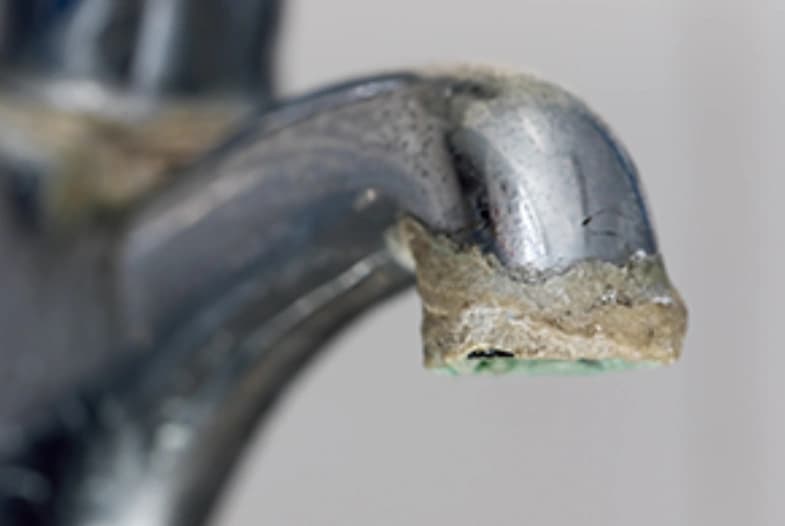
White or gray buildup should start an investigation, not an equipment order. This Westford case explains why water testing is essential before visible scale is labeled as hard water, blamed on one chemistry reading, or used to justify a softener. The deposit, water source, sample point, test method, plumbing, and affected equipment all belong in the same review.
In this case, repeated buildup appeared at faucets, shower fixtures, and an ice machine. A hardness screening did not support choosing an ion-exchange softener from appearance alone. That is why water testing is essential here: the result changed the decision from buying familiar equipment to checking what the evidence could establish.
Jeneral Plumbing is based in Westford, MA and is owner-operated by a Licensed Master Plumber (MA #9628831-PL-M). I present this case as an educational resource, not a diagnosis for another property. It shows why water testing is essential when a symptom has several possible causes.
Westford Context: Why Water Testing Is Essential
Start by confirming the source serving the address. Westford includes public-system customers and private-well properties, so a water bill, property record, and visible source equipment help establish which official information applies. A report for the public system cannot represent a household private well.
As reviewed on August 21, 2026, the Westford Water Department’s 2025 Annual Drinking Water Quality Report states that water supplied by the public system met all applicable health standards regulated by the state and federal government in 2025. That statement applies to the public system for the report period. It does not diagnose scale at one faucet or describe conditions in a private well, service line, fixture, or appliance.
For a private-well property, MassDEP’s private-well water-quality testing guidance is the next official starting point. It keeps the test tied to the property and reason for testing. Westford’s private-well information adds the local Board of Health context and laboratory resources.
At the Westford home in this case, I used hardness screening instead of treating visible deposits as a diagnosis. The result did not support specifying an ion-exchange softener from appearance alone, so I kept the sample point, plumbing, equipment, and need for further testing in view. The possible outcomes included maintenance, plumbing work, matched treatment, another test, monitoring, or no treatment at all. That decision path is why water testing is essential even when a symptom looks familiar.
About this water information
Utility reports summarize testing across a public water system; they are not a test of the water at your specific faucet. EWG health guidelines may be lower than enforceable federal or state limits. Homes on private wells are not represented by municipal utility data. Treatment recommendations should be based on the current utility report, household plumbing conditions, and a properly collected water sample.
Reviewed by: Jeneral Plumbing — August 21, 2026. Official water information: Westford Water Department’s 2025 Annual Drinking Water Quality Report · MassDEP private-well water-quality testing guidance · Westford private-well information.
The Scale Story and Its Evidence Limits
The homeowner reported white and gray deposits at several fixtures and inside an ice machine, along with repeated cleaning and service. Those observations establish where the material appeared and why the homeowner wanted an answer. They do not identify the deposit, establish the water source, or prove that hardness caused the equipment trouble. This gap between symptom and cause shows why water testing is essential before treatment is chosen.
Old screening numbers from this visit are not repeated here: without a collection date, calibration record, and complete units, they are not current household or Westford facts. That is part of why water testing is essential: a number without its date, method, unit, and sample point can create more certainty than the evidence supports.
The supportable turning point is narrower. Visible scale suggested hardness should be checked, but the hardness screening did not justify a softener by itself. Other field observations raised questions about pH, alkalinity, the appliance water path, and how the deposit formed, but they did not prove one cause.
The case includes a treatment recommendation, not a completed installation with follow-up results, so the recommendation is not a proven fix. A case study should separate what was observed, what was measured, what was proposed, and what was later verified.
Why Water Testing Is Essential When Scale Is Only a Symptom
Scale is a description of material left on a surface. Color and texture cannot identify its chemistry, and white residue does not automatically establish a whole-house hardness problem. That is why water testing is essential before the same explanation is applied to every faucet, appliance, and treatment stage.
Location supplies useful clues. Deposits only on hot-water fixtures raise different questions from deposits on raw cold water. Material found mainly in an ice machine may involve its inlet, internal filter, freeze-and-drain cycle, cleaning history, or water that becomes concentrated as ice forms. A symptom after existing treatment also calls for comparison with an appropriate raw-water point.
Household products can leave residue too, and a cleaned surface can change how quickly buildup becomes visible. Record the tap, temperature, timing, color, texture, and cleaning method without using those observations to name the material. If deposit identification is important to the decision, ask an appropriate laboratory what sample and method it needs.
Plumbing and equipment evidence remain separate from chemistry. A restricted aerator, leaking connection, worn valve, neglected appliance, or overdue model-specific maintenance can exist alongside a water condition. The goal is to find which evidence changes the next step.
Hardness Testing for Scale Buildup
Hardness testing reports total hardness in a defined unit; in household water, that result is usually dominated by dissolved calcium and magnesium. It can support a scale and soap-performance discussion, but it does not identify every dissolved substance or prove the composition of a deposit. The method, unit, source, sample point, treatment status, and date need to stay attached to the reading. That narrow scope shows why water testing is essential before equipment selection.
For the complete source-question-sample-method sequence, use the professional water testing process developed in the Acton pillar. That guide separates field screening from certified-laboratory work before equipment enters the conversation. The same sequence explains why water testing is essential in a Westford scale case.
Begin with an appropriate cold-water sample that answers the actual question. A sample before treatment describes incoming water; a sample after a softener or filter describes water after that stage. Hot water, one fixture, and appliance water can answer different questions, so the labels must remain clear.
Field screening is useful when the instrument and procedure fit, but a strip or handheld meter has limits. Record calibration or quality-control steps, follow the manufacturer’s method, and repeat a questionable result instead of averaging unlike samples. If the reading will support a formal health, real-estate, or contaminant decision, confirm whether an appropriate certified laboratory is required.
pH, Alkalinity, and TDS Add Context
pH describes acidity or basicity at the sample conditions, while alkalinity describes the water’s capacity to neutralize added acid. Both can affect how water interacts with minerals, plumbing, and treatment. Neither field result identifies the material on a fixture or proves that it caused an appliance failure. Their different roles show why water testing is essential when the deposit itself has not been analyzed.
Total dissolved solids, or TDS, is a broad measure of dissolved material. It does not name the ions or contaminants that make up the result, so it cannot replace hardness testing or analyte-specific laboratory work. Treating TDS as a complete water-quality score would hide the limits of the method.
Temperature, aeration, heating, evaporation, and appliance operation can change when and where deposits appear. Those conditions may help form a hypothesis, but the hypothesis still needs evidence. This is another reason why water testing is essential before high pH, low alkalinity, or one broad meter reading is called the cause.
pH adjustment is not one universal piece of equipment. The relevant technology, operating burden, and downstream effect depend on the measured chemistry and treatment objective. Some neutralizing media add hardness to the water, but not every pH correction approach creates a hardness problem.
A Test Sequence for Scale Buildup
A useful sequence keeps every observation connected to a decision. It also shows why water testing is essential before the treatment category is chosen.
- Confirm the source: identify the public supplier or private well and review the applicable current official information.
- Define the concern: record where the deposit appears, whether hot or cold water is involved, and what decision the result must support.
- Map the water path: note existing filters, softeners, bypasses, water heaters, appliance filters, and sample points before and after treatment.
- Screen the relevant conditions: use suitable methods for hardness, pH, alkalinity, TDS, temperature, or other selected plumbing context.
- Escalate when needed: use the proper certified laboratory for named contaminants or questions a field instrument cannot answer.
- Compare the evidence: connect chemistry to plumbing and equipment findings without asking one reading to prove the entire cause.
- Choose the least expansive supported step: consider maintenance, repair, monitoring, another test, matched treatment, or no treatment at all.
Write down the date, source, tap, temperature, treatment status, method, unit, and purpose for each result. Photos can document where a deposit appeared, while appliance records can show what was cleaned or replaced. This record makes follow-up testing comparable and keeps the case from turning into a memory-based product decision. Keeping those labels attached shows why water testing is essential when results are reviewed later.
Field Screening and Certified-Laboratory Work Have Different Jobs
Hardness, pH, alkalinity, temperature, chlorine, iron, and TDS may be screened in the field when the selected instrument fits. Field results provide immediate plumbing and treatment context. They are not a comprehensive analysis and should never be represented as a certified-laboratory report.
Bacteria, PFAS, lead, arsenic, uranium, nitrate, and other named health-related analytes require the appropriate laboratory method. The laboratory’s bottles, preservation, sample point, collection instructions, reporting limit, and chain-of-custody requirements affect whether the result can support the decision. The diagnostic water-testing service explains where field work ends and laboratory coordination begins.
The home water-quality decision guide also keeps public-system information, private-well context, household plumbing, and treatment evidence in separate lanes. That separation is why water testing is essential when a scale symptom sits beside a different health-related question. One screening result cannot answer both.
Why Water Testing Is Essential Before Choosing Treatment
A conventional ion-exchange softener has a defined hardness job. It may be considered when measured hardness, household goals, flow, demand, drain access, salt handling, and maintenance support it. Visible buildup by itself does not define the load or prove that ion exchange matches the concern.
The word “conditioner” is not a performance specification. Before considering equipment sold under that label, identify the technology class, exact model, stated purpose, operating conditions, pressure effect, maintenance, and verification method. A recommendation without those details cannot show whether the equipment addresses the measured condition.
Depending on verified results, technology classes may include activated carbon, reverse osmosis, ion exchange, oxidation/filtration, UV, or no treatment at all. These options are not interchangeable, and the list is not a prescription. It demonstrates why water testing is essential before a product category becomes the answer.
If a named contaminant is involved, a reduction claim applies only when that exact model carries a current third-party certification for that exact contaminant. The installed configuration, replacement components, flow, capacity, and operating conditions must stay within the certified design. A certification held by a different model does not support the claim. That model-specific boundary is why water testing is essential before a contaminant claim enters the scope.
Use Jeneral Plumbing’s filtration and softener planning guide for equipment work after the result establishes a need. More complex or coordinated stages belong in the test-first water-treatment process. Westford homeowners can also review the Westford water-treatment planning page for local service context.
If the evidence supports Jeneral Plumbing work, I provide flat-rate pricing with the total price and any applicable fees disclosed for approval before work begins. Testing does not commit a homeowner to equipment. No treatment at all remains a valid outcome.
Ice-Machine Deposits Need Appliance Evidence Too
An ice machine can make a scale complaint more visible because water freezes, drains, recirculates, and contacts model-specific internal parts. Repeated deposits do not prove that the machine needs whole-house treatment. They show why water testing is essential alongside an appliance inspection and service-history review.
Record whether the machine receives raw or treated water, which filter is installed, when it was serviced, where the material appears, and whether other cold-water outlets show the same change. Follow the exact manufacturer’s cleaning and filter instructions. Do not use household acids or cleaners on potable-water components unless the manufacturer permits them.
If the deposit returns, preserve a sample when a laboratory says it can analyze the material, and keep photos and service records. Compare the water entering the appliance with a relevant upstream point rather than assuming the machine represents the whole house. A repair history can establish repetition, but it cannot identify water chemistry by itself.
Verification After Maintenance, Repair, or Treatment
Define success before maintenance, repair, or treatment begins. A hardness objective calls for a relevant hardness check; a named contaminant objective calls for the appropriate laboratory method; an appliance objective may require inspection and model-specific performance evidence. Appearance alone is not enough when the decision depends on a measurement. The chosen endpoint shows why water testing is essential after the work as well as before it.
Use comparable sample points and methods for follow-up. Record any change to plumbing, treatment settings, consumables, appliance parts, or source conditions between samples. This is why water testing is essential after a recommendation as well as before it.
A result may show that the selected step worked, that maintenance is due, that another cause remains, or that the original hypothesis was wrong. Each is useful information. A test-first process is successful when it produces a supportable decision, including a decision to install nothing.
Test Scale Before Treating It
Jeneral Plumbing uses this evidence-first approach in Westford, Chelmsford, Acton, Littleton, Groton, and Carlisle, serving homeowners across Middlesex & Worcester County and southern New Hampshire. Water sources and household conditions remain property-specific in every town. The shared lesson is why water testing is essential: test the suspected condition, inspect the affected plumbing or equipment, and choose only the next step the evidence supports.
Call Jeneral Plumbing at (978) 392-7789 to confirm whether the scale question fits my water-testing, accessible plumbing, or treatment scope. Bring the current CCR, prior results, equipment labels, service history, and notes about where the buildup appears. I will explain where field screening can help and where a certified laboratory or appliance specialist belongs.
Why Water Testing Is Essential: Scale FAQs
Does white scale always mean hard water?
No. White residue can justify hardness testing, but appearance alone does not identify the deposit or establish a whole-house hardness problem. Sample point, water temperature, existing treatment, fixture condition, appliance operation, and cleaning history can change the interpretation. That uncertainty is why water testing is essential before a softener is selected.
What should a hardness test record?
A useful hardness result keeps the date, source, sample point, treatment status, method, unit, and purpose attached. It should distinguish raw water from water sampled after a softener or filter. The result can support a hardness decision, but it does not identify every dissolved substance or the composition of a deposit. This scope shows why water testing is essential instead of relying on a visual guess.
Can pH cause scale when a hardness reading is low?
pH can influence mineral chemistry, but one pH and hardness screening cannot prove what formed a deposit. Alkalinity, temperature, aeration, heating, evaporation, the water source, and appliance operation may also matter. Confirm the method and sample point, then choose additional testing or deposit analysis only when it will change the decision. That is why water testing is essential before naming high pH as the cause.
Do I need a water softener if fixtures have buildup?
Not from appearance alone. An ion-exchange softener should follow measured hardness plus household flow, demand, drain, salt, maintenance, and performance requirements. The next step may instead be cleaning, plumbing or appliance maintenance, another test, a different matched treatment class, monitoring, or no treatment at all. This choice is why water testing is essential before equipment is quoted.
Can a field test replace certified-laboratory analysis?
No. Field screening can add context for selected conditions such as hardness, pH, alkalinity, chlorine, iron, temperature, and TDS when the instrument fits. Named health-related analytes require an appropriate certified laboratory and its collection and reporting requirements. Keeping those roles separate explains why water testing is essential and why one meter cannot provide a complete water analysis.
Why does an ice machine keep developing deposits?
The water source, internal filter, freeze-and-drain cycle, cleaning history, component condition, and incoming chemistry may each matter. Inspect the exact appliance and compare relevant upstream water rather than treating the machine as proof of a whole-house condition. Preserve service records and follow the manufacturer’s maintenance instructions. The number of possible causes is why water testing is essential before whole-house treatment is selected.
Written by Jeneral Plumbing.
This article was drafted with AI writing tools and edited before publication. AI tools did not inspect any job or validate technical conclusions.
Last updated .