

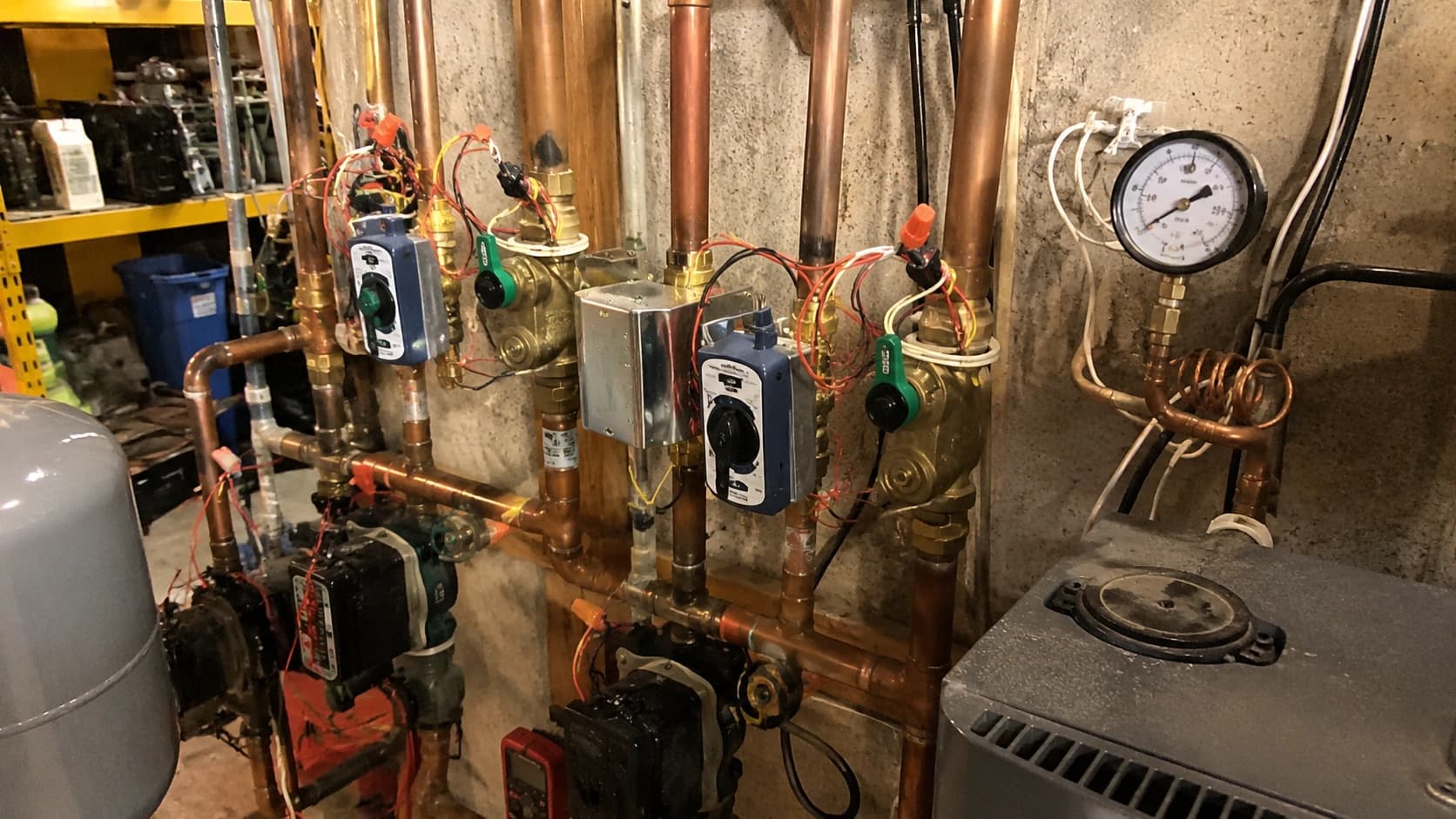
A warm first floor and a cold second floor can point to a zone valve, but the thermostat, controls, circulator, or water flow can cause the same symptom. Before replacing a part, the diagnosis needs to show where the upstairs heating sequence stops.
This guide uses a Concord home with a reportedly 57°F second floor to explain the checks behind a zone-valve repair, the difference between a powerhead and a valve body, and what you can safely record before a service visit.
When Does a Zone Valve Need Replacement?
Replacement fits a confirmed fault in the actuator, end switch, or valve body. A cold room alone does not identify that fault. The thermostat call, control power, valve movement, boiler or circulator response, and water flow need to be checked in sequence.
Some valves have a manual lever that moves the water port without starting the boiler or circulator. A pipe warming after that lever moves is a useful clue, but it does not identify the failed component.
What Happened in the Concord Home
The service record describes a warm first floor, a second floor reported at 57°F, and a pipe that began warming after the zone valve’s manual lever was moved. It identifies head replacement as the proposed next step and notes a maintenance concern on a 2012 boiler. It does not include the valve model, control and flow test results, or confirmation of a completed repair.
That leaves the cause unresolved. The warming pipe showed some heat could reach the loop under those conditions; it did not prove a failed powerhead or rule out a control or circulation problem. For a similar symptom at your home, the heating-system diagnosis path starts with those checks.
How a Hydronic Zone Call Travels
A hot-water boiler sends heated water through baseboards, radiators, or radiant tubing. Some homes use one shared circulator with separate zone valves; others use a circulator for each zone. The boiler and hydronic heating primer explains the larger system.
In a common zone-valve arrangement, the heating call follows this sequence:
- Thermostat: requests heat based on its settings and room temperature.
- Transformer or zone control: supplies and routes the control power.
- Actuator or powerhead: moves the valve mechanism.
- Valve body: opens the water path through that heating loop.
- End switch or control logic: requests boiler or circulator operation where the design requires it.
- Circulator and loop: move heated water through the emitters and back to the boiler.
The exact sequence depends on the equipment. Lever direction, latching method, voltage, and end-switch behavior vary, so the installed model’s label and manual take priority over a generic diagram.
What You Can Safely Observe
Start with thermostat displays and visible equipment information. Do not open a control cover, handle wiring, remove an actuator, drain the boiler, or reach across hot piping. Skip any check you cannot make from a dry, stable position.
- Record the symptom. Confirm that the home has hot-water heat and note whether one zone or the whole house is cold. Record the affected thermostat’s mode, setpoint, and any battery warning, plus which other zones still heat.
- Preserve the boiler information. Photograph a visible code, status indicator, or gauge without opening a panel. Do not repeatedly reset the boiler, add water, bleed a hot loop, or operate gas and electrical components.
- Identify the valve before touching it. Use the zone labels and exact model’s homeowner instructions. If the valve is unidentified, the manual is unavailable, or access is unsafe, leave it alone.
- Stop for unsafe conditions. Do not touch wet, leaking, scorched, damaged, or unusually hot equipment. For a gas odor or suspected fuel leak, a sounding CO alarm or possible exposure symptoms, escaping flame, smoke, or fire, leave immediately and call 911 from outside. For a suspected fuel leak, also call the gas utility or propane provider. Stay out until officials clear the property. Do not grip hydronic pipes to judge temperature.
- Move a manual lever only if the exact instructions permit it. Use light pressure in the labeled direction. Never force a resistant lever, remove the actuator, jump thermostat wires, or open the cover.
- Observe and return it as directed. Note the valve, boiler, or circulator response and whether the zone begins warming. Return the lever as the manufacturer directs and report what changed during the service visit.
What Manual Opening Can Tell You
Warming after manual opening shifts attention toward the normal opening sequence, but another zone may already be running a shared circulator. Conduction, limited flow, partial valve movement, or model-specific switching can also affect the observation.
No warming is inconclusive too. The boiler may not be producing heat, the circulator may be stopped, or air, a closed valve, or a restriction may prevent flow. Either result needs to be compared with the control and circulation tests below.
Valve, Thermostat, or Circulator?
One warm floor shows that the boiler can operate in at least one condition. It does not clear the upstairs controls or water path.
Thermostat and Control Power
A wrong mode, schedule, battery warning, missing thermostat call, wiring fault, or transformer problem can stop the sequence before the valve moves. You can check the normal display settings and follow the thermostat’s battery instructions. Wiring and voltage tests belong to a qualified professional.
Replacing a powerhead will not restore a signal that never reaches it. The hydronic zoning and comfort guide explains how the controls and room demands work together.
Actuator, Valve Body, and End Switch
An actuator can receive the correct signal but fail to move. A valve body can bind or leak, while an end switch can fail to request heat after the valve opens. Comparing the control signal with actual movement and switching separates these repair options. Do not force a binding mechanism.
Circulator and Loop Flow
A shared circulator fault may affect several zones; a dedicated circulator or relay can leave one area cold. Air, low pressure, a closed valve, or a restriction can produce similar symptoms. The boiler repair and circulation guide covers these system checks. For floor tubing and manifolds, see the radiant-zone service guide.
Powerhead or Full Valve Replacement?
A compatible removable powerhead can sometimes be replaced without opening the water side or draining the loop. That option requires a confirmed head or end-switch fault, a freely moving valve body, dry seals, and a compatible replacement. It remains electrical and control work.
A full valve-body replacement may be needed when the body binds, leaks, corrodes, or cannot accept a compatible serviceable head. This commonly involves cooling and isolating the affected piping, draining it, replacing the valve in the correct orientation, then refilling and purging the loop. The layout determines how much of the system must be drained.
What the Service Visit Includes
We identify the installed components and check the control and water path before proposing a repair. The finding may call for a powerhead, valve, wiring correction, relay, circulator, or another flow repair. Jeneral Plumbing prices repair and installation work at a flat rate, with the total and any applicable fees disclosed for approval before work begins.
After approved work, we check that the thermostat can start and stop the zone through its normal controls. Water-side repairs also require the applicable refill, purge, pressure review, and leak checks.
To arrange a visit, call (978) 392-7789 and tell us which rooms are cold and which zones still heat.
While You Wait for Service
A manual-open position is not a universal overnight fix. It may fail to start the heating equipment or allow a zone to heat whenever another thermostat calls. Leave a valve latched only when the exact model instructions permit it and a professional confirms the plan for that system. Do not leave a workaround unattended or rely on generic advice to use it while sleeping.
Never bypass controls, jumper wires, force a lever, repeatedly reset the boiler, add water repeatedly, or bleed a hot system. If using a listed portable electric heater, follow its instructions and CPSC’s space-heater safety guidance: keep it on a stable, dry floor with the required clearances, and plug it directly into a suitable wall outlet. Do not use an extension cord, power strip, damaged outlet, or unattended heater. Never use an oven, grill, open flame, or unvented combustion appliance as space heat.
For gas odor, a suspected fuel leak, a CO alarm or exposure symptoms, smoke, or fire, leave immediately and call 911 from outside. Do not operate switches, phones, windows, appliances, or shutoffs inside. For a suspected fuel leak, also call the gas utility or propane provider. Stay out until officials clear the property.
Where Maintenance Fits
Model-appropriate boiler service can check zone response, circulator operation, visible leaks, pressure, safety controls, venting, and combustion as applicable. It cannot prevent every component failure, and equipment age alone does not explain a cold zone. The current service-plan guide lists the inspection and member benefits.
Jeneral Plumbing is owner-operated by a Licensed Master Plumber (MA #9628831-PL-M) with 20+ years in the trade, including 7 years with a gas utility. We explain the finding behind each proposed repair and keep the immediate no-heat work separate from optional maintenance.
Questions Before a Zone-Valve Visit
What information should I have ready?
Tell us which rooms are cold, which zones still heat, and what the thermostat and boiler displays show. Note whether the symptom began after service or a control change. Share any safe, manufacturer-permitted observation without repeating the test for the appointment.
Does a cold upstairs mean the boiler needs replacement?
No. A thermostat, valve, control, or circulation fault can affect one zone while the boiler still heats another. The diagnosis comes before a component or equipment recommendation.
Will the whole heating system need to be drained?
Not necessarily. Some compatible powerhead repairs leave the water side closed. For a valve-body repair, the available isolation and piping layout determine how much must be drained.
Schedule Hydronic-Zone Diagnosis
Jeneral Plumbing serves homes within 20 miles of Westford, MA, including Concord and nearby Middlesex County communities. Check our service-area directory and call to confirm your address, the requested work, and availability before booking.
Call (978) 392-7789 to discuss a cold zone or a suspected valve problem.
Written by Jeneral Plumbing.
This article was drafted with AI writing tools and edited before publication. AI tools did not inspect any job or validate technical conclusions.
Last updated .