
When More Isn't Better: The Dual Well Pump Problem
Every so often, we walk into a basement and find a plumbing setup that tells a story — usually a story the previous homeowner never bothered to explain. That's exactly what happened during a recent consultation at a home on Forest Road in Westford, MA. The current owner had inherited a redundant dual-pump well water system, a leaking water filter, and a handful of other issues he was trying to sort out before putting the house on the market. What looked complicated at first glance turned out to be a system that was doing more than it needed to — and costing more than it should.
If you're a homeowner in Westford, Chelmsford, or Groton dealing with well water and wondering why your pressure tank setup looks more like a science experiment than a plumbing system, you're not alone. Let's break down what we found and what it means for you.
Understanding Your Well Pump and Pressure Tank System
In a standard private well setup, here's how it works: a submersible pump sits down inside your well and pushes water up into your home. That pump feeds into a pressure tank — a blue or white tank you've probably seen in your basement — which maintains consistent water pressure throughout the house. A pressure switch monitors when pressure drops and signals the well pump to kick back on. Simple, effective, and self-contained.
This Westford home had all of that. A submersible pump in the well. A pressure tank. A pressure switch set to deliver around 60 pounds of pressure. Everything needed to run a house with full, reliable water pressure.
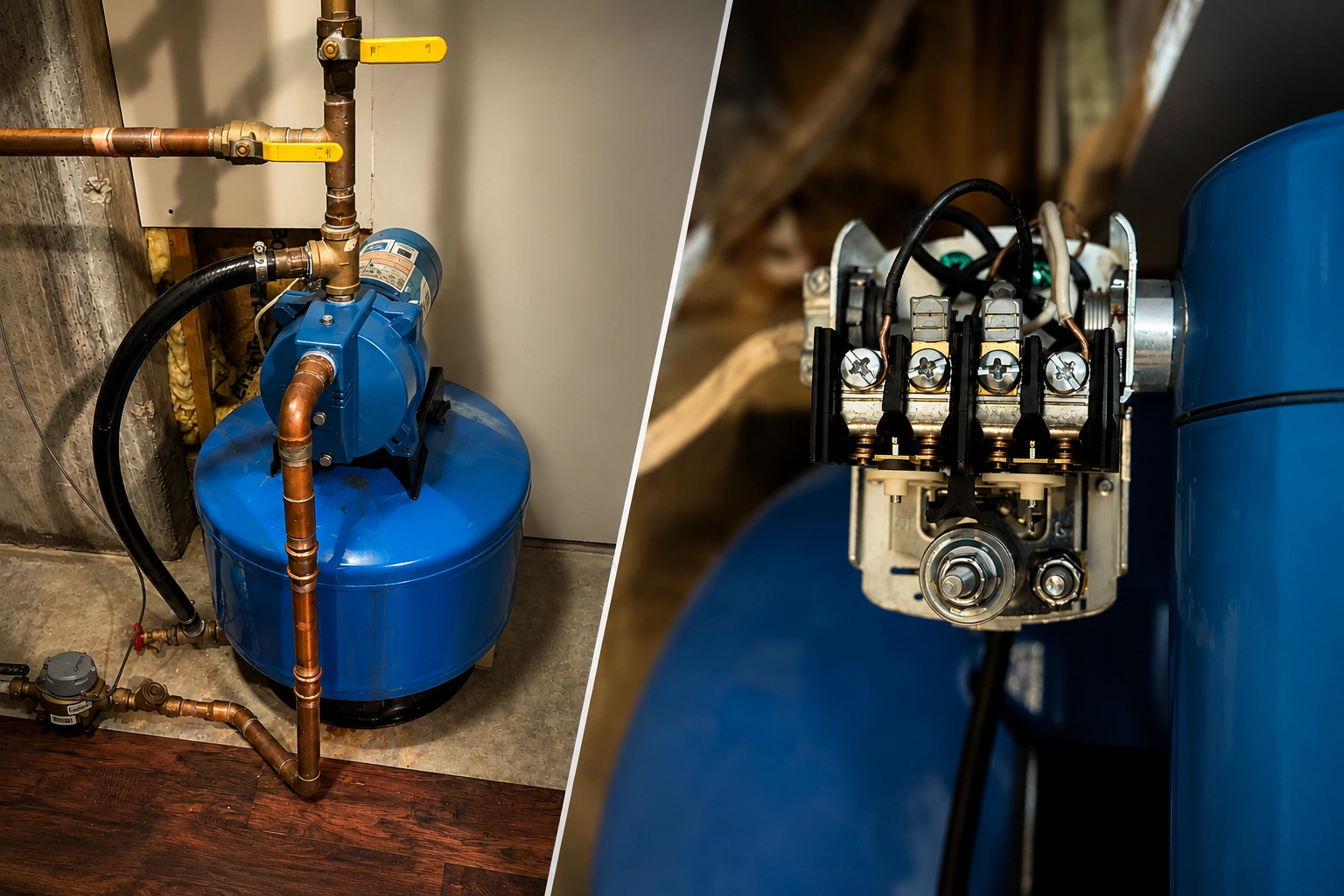
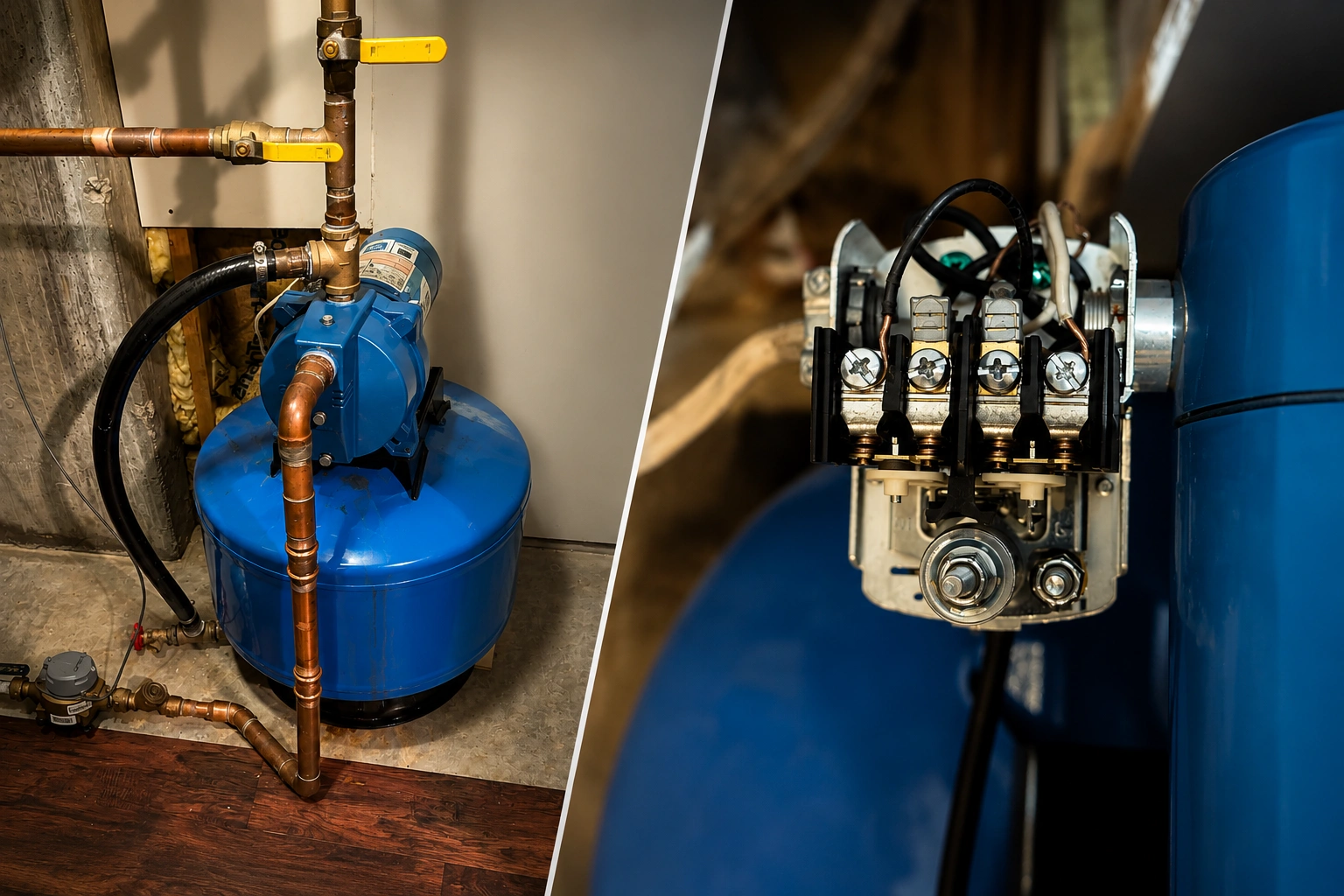
So why was there a second jet pump with its own separate pressure tank sitting right next to it? That's where things got interesting.
Why Homes End Up With Redundant Pump Systems
Our technician's best assessment — and it's one we see more often than you'd think — is that the submersible pump in the well failed at some point, and rather than pulling it and replacing it (which costs more upfront), a previous owner installed a jet pump as a workaround. The jet pump sits above ground, draws water up from the well mechanically, and was essentially doing the job the original well pump was no longer doing.
Then, at some later point, the well pump was replaced and brought back online. Nobody removed the jet pump. Now the house had two systems running in parallel — one doing the actual work, one just sitting there drawing power and taking up space.
To confirm this, the Jeneral Plumbing technician unplugged the jet pump entirely and had the homeowner go outside and run a hose. Full pressure. No change whatsoever. The well pump was handling everything on its own, just as it should.
What a Booster Pump Is (And When You Actually Need One)
To be fair to the previous owner, there is a legitimate reason to install a secondary pump: low water pressure. A booster pump is sometimes added when the pressure coming from a well isn't sufficient for the home's needs — multiple bathrooms running simultaneously, long pipe runs, or older wells that simply can't keep up. In those situations, a booster pump makes sense.
But that's not what was happening here. With a properly functioning submersible well pump pushing 60 PSI through the system, this home had plenty of pressure. The jet pump wasn't boosting anything. It was just there.
Our recommendation was straightforward: remove the redundant jet pump and its associated pressure tank, properly cap the lines back into the main system, and simplify. Less equipment means fewer potential failure points, lower energy use, and a cleaner basement — all of which matter when you're trying to sell a home.
The Water Filter Leak: A Gasket and Valve Problem
Separate from the pump situation, the homeowner was also dealing with a leaking water filter. He'd already done some impressive troubleshooting on his own — shutting off the main water, swapping out a connection, and reducing the leak significantly — but it hadn't stopped completely.
Our technician identified two remaining leak points. One was at a connection where the rubber gasket inside had likely worn out or wasn't seating correctly. These gaskets are small, inexpensive, and easy to overlook, but they're the most common cause of a dripping filter housing connection. The fix is to disassemble the connection, replace the gasket, and reassemble with proper seating.
The homeowner had actually already sourced the replacement part from Amazon — impressive initiative. The recommendation was to also add shutoff valves at the filter connections so that in the future, the filter can be serviced without shutting off water to the entire house. That's a small upgrade that makes a big difference in convenience, especially in older homes where the filter is part of the main supply line.
A Note on Water Quality and Equipment Lifespan
During the visit, a natural question came up: how long should a pressure tank or filter system last? The honest answer is — it depends entirely on your water quality.
Pressure tanks have a rubber diaphragm inside that separates the water from the air charge. Hard water, meaning water with high mineral content, can eat through that rubber faster than clean water would. We've seen tanks fail in five years and others still running fine at twenty-five. The same principle applies to filter housings and gaskets.
If you're in Groton, Chelmsford, or elsewhere in the Westford area and you're on well water, a periodic water quality test is one of the smartest investments you can make. It tells you what's actually in your water, helps you size your filtration properly, and gives you a realistic picture of how hard your equipment is working.
Pre-Sale Plumbing Repairs: Fix It Right Before Listing
This consultation was specifically for pre-sale repairs, and that context matters. Buyers today — especially in the Westford and greater Middlesex County market — are savvy. Home inspectors will flag a redundant pump system, a leaking filter, and any visible corrosion. That flags turn into negotiating leverage against your asking price, or worse, deals that fall through entirely.
Addressing these issues proactively — removing the unnecessary equipment, stopping the leaks, cleaning up the plumbing in the basement — doesn't just pass inspection. It signals to buyers that the home has been well cared for. That perception has real dollar value.
Key Takeaways
Redundant well pumps are more common than you think. If your home has both a submersible well pump and a jet pump, there's a good chance one of them isn't doing anything useful. A simple pressure test can confirm this.
You do not need two pressure tanks. One properly sized pressure tank matched to your well pump is all a standard home requires.
Leaking water filter connections are usually gasket failures. Small rubber gaskets inside couplings are cheap to replace and are usually the culprit when a filter connection won't stop dripping.
Add shutoff valves to your filter. It lets you service the filter without killing water to the whole house — a simple upgrade that saves real frustration.
Water quality affects equipment lifespan. Get your well water tested. Hard, mineral-heavy water will shorten the life of diaphragms, gaskets, and pressure tanks significantly.
Pre-sale plumbing repairs pay off. Clean up the basement plumbing before you list. Inspectors will notice, and buyers will respond.
Frequently Asked Questions
Why does my house have two well pumps?
Most likely, the original pump (usually a submersible inside the well) failed at some point, and a secondary pump was added as a temporary or lower-cost fix. If the original pump was later replaced but the secondary one was never removed, you end up with two systems. In most cases, only one is actually needed. A plumber can run a quick test to determine which one is doing the work and whether the other can be safely removed.
How do I know if my water filter is leaking because of a bad gasket?
If you see dripping at a threaded connection or coupling on your filter housing, the rubber gasket inside that connection is the most common cause. These gaskets compress over time, especially in homes with hard well water, and eventually lose their seal. The fix is usually disassembly, gasket replacement, and reassembly — a straightforward repair for a licensed plumber.
Do I need a booster pump if I have low water pressure?
Possibly — but first, confirm that your existing well pump and pressure tank are functioning correctly. Low pressure is often caused by a failing pressure tank (waterlogged diaphragm), a worn pressure switch, or a well pump that's struggling. A booster pump is appropriate only after those root causes have been ruled out. Adding a booster to a system that already has a problem elsewhere won't solve anything long-term.
How long does a pressure tank last on well water?
Typically anywhere from 5 to 25 years, depending heavily on water quality. Homes with hard, mineral-rich well water will see diaphragms degrade much faster than homes with cleaner water. Regular water testing and a whole-house water softener or filtration system can significantly extend equipment life.
Should I fix plumbing issues before selling my home?
Yes — and the earlier the better. Home inspectors are thorough, and issues like redundant equipment, visible leaks, and corrosion will show up in the inspection report. Buyers use those findings to negotiate lower prices or request costly credits. Addressing the issues proactively is almost always more cost-effective than discounting your asking price after the fact.
Ready to Simplify Your Plumbing Before You Sell — or Just Because It's Time?
Whether you're in Westford, Chelmsford, Groton, or anywhere in the surrounding Middlesex County area, the Jeneral Plumbing team is here to help you make sense of what's in your basement. We'll give you honest answers, clear options, and fair pricing — no upselling, no unnecessary work. Just practical plumbing done right.
Give us a call at (978) 392-7789 to schedule a consultation. We're a family-owned company right here in Westford, and we treat every home like it's our own.
Written by Jeneral Plumbing.
This article was drafted with AI writing tools from Jeneral Plumbing job notes and source materials, then edited before publication. AI tools did not inspect the job or validate technical conclusions.
Last updated .