

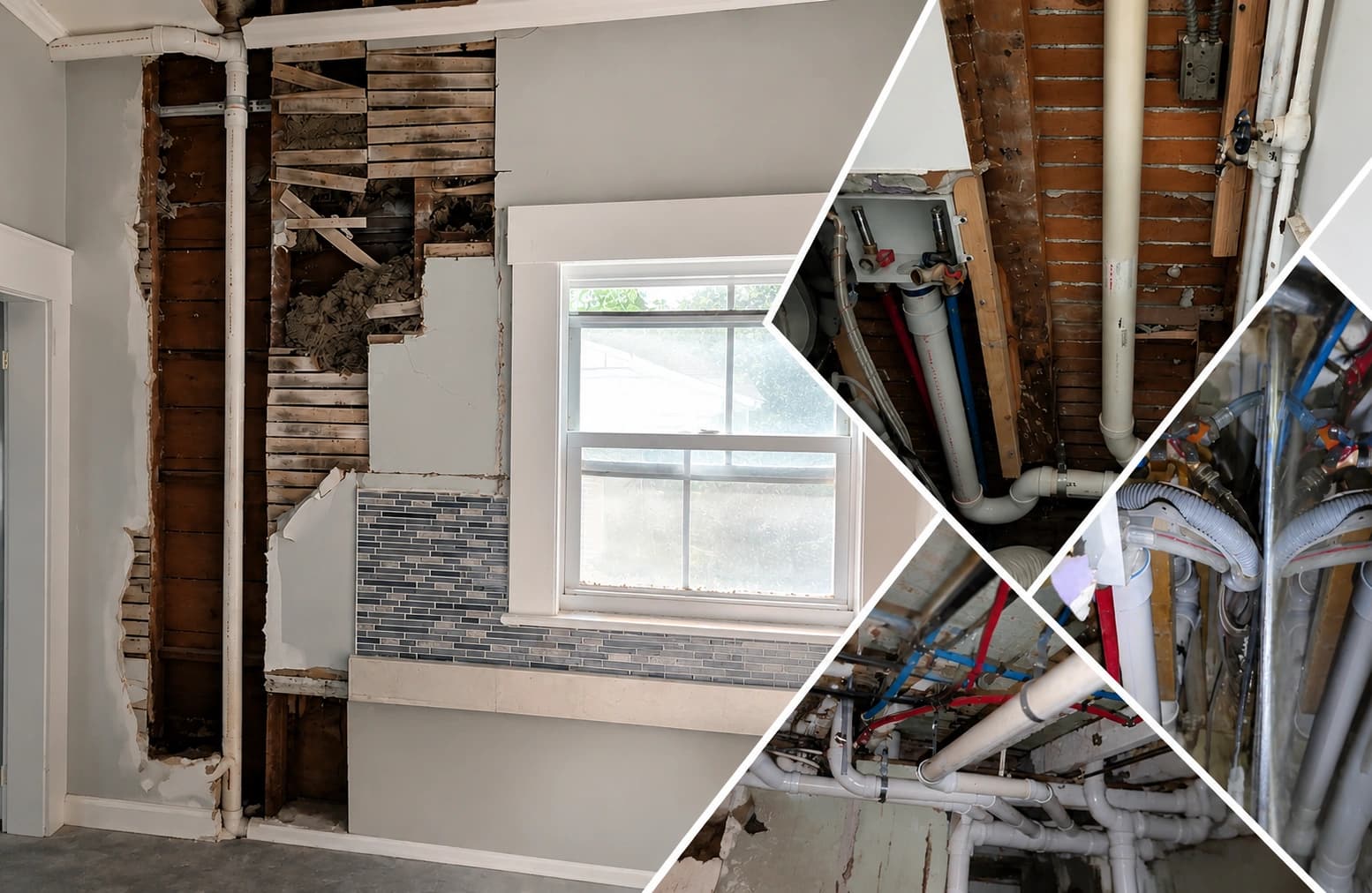
Yes. Poor-quality plumbing work can damage your home's structural framing when pipes are installed without following building codes. Oversized holes drilled through floor joists, improperly routed drain lines, and unnecessary structural modifications are the most common forms of structural damage from plumbing work — they can weaken your home, lead to failed inspections, and result in expensive repairs. A professional plumbing inspection can identify these problems before they become larger structural issues.
Many homeowners assume that if the sink drains and the water heater still works, the plumbing system is in good condition. Unfortunately, that's not always the case.
At Jeneral Plumbing, we frequently inspect homes in Westford, MA and nearby towns where previous plumbing work looks acceptable on the surface but hides real problems behind ceilings, inside walls, or beneath floors. During one recent inspection in Massachusetts, what seemed like a simple kitchen plumbing project uncovered structural damage, an improper drain installation, and a repair recommendation that would have cost the homeowner thousands of dollars more than necessary.
This case shows why hiring an experienced, code-compliant plumber protects far more than your plumbing.
What Does Structural Damage From Plumbing Look Like?
Plumbing systems are woven through your home's framing, flooring, walls, and mechanical systems. When plumbing is installed incorrectly, the damage often extends well beyond leaking pipes.
Improper workmanship can result in:
- Structural damage to floor joists
- Failed building inspections
- Sagging or weakened floors
- Cracked drywall
- Poor drain performance
- Unnecessary demolition
- Costly future repairs
- Reduced home value
Most of these problems are avoidable when plumbing is planned and installed to Massachusetts building codes and trade best practices.
Why Are Floor Joists So Important?
Floor joists are the structural members that carry the weight of your floors, walls, furniture, and everything inside your home. Every hole drilled through a joist affects its strength.
Building codes allow plumbers to drill through joists only under specific conditions. Hole size and placement are regulated to preserve the framing's structural capacity.
Generally, holes belong in the center portion of the joist depth and must stay within allowable size limits. Oversized holes, or holes drilled too close to the top, bottom, or ends of a joist, can significantly weaken the structure.
Ignoring these limits can create long-term structural concerns that require professional repair.
How Big a Hole Can Be Drilled in a Floor Joist?
For sawn-lumber joists, the framing provisions commonly applied in Massachusetts follow a few consistent limits. These are the rules of thumb inspectors generally work from — the inspector's reading of the code governs on any specific job, so confirm before anyone cuts.
- Bored holes are commonly limited to one-third of the joist's depth — about 2-3/8 inches in a 2x8, about 3 inches in a 2x10, and about 3-3/4 inches in a 2x12
- Holes commonly must stay at least 2 inches from the top and bottom edges of the joist, and at least 2 inches from any other hole or notch
- Notches in the joist edge are commonly limited to one-sixth of the joist depth, and notches are generally not permitted in the middle third of the span
- Notches at the end of a joist, where it bears on a wall or beam, are commonly limited to one-quarter of the depth
- Engineered I-joists follow the manufacturer's hole chart instead of the sawn-lumber rules — the web can accept larger holes in some zones, and the flanges must never be cut or drilled
For scale: a 2-inch PVC drain has an outside diameter close to 2-3/8 inches, so the hole it needs sits at or past the commonly applied one-third limit for a 2x8 joist before the pipe even has clearance. That is why routing decisions matter as much as pipe size.
What Did We Discover During This Plumbing Inspection?
The homeowner originally asked for a general plumbing evaluation and advice on an aging water heater.
During the inspection, we found two separate issues.
The first involved the existing water heater. The unit was manufactured in 2020 and approaching the later part of its expected service life, but it was still working. Rather than recommending immediate replacement, we suggested replacing the anode rod — a relatively inexpensive maintenance item that can meaningfully extend the life of the tank.
The second discovery was far more concerning.
While inspecting the kitchen plumbing, I found that a previous contractor had installed a new drain line by drilling an oversized hole straight through a floor joist.
Instead of routing the piping through a less invasive path, the installer compromised one of the home's structural framing members.
Was the Drain Pipe Even the Correct Size?
No.
The previous contractor installed a 2-inch PVC drain line, even though a 1½-inch drain line would have been sufficient for the kitchen sink.
Because the pipe was larger than necessary, a much larger hole had to be drilled through the floor framing.
With proper planning, the drain could have been routed through the back of the kitchen cabinetry before entering the floor system, avoiding the structural damage altogether.
Pipe size is about more than drain performance — it decides how much framing has to be modified during installation. When an existing kitchen drain needs correcting, Jeneral Plumbing handles repair of accessible kitchen drain piping: traps, connections, and accessible branch sections.
Why Does Pipe Routing Matter?
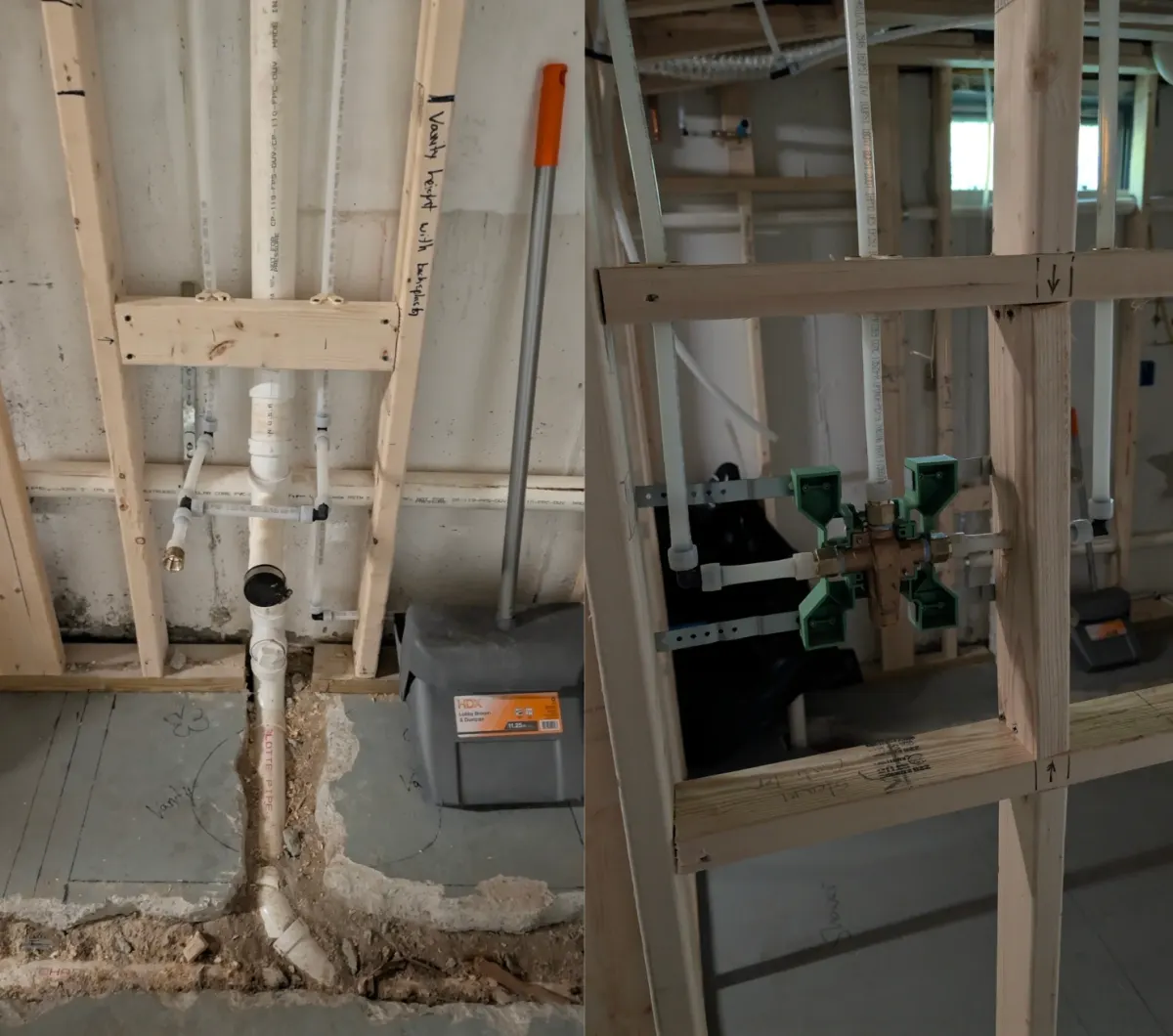
Professional plumbers consider more than getting water from one point to another.
Every installation should balance:
- Plumbing performance
- Structural integrity
- Accessibility for future service
- Building code compliance
- Appearance
- Long-term reliability
Sometimes a slightly longer pipe route is the better solution because it avoids cutting structural framing.
This is why routing is a design decision, not an afterthought. On renovations and additions, our plumbing system design service coordinates pipe paths with the framing before rough-in, so structural members are never sacrificed to reach a fixture.
Can Structural Damage Like This Be Repaired?
Yes.
Damaged floor joists can often be repaired without replacing the entire floor structure.
In this case, we recommended having a qualified contractor sister the damaged joist — attaching a new structural member alongside the compromised one.
Sistering is a widely accepted repair method when performed correctly, and it restores much of the joist's original strength. The framing repair itself is carpentry, not plumbing; we document what we find and refer the structural work honestly.
Repairing the framing was a far better answer than ignoring the problem and hoping it never causes issues.
Did the Homeowner Really Need an $11,000 Ceiling Repair?
No.
The homeowner had previously received an estimate of approximately $11,000 to repair drywall and conceal the exposed plumbing.
After evaluating the installation, we recommended a more practical approach.
Instead of extensive drywall reconstruction, the homeowner could build a soffit or incorporate the exposed drain line into the design of future kitchen cabinetry during an upcoming remodel.
This solution would:
- Conceal the plumbing
- Improve the finished appearance
- Reduce demolition
- Save thousands of dollars
- Preserve flexibility during future renovations
Sometimes the smartest repair isn't the most expensive one.
Should You Replace an Older Water Heater Right Away?
Not necessarily.
Many homeowners assume an older water heater automatically needs replacement. That's not always true.
During this inspection, the existing water heater was still operational and showed no immediate signs of failure.
Instead of recommending replacement, we advised replacing the sacrificial anode rod. This maintenance item protects the inside of the tank from corrosion and can often extend the heater's life by several years.
For many homeowners, honest maintenance is a better investment than premature replacement. When a tank does reach the end of its life, our water heater service in Westford, MA covers evaluation, repair, and replacement — with the same routing and code discipline this article describes.
What Photos Should You Take Before the Ceiling Is Closed Up?
If plumbing work is happening in your home, take photos before the drywall goes back up. Once the ceiling is closed, the only way to verify the work is to open it again.
Photograph:
- Every joist bay where new piping runs, wide enough to show the framing around it
- Close-ups of each hole or notch, with a tape measure in frame to record size and distance from the joist edges
- The full routing path of each new drain and supply line, from the fixture to where it leaves the room
- Trap, cleanout, and shutoff valve locations you may need to find again years later
- The permit card and any inspection sign-off, if the work was permitted
These photos cost nothing and can settle questions later — during a home sale, an insurance claim, a warranty dispute, or a future renovation. They also make any second-opinion review faster, because we can see conditions that are now hidden.
How Can You Protect Yourself From Poor Plumbing Work?
Before hiring any plumbing contractor, ask questions about the proposed installation.
A professional plumber should be able to explain:
- Why a specific pipe size is being used
- How the piping will be routed
- Whether structural framing will be affected
- Whether permits are required
- How the work complies with local plumbing and building codes
It's also wise to request photos of completed work, review warranties, and get detailed written estimates. Permits matter more than most homeowners realize — we wrote a companion guide on what happens when plumbing work isn't permitted, and the short version is that unpermitted work follows the house, not the contractor.
The lowest price is rarely the best value if improper workmanship creates expensive repairs later.
When Should You Get a Second Opinion?
Consider scheduling an independent inspection if you notice:
- Recent plumbing work that required excessive cutting
- Large holes through floor joists
- Exposed plumbing in finished ceilings
- Installations that seem unusually invasive
- Water heater replacement recommendations without clear justification
- Expensive repair estimates that don't fully explain the problem
- Water stains or damp framing near recent work — a sign worth a pipe leak evaluation before anything gets sealed up
Jeneral Plumbing is owner-operated by a Licensed Master Plumber (MA #9628831-PL-M), and second opinions are a routine part of our work in Westford, Chelmsford, Acton, Littleton, Groton, and Carlisle. An independent inspection can identify alternatives that save money while protecting your home.
What Does a Second-Opinion Inspection Cost?
For a regular-hours visit, the cost is an $80 dispatch fee — the cost of the visit, waived when you hire us for the work.
That covers the inspection itself. We look at the work in question, explain what we find in plain language, and put our recommendation in writing. If the previous work is sound, we say so and leave you with documentation you can keep with your home records.
Frequently Asked Questions
Can a plumber cut or drill through floor joists?
Yes, but only within the limits set by the building code. Bored holes are commonly capped at one-third of the joist depth and kept 2 inches clear of the edges, and notches are not permitted in the middle third of the span under the commonly applied rules — though the inspector's reading governs on any specific job. A plumber who drills first and checks the limits later is creating structural work for someone else. When a hole can't fit the code, the pipe route changes, not the joist.
Is a 2-inch drain pipe required for every kitchen sink?
No. Most residential kitchen sinks drain properly on a 1½-inch line, and larger piping is only required in specific situations. Oversizing a drain forces bigger holes through framing without improving performance. In the inspection described above, the unnecessary jump to 2-inch PVC is what turned a plumbing job into a structural problem.
Can a damaged floor joist be repaired?
In many cases, yes. Sistering — fastening a new structural member alongside the damaged one — is one of the most common repair methods, and it restores much of the joist's original strength when done correctly. The framing repair itself is carpentry rather than plumbing, so the right sequence is a plumbing inspection to document the cause, then a qualified contractor for the structural fix. Severe or repeated damage may call for an engineer's assessment.
Who pays when a contractor damages framing?
Responsibility generally follows the contractor whose work caused the damage, which is one reason licensing and insurance matter when you hire. Your best protection is documentation: dated photos, the written estimate, the permit record, and an independent inspection report describing what was found. Massachusetts homeowners may also have recourse through the contractor's insurance or state complaint processes, but that is a legal question we can't answer for your specific situation. What we can do is document the condition clearly so you have the facts.
How do I check plumbing work a previous contractor did?
Start with what you can see: large or ragged holes through joists, notches in the top or bottom of framing, sagging floors above recent work, and piping runs that seem to fight the structure. Check with your town whether a permit was pulled and closed out — unpermitted work is a red flag worth taking seriously. Then have the work inspected by a licensed plumber who wasn't involved in the original job. Photos from before the walls were closed, if you have them, make this much easier.
Should I replace a water heater because of its age alone?
Not always. Age matters, but condition matters more — a maintained tank can outlast its nameplate expectations, and anode rod replacement is one of the least expensive ways to extend its life. Replacement makes sense when a tank leaks from the shell, fails repeatedly, or can no longer keep up with your household. A pushy replacement quote for a working heater is exactly the kind of recommendation worth a second opinion.
Can poor plumbing work reduce my home's value?
Yes. Code violations, structural damage, and improperly installed plumbing can complicate inspections, renovations, and real estate transactions. Buyers' inspectors look for exactly the kinds of framing damage this article describes, and unresolved issues turn into repair credits and price reductions at closing. Documenting and correcting problems before you sell is almost always cheaper than discounting the house.
Protect Your Home With a Professional Plumbing Inspection
Poor plumbing workmanship creates problems that extend far beyond leaking pipes: improper drain installations, framing damage, unnecessary demolition, and repair recommendations that cost more than they should.
Jeneral Plumbing believes every installation should protect both your plumbing system and your home's structure. Whether you need a second opinion, a plumbing inspection, a water heater evaluation, or corrections after a previous contractor's work, we explain what we find and recommend the practical fix, not the expensive one.
We're based in Westford, MA and serve 26 towns across Middlesex & Worcester County and southern New Hampshire — see the full list of communities we serve. If you have concerns about previous plumbing work in your home, call Jeneral Plumbing at (978) 392-7789 or request an inspection online, and we'll help you understand the condition of your system and the options that protect your home — not just your plumbing.
Written by Jeneral Plumbing.
This article was drafted with AI writing tools and edited before publication. AI tools did not inspect any job or validate technical conclusions.
Last updated .