

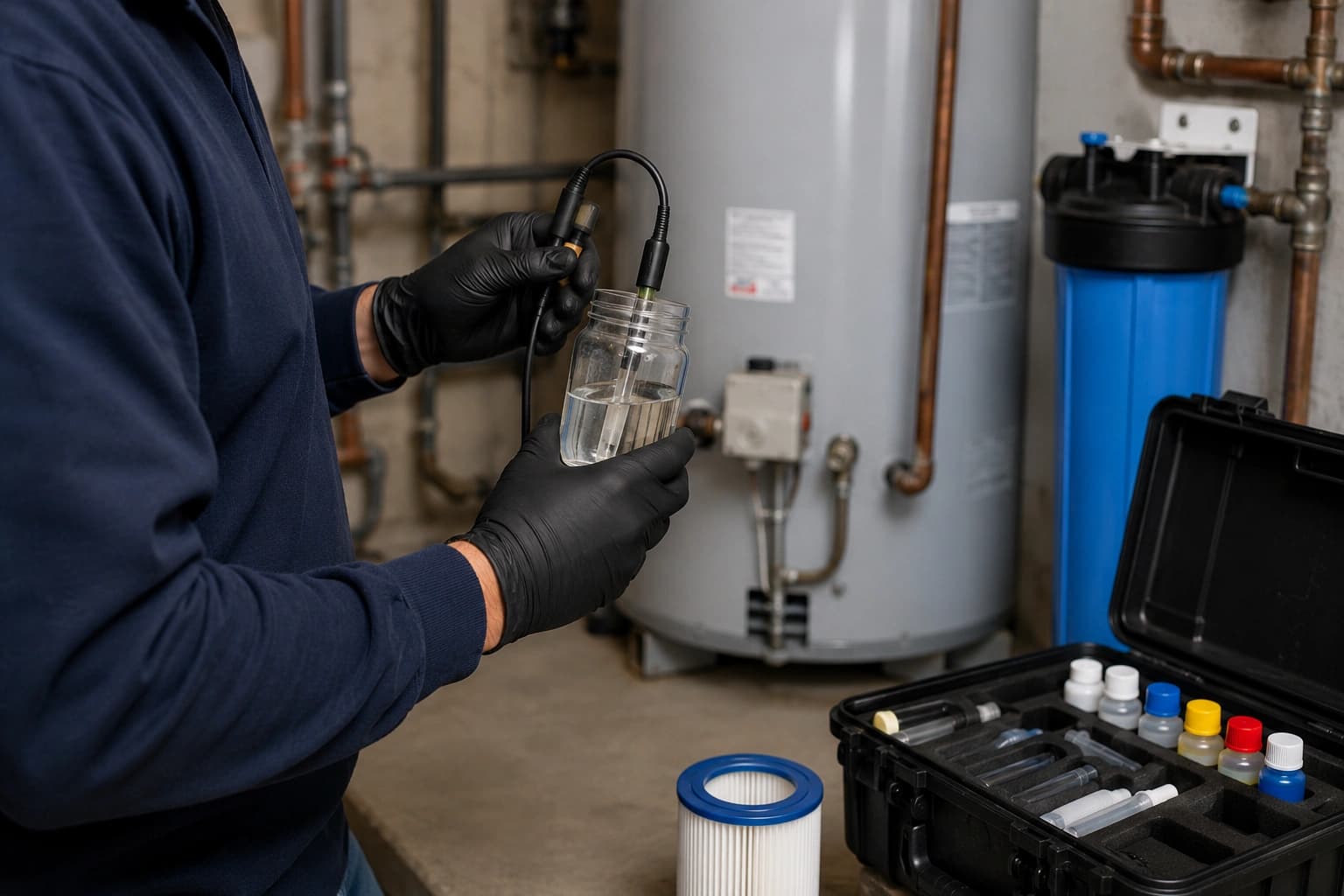
White spots on the faucets, a salesperson recommending a whole-house system, a water heater that seems to be struggling. Before spending money on any of it, it's fair to ask whether a water test would change the decision. Sometimes a result helps you avoid unnecessary equipment or choose a smaller repair. Testing can't promise a dollar figure or prevent every failure, but it can give you better information before you spend.
Where a test can change the money decision
| Situation | What a test can do | What it can't do |
|---|---|---|
| You're about to buy treatment equipment | Define the job, so the system is sized for a measured condition, or skipped | Make a product fit a problem the results don't show |
| Existing equipment isn't keeping up | Compare incoming and treated water as part of an equipment inspection | Decide by itself which setting, part or maintenance task will fix it |
| The symptom shows up only in hot water | Point the investigation toward the water heater and hot piping instead of a whole-house system | Prove why the heater changed |
| Pinhole leaks keep recurring | Add chemistry to a pipe material and installation review | Establish a whole-house problem from one failed fitting |
| You have a health question | Route it to the right certified-laboratory test | Be answered by a field meter or test strip |
The useful comparison is between the original proposal and the work supported by the results and inspection. A test may also confirm that existing equipment is performing as intended. That's useful information even when it doesn't lead to a different purchase; it simply isn't proof of money saved.
Start with the water source
Westford has both public-water customers and private wells, so the address comes first. The Westford Water Department's 2025 Annual Drinking Water Quality Report states that the public system met applicable state and federal health standards in 2025. That describes the public system for that year. It doesn't establish the quality of a private well or the water at your faucet after it passes through your service line, plumbing and any treatment.
For a private well, MassDEP's private-well testing guide and Westford's private-well information are the official starting points. The EPA's private-well guidance explains why appearance and taste can't establish safety. A neighbor's results don't establish yours.
Ask one answerable question
Are you chasing scale, staining, odor, taste, corrosion, pressure changes, a new purchase, an existing system or a specific contaminant? Each question can call for a different sample point, method or laboratory. A raw sample taken before treatment answers a different question than one taken after a softener, a filter, the water heater or a single faucet. Write down when the problem started, which taps show it, and what work came before it. Keep old reports as history, but don't treat a result from another sample point as a current measurement.
Field screening can add context for things like hardness, pH, conductivity and temperature, and each instrument has its own limits. Health-related questions, such as bacteria, PFAS, lead, arsenic, uranium and nitrate, need the right laboratory method, containers and handling. PFAS is never tested on site. Our water testing service explains how we define the question and sample point before discussing any equipment.
Symptoms are clues, not diagnoses
Scale at a faucet justifies a hardness question, but it doesn't prove every deposit came from hardness. Color alone doesn't identify a metal. Odor can come from the source, treatment equipment, the water heater, a drain or the fixture itself, so note whether it shows up in hot water, cold water or both. Recurring pinholes deserve a pipe material and installation review alongside any chemistry testing, and our pipe leak repair service covers that side. Pressure changes need their own diagnosis, because a chemistry result can't locate a restriction.
The same caution applies to water heaters. Chemistry may contribute to sediment, scale or corrosion, but the heater still needs its own inspection and service history, and a test doesn't prove what caused a failure. Our water heater service keeps those questions separate.
If the result supports treatment, count the whole cost
When a result does support treatment, the installed equipment is only part of the cost. Plumbing changes, drain and power needs, bypass and sample access, consumables, maintenance, follow-up testing and eventual component replacement all belong in the comparison. The wrong stage adds pressure loss, drainage, maintenance and failure points without fixing anything.
Any claim that a product reduces a specific contaminant has to come from that exact model's current third-party certification for that contaminant, checked in a listing such as the NSF certification directory. Our test-first water treatment process and filtration and softener service start only after the results define the job. We price supported work at a flat rate, with the total shown for approval before work begins, and we don't attach invented payback periods.
No treatment is a valid answer
The result should lead to the smallest next step that answers the concern. That might be no action, monitoring, another sample, a fixture cleaning, a plumbing repair, water heater service, maintenance on existing equipment, or new treatment. More equipment isn't automatically more protection. When the evidence doesn't support buying anything, the test has done its job.
Can water testing guarantee lower plumbing costs?
No. It reduces guesswork when a result changes a repair, maintenance, monitoring or treatment decision, but it can't guarantee savings or equipment life. The value depends on the property and what the result shows.
Testing your water in Westford
Jeneral Plumbing is based in Westford, MA, owner-operated by a Licensed Master Plumber (MA #9628831-PL-M), and serves homes across Middlesex & Worcester County. A regular-hours visit carries an $80 dispatch fee — the cost of the visit, waived when you hire us for the work. When we're already at your home for a visit, the on-site water test is free. We don't make a separate trip for a free test, and laboratory fees are separate. Call (978) 392-7789 to talk through what you're seeing and whether a test would change the decision.
Written by Jeneral Plumbing.
This article was drafted with AI writing tools and edited before publication. AI tools did not inspect any job or validate technical conclusions.
Last updated .