

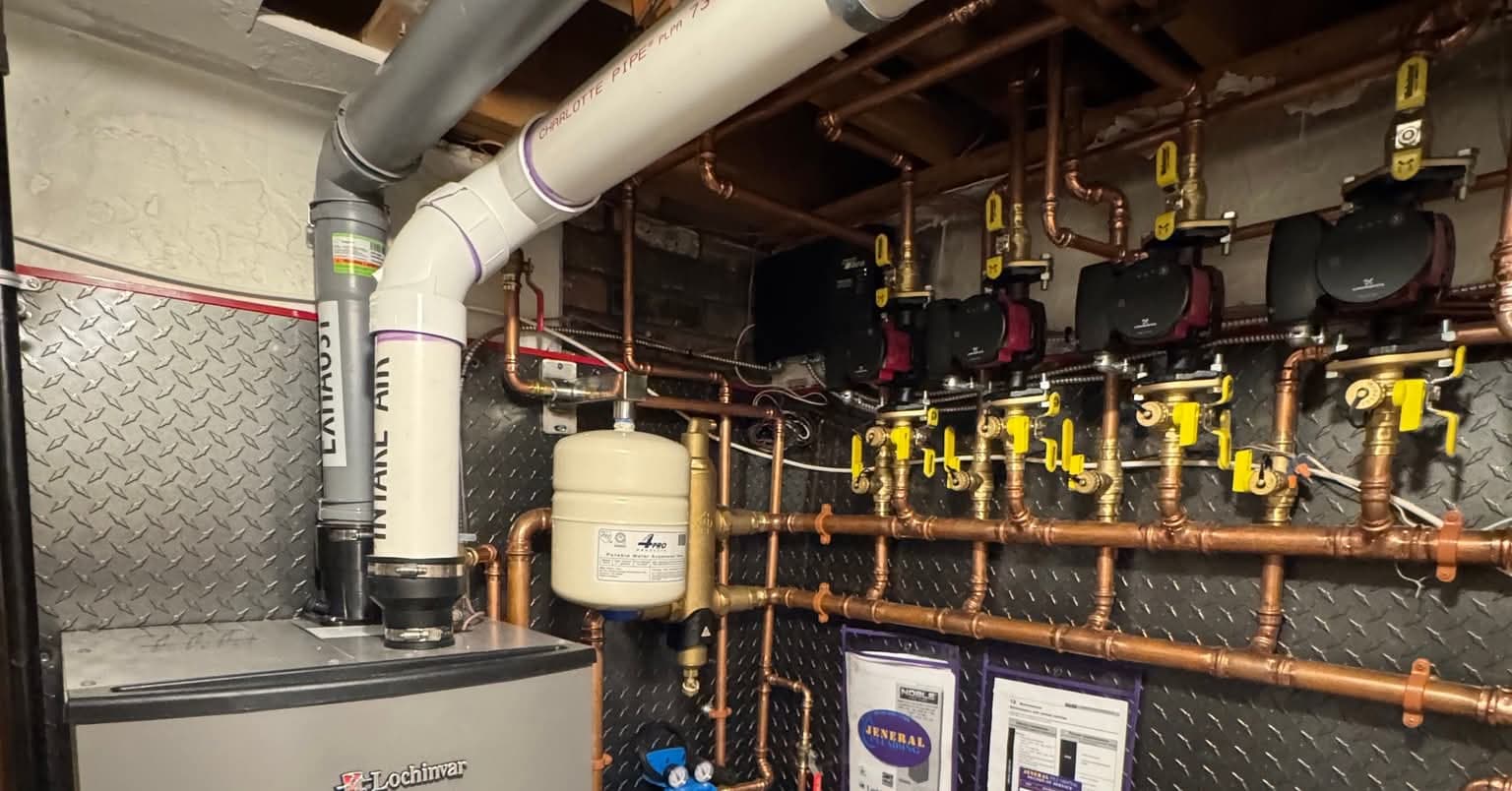
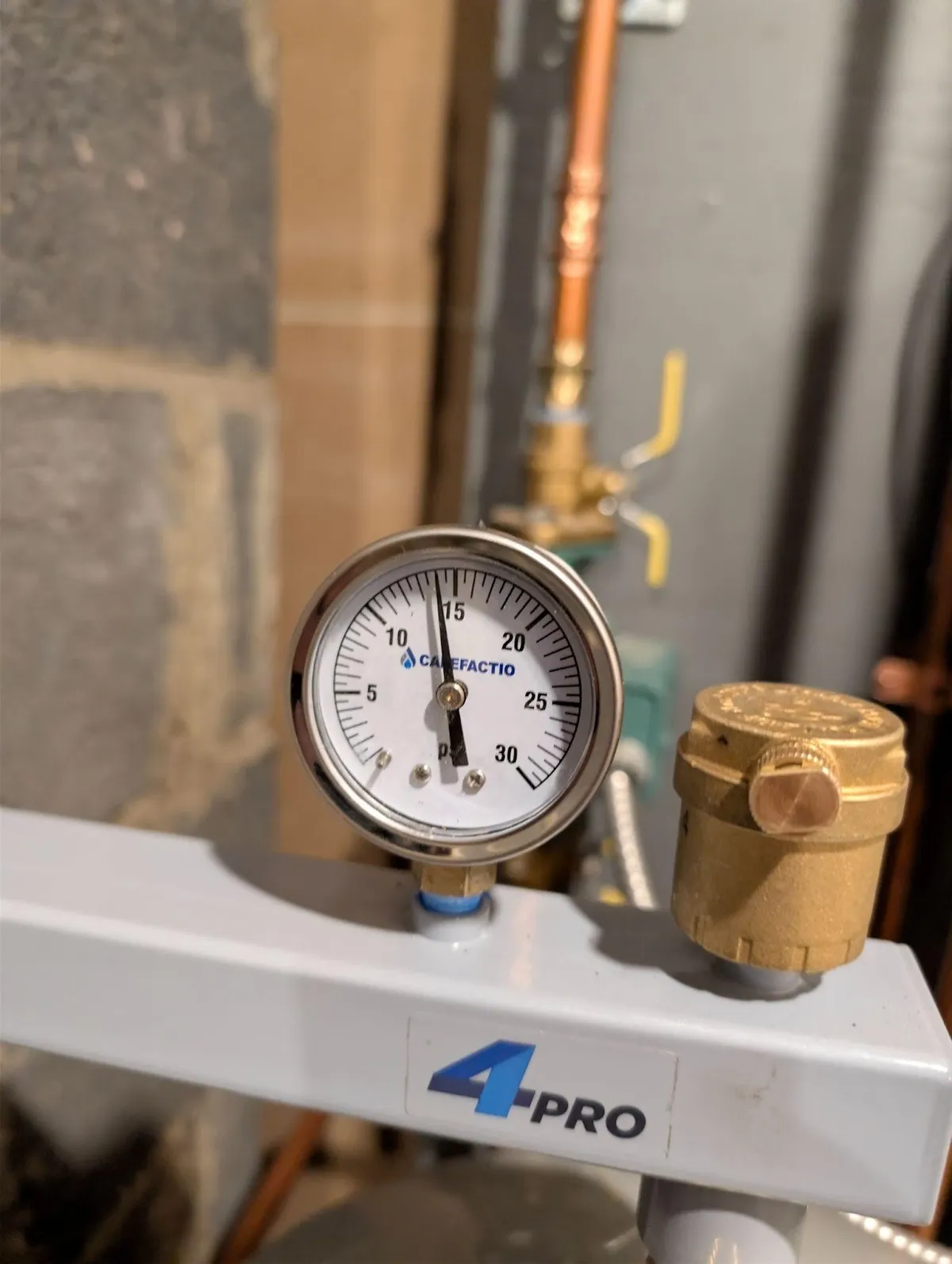
Your boiler's pressure gauge reads close to 20 PSI, and the burner hasn't fired yet. The house is warm and nothing is dripping, so it's easy to walk past. On one service call, a Navien NCB combi boiler had several pressure and maintenance concerns in the same home. The first four topics below draw on that visit. The fifth, a boiler in lockout, can leave any modern boiler cold, so we've included it with a clear line between what you can do and what needs a technician.
1. Boiler pressure near 20 PSI before the burner fires
Is 20 PSI too high for a boiler? It depends on when you read it. Water expands as it heats, so a hot-water heating system filled to a set pressure while cold climbs every time the burner runs. A boiler reading 20 PSI while hot may be fine. One sitting at 20 PSI cold starts each cycle with much of its margin already spent. Most residential hot-water boilers have a relief valve rated at 30 PSI, and the tag on yours shows its exact rating. All of that expansion has to fit below it.
The right cold pressure depends on the height of the house and the boiler manual, so we confirm it on site rather than from a chart. The more useful habit is noting the cold and hot readings and whether the gap between them grows. A high or climbing reading usually points to another part:
- an expansion tank that no longer absorbs the change
- a fill valve letting water creep into the loop
- on a combi boiler, a leak inside the domestic hot-water heat exchanger that lets higher-pressure household water into the heating side
These faults can each raise pressure for a different reason. Bleeding water off to lower the reading treats the number, not the cause. A dripping relief valve may be reacting to high pressure or may have failed itself; never cap or plug it. A boiler repair visit starts by finding out why the pressure moved.
2. A condensate neutralizer glued in with no unions
A condensing boiler pulls enough heat from its exhaust that water condenses out of it, and that condensate is acidic. A neutralizer is a canister of media that treats the condensate before it reaches your drain. The media is used up as it works, so it needs checking and eventual replacement for the life of the boiler.
On this call, the neutralizer had been cemented straight into the condensate line at both ends, with no unions. Unions are threaded joints that let a canister come out for service without cutting pipe. Without them, a few minutes of routine maintenance becomes a job of cutting out and rebuilding that section of the line.
If you have a high-efficiency boiler, look at the canister on its condensate line. Union nuts or threaded ends mean it can be opened. Smooth glued joints at both ends mean the next service will take longer, and it's worth asking to have unions added. The neutralizer maker's instructions set how often the media needs replacing, and we check it at every annual service.
3. An expansion tank that has stopped absorbing pressure
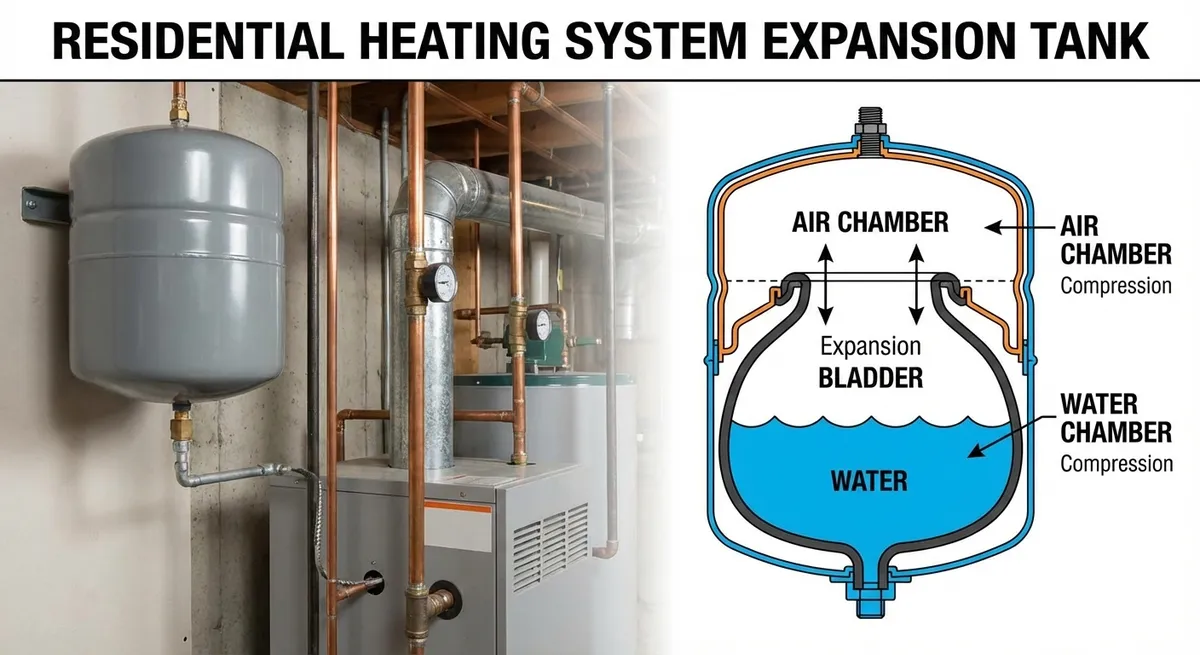
On the same service call, readings climbed from 14.5 PSI to 24.7 PSI through one heating cycle. A working expansion tank absorbs most of that rise. A swing that wide means the tank isn't keeping up, and the extra pressure strains pipe joints, circulator seals, the heat exchanger and the relief valve every time the boiler runs.
The tank is usually a small cylinder on the piping near the boiler. Inside, a rubber diaphragm or bladder separates a cushion of pressurized air from the system water. When the bladder fails or the air charge leaks down, water takes over the tank and the cushion is gone.
One rough clue needs no tools: tap the tank with a knuckle. A healthy tank usually sounds hollow on the air side and solid on the water side. If it sounds solid all the way up, it needs a look. Sometimes the air charge can be restored, and sometimes the tank must be replaced. Telling which takes a gauge and isolating the tank from the system, which is part of a boiler-first heating diagnosis.
4. A water heater with pressure spikes and a temperature setting worth reviewing
The same house had a separate water heater with numbers that don't belong on a household system. One reading hit 138 PSI. After the trapped pressure was relieved, the gauge read 28.5 PSI, which showed the spike was real rather than a faulty gauge. Spikes like that usually mean heated water has nowhere to expand or a pressure-reducing valve has stopped regulating. The next step was tracing which control had failed, because a heater that spikes once tends to do it again.
The heater was also set to 130°F. Storage temperature is a trade-off: cooler water lowers scald risk and energy use, while hotter storage helps limit bacterial growth, including Legionella. A thermostatic mixing valve can let a home store water hotter and still send a safer temperature to the taps. The right setting depends on the household and the heater, so it's worth deciding with a plumber rather than guessing.
Other water heater warning signs
- Water around the base, or a drip from the relief valve's discharge pipe
- Rusty or discolored hot water
- Popping or rumbling while it heats, often from sediment
- Hot water running out sooner than it used to
A smart water monitor on the main line can flag unusual pressure and flow between visits, though it can't name the cause. Our Phyn smart water monitoring page explains where it fits.
How long should a water heater last?
For a planning reference, a U.S. Department of Energy guide describes tank-type heaters as generally lasting 10 to 15 years and tankless heaters up to 20 years. Those ranges are not replacement deadlines. The model, water quality, installation, use, maintenance and present condition matter more than age alone. If your heater is leaking, losing capacity or needing repeated repairs, compare a diagnosis and repair price with replacement; our water heater repair and replacement guide covers tank, tankless and hybrid options.
5. A boiler that has locked itself out
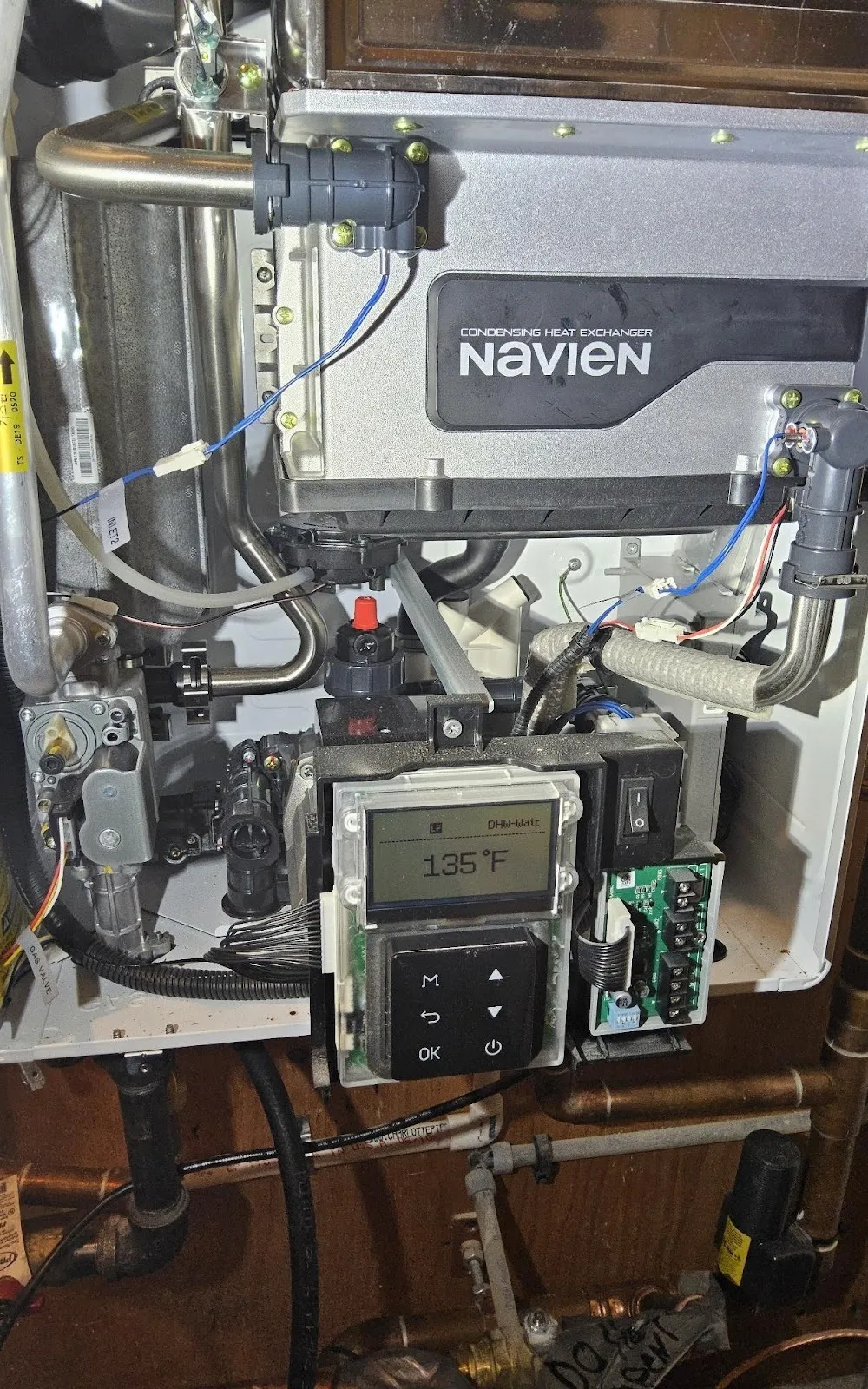
A modern boiler that can't light, loses its flame or senses a fault may shut down and stay off until someone resets it. That's a lockout. The display may show a code, the burner won't fire and the house starts to cool.
How do you turn on a boiler after a lockout?
Start with the owner's manual for your exact model, not a video about a different boiler. Some manuals describe a step the owner may take after a lockout; others leave it to a qualified technician. Do only what your model's manual permits. If it gives no owner step, or the lockout comes back, stop and call for service. Repeated resets can hide the reason the boiler shut down. Write down the code, the model and what the boiler was doing before it stopped. A code tells a technician where to start, not which part failed.
Leave the boiler alone if you smell gas, hear a carbon monoxide alarm, see scorching or soot, or find water leaking from it. For a gas smell or a CO alarm, leave the house and call 911 from outside. Once the fire department or gas utility says it's safe, we can diagnose and repair the boiler.
What a service visit should catch
Jeneral Plumbing is owner-operated by a Licensed Master Plumber (MA #9628831-PL-M), factory trained by Navien and NSS certified. On a combi boiler like the one in this story, we check the cold fill pressure against the manual, the swing through a full heating cycle, the expansion tank's air charge, the relief and fill valves, the condensate trap and neutralizer, and any error history the boiler stores. The point is to find the next failure while it's still a small repair.
We're based in Westford, MA, and work in homes across our Middlesex County service area. If your gauge swings, your relief valve drips, your boiler locks out or your water heater shows the signs above, we can take a look. Call (978) 392-7789 to schedule. A regular-hours visit carries an $80 dispatch fee — the cost of the visit, waived when you hire us for the work. If you're planning how heating, hot water and water protection fit together, our home comfort systems planning guide explains how we approach it.
Written by Jeneral Plumbing.
This article was drafted with AI writing tools and edited before publication. AI tools did not inspect any job or validate technical conclusions.
Last updated .