Boiler Repair and Maintenance in Andover, MA: Keeping Your Home Warm All Winter

Boiler Repair and Maintenance in Andover, MA: Keeping Your Home Warm All Winter

Jeneral Plumbing

Heating

When a boiler quits on a January night in Andover, the questions get practical fast — what failed, what it costs to fix, and whether the fix is worth making on equipment this age. This guide to boiler repair and maintenance in Andover, MA covers the three boiler families found in local homes, the warning signs worth acting on and why they happen, what an annual maintenance visit covers step by step, and how a repair-or-replace conversation should go. Jeneral Plumbing wrote it as an educational resource, not a diagnosis.

One thing named plainly up front: Jeneral Plumbing is based in Westford, MA, and our 23-town core service area covers Middlesex & Essex County communities including Westford, Chelmsford, Tewksbury, Billerica, and Wilmington. Andover sits in Essex County beyond that core, and we take Andover boiler work case by case — availability is confirmed by phone before anything is scheduled. We would rather name that boundary here than have you discover it after reading two thousand words.

Steam, Hot Water, or Condensing: Know Which Boiler You Own

Boiler advice only helps when it matches the equipment in your basement, and Andover’s housing spans three distinct boiler families. Per census-era housing data, roughly 22% of Andover homes were built before 1939, and a share of those older properties still heat with steam — alongside decades of hot-water systems and a growing number of condensing units. Here is how to tell them apart and what each one asks of its owner.

Steam Boilers in Andover’s Older Homes

A steam boiler boils water and lets the steam rise through large piping to cast-iron radiators, where it condenses and drains back by gravity. There is no circulator pump doing the work — pipe pitch, radiator vents, and water level run the system, which is why steam misbehaves in its own vocabulary: hissing vents, water hammer, a sight glass reading too high or too low. Steam boilers also need closer attention to water condition than sealed hot-water systems, because fresh water enters the boiler regularly and brings oxygen and minerals with it. If your radiators are heavy cast iron and your boiler has a sight glass, you are likely living with steam, and equipment fit for service is confirmed by phone.

Hot-Water (Hydronic) Boilers

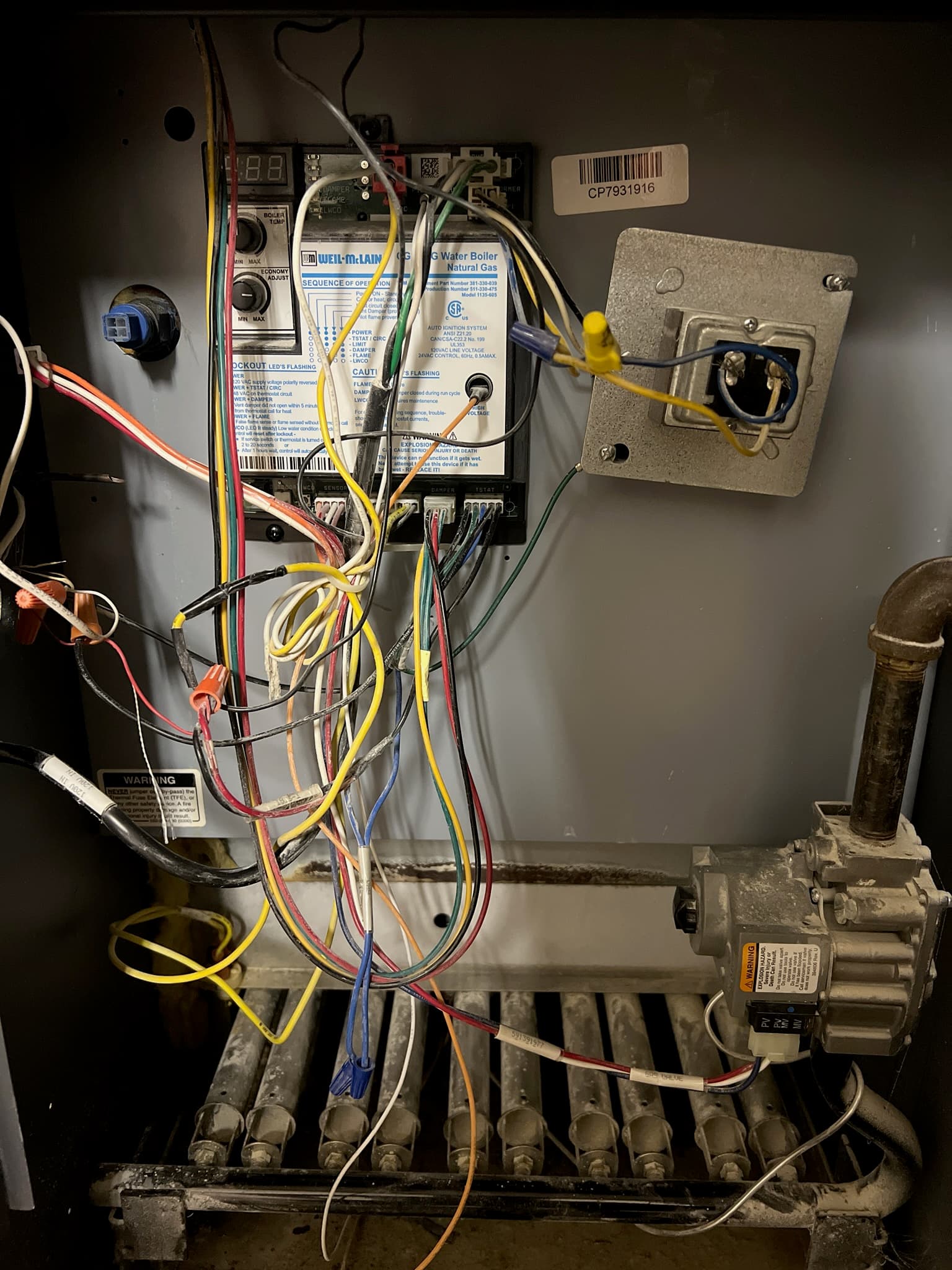
Hot-water boilers — hydronic systems, in trade terms — heat water without boiling it and pump it through a closed loop of baseboards, radiators, or radiant floor tubing. Many mid-century and newer Andover homes heat this way. Because the loop is sealed and pressurized, the supporting cast matters: an expansion tank absorbs the pressure swing as water heats, zone valves or zone circulators decide which rooms get heat, and a fill valve maintains system pressure. When something goes wrong, the fault sits on one of four paths — heat production, circulation, distribution, or control — and finding which one is the whole diagnostic job.

High-Efficiency Condensing Boilers

A condensing boiler earns its higher rated efficiency by pulling extra heat out of the flue gases — enough that water vapor in the exhaust condenses inside the appliance. It can only do that when the system returns water cool enough to allow condensing, which is why the same boiler can perform differently in two different homes. Condensing equipment vents through plastic piping and drains acidic condensate that must stay flowing, and in a Massachusetts cold snap a freeze-prone condensate run can shut the boiler down protectively. Our page on condensing-boiler compatibility, controls, and commissioning explains what has to be checked before efficiency numbers mean anything.

Boiler Repair and Maintenance: Warning Signs Worth Acting On

Most boiler failures announce themselves before the cold morning. These are the signs we take seriously, with the reason behind each one — because a symptom you understand is a symptom you report accurately.

  • Banging or hammering. In steam systems this is usually water hammer — condensate pooling in a sagging pipe until fast-moving steam slams into it. In hot-water systems, banging can point to trapped air or to kettling, where mineral scale makes water boil against the heat exchanger. Both have causes worth finding, not background noise worth ignoring.
  • Pressure that keeps dropping. A hydronic loop holds a set pressure; a falling gauge means water is leaving somewhere — a weeping relief valve, a failing expansion tank, or a concealed leak. Refilling restores heat for a while, but it hides the loss and feeds fresh oxygen to iron components.
  • One cold radiator — or several. One cold emitter points local: a stuck valve, trapped air, a clogged steam vent. Several cold rooms move the suspicion toward circulation, zone controls, or pressure. Which rooms are cold is diagnostic information; note it before calling.
  • Short cycling. A boiler that fires, quits, and refires in quick rhythm may be responding to a control fault, a circulation problem, or a safety condition. Repeated resets can erase the fault history a diagnosis needs, so record the code and resist the reset button.
  • Water at the base of the boiler. The source may be a valve, pump flange, relief discharge, or an internal component — and those carry different repair conversations. Keep clear of hot surfaces and note where the water appears.
  • Fuel use rising without a weather excuse. Efficiency losses from scale, combustion drift, or failing controls tend to show up on the bill before they show up as a breakdown.

What we evaluate on site — and how a written scope separates the finding from the guesswork — is laid out on our boiler diagnosis and repair page. One rule outranks every symptom above: if you smell gas, leave the building without touching switches or gas controls, call 911 from outside, and request plumbing service only after emergency responders clear the property.

An Annual Maintenance Visit, Step by Step

“Annual service” means little until someone tells you what happens during the hour. The checklist flexes by model, fuel, and history — a steam boiler and a wall-hung condensing unit do not get the same visit — but an honest maintenance call on a typical hot-water boiler follows this arc:

  • History first. Fault codes, service records, and your own observations — which rooms lag, what noises appeared, what changed since last season.
  • Visual inspection. Active seepage, corrosion, staining under connections, and the condition of visible piping and wiring.
  • Combustion check. Verified with an analyzer where the equipment calls for it, not judged by flame color.
  • Controls and safeties. Operating controls, high limits, and safety devices observed doing their jobs.
  • Circulation and zones. Each thermostat’s call for heat traced to actual water movement in its zone.
  • Pressure and expansion. System pressure checked against spec, and expansion-tank behavior watched as the water heats.
  • Venting and condensate. Flue condition, and on condensing equipment a clear condensate path — the shutdown cause winter finds first.
  • The paperwork. Findings documented in writing, including anything worth monitoring before it becomes a repair.

Here is the honest part: maintenance cannot prevent every failure, and nobody who services boilers should promise otherwise. What a documented annual visit can do is catch visible conditions early, keep written warranty requirements satisfied, and build the equipment record that makes a future no-heat call faster to diagnose. That is worth the appointment — as risk reduction, not as a guarantee.

Repair or Replace? The 15-to-20-Year Question

Somewhere between 15 and 20 years old, most boilers enter the window where every repair invites a bigger question. Age alone never settles it. A 20-year-old cast-iron boiler with a sound heat exchanger and available parts can be worth repairing; a much younger unit with a deteriorating exchanger may not be. Parts wear out on boilers that still have years of service in them.

A repair tends to fit when the failure is isolated — a control, sensor, circulator, valve, or accessible pipe — the needed parts are available, and the rest of the system supports the work. Replacement deserves discussion when there is a safety concern, a non-serviceable major component, repeated failures, parts that can no longer be sourced, or a boiler that no longer matches the system it serves.

Two disciplines keep that conversation honest. First, restoring heat now stays separate from any equipment decision — nobody chooses a boiler well while the house is cold. Second, replacement pricing follows an on-site assessment, because venting, fuel, water conditions, and the connected system change the scope from one basement to the next. What a written installation scope should include is covered on our boiler replacement planning page.

Factory Training, Stated Precisely

Jeneral Plumbing is owner-operated by a Licensed Master Plumber (MA #9628831-PL-M) with 20+ years in the trade, including seven with a gas utility. We are factory trained by Navien, Lochinvar, Rinnai, Weil-McLain, and Noritz — the manufacturers taught us their fault-code logic, combustion settings, and commissioning procedures — and Navien Service Specialist (NSS) certified, which is Navien’s recognition of that training on its boilers specifically. Viessmann is a heating partner brand we install and service; we state that at partner level because credential words mean specific things, and we use them the way the manufacturers do.

Boiler Help for Andover, from Our Westford Home Base

Jeneral Plumbing serves 23 towns across Middlesex & Essex County from our base in Westford, MA — Westford first, then neighbors like Chelmsford, Tewksbury, Billerica, and Wilmington on Andover’s doorstep. The full service-area list shows every core town. Andover itself sits beyond that core in Essex County, and we handle Andover boiler calls case by case: describe the boiler, the fuel, any fault code, and which rooms are affected, and we will confirm by phone whether the visit fits our schedule and scope. The rest of our heating work — from no-heat diagnosis to hydronic zoning — is described on our boiler-first heating services page.

Call (978) 392-7789 to talk it through. For regular-hours visits, we charge an $80 dispatch fee — the cost of the visit, waived when you hire us for the work. Off-hours, holiday, and Sunday dispatch has a $599 emergency callout fee — non-refundable, non-negotiable, collected prior to dispatch, covers the dispatch only and is never applied to repair work.

Frequently Asked Questions

How often should a boiler be serviced in Massachusetts?

Annual service is the common rhythm for Massachusetts boilers, but the governing schedule is the one in your manufacturer’s instructions and warranty paperwork — some warranties require documented maintenance to stay valid. Condensing boilers generally justify a yearly visit because combustion setup and condensate handling matter more on that equipment. Steam systems reward in-season attention too, since water level and vent condition change as the system runs. Scheduling before the heating season leaves time to address findings before sustained cold arrives.

Why is my boiler making a banging noise?

In a steam system, banging is usually water hammer: condensate pools in a pipe that has lost its pitch, and steam moving at speed slams into the standing water. In a hot-water system, the suspects shift to trapped air or kettling, where mineral scale on the heat exchanger makes water flash-boil against the metal. The noises sound similar from the kitchen but point to different causes and different fixes. Note when it happens — on startup, mid-cycle, or shutdown — because timing narrows the diagnosis before anyone opens a panel.

How long do boilers last?

Service life varies too much for one honest number: cast-iron boilers can run for decades, wall-hung condensing equipment typically carries a shorter design life, and water quality, installation quality, and maintenance history move every estimate up or down. Most boilers enter a repair-or-replace window somewhere between 15 and 20 years, which is a reason for attention rather than a replacement deadline. Two boilers installed the same year can support opposite decisions. Condition, documented on site, beats the calendar every time.

Why are my radiators slow to heat up?

In hot-water systems, slow radiators usually trace to trapped air, a tired circulator, a sticking zone valve, or low system pressure — each interrupts flow in its own way. In steam systems, the common cause is clogged air vents: if air cannot leave the radiator, steam cannot enter it. Whether one radiator lags or several lag together matters, because a single cold emitter points local while a pattern points to circulation or controls. Gather those observations before the service call; they shorten it.

Is it worth repairing a 20-year-old boiler?

Sometimes, yes — age alone does not answer the question. A 20-year-old boiler with a sound heat exchanger, available parts, and an isolated failure can be a reasonable repair; the conversation changes when the exchanger is deteriorating, parts have become unavailable, or failures repeat. Ask for written findings that separate restoring heat now from any replacement decision, so you are never choosing equipment under no-heat pressure. Jeneral Plumbing quotes replacement only after an on-site assessment defines the scope.

Does Jeneral Plumbing offer boiler repair in Andover, MA?

Yes, on a case-by-case basis: Andover sits in Essex County beyond our 23-town core service area, so we confirm availability by phone before scheduling any Andover visit. We are based in nearby Westford, MA, and our core coverage includes Andover’s neighbors Tewksbury and Wilmington. Call (978) 392-7789 with your boiler type, fuel, and symptoms, and we will tell you straight whether the visit fits our schedule — and point you in the right direction if it does not. Regular-hours visits carry an $80 dispatch fee — the cost of the visit, waived when you hire us for the work.

Written by Jeneral Plumbing.

Last updated .

Related Topics:boiler repair Andover MAboiler maintenance Andoversteam boiler repairhydronic boiler serviceboiler replacement Andoverheating system repair Massachusettsannual boiler maintenanceemergency boiler repairhigh-efficiency boiler upgradeJeneral Plumbing Andover

Jeneral Plumbing is owner-operated by a Licensed Master Plumber (MA #9628831-PL-M) serving Westford and 23 towns across Middlesex & Essex County. Call (978) 392-7789 to schedule.

Dealing with this in your home? We can help.