

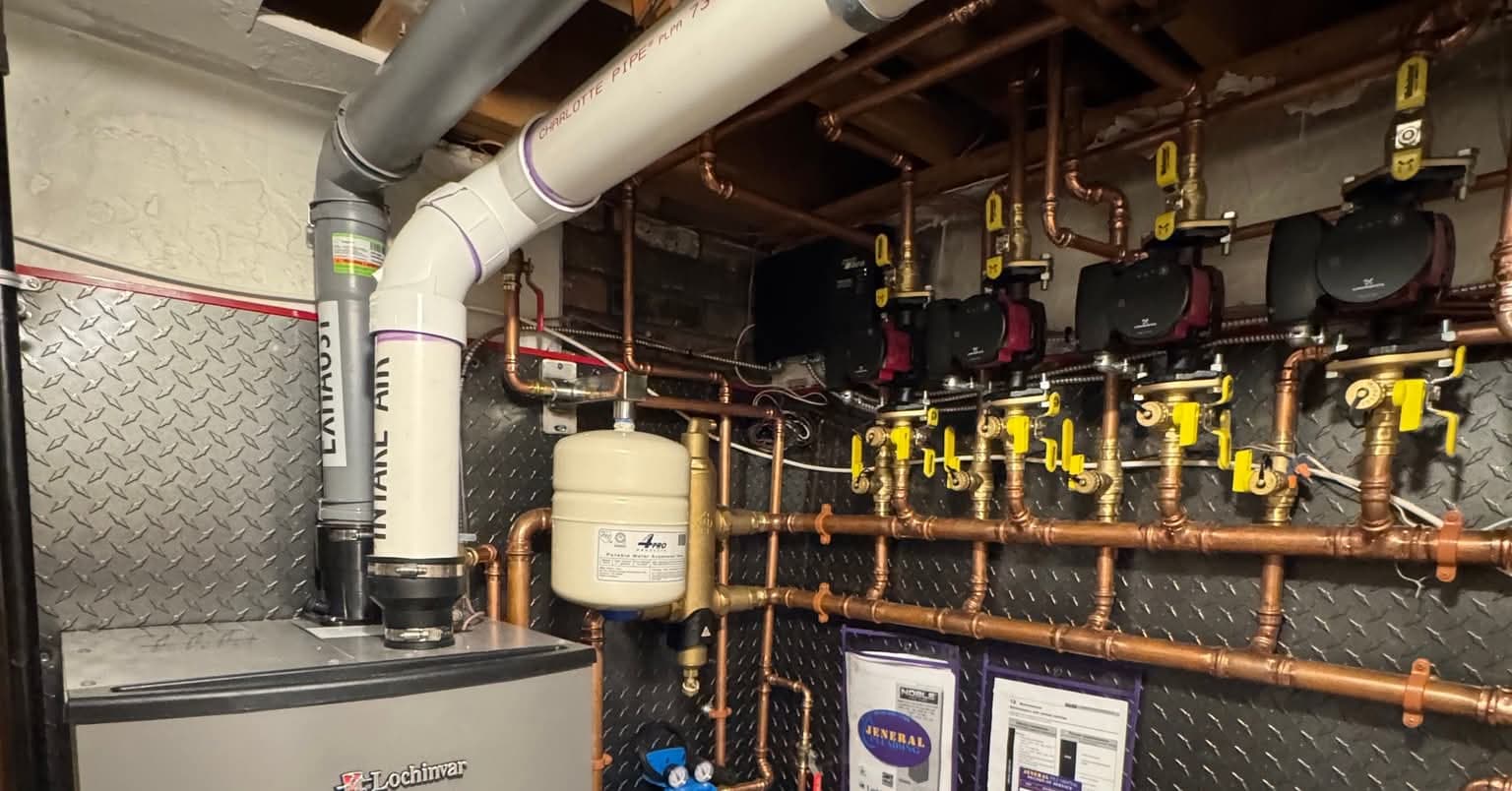
Boiler installation within 20 miles of Westford
Boiler Installation & Replacement in Westford, MA
When an old boiler fails or keeps breaking down, its replacement has to fit the heating system already in your home. Jeneral Plumbing installs and replaces residential steam and hydronic hot-water boilers for homes within 20 miles of Westford, MA. We size the new boiler, check the piping, fuel, venting, and controls it connects to, and give you a written scope to approve before work begins.
Clear scope before work begins
A Service Visit Built Around Your Home
Start with the building
We look at the house first: how much heat it needs, how that heat reaches each room, and which rooms are hard to keep warm.
Plan connected work
Next, we review what the boiler connects to: fuel supply, venting, combustion air, controls, electrical, and the steam or hot-water piping.
Approve a written scope
We recommend equipment after seeing the system, then list what’s included, what isn’t, and any known conditions, so you approve the plan before installation starts.
Design before equipment selection
Residential Boiler Installation Starts with the Whole System
The boiler is only one piece of your heating system. Before recommending equipment, we trace how heat moves through the house — steam or hot water, through radiators, baseboard, or radiant zones — and what else the boiler depends on: piping, controls, fuel supply, venting, electrical service, and any domestic hot water it supplies.
For homes in Westford, MA, and nearby towns, we do this in person and write down the comfort and reliability problems you want solved. The old boiler’s size and piping layout are checked, not copied — copying them can carry an old mistake into a new installation.
- How much heat the house needs (or, for steam, how much radiation is connected), plus rooms that are hard to heat
- Existing radiators, baseboard, radiant zones, and steam or hot-water piping
- Fuel supply, venting, combustion air, and condensate needs
- Controls, circulators, zoning, and accessible electrical conditions
- Domestic hot-water connection, if the boiler also heats your tap water
- How equipment gets in and out, plus permits and inspection
Size the replacement for the system it serves
Steam Boiler Installation and Replacement in Westford
Jeneral Plumbing installs and replaces residential steam boilers on one-pipe and two-pipe systems. We check the radiators and steam piping the boiler will serve, then spell out the equipment and any radiator or piping corrections the project needs.
Sizing works differently for each type. A steam boiler is sized to the radiators it has to fill, measured as equivalent direct radiation (EDR). A hot-water boiler is sized to how much heat the building loses. Either way, copying the old boiler’s rating can miss what the home needs.
We also check the near-boiler piping, the return lines, and the water-level controls against the new model’s installation instructions. Keeping your radiators on steam and converting to hot-water heat are weighed as separate options — a condensing hot-water boiler is not a drop-in replacement for a steam boiler.
Sources: Weil-McLain replacement guide: hot-water and steam sizing
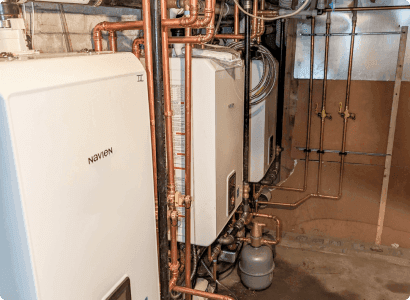
Two different heat-distribution systems
Boiler vs. Furnace: Match the Equipment to the Home
A boiler heats water or makes steam and sends it through pipes. Hot water can feed baseboard, radiators, or radiant floors; steam goes to radiators. A furnace heats air and blows it through ducts. They are different systems, not two versions of the same one.
If your home already heats with steam or hot water, a boiler replacement starts with understanding the radiators, baseboard, or radiant floors you have. Switching to a different type of heat can involve piping or ductwork, controls, electrical, fuel, venting, the space the equipment needs, and the finished walls and floors around it — so that choice needs a plan for your specific house.
Sources: U.S. Department of Energy guide to home heating systems
Condition matters more than age alone
How Long Does a Boiler Last?
There’s no honest single number. How long a boiler lasts depends on how it was built, the fuel it burns, how often it cycles, the venting, past repairs, parts availability, and two things you can influence: maintenance and water quality.
Water quality matters because fresh water brings in oxygen and minerals that corrode and scale a heat exchanger, and many condensing-boiler manuals set water-quality limits for the heating loop. System type changes the pattern. A steam boiler takes on fresh water whenever steam escapes through leaks or failing air vents, while a sealed hot-water system should need very little once it’s filled. Annual maintenance can uncover leaks, condensate blockages or pressure problems that need attention. Two boilers installed the same year can still call for different decisions.
Signs you may need a new boiler: a major failure that can’t be repaired, a safety concern that can’t be resolved, breakdowns that keep coming back, extensive leaks or corrosion, critical parts you can no longer get, or a boiler that no longer suits the system it serves. Uneven heat, noise, rising fuel use, or frequent resets are worth diagnosing — but none of them alone proves you need a replacement.
We keep the urgent repair separate from the long-term replacement question. If a repair still makes sense, we’ll tell you. If replacement is worth considering, the written assessment explains what’s driving that recommendation.
The system decides what fits
Cast-Iron, Gas, Combi, and High-Efficiency Equipment Planning
A cast-iron boiler and a wall-mounted condensing boiler differ in venting, water volume, operating temperatures, and how they work with the rest of the heating system. Material and efficiency rating alone don’t decide the right replacement — that comes from reviewing your chimney, piping, radiation, controls, and the temperatures your system runs at.
If you smell gas, leave the building and call 911 from outside; contact a plumber only after the fire department or gas utility clears the property. A planned gas boiler replacement in Massachusetts includes a check of gas capacity, approved venting, combustion air and electrical needs. Condensing models also need condensate drainage. A combi boiler has to keep up with household hot water as well as space heat; neither is a direct replacement for steam equipment. We do not offer New Hampshire fuel-gas work.
Non-condensing vs. condensing boilers for radiators that need hot water
Radiators and baseboard sized for an older boiler may need hot water on the coldest days. A condensing boiler earns its extra efficiency only when the water coming back to it is cool enough for the flue gases to condense, so a system that runs hot most of the winter narrows the gap, and a well-matched non-condensing boiler can be the better fit. Outdoor reset, which lowers the water temperature on milder days, can keep a condensing boiler in its efficient range for much of the season, even on older radiators. We base the recommendation on your home’s heat loss, the radiation installed, and the temperatures the system actually needs.
Equipment follows the measured application
Boiler Brands We Install and Why
Jeneral Plumbing installs heating equipment from Navien, Viessmann, Weil-McLain, Lochinvar, and Rinnai. The model has to fit your application, fuel, venting, controls, and the space needed to service it. Your system type narrows the list further, since not every one of these brands makes both steam and hot-water boilers.
We are Navien Service Specialist (NSS) certified and factory trained by Navien, Lochinvar, Rinnai, and Weil-McLain; Viessmann is a heating partner at the brand level. That familiarity helps with planning and startup, but the line and model for your home come from what we find there.
- Navien — NSS certified and factory trained
- Weil-McLain, Lochinvar, and Rinnai — factory trained
- Viessmann — heating partner at the brand level
The boiler is only one part of a fuel change
Converting from Oil or Propane
Homes in Westford, Chelmsford, and Lowell may still heat with oil or propane, but a home’s age or location alone doesn’t show whether switching to gas is practical. We handle gas conversions in Massachusetts only, and an oil-to-gas or propane-to-gas plan starts by confirming gas is available with enough capacity. Then we review sizing, boiler location, approved venting, combustion air, electrical needs, controls, and the steam or hot-water system you already have.
New or extended gas piping is sized and routed once we know every appliance it will feed, and it goes into the written scope. Our gas line installation service covers that part of the project. Oil-tank pumping, removal, and environmental work are referred to the appropriate tank contractor, while boiler removal, venting changes, permits, and startup stay within the approved plumbing and heating scope.
If natural gas isn’t available on your street, a propane vs oil boiler comparison starts with fuel storage and approved venting. Staying with oil keeps the tank, usually the chimney, and an oil burner in the plan, and any tank work stays with a tank contractor. Propane needs a tank arranged through a propane supplier, fuel-gas piping, and venting approved for the new boiler, and many wall-hung condensing and combi models can be set up for propane following the manufacturer’s conversion instructions. We install propane and natural-gas piping in Massachusetts only.
No useful price without a defined scope
How Much Does a Boiler Cost to Replace?
Boiler replacement cost depends on more than the boiler. The biggest drivers are the size the house needs (heat loss for hot water, connected radiation for steam), the radiators, baseboard, or radiant zones the boiler serves and any corrections they need, venting or chimney work, the fuel and gas-piping work, and removing the old boiler. Combustion air, condensate drainage, controls, electrical work, hot-water connections, access, permits, and inspections add to that list.
That’s why we see the system in person before quoting. You get a written flat-rate price, and the scope spells out what’s included, any known conditions, and anything still to be confirmed.
We install boilers for homeowners in Westford, Chelmsford, Acton, Littleton, Groton, Carlisle, and nearby Middlesex & Worcester County communities, and each steam or hot-water project is assessed on that home’s own distribution, fuel, and equipment.
As of August 2026, Mass Save states that broad rebates, incentives, and financing are no longer available for equipment powered by natural gas, oil, or propane. It makes an exception for income-eligible households considering qualifying high-efficiency replacements. Eligibility and program terms change, so confirm the current Mass Save terms before you choose equipment.
| Project condition | Why it affects the scope |
|---|---|
| Sizing and distribution | Hot-water boilers are sized to heat loss and steam boilers to connected radiation, not to an unchecked copy of the old boiler’s rating. |
| Fuel, venting, and combustion air | Available fuel capacity, the approved vent route, and chimney condition can change which boiler fits and what connected work it needs. |
| Piping, pumps, and controls | Existing steam or hot-water parts may be reused, corrected, or rearranged to suit the new boiler. |
| Access, removal, permits, and inspection | How equipment gets in and out, the work area, disposal, local requirements, and inspections all go into the installation plan. |
A documented path from assessment to startup
What the Boiler Installation Process Includes
It starts with the assessment and a written scope you approve. From there, the plan covers each step your job needs: permits, removing the old boiler, setting the new one, piping, fuel, venting, condensate, electrical connections, controls, filling, purging, startup, and inspection.
Boiler installation and maintenance cover different stages. Installation ends with commissioning: we check the new boiler against the manufacturer’s startup instructions and the approved scope, then show you how the controls work and what to watch for day to day. Maintenance comes after, as an annual boiler service visit that follows the upkeep the manufacturer calls for. If we find a separate problem during the job, we document it and explain the next step — we don’t expand the work without your approval.
Plan around condition, weather, and confirmed availability
Timing a Replacement Before Winter
A boiler replacement is often easier to plan before steady cold weather sets in. There’s time to compare equipment, confirm venting and fuel conditions, order approved components, and get permits — without a no-heat failure forcing every decision. Spring and fall scheduling can leave more room to plan, but equipment lead times, permit timing, and project availability vary, and we confirm them for each job.
If your boiler still runs, an early visit can separate what needs attention now from replacement planning that can wait. If it has already failed, we diagnose that problem first and tell you if a safe repair can keep you going while you weigh the bigger decision.
Removal is part of the written project plan
What Happens to the Old Boiler
The scope spells out how the old boiler will be shut off, disconnected, carried out of the house, and sent for lawful disposal or recycling. Tight access, unusually heavy sections, possible asbestos-containing material, oil-tank work, and other specialist conditions are documented before removal, and anything outside the plumbing scope is referred to the right specialist.
Once the new boiler is running, we coordinate the required inspections and permit close-out, go over the controls with you, and leave the work area as agreed. Any inspection or specialist item that’s still open is written down as open, not treated as finished.
Helpful next steps
Plan the Connected Work
Jeneral Plumbing
Local facts, clear expectations
- Jeneral Plumbing is owner-operated by a Licensed Master Plumber (MA #9628831-PL-M), with more than 20 years in the trade, seven years with a gas utility, Navien Service Specialist (NSS) certification, and factory training from Navien, Lochinvar, Rinnai, Weil-McLain, and Noritz.
- 5 Westford Hills Rd, Unit 5119, Westford, MA 01886 · office@jeneral-plumbing.comBased in Westford, we serve homes within 20 miles across Middlesex & Worcester County and southern New Hampshire. We confirm coverage for your address when you schedule.
- Mon–Fri 7:00 AM – 5:00 PM · Sat 8:00 AM – 3:30 PM · Sun Closed · 24/7 emergency — confirmed by phone
- (978) 392-7789For regular-hours visits, the cost is an $80 dispatch fee — the cost of the visit, waived when you hire us for the work. Off-hours, holiday, and Sunday dispatch has a $599 emergency callout fee — non-refundable, non-negotiable, collected prior to dispatch, covers the dispatch only and is never applied to repair work.Personal-loan offers through Hearth may include up to $250,000 with terms up to 12 years, subject to lender approval. Separate credit-card offers may include 0% introductory APR for qualified applicants. Rates, fees, terms, and eligibility depend on the applicant, lender, and offer. Funding timing depends on the lender and completed approval. Confirm it before scheduling work. See financing options and the lender disclosure.Jeneral Plumbing offers separate senior and church community discounts. Eligibility and the discount are confirmed with the approved project scope and price.
Straight answers
Frequently Asked Questions
What affects boiler replacement cost?
Boiler replacement cost depends on the boiler your home needs and everything it connects to: distribution, piping, pumps, controls, fuel capacity, venting or chimney, combustion air, condensate, electrical work, and hot-water connections. Access, removal, permits, and inspection count too. We check those in person and give you a written, flat-rate scope before you approve the work. During regular hours, that assessment visit carries an $80 dispatch fee — the cost of the visit, waived when you hire us for the work.
When should I replace my boiler?
Consider replacement when repairs stop making sense: a safety concern, a major failure that can’t be repaired, repeat breakdowns, critical parts you can no longer get, extensive deterioration, or a poor fit with the system the boiler serves. Age alone doesn’t decide it, and one repair doesn’t mean the boiler is finished. A written assessment lets you compare a repair with replacement planning on the same facts.
Can you replace a steam boiler and keep the existing radiators?
Yes. Jeneral Plumbing plans steam boiler replacements around existing radiators when their condition and the piping support it. We size the new boiler to the connected radiation and check the piping, returns, venting, and controls before choosing equipment. Any radiator or piping correction is listed in the written scope, not assumed to be part of the boiler replacement.
What is involved in a gas boiler replacement?
A planned gas boiler replacement starts with sizing, the steam or hot-water system it serves, and the condition of the old unit. The work can include gas capacity, fuel piping, approved venting, combustion air, electrical connections, controls, condensate and permits. We handle fuel-gas work in Massachusetts only and check the complete installation before recommending equipment.
Do you install Navien/Weil-McLain boilers?
Yes, Jeneral Plumbing installs Navien and Weil-McLain boilers when the model fits your home. We are Navien Service Specialist (NSS) certified and factory trained by both brands. Steam and hot-water systems need equipment made for each, and naming a brand doesn’t mean every model serves both, so we confirm sizing, distribution, fuel, venting, controls, and access before a model goes into your written scope.
Can I switch from oil to gas heat?
In Massachusetts, you may be able to — we don’t offer gas work in New Hampshire. It depends on gas service being available with enough capacity and on the house supporting the new fuel piping, venting, combustion air, electrical work, controls, and boiler. We check those conditions and write up the plumbing and heating scope before equipment is chosen. Oil-tank pumping, removal, and environmental work are referred to the appropriate tank contractor and stay separate from our written scope.
Plan Your Boiler Replacement in Westford
Book a visit to see what your home needs. We’ll look at the boiler and the system it serves, then document the equipment, connected work, and known conditions in a written scope before installation begins.
Serving Homes Within 20 Miles of Westford
See our related local service page for Westford, in Middlesex County:
Boiler Installation & Replacement Across Westford & Middlesex County
Based in Westford, Massachusetts, Jeneral Plumbing serves homes within 20 miles. Our directory lists 26 towns across Middlesex & Worcester County and southern New Hampshire. Find local plumbing help in the towns nearest us:
Plumbing Tips From Our Blog
All ArticlesCondensing vs Non-Condensing Boilers: A Dracut Homeowner’s Guide
Condensing vs non-condensing boilers differ in heat recovery, venting, and system fit. See what matters before choosing one for a Dracut home.
Read Article Gas SystemsOil vs Propane vs Gas Boilers for Lexington Homes
Compare oil vs propane vs gas boilers by fuel access, storage, venting, service, and conversion scope. See how a Lexington case frames the choice.
Read Article Emergency ServicesBoiler Backdrafting: What a Westford Draft Test Revealed
Boiler backdrafting can send combustion gases indoors. This Westford case explains draft testing, chimney work, CO detectors, and steam-boiler safeties.
Read Article