
Tankless Water Heaters · Middlesex County
Tankless vs. Tank Water Heater: Real Costs for Massachusetts Homes
Most pages selling tankless water heaters lead with energy savings. We’re going to lead with the arithmetic instead, because in a Massachusetts home the gas bill is rarely the reason to go tankless — and you deserve to know that before you spend the money. Jeneral Plumbing, owner-operated by a Licensed Master Plumber, installs and services condensing tankless water heaters for Massachusetts homes within 20 miles of Westford, MA.
- Licensed Master Plumber
Clear options. Proper sizing. Professional installation.
Built Around Your Home
Continuous hot water
Instead of emptying a stored tank, a correctly sized whole house tankless water heater heats water as it flows, and keeps going as long as demand stays within its rated capacity.
Compact wall-mounted design
Tankless equipment frees the floor space a large storage tank occupies. It still needs code-compliant service access, venting, piping, and clearance.
Reduced standby loss
The burner fires in response to a hot-water call rather than holding fifty gallons at temperature around the clock.
How does a tankless water heater work?
Opening a hot-water fixture starts flow, lights the gas burner, and sends water through the heat exchanger. Closing the fixture stops flow and shuts the burner down.
With no reservoir to deplete, hot water can continue through long showers or back-to-back use while total flow and temperature rise stay within the model’s capacity.
Continuous hot water does not mean unlimited gallons per minute. Simultaneous showers, dishwasher, sink, and washing-machine demand can exceed output, especially when cold Westford or Groton winter groundwater requires a larger temperature rise.
Still weighing tankless against a tank? Our water heater repair and replacement guide compares all four types with annual operating costs for each.
To see the combustion blower, burner, primary and secondary heat exchangers, and flow sensing on an illustrated unit, open our interactive guide to how tankless and tank water heaters work.
Tankless water heater pros and cons
Continuous production is the benefit you notice first. No waiting for a storage tank to recover after it’s been drained — provided the system is sized correctly and demand stays within capacity. That suits households with sequential showers, heavy daily hot-water use, or anyone tired of managing a finite tank. Stable delivery also depends on minimum activation flow, setpoint, plumbing layout, and fixture mixing.
The compact wall-mounted format recovers utility-room floor space. But the wall still needs a suitable location, structural support, vent clearances, piping, valves, and room to service the unit. Relocating equipment is possible and may add gas, water, vent, drain, and electrical work. A small box does not automatically mean a simple or inexpensive installation.
Energy performance is real but modest, and we’ll put numbers to it below. A condensing tankless water heater captures more heat from combustion and discharges condensate, reaching efficiencies a standard storage tank can’t approach.
- Hot water continues while flow and temperature rise stay within capacity
- Wall mounting recovers floor space in the mechanical room
- On-demand firing eliminates storage standby heat loss
- Electronic controls support diagnostics, scheduling, and selected recirculation strategies
- Higher installed cost, and gas or venting work can raise it further
- Requires periodic descaling, especially on well water
Find out whether tankless fits your home
We compare winter demand, gas capacity, venting, condensate routing, service access, and budget before recommending a system.
Tankless water heater cost to run vs. a standard tank
Here’s the comparison almost nobody publishes. All figures use the DOE test basis — 55 gallons per day at a 67°F rise for a typical family, 84 gallons per day for a heavier household — against a standard-efficiency atmospheric gas tank at 0.61 UEF and a condensing tankless at 0.95 UEF. Gas priced at $2.20–$2.60 per therm, derived from EIA Massachusetts residential data.
| Equipment | Therms/year | Annual cost |
|---|---|---|
| Standard-efficiency gas tank | 184 | $441 |
| Non-condensing tankless | 137 | $328 |
| Condensing tankless | 118 | $283 |
| Equipment | Therms/year | Annual cost |
|---|---|---|
| Standard-efficiency gas tank | 281 | $674 |
| Condensing tankless | 180 | $433 |
Are tankless water heaters worth it on energy alone?
No. Not in most Massachusetts homes, and we’d rather say so now than after you’ve written the check.
Here is our actual installed pricing, so the comparison is honest. The premium for tankless over a storage tank runs from about $2,000 in the best case to $8,000 or more when gas upsizing and a new vent route are involved. Against $158 to $241 a year in fuel savings, that is a payback of roughly eight years at the absolute best — and thirty to fifty in the common cases. Every common-case payback outlives the equipment itself.
Natural gas is inexpensive in Massachusetts relative to electricity, and the efficiency gap between a decent tank and a condensing tankless is real but narrow. The fuel savings alone rarely justify the premium inside a reasonable ownership window.
So why do people buy them? Continuous hot water, reclaimed floor space, and service life. Those are good reasons. “It’ll pay for itself in gas savings” is not one, and any contractor who leads with that is selling you a number they can’t defend.
| Equipment | Installed cost |
|---|---|
| Gas storage tank | $2,900 – $6,500 |
| Condensing tankless | $8,500 – $11,000+ |
| Measure | Gas storage tank | Condensing tankless |
|---|---|---|
| Installed cost | $2,900 – $6,500 | $8,500 – $11,000+ |
| Typical equipment cycle over 20 years | Two tanks; three if each lasts about eight years | One maintained unit commonly reaches the period |
| 20-year total at the fuel assumptions above | $14,600 – $21,800 for two tanks | $14,200 – $16,700 plus descaling visits |
| Upgrade payback from fuel savings | Baseline | At least eight years in the best case; 30–50 years commonly |
Tankless heat exchanger warranty snapshot
Noritz carries an industry-unique 25-year heat exchanger warranty on its residential tankless water heaters. Rinnai and Navien each carry 15-year heat exchanger coverage. Those are the warranty terms used in this comparison; model selection still follows winter output, installation conditions, water chemistry, maintenance access, and current availability.
| Tankless brand | Heat exchanger warranty |
|---|---|
| Noritz | 25 years — industry-unique |
| Rinnai | 15 years |
| Navien | 15 years |
How long do tankless water heaters last?
A storage tank typically lasts 8 to 12 years; a maintained condensing tankless commonly reaches 20 years or more. Over two decades, that can mean roughly two tanks or one tankless.
A tankless heat exchanger is serviceable and, on many models, replaceable. A corroded storage tank requires replacement.
At our installed pricing, one tankless over twenty years costs about the same as two gas tanks before descaling. Actual tank life and the maintenance schedule determine the margin: an eight-year tank life favors tankless, while frequent professional descaling narrows the difference. Water hardness often decides the comparison.
Hard water shortens tank life and drives up tankless descaling frequency at the same time. Water hardness varies considerably from house to house across Westford, Chelmsford, Littleton, Groton, and the surrounding towns — by supply, by season, and by property.
We test rather than assume. In a soft-water home with a long-lived tank, tankless is a comfort and space decision, not a financial one — and we’ll tell you that. In a hard-water home, the tankless case strengthens considerably, and water treatment often deserves to be part of the same conversation. These figures are undiscounted and assume flat fuel prices. They’re directionally sound, not a financial projection.
| Scenario | 20-year total |
|---|---|
| Gas tank, 10-year life (two units at $2,900–$6,500 each) | $14,600 – $21,800 |
| Gas tank, 8-year life (three units) | $17,500 – $28,300 |
| Condensing tankless, one unit ($8,500–$11,000+) | $14,200 – $16,700 + descaling visits |
See whether tankless pays off in your home
We compare installed cost, expected fuel use, maintenance, and household demand using the conditions in your home.
- Tankless and storage options compared
- Financing options available, subject to approval
What size tankless water heater do I need?
Tankless sizing starts with temperature rise: desired outlet temperature minus incoming water temperature. Groundwater entering a home around Westford, Acton, or Tyngsborough during the cold months runs far below the inlet temperatures used in optimistic marketing examples. As temperature rise increases, available gallons per minute fall. We use manufacturer performance data at a realistic New England design temperature, rather than treating nominal maximum flow as guaranteed winter output.
Next we estimate how many fixtures might run at once. Low-flow showers use roughly two gallons per minute each, but real fixtures vary widely. Large rain heads, body sprays, soaking tubs, older faucets, and appliances all add demand. Lifestyle matters too — two simultaneous showers is a different design case than four sequential ones.
The goal isn’t to run every fixture at once. It’s to design around your household’s credible peak without setting expectations the equipment can’t meet. Some larger homes need a high-capacity model, cascaded units, demand management, or a different water-heating strategy altogether.
Recirculation can cut the wait for hot water at distant fixtures, but it has to be designed and controlled carefully. Continuous uncontrolled recirculation wastes heat and fuel, eroding the efficiency you paid for. Built-in pumps, external pumps, dedicated return lines, crossover valves, timers, sensors, and on-demand controls all behave differently.
Gas, venting, condensate, and installation requirements
Whole-home tankless water heaters fire at high maximum input, so the gas system has to be evaluated before anything is ordered. Your existing gas pipe is not automatically adequate just because a storage tank ran on it. Pipe diameter, developed length, fittings, supply pressure, meter and regulator capacity, fuel type, and the input of every connected appliance all matter. A gas-load calculation may show that piping work or utility coordination is required. Correct combustion setup and leak testing are part of commissioning, not optional extras.
Homes in Westford, Chelmsford, Acton, Littleton, and Tyngsborough span different construction periods and renovation histories, so no town name predicts the gas piping or vent route in one house. Some older properties may have a meter, regulator, or branch sized for a storage tank rather than a high-input tankless unit; the load calculation and site measurements decide.
Condensing units use manufacturer-approved vent materials and routes for combustion air and exhaust. Vent diameter, equivalent length, elbows, slope, supports, termination location, and clearances from openings or grade must comply with the unit’s listing and local code. Sidewall venting offers flexibility, but snow accumulation, prevailing weather, property features, and service access all deserve attention in a Massachusetts winter. An existing masonry chimney is generally not reused as though the tankless unit were an atmospheric tank.
Condensing operation produces acidic condensate. The installation needs a properly trapped drain path and, where required, neutralization or a condensate pump. The unit also needs electrical power for controls, ignition, freeze protection, and pumps. During a power outage, a gas tankless water heater will not operate without suitable backup power — worth knowing before storm season. Exterior installation is rarely the right default in this climate. Freeze protection and product location rules have to be taken seriously.
- Calculate total gas load and verify pipe, pressure, meter, and regulator capacity
- Design intake and exhaust from the exact model manual using approved materials
- Provide a reliable condensate drain, with neutralization where required
- Install service valves, isolation points, relief protection, and accessible power
Confirm the gas, vent, and drain plan before equipment is ordered
A site assessment checks gas load, meter and regulator capacity, vent clearances, condensate disposal, power, and service access.
Tankless water heater maintenance, flushing, and repair
A tankless water heater is serviceable equipment, not a maintenance-free appliance. That distinction is the difference between twenty years of service and a premature failure. Minerals accumulate inside the heat exchanger, and the harder your water, the faster it happens. Periodic descaling, inlet filter cleaning, condensate inspection, vent inspection, and combustion checks all belong on the schedule.
How often should a tankless water heater be flushed? Most manufacturers call for annual descaling, though homes with softened or naturally soft water can often move to every two years. Homes on hard well water sometimes need it more often than annually. Follow the instructions for your installed model, and let a water test — not a guess — set the interval.
Symptoms worth diagnosing include fluctuating temperature, reduced flow, ignition failure, repeated error codes, unusual noise, visible leakage, delayed hot water, condensate or exhaust concerns, or a unit that drops out under heavy demand. Common tankless water heater problems trace back to scale, restricted filters, flow sensors, gas supply, venting, combustion components, mixing valves, crossover plumbing, recirculation controls, or issues on the fixture side. An error code is a starting point, not a diagnosis.
Good water quality protects heat transfer. Treatment should follow actual water testing and the equipment’s requirements — a generic sediment filter does nothing about hardness. Service life varies with model, installation, water chemistry, demand, maintenance, environment, and parts availability, which is why we won’t promise one universal number.
For homeowners who want recurring care organized in one place, the Jeneral Plumbing service plans list Tankless Annual Service as an add-on. Plan membership includes a waived dispatch fee as a separate member benefit; the correct flush interval still follows the installed model, water test, and scale found during service.
Tankless unit due for a flush or showing an error?
Call for descaling, filter and condensate checks, temperature or flow problems, ignition failures, leaks, or repeated error codes.
- Flush intervals depend on model guidance and water hardness
- An error code is not a diagnosis
Tankless error codes: what they usually mean
Codes vary by model, software version, and installation, and Navien and Rinnai numbers do not translate one-for-one. Photograph the full display and note what was running when the code appeared. Repeated resets can clear useful history without correcting the condition.
Most codes fall into a few families: ignition or flame proving, combustion air or exhaust, water flow or outlet temperature, condensate drainage, freeze protection, sensor input, or communication between controls. Each family narrows the inspection, but it does not identify a failed part by itself. Gas pressure, scale, filters, venting, wiring, controls, recirculation, and fixture-side mixing can produce similar symptoms.
Our Navien error code 110 case study and Navien error code 515 case study show why the surrounding conditions and service history matter. Start there when you want the full story on a specific code.
| Fault family | What it can indicate | What to do next |
|---|---|---|
| Ignition or flame | Fuel supply, ignition, flame sensing, combustion, or venting condition | Stop repeated resets and have the operating sequence checked |
| Air intake or exhaust | Blocked termination, vent configuration, fan, pressure, or combustion-air condition | Keep the exterior termination clear and schedule diagnosis if the code returns |
| Flow or temperature | Restricted filter, scale, flow sensor, mixing, recirculation, or demand beyond capacity | Record the fixtures running and whether temperature fluctuates |
| Condensate or drain | Blocked trap, pump, neutralizer, drain path, or freeze condition | Check for visible leakage without opening the appliance |
| Sensor or communication | Wiring, connector, control, actuator, or power-quality condition | Preserve the full code and subcode for model-specific testing |
Noritz tankless water heaters
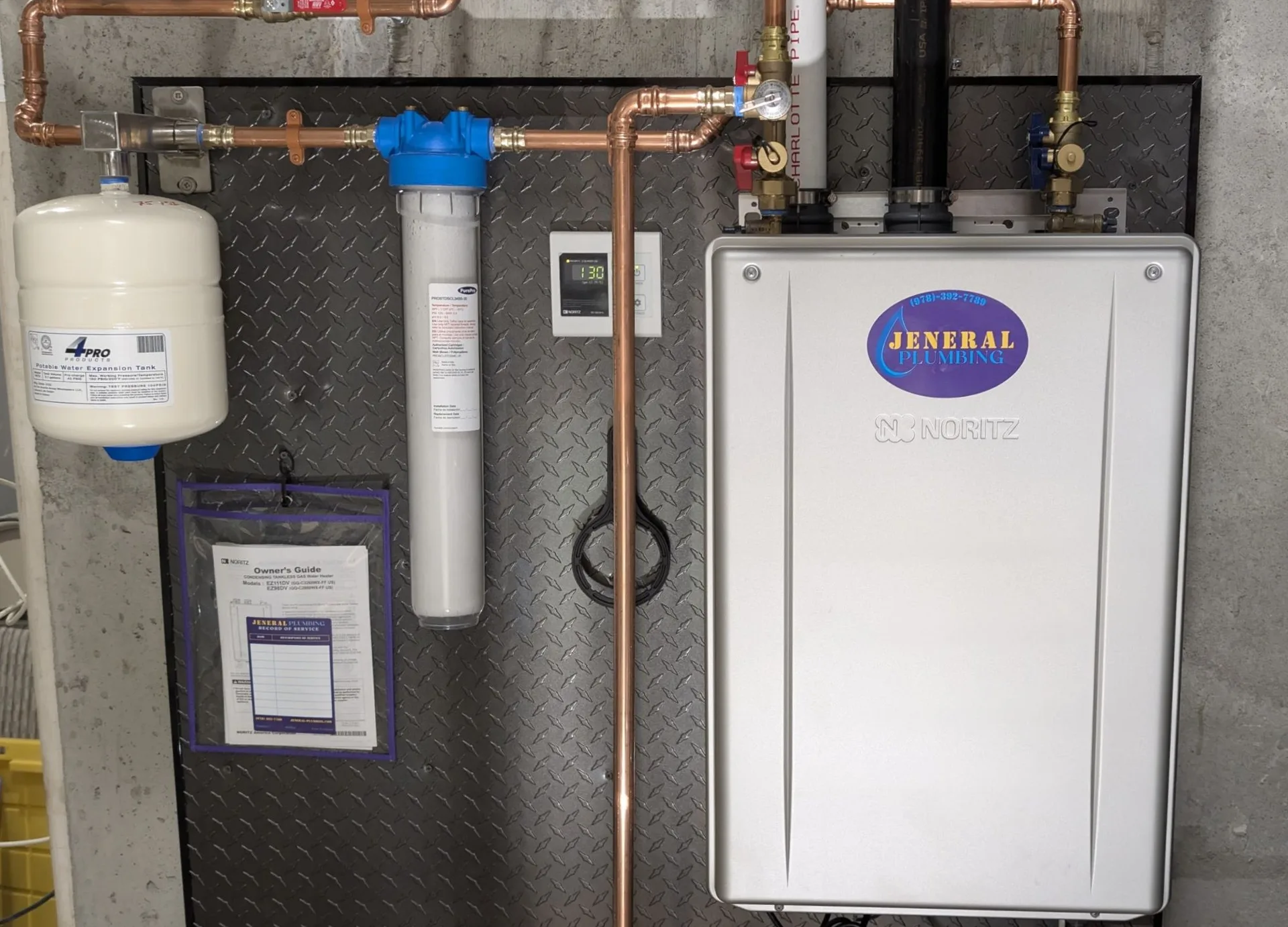
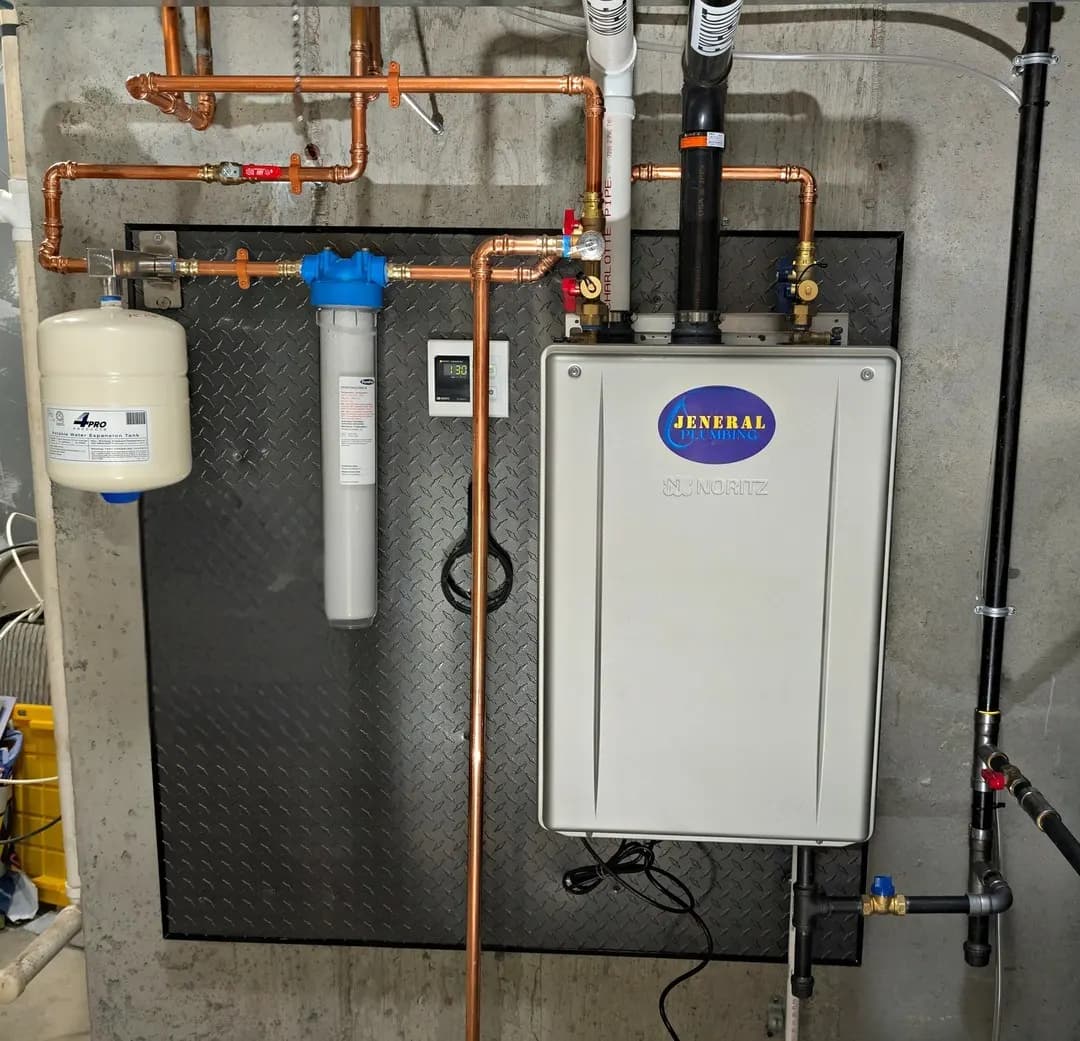
Noritz builds residential tankless systems for a range of replacement and recirculation layouts. The condensing EZ Series uses top-mounted water connections that simplify many storage-tank retrofits, and selected products include integrated recirculation.
Noritz also backs its residential units with a 25-year heat exchanger warranty — the only manufacturer in the tankless industry offering coverage that long. On a component that costs real money to replace, that term is worth weighing in the brand decision.
We still size from winter temperature rise and verify each model’s gas, venting, condensate, controls, water-quality, and service requirements.
Rinnai tankless water heaters
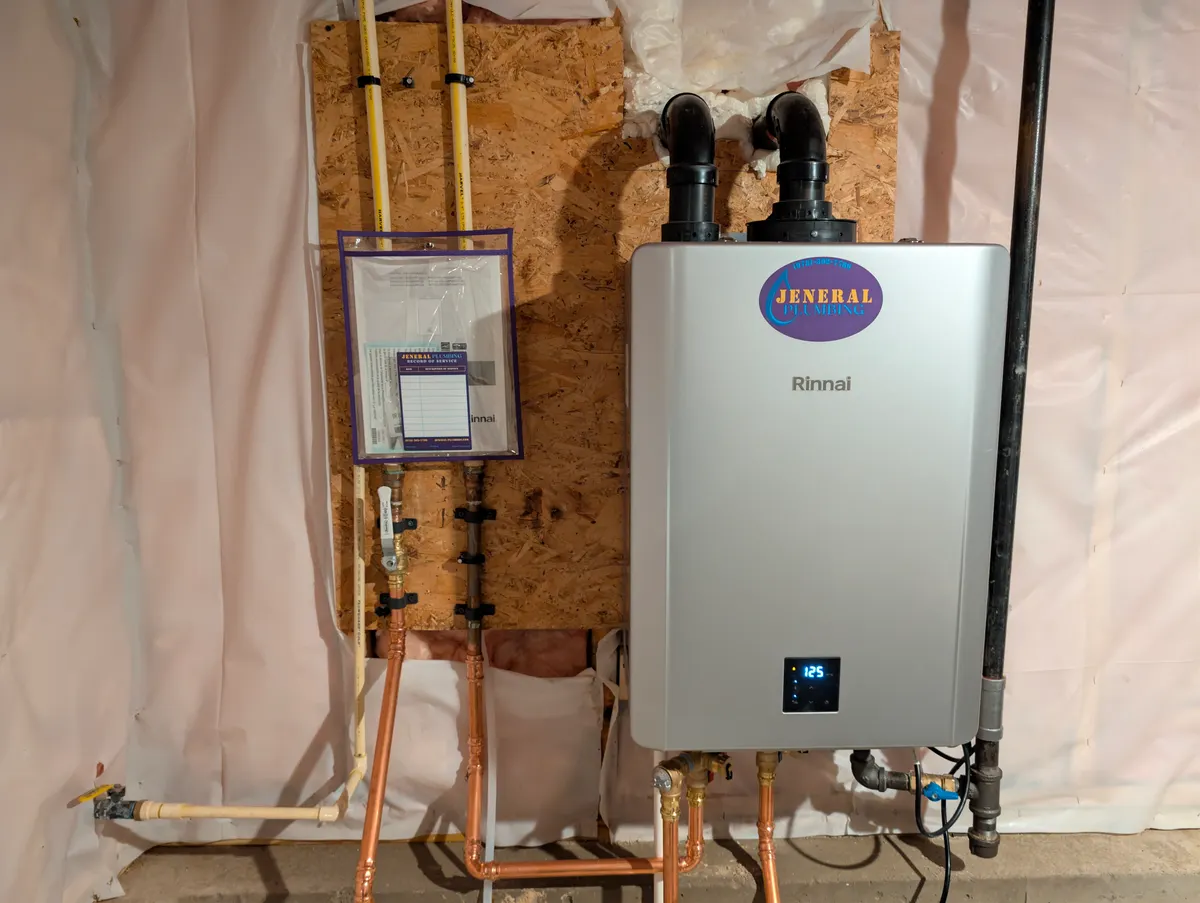
Rinnai’s residential lineup covers both condensing and non-condensing tankless water heaters. Selected models include a recirculation pump with Smart-Circ controls; others use different configurations or accessories. Residential heat exchanger coverage runs 15 years.
We compare winter output, installation location, approved venting, gas capacity, recirculation goals, controls, heat exchanger coverage, and service access before recommending a unit.
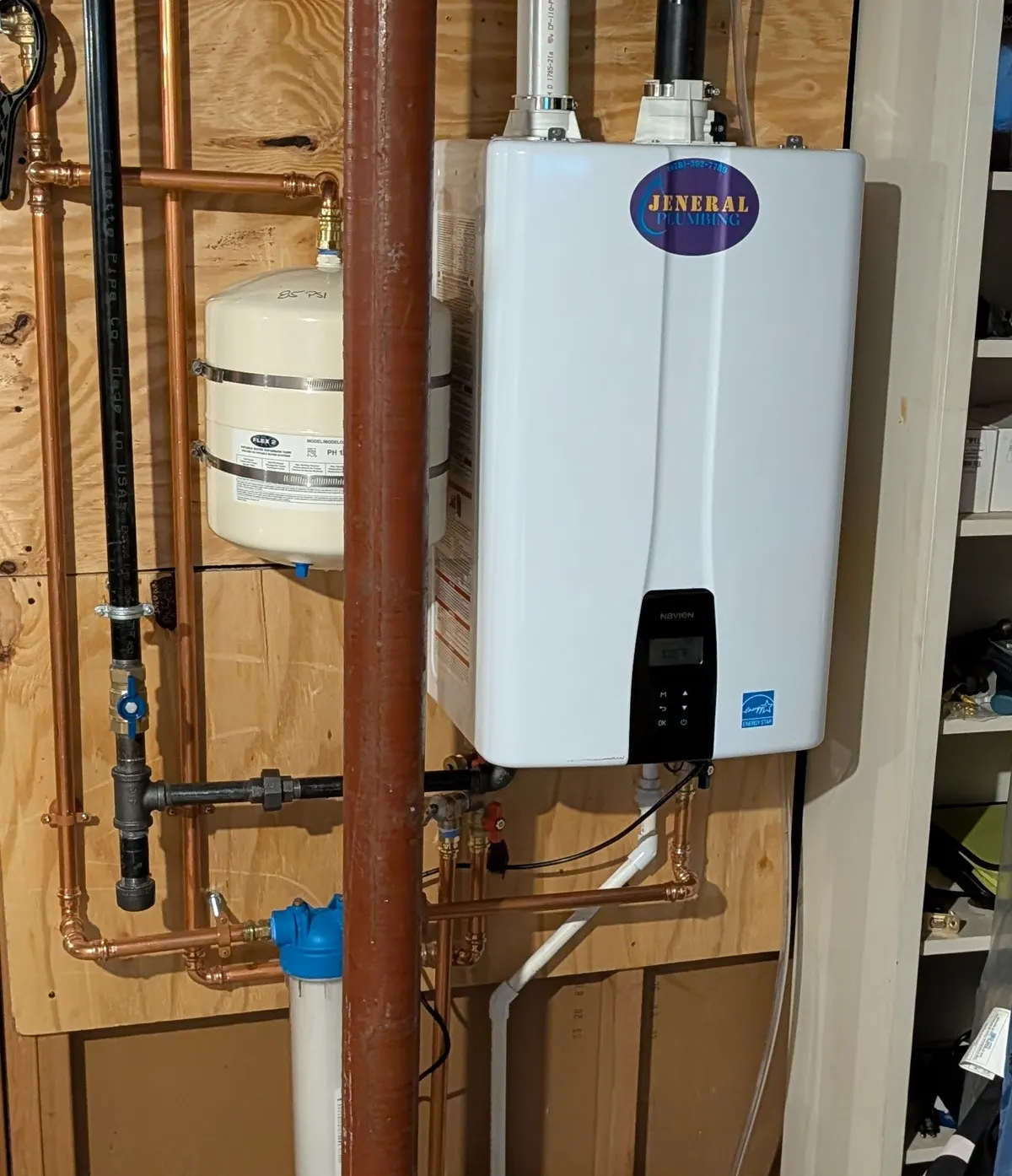
Navien tankless water heaters
Navien offers condensing and non-condensing models. Within the condensing NPE-2 line, selected NPE-A2 units pair an internal recirculation pump with a buffer tank through ComfortFlow; other models differ. Residential heat exchanger coverage runs 15 years.
Selection still comes down to temperature rise, peak flow, fuel supply, venting, condensate, controls, water quality, and accessible maintenance.
Compare Noritz, Rinnai, and Navien for your home
Brand comes after sizing. We compare winter output, installation requirements, recirculation goals, service access, and current model availability.
- Noritz, Rinnai, and Navien options
- Model availability confirmed before recommendation
Talk to a licensed master plumber
Jeneral Plumbing installs, services, and repairs tankless water heaters from its Westford, MA base throughout nearby Middlesex County communities.
Jeneral Plumbing is owner-operated by a Licensed Master Plumber (MA #9628831-PL-M) with more than twenty years in the trade, including seven with a gas utility — Navien Service Specialist certified and factory trained by Navien, Lochinvar, Rinnai, Weil-McLain, and Noritz. If tankless is the wrong call for your house, we’ll say so.
Jeneral Plumbing is family-owned and operated, serving homes within 20 miles of Westford, MA. Upfront pricing, no hidden fees. Licensed, certified, insured.
Call (978) 392-7789 or request an assessment online. Regular-hours visits carry an $80 dispatch fee — the cost of the visit, waived when you hire us for the work. Service Plan members receive a separate waived dispatch fee benefit. Off-hours, holiday, and Sunday dispatch carries a $599 emergency callout fee — non-refundable, non-negotiable, collected prior to dispatch, covers the dispatch only and is never applied to repair work. Emergency availability is 24/7 and confirmed by phone. Lender financing offers may include up to $250,000, terms up to 12 years, 0% introductory APR, and 1–3 day funding after approval, subject to the applicant, lender, and selected offer. Jeneral Plumbing offers separate senior and church community discounts. Eligibility and the discount are confirmed with the approved project scope and price.
Jeneral Plumbing · 5 Westford Hills Rd, Unit 5119, Westford, MA 01886 · (978) 392-7789 · office@jeneral-plumbing.com
Mon–Fri 7:00 AM – 5:00 PM · Sat 8:00 AM – 3:30 PM · Sun Closed · Emergency 24/7 · Family-owned and operated. Serving Middlesex & Worcester County.
Get an honest tankless recommendation
We weigh winter flow, gas and vent conditions, water hardness, maintenance, brand, and budget—and say when a tank is the better fit.
- MA Master Plumber #9628831-PL-M
- More than twenty years in the trade
- BBB Accredited, A+ Rating
Frequently Asked Questions
How much does a tankless water heater cost to install?
At our pricing, a tankless installation runs $8,500 to $11,000+ depending on whether your gas line, venting, and condensate drainage are already adequate. A straightforward swap sits at the low end; gas upsizing and a new vent route push it higher. We quote after assessing the actual conditions, not from a price list.
Is tankless more efficient than a storage tank?
Yes, but less dramatically than most advertising suggests. A condensing tankless uses roughly 118 therms a year for a typical family versus about 184 for a standard-efficiency tank — around $158 in annual savings. Real, but not enough to justify the upgrade on fuel alone.
How often should a tankless water heater be flushed?
Annually for most homes, potentially every two years with soft or softened water, and sometimes more often on hard well water. A water test should set your interval. The equipment instructions and observed scale at service should confirm whether that interval needs to change.
How does tankless compare to the other water heater types?
Can a tankless water heater use my existing gas line?
Sometimes, but never assume it. Tankless units fire at much higher input than storage tanks. We run a gas-load calculation covering pipe diameter, length, pressure, meter and regulator capacity, and every other appliance on the system before committing to a model.
What size tankless water heater do I need?
It comes down to temperature rise and simultaneous demand. Winter groundwater in this area is cold, which reduces available flow. We size from manufacturer performance data at realistic local design conditions rather than nominal maximum output.
Get the right water heater—not a one-size-fits-all answer
Jeneral Plumbing serves Westford and nearby Massachusetts communities with water-heater assessment, installation, replacement, repair, and maintenance. Schedule online or call to discuss your hot-water needs.
Serving Homes Within 20 Miles of Westford
Explore plumbing and water services in nearby Middlesex County communities:
Plumbing Tips From Our Blog
All ArticlesTankless Water Heater Cost in 2026: Westford, MA Guide
Tankless water heater cost in 2026 is $8,500 – $11,000+ installed for a condensing system. See how gas, venting, water, and permit needs affect scope.
Read Article Water HeatingTankless Water Heater Failure: A Low-pH Chelmsford Case
A tankless water heater failure after four years brought a pH 6.3 field result to light in Chelmsford. Compare low-pH corrosion risk with hard-water scale.
Read Article HeatingRinnai Tankless Water Heater Error Codes 14, 15 & 22 in Pepperell, MA
Tankless water heater error codes vary by brand and model. Learn how to document Rinnai codes 14, 15, and 22 before a Pepperell diagnosis.
Read Article