

Tankless water heater failure after only four years should trigger two investigations at once: what happened inside the appliance and what conditions acted on it. In this documented Chelmsford, MA, case, a Navien unit installed in July 2022 was showing recurring, unspecified error codes by 2026. A field screen found pH 6.3 and low alkalinity, making corrosive-water exposure the leading concern even though the sample was not hard.
This case does not prove that one water reading was the sole cause. It does show why tankless water heater failure cannot be diagnosed from an error code, the town name, or visible deposits alone.
Quick Answer: What Led This Tankless Water Heater Failure Investigation?
Quick answer: The Chelmsford field screen recorded pH 6.3, qualitative low alkalinity, and hardness of only 1.2 grains. That pattern made low-buffer, acidic water a more credible corrosion concern than classic hard-water scale. I recommended confirming the chemistry, then sizing an acid-neutralizing system if the results were confirmed and retesting after treatment.
The responsible conclusion is narrower than “acid killed the heater.” A one-time field sample does not establish historical water conditions or prove the exact failure mechanism. Appliance inspection, model-specific testing, water evidence, service history, and manufacturer review all belong in the decision.
Safety Comes Before Diagnosis
An error code is not permission to remove the cover, insert a brush or tool into a vent, adjust a gas control, or keep resetting the appliance. Photograph the complete display, including any subcode, and note which fixtures were operating. If there is no active gas, fire, or carbon-monoxide emergency, stop using the unit and follow only the exact model manual's homeowner-level instructions while arranging licensed diagnosis.
If you smell gas, hear hissing that may indicate a fuel leak, or suspect a leak, get everyone outside immediately. Do not operate switches, phones, appliances, windows, shutoffs, plugs, or flames inside. From outside, call 911 and the gas utility or propane provider, then stay out until officials clear the property.
Carbon monoxide has no smell. If a CO alarm sounds, flame or scorching appears outside the intended combustion area, or anyone may have exposure symptoms, leave and call 911 from outside. A diagnostic visit begins only after any active emergency has been cleared.
How I Approached This Chelmsford Case
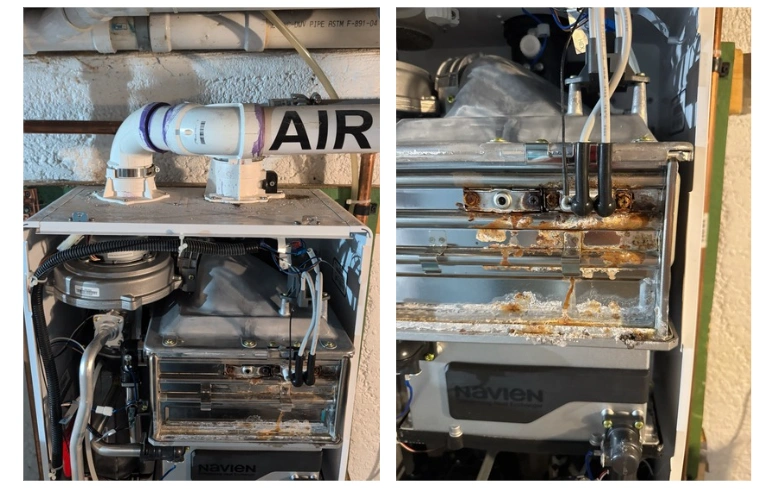
This case began with the homeowner's report of recurring display codes on the Navien and one unspecified internal part replaced about 18 months after the July 2022 installation. I treat those details as reported history, not confirmed facts. The early repair raised a reason to look beyond the current code, but it did not identify the cause.
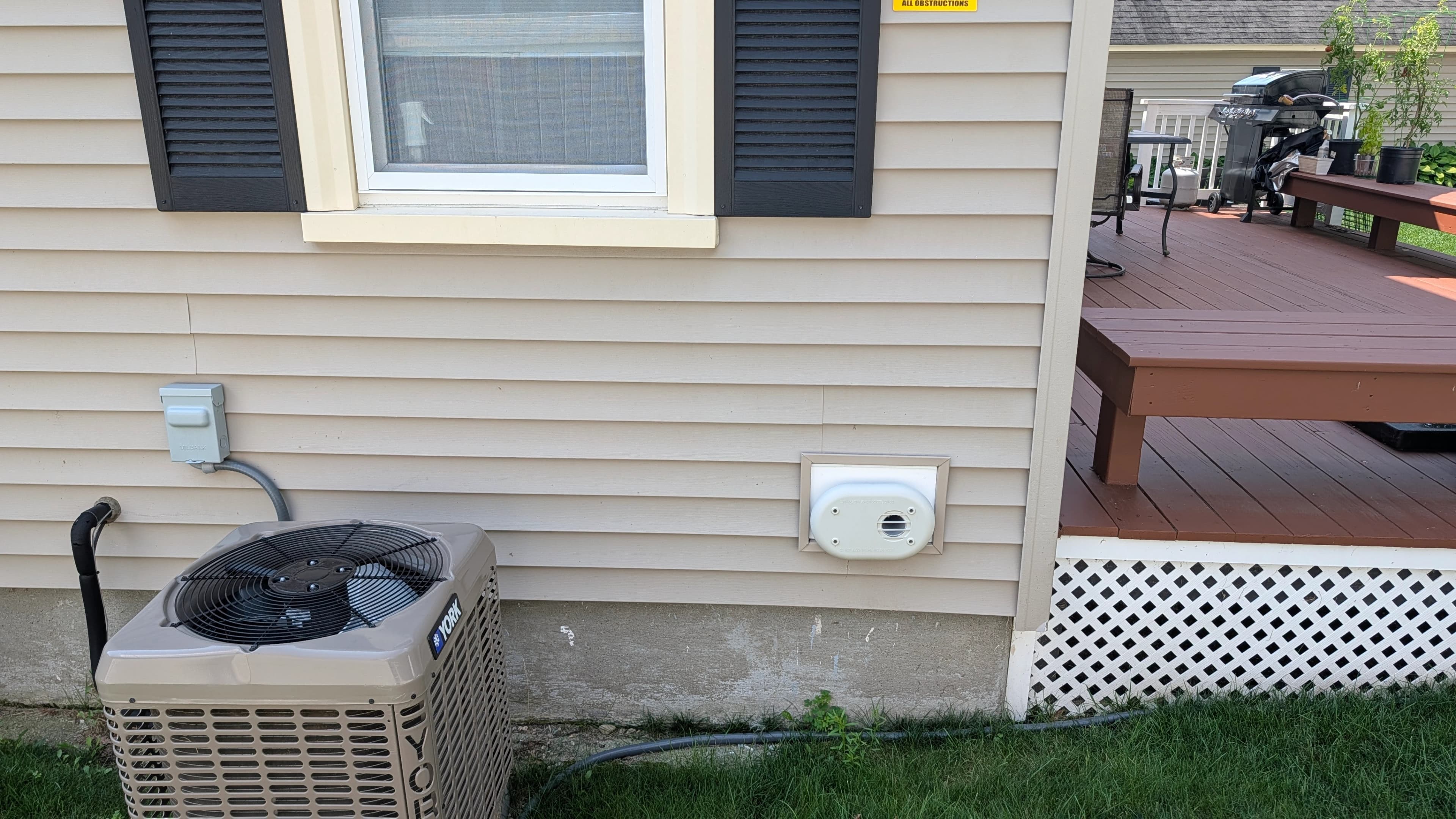
I inspected the accessible intake and exhaust and did not see an obvious obstruction. I also photographed the venting for the equipment record and possible manufacturer review. That visual finding did not rule out a vent configuration, combustion, fan, pressure, condensate, control, or internal condition; those require the exact model instructions and measured testing.
For any tankless water heater failure, the rating plate, full code and subcode, operating history, and exact manual come before a parts diagnosis.
The Field Screen That Changed the Investigation
In this case, I collected a water sample and performed a field screen after no obvious accessible vent obstruction appeared. Field screening can organize the next decision, but it is not certified-laboratory analysis and does not identify every dissolved constituent. The water-testing guide explains when field measurements are useful and when a health, bacteria, PFAS, or other question needs an appropriate certified laboratory.
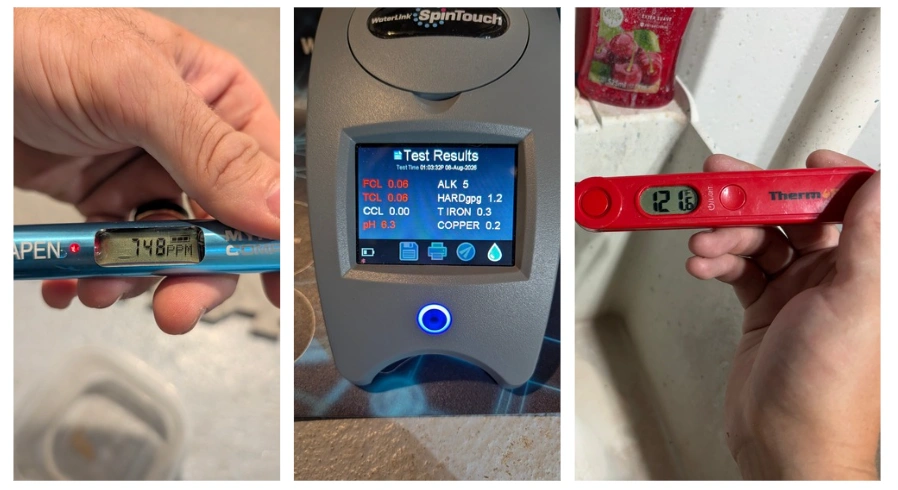
- pH: The recorded field result was 6.3, an acidic reading that belongs beside alkalinity and the plumbing materials when evaluating corrosion potential.
- Alkalinity: The field screen described it only qualitatively, as low. Low alkalinity can mean less buffering against pH change.
- Hardness: The field screen showed 1.2 grains. That did not support hard-water scale as the leading explanation for this sample, although one result cannot reconstruct all past conditions.
- Total dissolved solids: The meter display read 748; without a stated unit and calibration, that number is only a rough screen. A handheld TDS meter estimates aggregate dissolved content from conductivity; the result does not identify the ions, equal hardness, prove corrosivity, or determine warranty eligibility.
- Other readings: Chlorine and iron results were also recorded, but missing method and unit details make them unsuitable as stand-alone treatment or utility-compliance conclusions.
The water district or town name does not replace a sample from the property. Chelmsford has multiple public-water systems, and conditions can also change across premise plumbing, treatment equipment, sampling points, and time. This article applies the evidence from one address without assigning the same chemistry to other Chelmsford homes.
Hard Water vs. Acidic Water
Hardness and acidity answer different questions. Hard water can leave mineral scale that restricts passages or insulates heat-transfer surfaces. Low-pH, low-buffer water may increase corrosion risk for susceptible metal components, but either condition needs measurements and equipment inspection before it is tied to an equipment failure.
| Comparison point | Hard water | Low-pH or acidic water |
|---|---|---|
| Primary evidence | Measured hardness, commonly reported in grains per gallon or mg/L | Measured pH considered with alkalinity and related chemistry |
| Possible equipment effect | Mineral scale may restrict water passages and reduce heat transfer | Corrosive conditions may contribute to pitting, thinning, or leakage in susceptible metals |
| Possible clues | White deposits or changing flow may support inspection but do not diagnose the cause | Blue-green staining or metal deterioration may support inspection but do not prove low pH |
| Chelmsford case evidence | Hardness was recorded as 1.2 grains, so scale was not the leading field finding | pH was 6.3 with qualitative low alkalinity, making corrosion potential the leading concern |
| What the evidence cannot prove | One soft reading cannot establish the home's entire water history or rule out old deposits | One acidic reading cannot prove the failed component or establish a sole cause |
| Test-first response | Set descaling and softening decisions from measured hardness, observed scale, and model guidance | Confirm the chemistry, size neutralization if supported, commission it, and retest before adding another stage |
| How TDS fits | TDS is neither a hardness measurement nor a pH measurement; a handheld meter uses conductivity to estimate total dissolved content without identifying the constituents | |
Hard and acidic water can coexist, and treatment for one condition can change the other. That is why a white deposit is not a complete diagnosis and why a pH number is not an equipment autopsy. The hard-versus-acidic distinction narrows the failure investigation without replacing it.
What a pH of 6.3 Can Mean Inside a Tankless Heat Exchanger
Water below neutral pH can be more corrosive, especially when buffering capacity is low. Corrosion behavior still depends on alkalinity, temperature, dissolved chemistry, flow, stagnation, and the exact wetted materials. Without the exact model and its parts documentation, copper, stainless steel, seals, or another material cannot be assigned to this unit.
A tankless heat exchanger moves water through compact passages while transferring burner heat. If the water is corrosive to a susceptible material, repeated exposure may contribute to pitting, wall loss, leakage, or water damage to nearby components. This is a credible mechanism to investigate, but proving it would take a teardown or metallurgical analysis.
The pH 6.3 result and low-alkalinity description therefore changed the working diagnosis. They made water chemistry a priority alongside the appliance tests instead of treating the failure as a code-only parts problem. They did not make venting, fuel, combustion, condensate, electrical, control, or installation checks optional.
Why TDS Did Not Decide the Cause
The field display of 748 deserved documentation, but TDS is a composite screening value. It does not reveal which ions are present, whether they create hardness, or how the exact combination affects corrosion. A warranty comparison would also need the unit of measure, meter calibration, sample temperature, and the exact model manual.
I would verify the rating plate and the current Navien instructions before applying any manufacturer water-quality limit. A public secondary guideline is not the same as an appliance requirement, a health limit, or an automatic warranty ruling. A warranty claim requires the exact written terms and the manufacturer's determination.
The Resolution: Neutralize, Then Verify the Results
In this case, the pH 6.3 and low-alkalinity field screen led me to recommend confirming the water source and chemistry, then sizing an acid-neutralizing system if those results were confirmed. Flow, household demand, plumbing, drainage, space, upkeep, and the chosen media affect the design. The recommendation was a next step, not a completed neutralizer installation.
After commissioning, I would retest pH, alkalinity, hardness, and other relevant parameters at the planned sample points. That follow-up verifies whether the treatment is working and supplies a baseline for maintenance. The test-first water-treatment service and the water-treatment systems pillar explain why the test, design, installation, and verification steps stay connected.
Neutralizing media may increase hardness. That does not make a salt softener automatic. A post-neutralizer hardness result, household demand, peak flow, plumbing, regeneration needs, drainage, power, salt access, and maintenance determine whether the filtration or softener path belongs in the final treatment train.
Descaling and neutralization solve different problems. Descaling can remove certain mineral deposits when the model procedure and observed scale call for it; it does not correct incoming low-pH water or reverse metal loss. Treatment follows test results, and the finished system is retested rather than assumed to work.
Navien Warranty Review
Navien residential heat-exchanger coverage runs 15 years, but that is a component term rather than a promise that this entire unit or repair qualified. Eligibility depends on the exact model, application, serial number, installation documentation, registration requirements, maintenance, water conditions, exclusions, and current written terms. Navien decides the claim.
I would document the rating plate, full code, venting, water readings, condition, and proposed corrective scope before submitting the case. The plan was to seek manufacturer review; no approval, parts shipment, labor coverage, or completed repair is described here. Water treatment, access, labor, vent correction, and other connected work are not automatically included in heat-exchanger coverage.
Jeneral Plumbing is owner-operated by a Licensed Master Plumber (MA #9628831-PL-M) with more than 20 years in the trade, including seven years with a gas utility. I am factory trained by Navien and NSS certified (Navien Service Specialist). Those credentials support model-specific documentation and testing; they do not let me promise a manufacturer's warranty decision.
Repair or Replace a Four-Year-Old Unit?
A failure at four years is early, but age alone cannot make the repair-or-replace decision. I compare the confirmed failed component, the extent of leakage or secondary damage, parts availability, warranty eligibility, venting, gas capacity, condensate, electrical and control condition, water correction, access, and the complete written scopes. A repair makes sense only when the root condition is correctable and the appliance can pass its return-to-service checks.
Replacement deserves discussion when a major component is not serviceable, damage extends beyond an isolated repair, critical parts are unavailable, a listed installation condition cannot be corrected reasonably, or repair plus required connected work is poor value. The tankless installation cost guide explains why a complete proposal must include gas, venting, condensate, water, electrical, permit, inspection, startup, and commissioning scope rather than an equipment-only number.
After work that affects the burner, gas train, ignition, flame proving, heat exchanger, controls, or venting, I perform the model-directed return-to-service process before normal operation. That includes applicable leak checks, vent and condensate verification, safeties, combustion analysis, and operation across the required modes. The tankless water-heater service guide covers the broader installation, maintenance, and repair framework.
Preventing Early Failure From Day One
Water testing belongs in the planning stage when the result could change equipment, treatment, or maintenance. I confirm the water source, sample point, model requirements, hardness, pH, alkalinity, and other relevant questions before recommending a treatment stage. A field screen can answer equipment questions, while health-related concerns go to the appropriate certified laboratory.
Water is only one part of a complete tankless installation. Winter temperature rise, credible simultaneous demand, gas capacity, approved venting and combustion air, condensate, water pressure and expansion, electrical and controls, service access, permits, inspection, and commissioning all affect the result. The water-heating comparison guide helps determine whether tankless or another system type fits the property.
Maintenance then follows the exact model, the water evidence, service history, and observed condition. A town name does not set a flushing interval. The service-plan guide can organize recurring care, but no schedule guarantees that a unit will not fail.
Chelmsford Service Context
From my Westford, MA, base, I serve the 26-town core across Middlesex & Worcester County and southern New Hampshire, including Westford, Chelmsford, Acton, Littleton, Groton, Carlisle, and Billerica. I do not assume that a town, water district, or neighboring house predicts one property's pH, hardness, TDS, plumbing materials, or appliance condition. The address and current evidence control the recommendation.
Chelmsford homeowners with repeated codes, leakage, fluctuating temperature, or an early tankless water heater failure should preserve the display and arrange a model-specific assessment. I can separate appliance evidence from water evidence, explain the repair and replacement paths, and recommend treatment only when confirmed results support it.
Key Takeaways From This Case
- The Navien was installed in July 2022 and was about four years old in the 2026 case context.
- The field screen recorded pH 6.3, low alkalinity, hardness of 1.2 grains, and a TDS display of 748; the missing method and unit details limit how some values can be used.
- Low pH was the leading corrosion concern, while one field sample could not prove the failed component or sole cause.
- Hard-water scale and low-pH corrosion are different conditions that require different measurements and responses.
- An acid neutralizer was recommended, followed by post-install testing; a softener would depend on the measured downstream hardness rather than an assumption.
- Manufacturer approval, completed repair or replacement, neutralizer installation, and follow-up results are not described here.
Frequently Asked Questions
Can acidic water cause tankless water heater failure?
Low-pH water can increase corrosion risk for susceptible metal components, especially when alkalinity is also low. The effect depends on temperature, flow, chemistry, materials, and exposure time. A pH result supports an investigation but does not identify the failed component by itself. Appliance inspection and water evidence must be read together.
How is hard water different from low-pH water?
Hardness measures calcium and magnesium that can form scale. pH measures how acidic or basic the water is, while alkalinity describes buffering against pH change. Hard-water scale may restrict passages or reduce heat transfer; low-pH conditions may increase corrosion risk. A property can have either condition, both conditions, or neither.
What does a pH of 6.3 establish?
A pH of 6.3 is an acidic field result and, with low alkalinity, creates a credible corrosion concern. It does not prove how long the property had that chemistry, which internal material was affected, or whether the reading was the sole cause of failure. Confirm the sample method and related chemistry before selecting equipment. Retest after treatment to verify the result.
Does Navien's warranty cover water-quality damage?
Navien residential heat-exchanger coverage runs 15 years, but eligibility is model- and application-specific. Installation, registration, maintenance, water conditions, exclusions, and current written terms can affect a claim. Heat-exchanger coverage does not automatically include the whole unit, other parts, labor, access, shipping, or treatment. Navien makes the final coverage decision.
Does an acid neutralizer mean I also need a softener?
No. Neutralizing media may increase hardness, so the treated water should be measured after the neutralizer is commissioned. A softener belongs in the design only when the downstream hardness, household demand, flow, plumbing, drainage, and upkeep support it. Treatment follows test results rather than a preset two-equipment package.
Should water be tested before a tankless installation?
Test when the result could change equipment selection, treatment, warranty planning, or maintenance. The scope should match the question: a field screen may address hardness and pH, while health-related concerns require appropriate laboratory analysis. Compare confirmed results with the exact model's current water requirements. Keep the baseline for later service and retest after any treatment change.
Close the Loop After a Failure
A durable response to a failure connects the appliance diagnosis, water evidence, corrective scope, commissioning, and follow-up test. If follow-up testing confirms corrosive conditions, replacing a part without addressing them leaves the water question open; installing treatment without verifying its output leaves the equipment question open. I document both paths and explain what the evidence proves, what still needs testing, and what the next authorization covers.
Call Jeneral Plumbing at (978) 392-7789 to discuss a Chelmsford tankless assessment or test-first water-treatment plan.
Written by Kris Record, Licensed Master Plumber (MA #9628831-PL-M).
This article was drafted with AI writing tools and edited before publication. AI tools did not inspect any job or validate technical conclusions.
Last updated .