

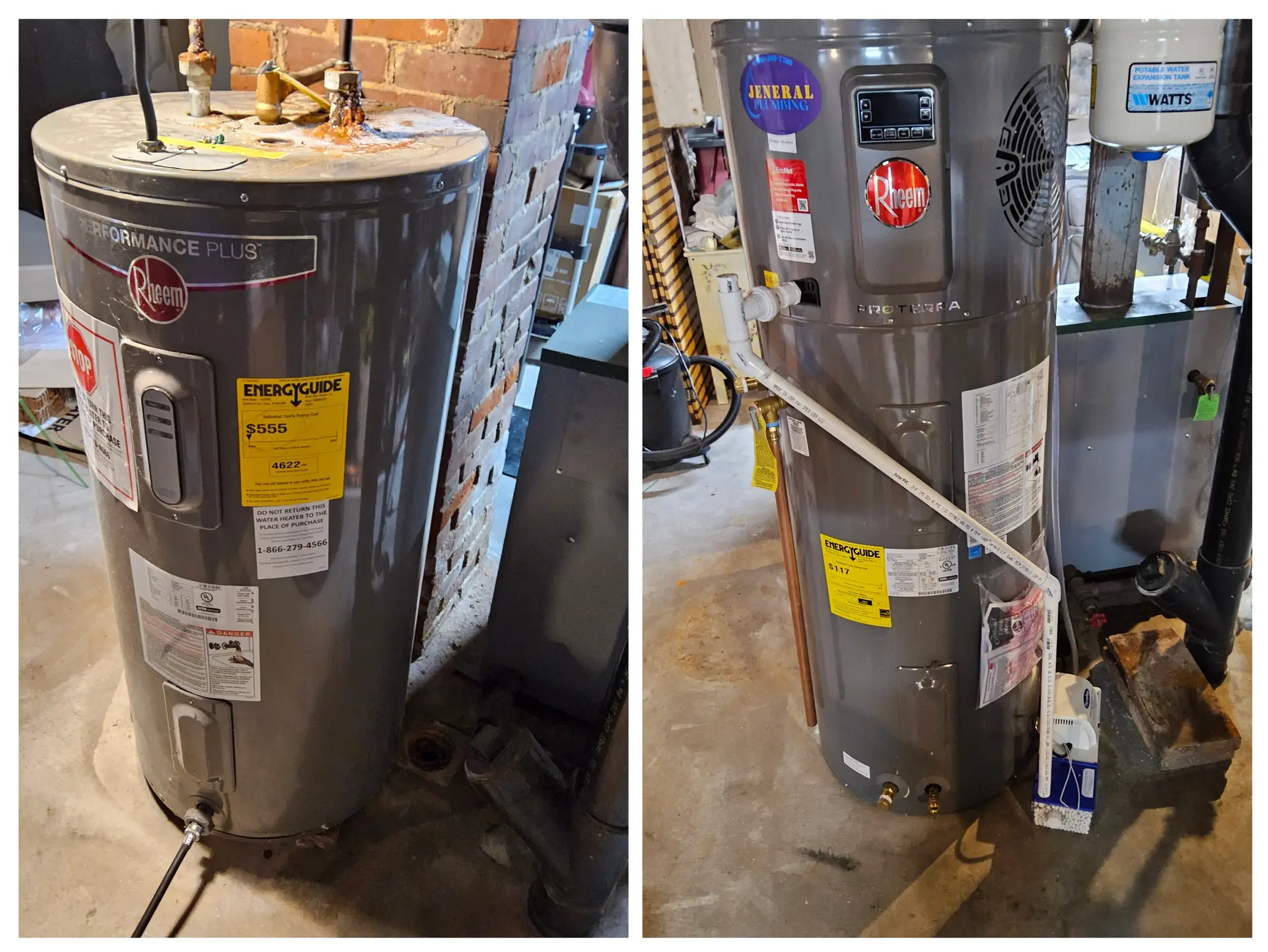
Heat Pump & Electric Water Heaters · Middlesex County
Heat Pump vs. Electric Water Heaters: Real Costs for Massachusetts Homes
On our tankless page we tell people the energy savings usually don’t justify the upgrade. This page is the opposite case. Replacing an electric resistance tank with a hybrid heat pump water heater is one of the few equipment swaps in this trade that genuinely pays for itself — and we can show you the arithmetic, using our real installed pricing. Jeneral Plumbing, owner-operated by a Licensed Master Plumber, installs hybrid heat pump and electric water heaters for homes within 20 miles of Westford, MA.
- Space, electrical capacity, and condensate route checked before selection
Clear options. Proper sizing. Professional installation.
Built Around Your Home
A 66% cut in water-heating electricity
A resistance tank consumes about 3,574 kWh a year for a typical family. A properly installed hybrid consumes about 1,218 kWh for the same hot water — the arithmetic is on this page.
The lifetime-cost case, in real dollars
The installed-price gap is measured against $683–$848 in modeled annual electricity savings, with the current program facts dated and sourced below.
Payback in years, not decades
The complete installed-cost math produces roughly three to seven years after the current Mass Save discount — every assumption is stated below.
Quick answer
For a typical family replacing electric resistance, the kWh model on this page drops water-heating use from about 3,574 to 1,218 kWh a year, saving roughly $683–$848 annually at the modeled rates. As of August 2026, qualifying equipment may receive a $750 instant Mass Save rebate. Against Jeneral Plumbing’s installed pricing, the resulting hybrid premium pays back in about three to seven years, depending on site conditions and use.
Two electric approaches to stored hot water
A resistance water heater uses thermostatically controlled electric elements in an insulated tank. It needs no burner, gas line, chimney, or combustion exhaust.
With suitable electrical service, resistance tanks offer straightforward installation, quiet operation, familiar repair parts, and lower initial equipment cost than most hybrids.
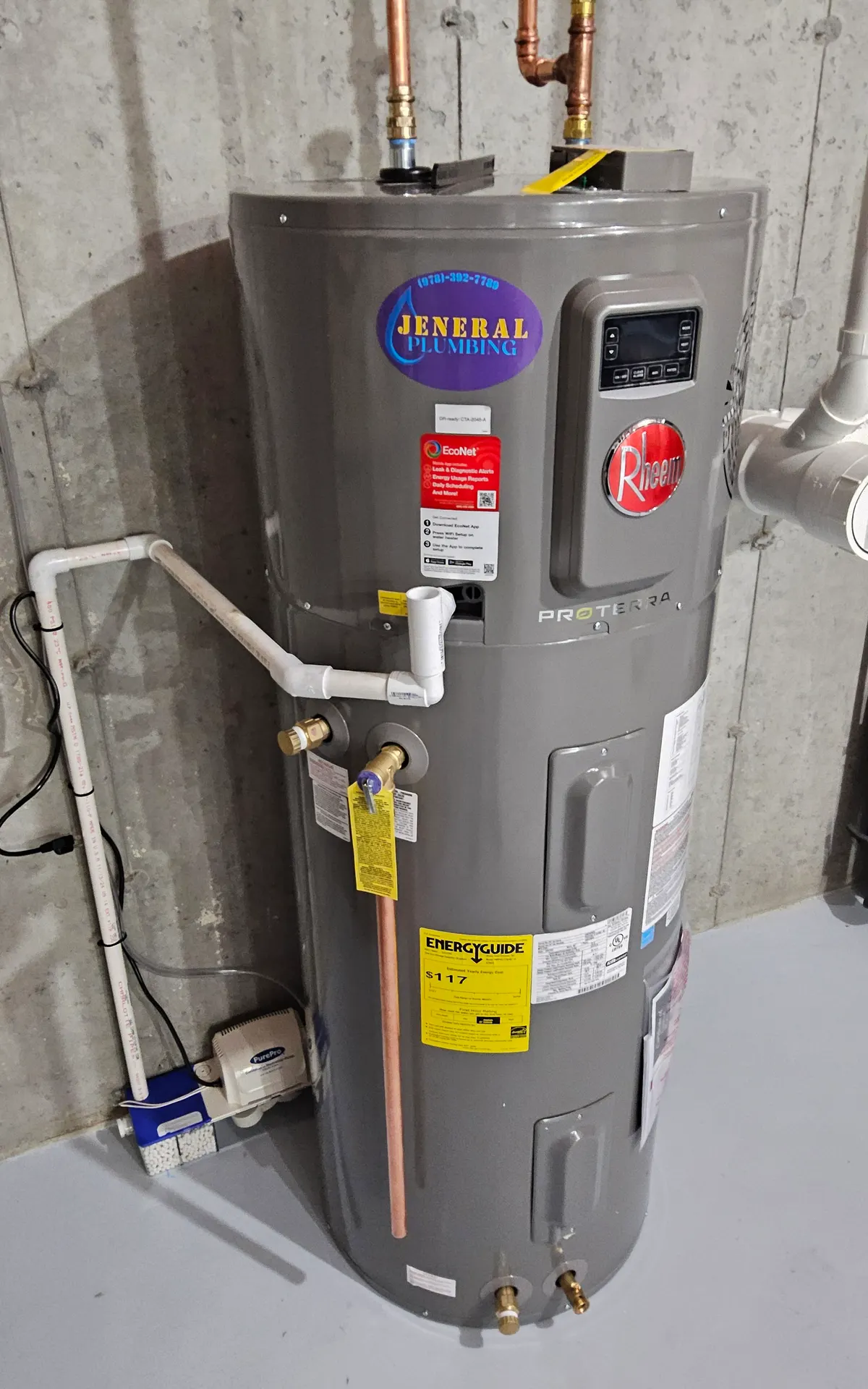
What is a heat pump water heater?
A hybrid heat pump water heater (HPWH) moves heat into a storage tank. A fan draws surrounding air across the refrigerant circuit; a compressor concentrates the warmth and a heat exchanger transfers it into the water.
Most integrated hybrid models also carry electric resistance elements for backup, cold conditions, or heavy demand. Operating modes may prioritize efficiency, faster recovery, vacation settings, or a blend of heat-pump and resistance operation.
The two technologies shouldn’t be compared on tank gallons alone. Compare first-hour rating, Uniform Energy Factor, recovery performance, voltage and amperage, ambient operating range, sound rating, condensate requirements, dimensions, and service access.
Jeneral Plumbing installs selected Bradford White and Rheem water heating equipment and recommends from the whole installation rather than a brand name. The Navien NWP500 appears below as a performance example only; its current availability is checked separately before any model enters a proposal. If you’re still deciding between fuel types, start with our water heater repair and replacement guide, which compares all four side by side.
To see the fan, evaporator, compressor, condenser coil, and backup elements on an illustrated unit, open our interactive guide to how heat pump and electric water heaters work.
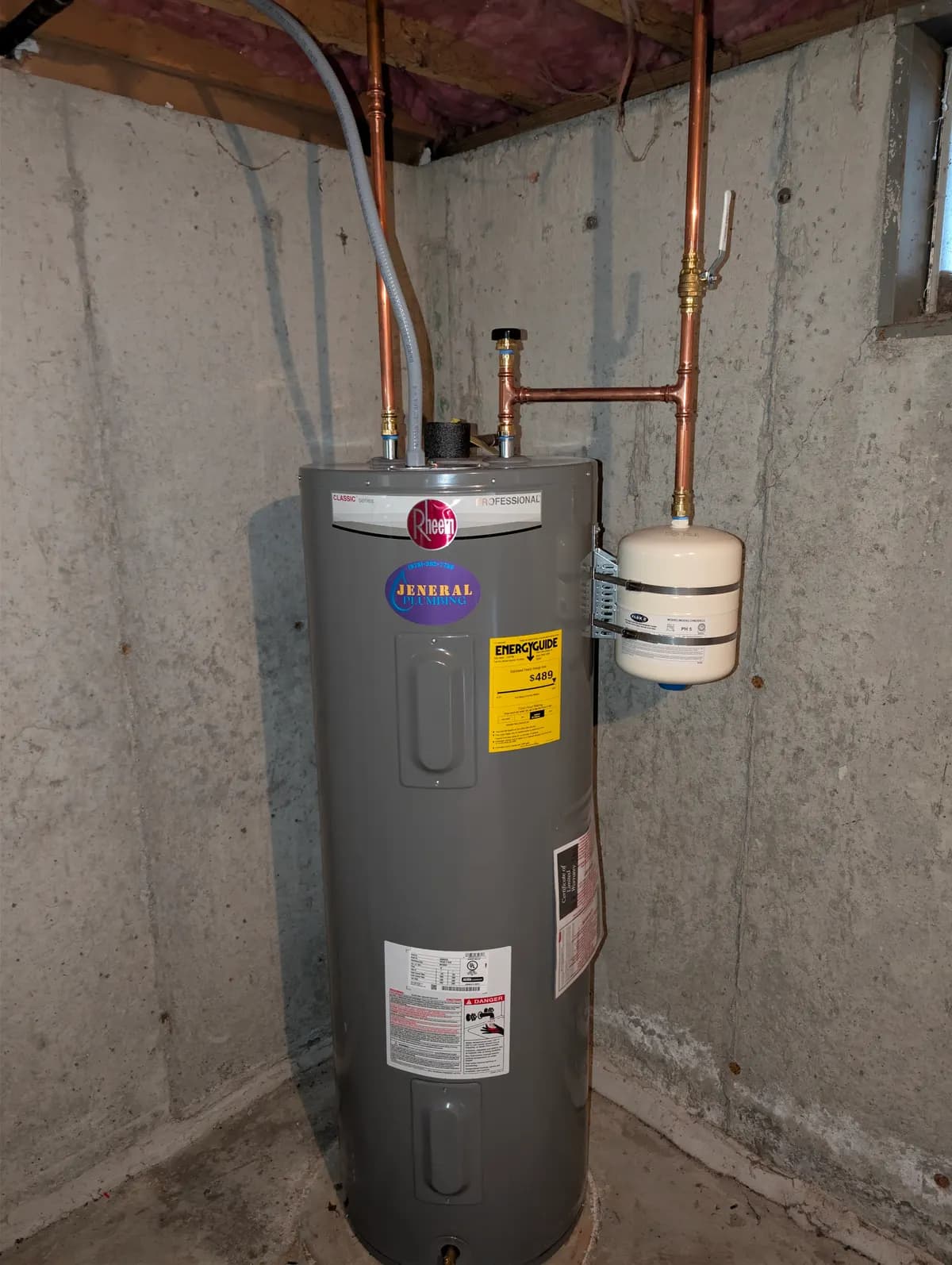
Conventional electric resistance water heaters
A full-electric resistance tank makes sense when simplicity, quiet operation, limited venting options, or replacement cost are the leading priorities. Because the equipment needs no flue, it fits locations where safe gas venting would be difficult. Components are familiar to any service technician, and the tank supplies multiple fixtures until its stored volume runs out. There’s also no on-site combustion and no carbon monoxide risk at the appliance.
The tradeoff is energy use, and it’s substantial. Resistance elements convert electricity directly into heat at roughly one-to-one. A heat pump moves heat that already exists, delivering several times more hot water per unit of electricity consumed. In a state with electricity rates as high as ours, that gap shows up on every bill.
Installation still needs professional planning. The circuit, the breaker, conductor size, disconnecting means, voltage, grounding, bonding where applicable, water connections, expansion control, relief valve discharge, drain pan, and leak protection all have to suit the unit and local code.
Never energize an empty electric tank. Exposed elements fail within seconds. And if you’re replacing gas with electric resistance, the home may need electrical upgrades that change the project cost materially.
- Simple storage-tank operation with no flue or combustion air
- Quiet equipment with familiar elements and thermostats
- Available in capacities and first-hour ratings for varied households
- Electrical service and peak hot-water demand must be verified before selection
- Highest operating cost of any water heating option in Massachusetts
What UEF actually means
Uniform Energy Factor is a mileage rating for water heaters. It tells you how much hot water you get out for the electricity you put in.
A standard electric resistance tank runs about 0.92 UEF. Put a dollar of electricity in, get roughly 92 cents of hot water back. The rest leaks away as standby loss.
As of August 2026, Mass Save lists 3.30 UEF as the qualifying threshold for a $750 rebate on a standard 240-volt heat pump model; verify the current threshold and eligibility on the Mass Save heat pump water heater page. At 3.30 UEF, that same dollar buys about $3.30 of hot water because the unit is relocating heat already present in the surrounding air.
The Navien NWP500 is rated up to 4.05. Same dollar. Four times the hot water. For a typical Westford household, that gap works out to around $750 a year off the electric bill. Call it 200 Dunkin’ runs, every year, for the life of the tank.
Heat pump water heater cost to run vs. electric resistance
Here are the actual numbers. All figures use the DOE test basis — 55 gallons per day at a 67°F rise, which is a household of three or four — producing 3,288 kWh of delivered heat per year.
A resistance tank at 0.92 UEF consumes about 3,574 kWh a year. A hybrid rated at 3.30 UEF, derated to a realistic 2.70 for an unheated Massachusetts basement, consumes about 1,218 kWh — roughly a 66% reduction.
Westford, Chelmsford, and most of the surrounding towns take delivery from National Grid, with supply through either basic service or the town aggregation program. National Grid’s basic service supply rate was 17.19 cents per kWh effective August 1, 2026; delivery, transmission, and efficiency charges roughly double that before it reaches your bill.
We’ve used the DOE inlet temperature here, which is warmer than what actually comes into a home in Groton or Littleton in February. Real consumption trends about 9% higher, so treat these as conservative.
| All-in electric rate | Resistance tank | Hybrid heat pump | Annual savings |
|---|---|---|---|
| $0.29/kWh (Massachusetts average) | $1,036 | $353 | $683 |
| $0.32/kWh (typical Westford bill) | $1,144 | $390 | $754 |
| $0.36/kWh (higher-usage homes) | $1,287 | $438 | $848 |
Are heat pump water heaters worth it?
Here is our actual installed pricing, so the payback math is honest. A standard electric tank installation starts at $2,300. A hybrid heat pump installation runs up to $7,800 before the $750 instant discount listed by Mass Save as of August 2026 comes off. Confirm the current amount and eligibility with Mass Save before equipment is purchased.
The gap between the two, after the $750 discount above, typically lands in the low-to-mid thousands depending on tank size and what electrical work the install requires. At $683 to $848 a year in savings, that pays back in roughly three to seven years — against equipment that should last more than a decade, while a resistance tank goes right on costing $1,000+ a year to run. That’s still one of the strongest cases in this trade, and it’s why we recommend hybrids far more often than we recommend tankless.
| Equipment | Installed cost |
|---|---|
| Standard electric resistance tank | from $2,300 |
| Hybrid heat pump water heater | up to $7,800 (before the $750 Mass Save discount, as of August 2026; source linked above) |
Know whether a hybrid fits before you choose equipment
We check room volume, circuit and panel capacity, condensate drainage, sound location, and hot-water demand before recommending a model.
Hybrid vs. your other options at a glance
Installed-price and payback comparisons only work when the same assumptions are used. The hybrid row below includes the $750 Mass Save discount available as of August 2026; amount and eligibility must be re-verified before purchase. The tankless row is included for orientation, while its sizing and lifecycle details remain on the dedicated tankless page.
| Option | Installed pricing | Operating and payback context |
|---|---|---|
| Electric resistance tank | from $2,300 | Lowest installed cost; modeled annual electricity here is $1,036–$1,287 |
| Hybrid heat pump water heater | up to $7,800 before the $750 Mass Save discount (as of August 2026; linked above) | Modeled annual electricity is $353–$438; about 3–7 years after the rebate |
| Condensing tankless | $8,500 – $11,000+ | Gas, venting, and condensate project; at least eight years best case and 30–50 years commonly against gas storage |
Pairing a hybrid with solar
Two situations, and the intuitive answer to the second one is wrong.
If you’re sizing a new array, a resistance tank needs roughly 3.0 kW of panels to cover its annual consumption at Westford’s production levels. A hybrid needs about 1.0 kW. The hybrid avoids around 2 kW of array — roughly $5,000 to $6,400 installed. That’s more than the water heater upgrade costs.
If you already have solar and you’re net-metered, the 2,350 kWh the hybrid frees up doesn’t disappear. It becomes net-metering credit at close to retail value. Your savings stay in the $683 to $848 range.
Solar does not make a hybrid less worth installing. It’s a common misconception and it costs people money.
Hybrid heat pump water heaters: what to know before you commit
For the right home, a hybrid dramatically reduces water heating electricity, and the kWh numbers above show why. Hybrids are especially attractive for homeowners planning electrification, replacing oil or propane equipment, pairing upgrades with solar, or trying to cut household energy use.
But they aren’t right for every house, and here’s what the marketing tends to skip.
What are the disadvantages of a heat pump water heater?
It takes heat from the room it’s in. In an unconditioned basement, that’s free energy and useful summer dehumidification. In a heated basement, you’re paying a small winter penalty as the boiler or furnace makes up the difference. It’s rarely a dealbreaker, but you should know about it.
It needs air volume. A hybrid moves a lot of air across its evaporator. Manufacturer clearance requirements are model-specific — the Navien NWP500 needs 450 cubic feet for an unvented install, with ducting required in tighter spaces. A closet that comfortably held a resistance tank may not work.
It makes noise. Navien publishes an under-45-dBA rating for the NWP500 under its test conditions, but a heat pump unit is not silent the way a resistance tank is. Next to a finished bedroom, the installation location matters. It also produces condensate: you need a reliable drain or a condensate pump, plus filter and airflow maintenance.
Recovery in efficiency mode is slower. Hybrid and high-demand modes call on the backup elements, which speeds recovery at the cost of efficiency. Correct sizing keeps the unit in efficient operation more of the time.
Condensate and drain planning
A heat pump water heater removes moisture from the air as it runs, so condensate is normal operation rather than a leak. The installation needs a continuous, serviceable drain path with the pitch, trap, air gap, and termination required by the selected model and local conditions. A nearby floor drain may work after its location and condition are confirmed; a convenient-looking pipe is not automatically an approved receptor.
Where gravity drainage is not available, a listed condensate pump can lift the water to an approved discharge point. Pump capacity, vertical rise, tubing route, freeze exposure, power, service access, and overflow protection all matter. The route should not cross an area where a disconnected or blocked tube could damage a finished floor.
The condensate line, drain pan, and temperature-and-pressure relief discharge perform different jobs and are planned separately. Jeneral Plumbing checks each path during installation and leaves the filter, pan, pump, and drain accessible for maintenance — the quietest mechanical-room corner is not a good location if the drainage cannot be made reliable.
Sound levels in a real basement
Selected current models publish sound ratings around 45 dBA under defined test conditions, which gives the rough context of a quiet refrigerator. That number does not predict exactly what you will hear through a basement door, floor framing, finished wall, or duct because distance, surfaces, fan speed, operating mode, and room acoustics change the result.
The sound is usually a steady fan-and-compressor cycle rather than burner noise. Vibration can also travel through an uneven base or rigid contact with nearby framing, so the installation follows the manufacturer’s support and clearance instructions. Ducting may move intake or discharge air, but it can also transmit sound if the model and route are not designed for it.
Location matters most next to a basement bedroom, home office, media room, or frequently used stair. We discuss the proposed position and service clearances before equipment is selected. A utility-room installation may be unobtrusive for one household and noticeable for another, so Jeneral Plumbing does not promise silent operation.
Do heat pump water heaters need a 240-volt circuit?
Most do. Standard integrated hybrid models run on 240 volts, and if you’re converting from gas or oil you’ll likely need a new circuit — sometimes panel capacity along with it.
There’s a growing exception. Selected 120-volt/15-amp models use a standard household circuit and can avoid new branch-circuit work where the existing circuit and model requirements are confirmed. As of August 2026, Mass Save lists the same $750 amount at a lower 2.20 UEF threshold for this category; verify the current requirements on the Mass Save heat pump water heater rebate page.
That option is worth asking about specifically. It can be the difference between a straightforward replacement and a project that needs an electrician.
Sizing a heat pump water heater
We consider family size, shower patterns, large tubs, laundry, dishwasher timing, incoming water temperature, tank setpoint, mixing strategy where appropriate, and the specific model’s first-hour rating before recommending capacity.
Hybrids are commonly available in 50, 65, and 80 gallon configurations. An 80 gallon heat pump water heater suits larger households or homes where slower heat-pump-mode recovery needs a bigger buffer.
Mass Save rebates and 2026 eligibility
As of August 2026, Mass Save offers an instant discount at the point of sale — not a mail-in check — on qualifying ENERGY STAR heat pump water heaters.
As of August 2026, the linked Mass Save program page lists no water-heater rebate for gas, oil, or propane equipment, including gas tankless. If you’re comparing fuel types, that is worth factoring in.
Amounts and eligibility change — verify against the current Mass Save heat pump water heater rebate page (figures verified August 2026).
| Equipment | Efficiency requirement | Rebate |
|---|---|---|
| Heat pump water heater, 240V | ENERGY STAR, UEF 3.30 | $750 per unit |
| Heat pump water heater, 120V/15A | ENERGY STAR, UEF 2.20 | $750 per unit |
| Split-system heat pump water heater | ENERGY STAR, UEF 2.20 | $1,500 per system |
- Equipment must be installed by a licensed plumber between January 1 and December 31, 2026
- Documentation must be submitted by February 28, 2027
- One rebate per gas or electric account, residential properties of 1–4 units
- Must replace an existing electric, propane, natural gas, or oil water heater — or be new construction not earning incentives through another Mass Save program
- The discount applies through a participating distributor, Home Depot or Lowe’s, or the Mass Save online marketplace
Verify the site and current program rules first
We assess air volume, 120- or 240-volt options, panel capacity, condensate routing, and sound concerns; program approval remains separate from the plumbing scope.
- Current program rules are checked separately from site fit
The federal tax credit has expired
As of August 2026, the federal Energy Efficient Home Improvement Credit covered qualifying heat pump water heaters placed in service from January 1, 2023 through December 31, 2025 and is not available for 2026 installations. Confirm the termination date in the current IRS Form 5695 instructions.
Pages that still promise 30 percent up to $2,000 for a 2026 installation are out of date as of August 2026. Tax situations are personal — consult current IRS guidance or a tax professional before counting on any credit.
As of August 2026, Mass Save also lists 0% HEAT Loan financing up to $25,000 for qualifying improvements, subject to program and lender approval. Verify the current financing and heat pump water heater eligibility on the Mass Save heat pump water heater page. We can explain the plumbing scope and equipment; final incentive and financing approval belongs to the program administrator and participating lender.
- Confirm the current Mass Save offer before purchasing equipment
- Verify your model appears on the ENERGY STAR certified list, not just the spec sheet
- Check participating utility, property, installation, and documentation rules
- Don’t assume the expired 2023–2025 federal credit applies in 2026
Installation, maintenance, and choosing the right system
A heat pump water heater assessment starts with measurements, not a brochure. We verify room volume and clearances, access for moving the tank, ambient temperatures, drain route, ceiling height, electrical capacity, water piping, pressure, thermal expansion, pan drainage, and service space for the air filter and top components. If ducting is proposed, the selected model has to allow it, and the design has to stay within the model’s limits.
Routine care means keeping the air filter clean, maintaining unobstructed airflow, checking the condensate path, watching for leaks, and following the manufacturer’s tank maintenance guidance.
Water chemistry, pressure, temperature, anode protection, sediment, usage, and installation conditions all influence service life. Water hardness varies considerably from house to house across Westford, Chelmsford, Littleton, Groton, and the surrounding towns — by supply, by season, and by property — so testing beats assuming.
Smart and connected features can provide alerts, scheduling, and mode control. They don’t replace physical inspection or correct sizing.
Talk to a licensed master plumber
Jeneral Plumbing installs and services electric and hybrid heat pump water heaters across Westford and nearby Middlesex County towns — Chelmsford, Acton, Littleton, and Groton.
Jeneral Plumbing is owner-operated by a Licensed Master Plumber (MA #9628831-PL-M) with more than twenty years in the trade, including seven with a gas utility. We’ll tell you which system fits your house — including when the answer is the cheaper one.
Jeneral Plumbing is family-owned and operated, serving homes within 20 miles of Westford, MA. Upfront pricing, no hidden fees. Licensed, certified, insured.
Call (978) 392-7789 or request an assessment online. Regular-hours visits carry an $80 dispatch fee — the cost of the visit, waived when you hire us for the work. Service Plan members receive a separate waived dispatch fee benefit. Off-hours, holiday, and Sunday dispatch carries a $599 emergency callout fee — non-refundable, non-negotiable, collected prior to dispatch, covers the dispatch only and is never applied to repair work. Emergency availability is 24/7 and confirmed by phone. Lender financing offers may include up to $250,000, terms up to 12 years, 0% introductory APR, and 1–3 day funding after approval, subject to the applicant, lender, and selected offer. Jeneral Plumbing offers separate senior and church community discounts. Eligibility and the discount are confirmed with the approved project scope and price.
Jeneral Plumbing · 5 Westford Hills Rd, Unit 5119, Westford, MA 01886 · (978) 392-7789 · office@jeneral-plumbing.com
Mon–Fri 7:00 AM – 5:00 PM · Sat 8:00 AM – 3:30 PM · Sun Closed · Emergency 24/7 · Family-owned and operated. Serving Middlesex & Worcester County.
Talk to a licensed plumber before you commit
Get a recommendation based on space, circuit capacity, drain access, noise location, hot-water demand, and budget.
- MA Master Plumber #9628831-PL-M
- More than twenty years in the trade
- BBB Accredited, A+ Rating
Frequently Asked Questions
Does a heat pump water heater work in an unheated New England basement?
It can, with a caveat. Many units list a lower ambient operating limit around 41°F, but the selected model’s operating range and the actual basement temperature have to be checked rather than assumed. Efficiency and recovery drop as the surrounding air cools, which is why we derate the rated UEF in the savings math on this page. A basement that approaches the model’s limit may need a different location, ducting strategy, operating plan, or water-heater type.
What are the disadvantages of a heat pump water heater?
It cools the space around it, needs meaningful air volume, requires a condensate drain, makes some noise, and recovers more slowly in efficiency mode. In a heated basement there’s a modest winter heating penalty. None of these are dealbreakers in the right location, but they’re real.
Are heat pump water heaters worth it in Massachusetts?
How long do heat pump water heaters last?
Comparable to a quality electric tank, generally north of a decade, with service life depending on water chemistry, maintenance, and installation conditions. The compressor and fan add components a resistance tank doesn’t have, which is why filter and airflow maintenance matters. Keeping the filter clean and the air path unobstructed helps the unit operate under the conditions its manufacturer expects.
Where can I compare all the water heater types?
Should I consider a hybrid or a tankless water heater?
What is a heat pump water heater?
It’s a storage water heater that moves heat instead of creating it. A fan pulls warmth from the surrounding air, a compressor and refrigerant concentrate it, and a heat exchanger transfers it into the tank. It uses roughly a third of the electricity a resistance tank does.
Will a heat pump water heater make my basement cold?
It drops the surrounding air a few degrees while running, then recovers between cycles. In summer, the cooling and dehumidification are a bonus. In winter, in a heated basement, your heating system makes up a small difference.
Get the right water heater—not a one-size-fits-all answer
Jeneral Plumbing serves Westford and nearby Massachusetts communities with water-heater assessment, installation, replacement, repair, and maintenance. Schedule online or call to discuss your hot-water needs.
Serving Homes Within 20 Miles of Westford
Explore plumbing and water services in nearby Middlesex County communities:
Plumbing Tips From Our Blog
All ArticlesElectric Water Heater Installation Options in Westford, MA
Electric water heater installation options range from standard resistance tanks to hybrid heat-pump units. Compare cost, electrical needs, and ownership.
Read Article Water HeatingOnly Hot Water in Westford, MA: Crossover and Scald Safety
Only hot water at a faucet can point to a plumbing crossover or cold-supply problem. See why safe diagnosis matters for Westford homes and rentals.
Read Article PlumbingSlow Hot Water in Bedford, MA: 4 Hidden Plumbing Problems Explained
Slow hot water in your Bedford, MA condo? It's often not the water heater. Four causes from a real service call — and what to check before you call.
Read Article