
Condensing boiler planning within 20 miles of Westford
High-Efficiency Boiler Service & Installation in Westford, MA
Replacing an aging boiler, or trying to keep a newer condensing model running well? Jeneral Plumbing installs and services high-efficiency boilers for homes within 20 miles of Westford, MA. Before recommending equipment, we check your home’s heat loss, your baseboard or radiators, the water temperatures they need, the fuel supply, and the venting and condensate route. The written scope explains why the equipment fits your home, with no blanket promise of lower fuel bills. If you smell gas or a carbon monoxide alarm sounds, leave the house, call 911 from outside, and stay out until the fire department or gas utility says it’s safe. Call a plumber only after that.
Clear scope before work begins
A Service Visit Built Around Your Home
Check system compatibility
Your home’s heat loss, the baseboard or radiators in each zone, the water temperatures they need on the coldest days, and the pumps and controls set how a boiler can run.
Plan every connection
We work out the fuel supply, approved venting, combustion air, condensate drainage, electrical needs, piping, access, and permits before installation day. Gas piping, gas connections, and gas venting are Massachusetts-only.
Verify real operation
At startup and during service, we go by combustion readings and operating data for your model, not the rating on the label.
A rating is one part of the decision
What High-Efficiency Boiler Service Means for a Real Home
Compared with a conventional, non-condensing boiler, a high-efficiency model is generally designed to get more usable heat from the same fuel. Its AFUE rating is a standardized estimate of how much of its fuel becomes heat over a heating season, measured under prescribed test conditions. That makes AFUE a fair way to compare boilers, but it can’t predict your fuel bills or how comfortable your home will feel.
Once the boiler is installed, its real efficiency depends on the house and system around it. The temperature of the water returning to the boiler, how much heat your baseboard or radiators give off, how much heat the house loses, the weather, zoning, how often the boiler cycles on and off, control settings, fuel setup, maintenance, and heat lost through the piping all shape how it performs.
Return-water temperature is why a condensing boiler vs conventional cast-iron boiler comparison comes out differently from house to house. A conventional boiler is generally piped and controlled so its exhaust doesn’t condense inside it, which means it wants warm return water. A condensing boiler recovers its extra heat only when that water comes back cool, so a system that runs hot most of the season narrows the difference. We don’t put a savings figure on it without your home’s numbers.
We check these conditions before an installation or major service job so you can see which changes the home needs. The recommendation connects the measurements, manufacturer requirements and operating problems you want to solve.
- AFUE helps you compare boilers but doesn’t guarantee household savings
- Cooler return water generally means more time in condensing mode
- The heating system, controls, cycling, and your home’s heat loss shape real-world performance
- Manufacturer specs have to be applied to your exact model and system
Recovering heat from the flue stream
How a Condensing Boiler Works
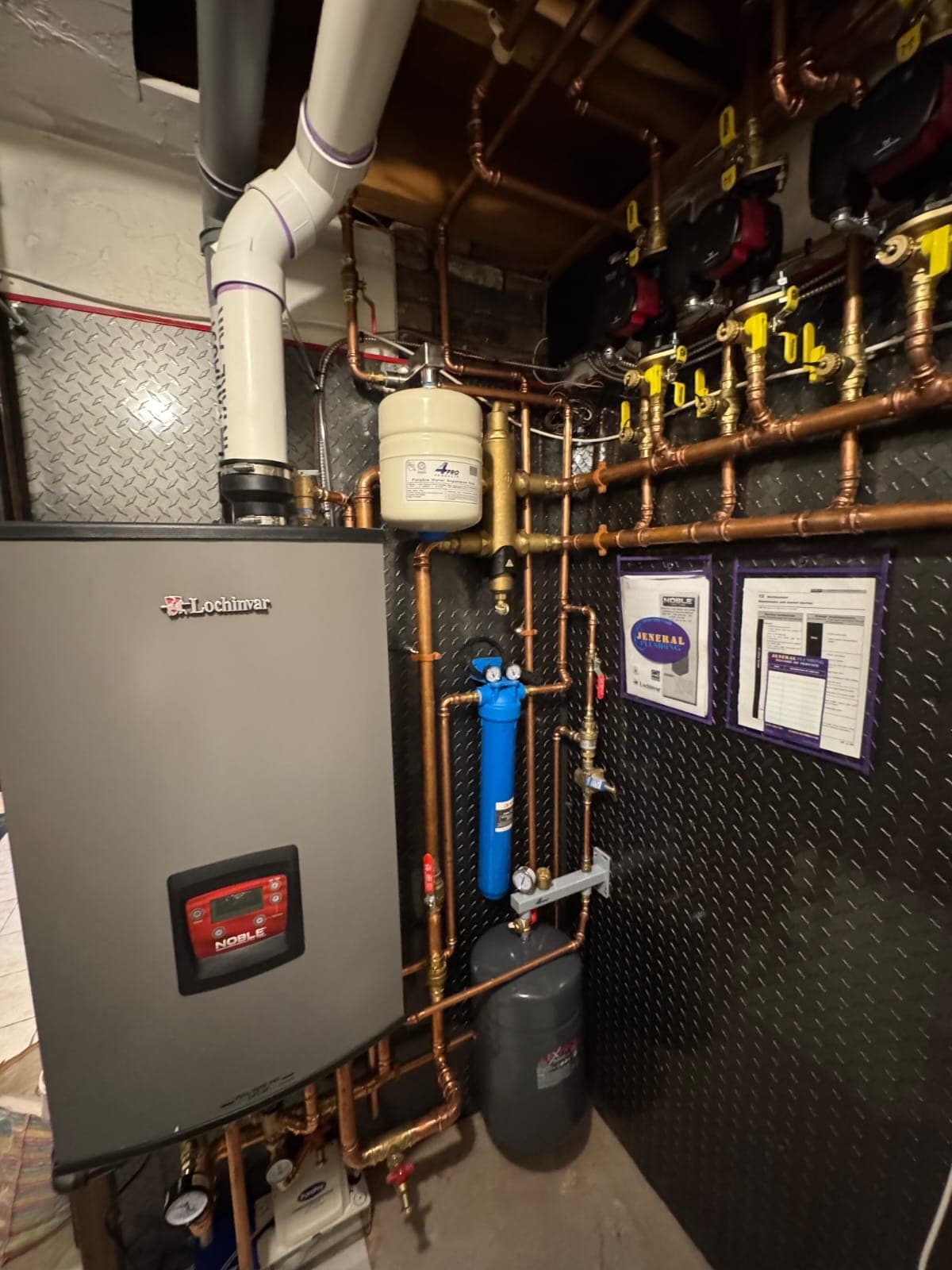
Burning fuel produces hot exhaust that carries water vapor. A condensing boiler cools that exhaust until the vapor turns to liquid inside a corrosion-resistant heat exchanger. That change releases heat the boiler passes to your heating water instead of sending all of it out the vent.
Cooler water returning from the heating system generally lets the boiler condense more, though the right target depends on the model, fuel, heating load and manufacturer data. A boiler supplying hotter water can still heat the home, but may spend less time in the conditions that produce its strongest condensing benefit.
Condensing boiler venting is different from a traditional chimney. The exhaust leaves cool and wet, so it usually runs in plastic pipe the manufacturer approves, such as PVC, CPVC, or polypropylene, out through a sidewall or the roof, often with a matching intake pipe for combustion air. An existing masonry chimney can’t carry that exhaust unless it’s used as a chase for a liner system approved for the model. If the old boiler shared a chimney with a gas water heater, the water heater’s venting also needs to be checked once the boiler is gone, and sometimes relined by a chimney contractor.
The water that condenses out of the exhaust, called condensate, needs somewhere to go. A proper installation gives it a suitable drain path, with freeze protection and neutralization where required. Combustion air and clearances also have to match the equipment instructions and local requirements.
The connected emitters set the operating conditions
Condensing vs Non Condensing Boilers for Existing Baseboard and Radiators
Can you keep your existing baseboard or radiators? Either type of boiler can heat them; the question is how often the water can run cool enough for a condensing boiler to condense. Your baseboard or radiators work with a high-efficiency boiler when they put out enough heat for the house at the water temperatures the new boiler will run. Baseboard versus radiators isn’t what decides it. We work from a heat-loss calculation for the home, how much baseboard or radiator surface is installed, the zone layout, piping and flow, and the temperature each area needs in cold weather.
Some systems can run on cooler water for much of the heating season, especially with outdoor reset, a control that adjusts boiler temperature as the weather changes. Other homes or zones may need hotter water on the coldest days. That cuts condensing time, but it doesn’t automatically rule out a high-efficiency boiler.
We compare the equipment with the system it will serve before telling you an installation will work. If the baseboard or radiators, controls, pumps, or piping need changes for the boiler you choose, that work is spelled out in your scope from the start instead of being assumed.
The condensing-boiler guidance on this page applies to hot-water heat. If your radiators run on steam, start with steam-boiler installation and replacement planning. We install and repair steam boilers too. A hot-water boiler would need a separate conversion assessment before it could be considered for a steam system.
A combi vs. heat-only high-efficiency boiler assessment also measures your household’s hot-water demand, so we can decide whether one appliance should handle both heating and hot water.
For radiant and low-temperature systems where condensing can shine, cooler return water can keep the boiler condensing longer when heat output, flow, controls, and the heating load are a good match.
| System condition | Why it matters |
|---|---|
| Building load | The boiler and distribution system need enough output for the house, based on its heat loss rather than the old boiler’s size. |
| Baseboard or radiator output | The heat that baseboard or radiators give off changes with water temperature, flow, covers or enclosures, and how much is installed in each zone. |
| Return-water temperature | Cooler return water generally supports more condensing operation, subject to the model and system design. |
| Zoning and controls | Zone size, cycling, outdoor reset, pumps, valves, and control logic affect how the boiler operates through the season. |
Equipment and connected work are one plan
Installing and Commissioning a High-Efficiency Boiler
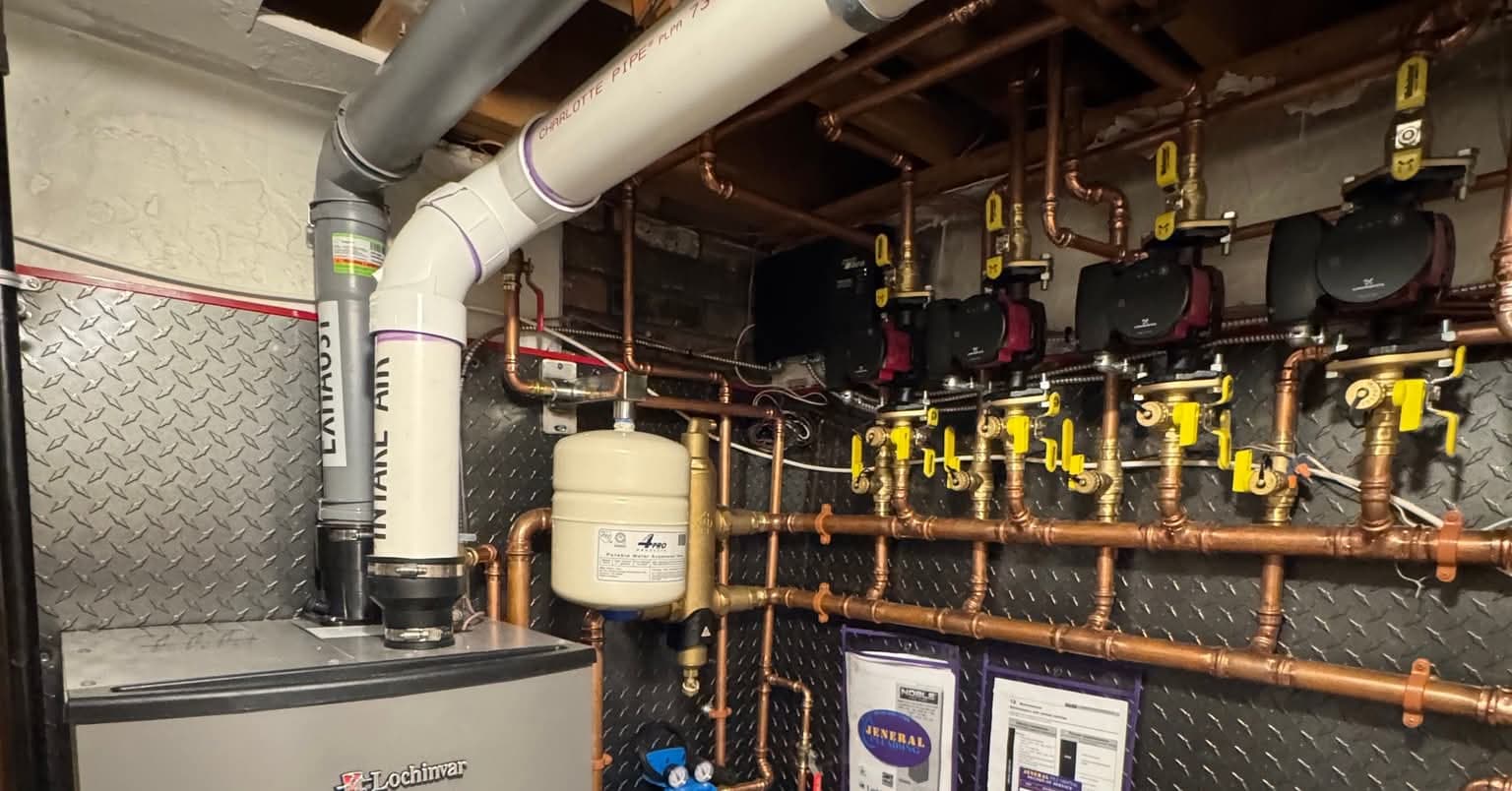
A high-efficiency boiler installation starts with the heating load and the distribution system, then moves to choosing equipment that fits the operating conditions we’ve confirmed. Depending on the house, the project can include piping, pumps, air elimination, expansion control, fuel capacity, approved venting, combustion air, condensate disposal, controls, electrical connections, removal of the old boiler, permits, and access for future service.
Once the boiler is in, we fill and purge the heating system, set up the controls, and start it according to the instructions for that model. Then we check operating temperatures, pressures, flow, safety functions, venting, condensate drainage, and combustion readings, so the handoff reflects how the system ran in your home rather than how it should run on paper.
Some homes need changes to pumps, controls or radiation to support the proposed boiler. Others are better served by a different equipment arrangement. We explain those options before you choose a model, and include the necessary connected work in the installation plan.
When you’re ready to plan a replacement, request a high-efficiency boiler assessment and share the boiler model and your goals for the project. New or larger gas piping in Massachusetts goes through a separate gas-line installation assessment.
Service follows the specific model
High-Efficiency Boiler Maintenance and Combustion Analysis
Maintenance on a high-efficiency boiler should follow the manufacturer’s current instructions and what we find on the unit. Depending on the model, a visit can include inspecting and cleaning accessible combustion parts, heat-exchanger surfaces, ignition components, venting, the air intake, and the condensate trap and drain. It can also cover the neutralizer if there is one, along with safeties, system pressure, controls, pumps, and visible piping connections.
Annual professional service is a practical planning interval for many residential systems, but the manufacturer and the equipment’s condition govern the exact work and timing.
Combustion analysis measures flue gases and operating values, then compares them with the requirements for your model. It isn’t a universal adjustment recipe. Venting, fuel pressure, inlet conditions, firing rate, dirty components, and other faults can all throw off a reading, so we treat the numbers as one part of a complete diagnosis or service visit rather than a single-number verdict.
Jeneral Plumbing is owner-operated by a Licensed Master Plumber (MA #9628831-PL-M) with more than 20 years in the trade, including seven years with a gas utility. Documented training includes Navien Service Specialist (NSS) certification and factory training from Navien, Lochinvar, Rinnai, and Weil-McLain.
If the boiler is shutting down, leaking, or leaving rooms cold, start with boiler fault diagnosis and repair rather than booking routine maintenance. When you call, have the model, any fault code, and the affected zones handy so we can set up the right visit.
A heating partner with documented training
Weil-McLain High-Efficiency Boilers
Weil-McLain is one of our heating partners, backed by documented factory training. We recommend a Weil-McLain boiler only when its output range, venting, condensate, controls, piping, and service-access requirements fit your home and its hot-water distribution.
Equipment selection tied to field conditions
Lochinvar High-Efficiency Boilers
Lochinvar is another heating partner, and our documented factory training includes its equipment. Before recommending a Lochinvar model, we compare it with your heating load, return-water temperatures, fuel capacity, venting route, condensate path, controls, and the baseboard or radiators it will serve.
A heating partner brand
Viessmann High-Efficiency Boilers
Viessmann is a heating partner as well, though our documented factory training is with Navien, Lochinvar, Rinnai, and Weil-McLain. A Viessmann recommendation goes through the same condition-based review, matching the specific boiler to your heating load, distribution temperatures, piping, venting, condensate, controls, and local project requirements.
Price follows a confirmed scope
High-Efficiency Boiler Cost Factors
A high-efficiency boiler’s cost depends on the equipment you choose and the connected work it takes for a safe installation or repair that fits your system. Heating load, distribution temperatures, piping and pumps, controls, fuel capacity, venting, combustion air, condensate routing, electrical work, access, removal, permits, commissioning, and any system corrections can all change the scope.
The quote includes the equipment and the connections needed to make it work in your home. We assess the system in person and provide a written, flat-rate price before you decide to proceed.
During regular hours, that assessment visit carries an $80 dispatch fee — the cost of the visit, waived when you hire us for the work.
We install and service high-efficiency boilers in Westford, Chelmsford, Acton, Littleton, Groton, Carlisle, and nearby towns across Middlesex & Worcester County. Every home gets the same compatibility check and startup testing, while the equipment and connected work are chosen for that house.
Current program status, verified before selection
Mass Save Incentives for High-Efficiency Boilers
As of August 2026, Mass Save states that broad rebates, incentives, and financing are no longer available for equipment powered by natural gas, oil, or propane. The current program page notes an exception for income-eligible households upgrading existing fossil-fuel equipment to qualifying high-efficiency models. Eligibility depends on the household, the utility sponsor, the equipment, and current program terms.
Program rules can change, so confirm the current Mass Save terms before you settle on a replacement. We keep incentives separate from the boiler recommendation itself: your heating load, system compatibility, safety, and the installation scope still decide whether the equipment fits your home.
Helpful next steps
Plan the Connected Work
Jeneral Plumbing
Local facts, clear expectations
- Jeneral Plumbing is owner-operated by a Licensed Master Plumber (MA #9628831-PL-M), with more than 20 years in the trade, seven years with a gas utility, Navien Service Specialist (NSS) certification, and factory training from Navien, Lochinvar, Rinnai, Weil-McLain, and Noritz.
- 5 Westford Hills Rd, Unit 5119, Westford, MA 01886 · office@jeneral-plumbing.com
- Mon–Fri 7:00 AM – 5:00 PM · Sat 8:00 AM – 3:30 PM · Sun Closed · 24/7 emergency — confirmed by phone
- (978) 392-7789For regular-hours visits, the cost is an $80 dispatch fee — the cost of the visit, waived when you hire us for the work. Off-hours, holiday, and Sunday dispatch has a $599 emergency callout fee — non-refundable, non-negotiable, collected prior to dispatch, covers the dispatch only and is never applied to repair work.Personal-loan offers through Hearth may include up to $250,000 with terms up to 12 years, subject to lender approval. Separate credit-card offers may include 0% introductory APR for qualified applicants. Rates, fees, terms, and eligibility depend on the applicant, lender, and offer. Funding timing depends on the lender and completed approval. Confirm it before scheduling work. See financing options and the lender disclosure.Jeneral Plumbing offers separate senior and church community discounts. Eligibility and the discount are confirmed with the approved project scope and price.
Straight answers
Frequently Asked Questions
Is a high-efficiency boiler worth it for my home?
It is worth considering when the boiler and heating system can work together at temperatures that support condensing. Compare the complete installation cost, required system changes, maintenance and expected operation with your current equipment. A high AFUE rating alone cannot establish your fuel savings or payback; the home’s heat loss, baseboard or radiators, controls and operating temperatures matter too.
What is a near condensing boiler?
Near-condensing is a descriptive term used for some boilers that extract more heat from flue gases than older conventional models. The term alone does not establish an AFUE rating, an operating-temperature limit or an approved venting arrangement. Cooler exhaust can change the venting requirements, so an existing chimney cannot be assumed suitable. We check the actual model’s rating, return-water temperature requirements and venting instructions, along with the chimney and connected appliances, before recommending a replacement.
Match the Boiler to the System Before Installation
Schedule a boiler assessment in Westford or nearby. We’ll review your home’s heating load, the water temperatures your baseboard or radiators need, your controls and venting, the condensate route, and every piece of connected work before you choose equipment.
Serving Homes Within 20 Miles of Westford
See our related local service page for Westford, in Middlesex County:
High-Efficiency Boiler Service Across Westford & Middlesex County
Based in Westford, Massachusetts, Jeneral Plumbing serves homes within 20 miles. Our directory lists 26 towns across Middlesex & Worcester County and southern New Hampshire. Find local plumbing help in the towns nearest us:
Plumbing Tips From Our Blog
All ArticlesCondensing vs Non-Condensing Boilers: A Dracut Homeowner’s Guide
Condensing vs non-condensing boilers differ in heat recovery, venting, and system fit. See what matters before choosing one for a Dracut home.
Read Article HeatingBoiler Combustion Test: What a Lowell Noritz Case Showed
A Lowell Noritz case shows why orange flame and blown fuses need a boiler combustion test plus separate electrical diagnosis before return to service.
Read Article HeatingBoiler Cleaning in Pepperell: What Hard Well Water Does to a Boiler
A stuck zone valve was the complaint. Well water at 11 grains with high iron was the cause — and the reason an ageing boiler was working harder than it should.
Read Article