

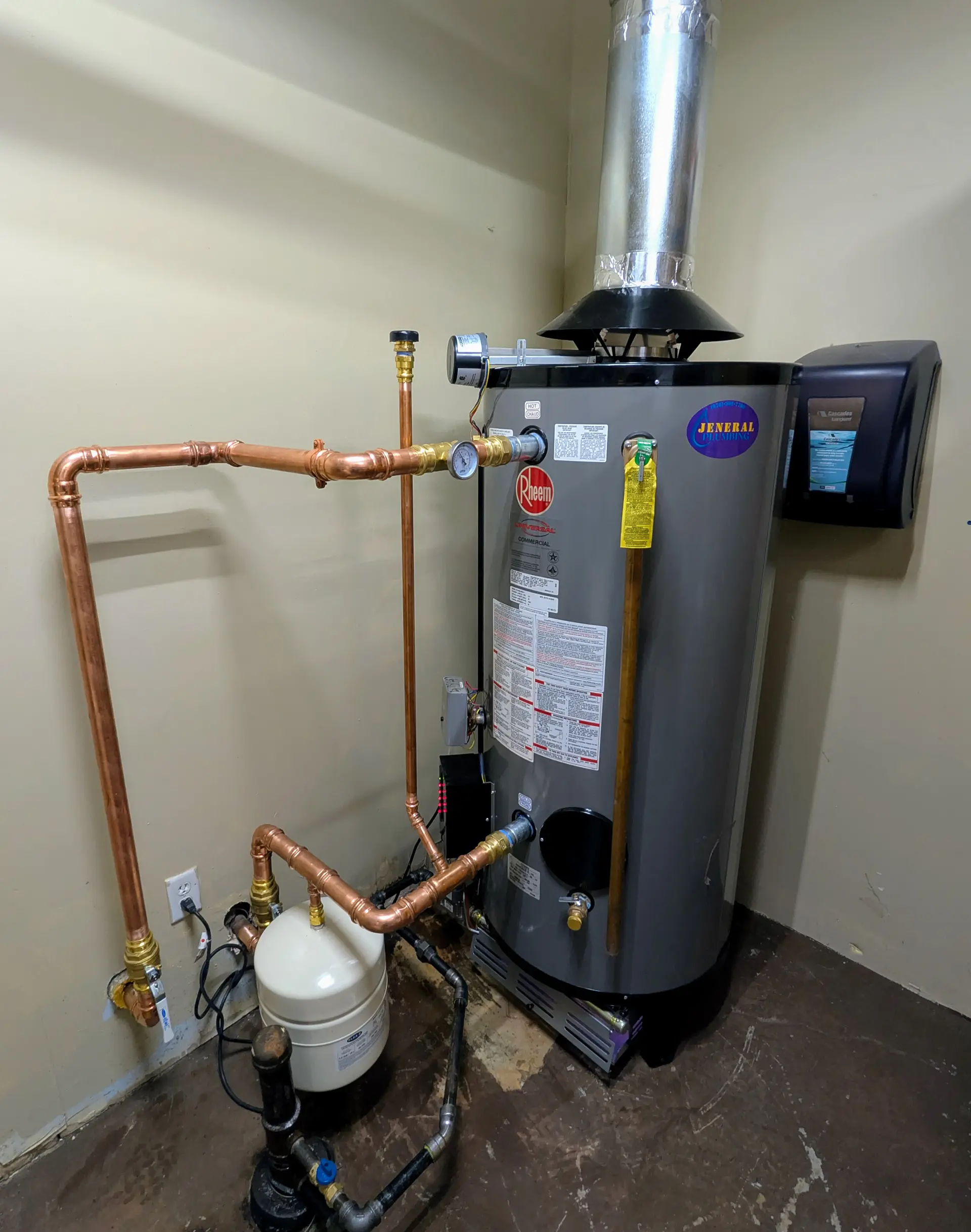
Gas Water Heaters · Middlesex County
Gas Water Heaters: Venting Types, Real Costs, and When to Replace
Most gas water heater pages will tell you a high-efficiency model saves you money. Two numbers matter more than that. Upgrading from a chimney-vented tank to a power-vented one saves about $40 a year once you account for the blower’s electricity — nowhere near enough to justify the premium. But if your chimney needs a liner, relining runs $2,400 to $6,500, and suddenly the power vent is the cheaper path by thousands. Your chimney decides this, not the efficiency label. Jeneral Plumbing, owner-operated by a Licensed Master Plumber, installs and replaces gas water heaters for Massachusetts homes within 20 miles of Westford, MA. Here’s the full math.
- MA Master Plumber #9628831-PL-M
Clear options. Proper sizing. Professional installation.
Built Around Your Home
Fast hot-water recovery
Gas burners replenish a storage tank quickly, which helps a properly sized system handle busy mornings and back-to-back showers.
Multiple venting options
Chimney vent, power vent, and direct vent configurations suit different home layouts when equipment, combustion air, termination, and clearances are planned correctly.
Proven tank design
Gas storage water heaters are familiar, widely serviceable systems with straightforward controls and capacities for most household patterns.
Gas water heaters built around your hot-water demand
A gas storage heater keeps water ready while its burner cycles to maintain the thermostat setting. For Massachusetts homes with natural gas or propane, it offers strong recovery without the electrical load of a resistance tank.
Compare first-hour rating, burner input, recovery, household schedule, soaking tubs, incoming temperature, gas-pipe capacity, dimensions, service access, drainage, and venting. Oversizing increases cost and standby loss; undersizing can leave showers cold.
We install selected Bradford White and Rheem gas storage equipment, and selected Navien tankless equipment where appropriate. Availability is confirmed for the proposed model. Installation follows its listing, Massachusetts requirements, fuel-gas rules, venting instructions, and applicable permits.
To see how the burner, gas control, central flue, and draft hood fit together in a gas storage tank, open our interactive guide to how water heaters work. It explains what each part does; it is not a repair or adjustment guide.
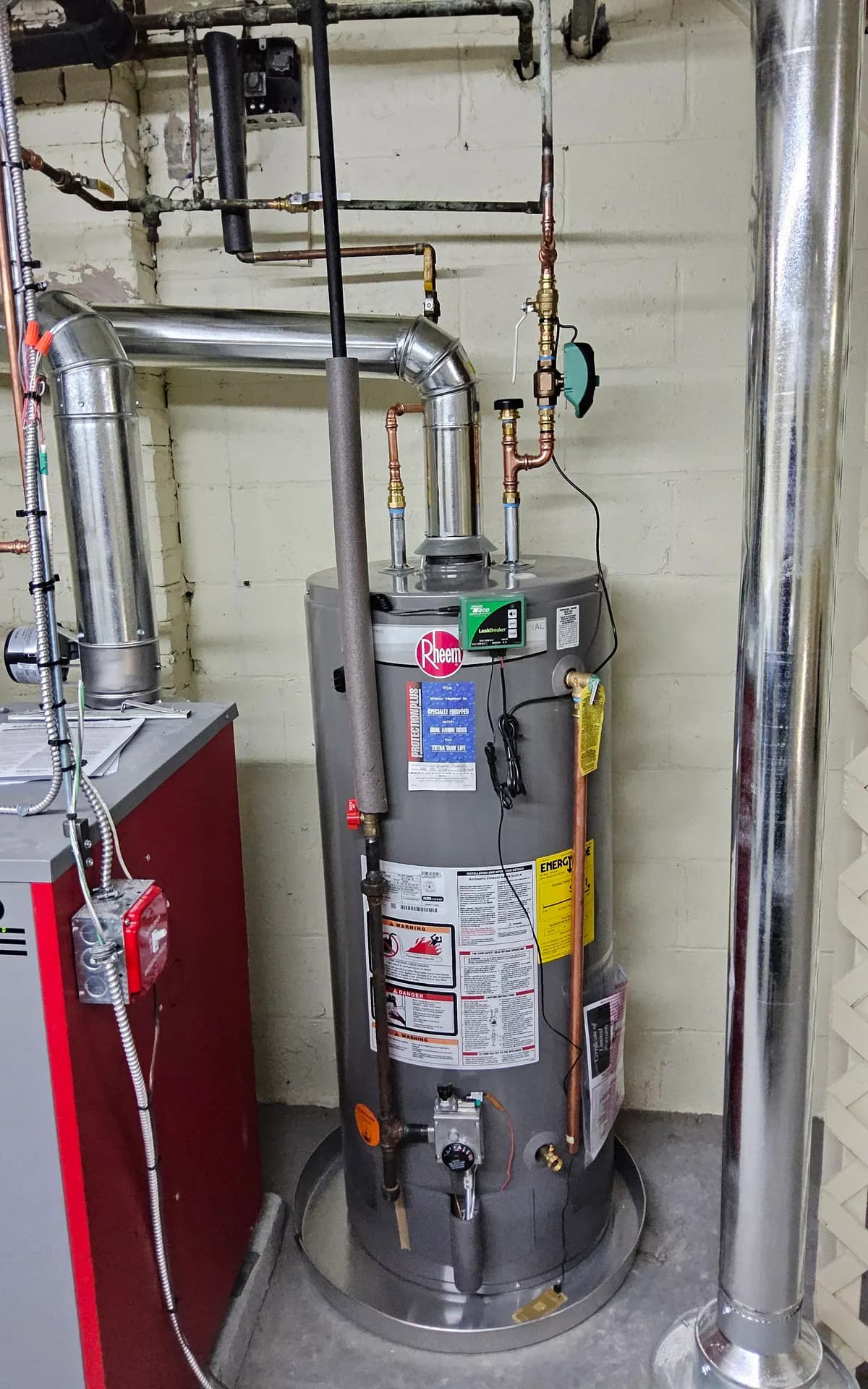
Chimney-vented (atmospheric vent) gas water heaters
An atmospheric vent water heater — also called chimney-vented or natural draft — uses buoyancy to carry combustion gases through a metal vent connector into an approved chimney or common vent. It’s the lowest-cost equipment, and it’s the only configuration that keeps making hot water during a power outage. Both are real advantages. But it only works if the chimney is sound, and in this area that’s a bigger “if” than most homeowners expect.
The chimney decides, not the water heater. Before we quote a chimney-vented replacement, the chimney itself has to be assessed. This is the step that gets skipped by installers quoting over the phone, and it’s where projects go wrong.
External chimneys need a liner — effectively always. A chimney running up the outside of the house sits outside the building’s thermal envelope, so it stays cold. Draft weakens, because buoyancy depends on the flue being warmer than outside air. And flue gases condense against cold masonry. Natural gas combustion produces a great deal of water vapor. When that condenses inside unlined brick, the moisture soaks into masonry and mortar — and in a New England freeze-thaw winter, it destroys the chimney from the inside out. The condensate is mildly acidic, which accelerates it. If your chimney is on an exterior wall, plan on a properly sized liner as part of any chimney-vented installation.
Internal chimneys depend on condition. A chimney running up through the middle of the house stays warmer, drafts better, and condenses far less. An interior chimney in genuinely good condition can often vent a gas water heater as-is. “Good condition” is a determination, not an assumption: intact liner, sound mortar joints, correct size for the appliance load, clear of obstruction and debris, sound crown and cap, and proper connector pitch and sizing.
A chimney sweep inspection is the gate. We recommend a Level II inspection from a CSIA-certified chimney sweep before committing to any chimney-vented replacement — a camera survey of the full flue, not a look up from the basement. If the sweep finds the chimney unsafe, that settles it: the appliance goes to power vent or direct vent, or the chimney gets lined. There is no third option and no judgment call to make. Venting a gas appliance into a compromised chimney risks carbon monoxide in the house.
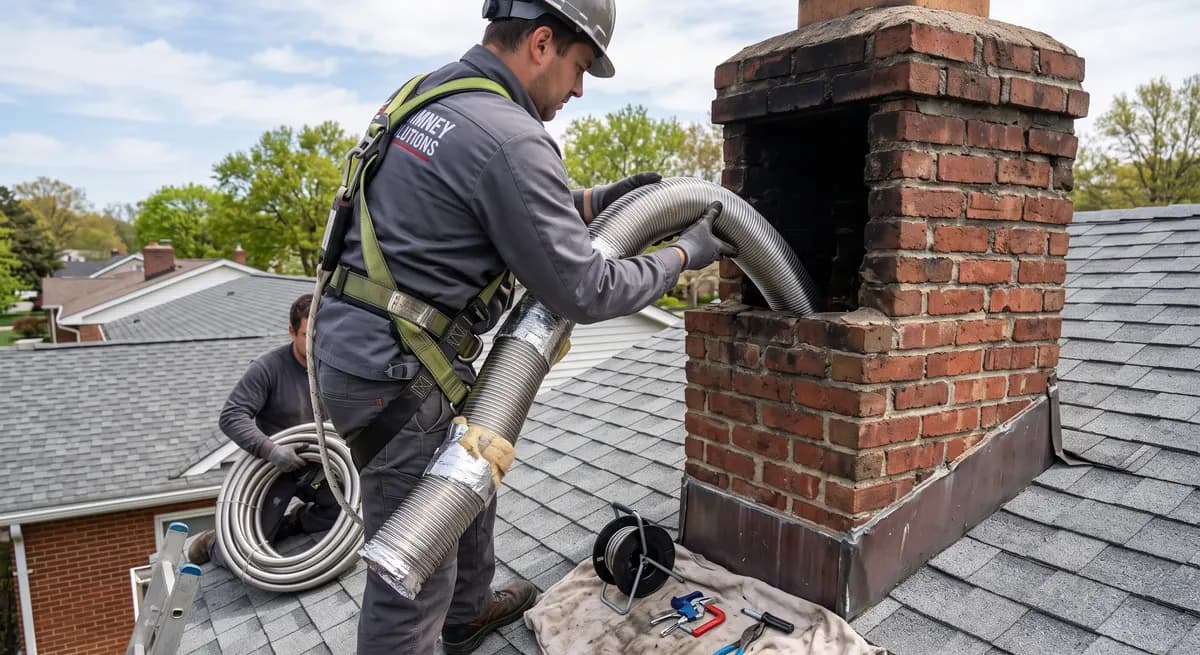
AI-generated example image (Google Gemini) — not a Jeneral Plumbing installation
What lining costs
This is the number that changes the whole decision, so here it is plainly. Cost scales with chimney height and access. A 35-foot flue on a two-story Colonial runs roughly double a 15-foot ranch. Massachusetts pricing sits at the upper end of national ranges.
One trap worth knowing about. If your boiler or furnace shares that chimney, taking the water heater off it doesn’t necessarily save you the liner. Removing an appliance leaves the flue oversized for whatever remains, which weakens draft and can create the exact condensation problem you were trying to avoid. That chimney may need relining or resizing regardless. We look at every appliance on the flue before recommending anything.
| Liner type | Typical installed cost | Notes |
|---|---|---|
| Aluminum | $625 – $2,000 | Only approved for mid-efficiency gas. Roughly 5–10 year life. Viable only where the water heater is the sole appliance on the flue |
| Stainless steel (316Ti) | $2,400 – $6,500 | The standard recommendation. Installed by a chimney contractor and suitable for the approved appliance and flue conditions |
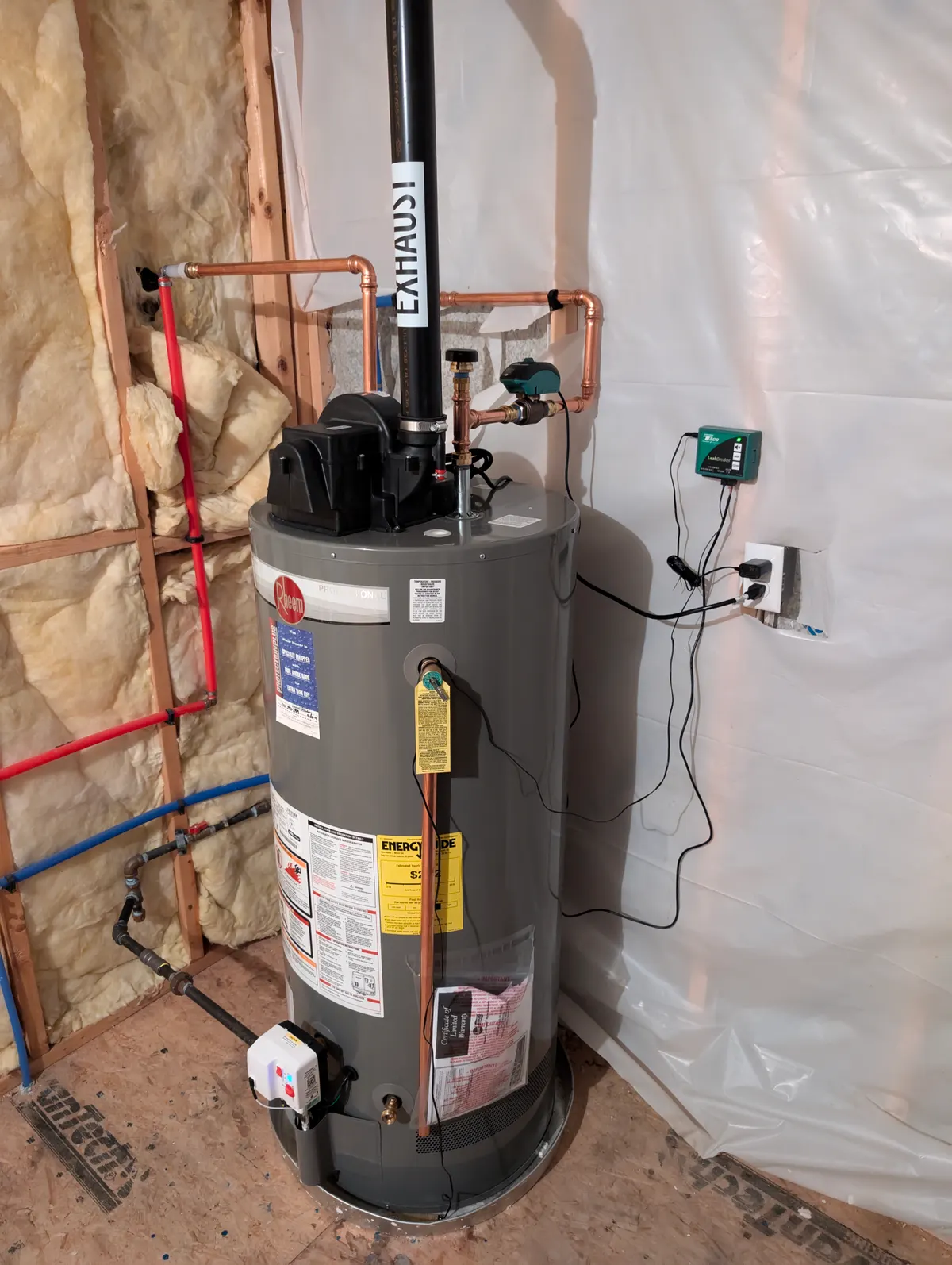
Power-vented gas water heaters
A power vent water heater uses an electrically powered blower to push exhaust outdoors. Depending on the listed model, approved venting can often run horizontally to a suitable sidewall termination. That’s the fix when a chimney is unavailable, unsafe, or being abandoned.
Power venting requires a receptacle or electrical connection and produces some fan noise. It must maintain manufacturer-specified distances from windows, doors, grade, property features, and air intakes. Vent length, elbows, pitch, material, and termination are system design details, not interchangeable preferences.
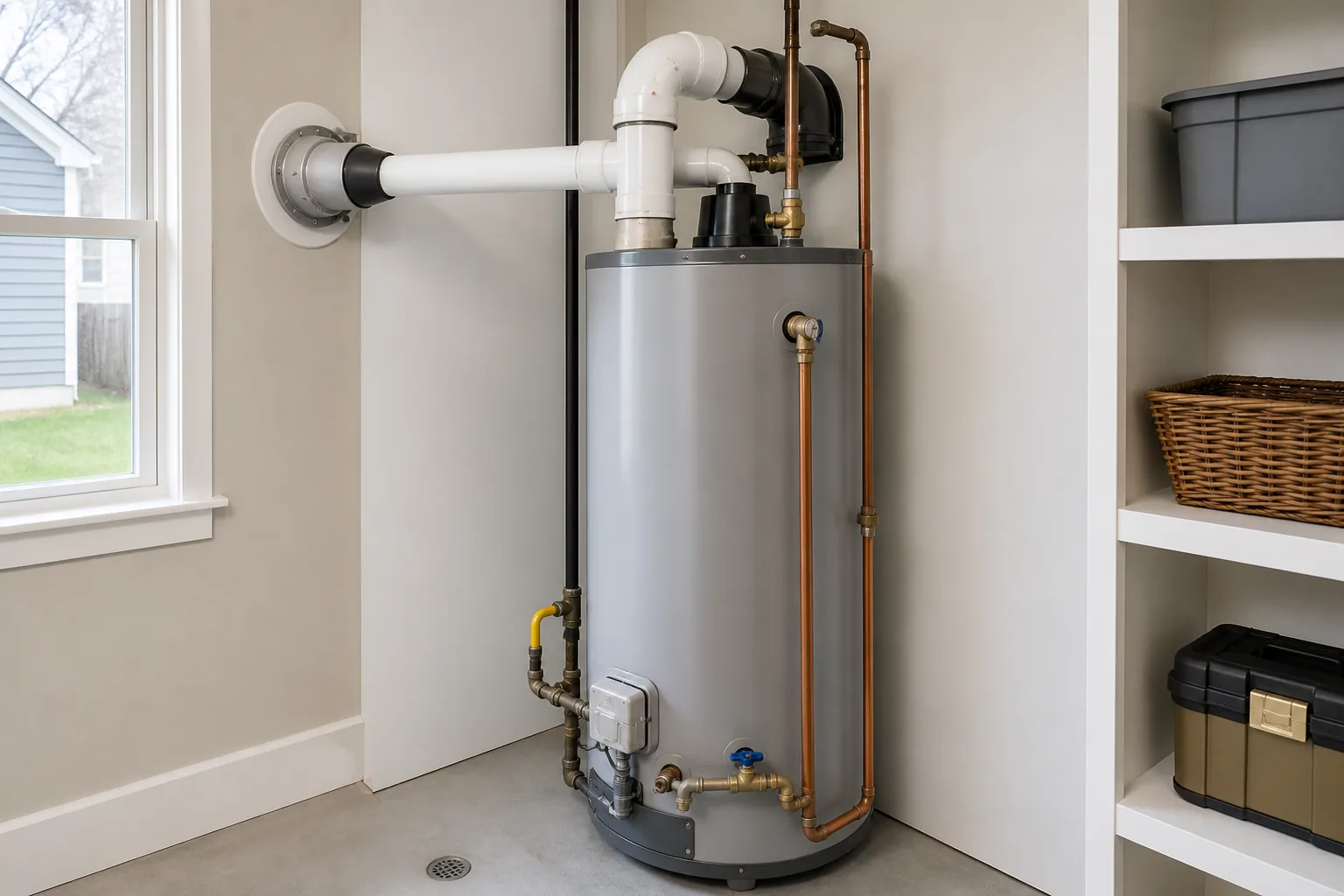
AI-generated example image — not a Jeneral Plumbing installation
Direct-vented gas water heaters
A direct vent water heater uses a sealed arrangement that draws combustion air from outside and sends exhaust outside. Because the combustion path is separated from indoor air, direct venting suits tight homes and certain utility-room conditions. It still requires an approved route and exact clearances.
Power vent vs. direct vent — these get used interchangeably in sales conversations, and they are not the same thing. Power vent pulls combustion air from the room and uses a blower to push exhaust out. Direct vent brings combustion air in from outdoors through a sealed system and exhausts outdoors, never touching indoor air. Some powered direct-vent products combine characteristics of both. We identify the actual equipment category and follow its manual rather than trusting a label on a box.
Gas water heater venting types at a glance
All three gas storage vent types fall within the same $2,900–$6,500 installed range. The correct row depends on the approved vent path, combustion-air conditions, clearances, electrical availability, and any appliance that remains on a shared chimney.
| Vent type | Electricity need | Installed-cost band | Typical fit |
|---|---|---|---|
| Chimney / atmospheric | No for a standing-pilot model | $2,900 – $6,500 | An approved, inspected chimney with adequate combustion air |
| Power vent | Yes — blower and controls | $2,900 – $6,500 | A failed or unavailable chimney with a compliant sidewall route |
| Direct vent | Model-specific — powered versions need it | $2,900 – $6,500 | A listed sealed-air path where indoor combustion air is limited |
Which vent type fits Westford-area homes
Some older homes in Westford, Chelmsford, and Acton retain masonry chimneys that may support an atmospheric tank, but age alone proves nothing. A Level II chimney inspection, the flue’s condition and size, and every connected appliance decide whether that path remains usable.
In homes around Littleton and Groton, a renovation, addition, or tightened mechanical room can change combustion-air and termination conditions even when the previous heater drafted acceptably. Power vent or direct vent may fit where a safe sidewall route exists, but the property has to be measured before that conclusion is made.
When an unsafe chimney needs $2,400–$6,500 in stainless relining by a chimney contractor, moving the water heater to an approved sidewall-vented configuration can be the less expensive project. If a boiler or furnace remains on the flue, the chimney may still need work — which is why the whole vent system is evaluated together.
Does a gas water heater need electricity?
It depends entirely on the vent type, and this catches people out during storm season.
A chimney-vented unit with a standing pilot generally keeps producing hot water through a power outage. There’s no blower and no powered ignition. A power vent or powered direct vent model will not. The blower needs electricity, and most also use electronic ignition. When the power goes out, so does your hot water.
If outage resilience matters to you, say so before we choose equipment. It’s a legitimate reason to keep a chimney-vented configuration where one is safely available.
What a gas water heater actually costs to run
All figures below use the DOE test basis — 55 gallons per day at a 67°F rise, roughly a household of three or four — producing 112 therms of delivered heat per year. Gas at $2.40 per therm from EIA Massachusetts residential data; electricity at $0.32 per kWh.
This table includes something most comparisons leave out: the electricity a blower consumes. Power-vented and condensing units run a fan whenever the burner fires. That’s a real cost, and in a state with our electric rates it cancels a meaningful share of the fuel savings.
A sealed direct vent unit that draws its own combustion air does not use a blower and does not need electricity. A powered direct vent does. The distinction shows up on your bill.
| Vent type | UEF | Therms/yr | Gas cost | Blower kWh | Electric cost | Total/yr | vs. chimney |
|---|---|---|---|---|---|---|---|
| Chimney / atmospheric vent | 0.61 | 184 | $441 | — | — | $441 | — |
| Direct vent (sealed, natural draft) | 0.62 | 181 | $434 | — | — | $434 | $7 |
| Powered direct vent | 0.68 | 165 | $396 | 54 | $17 | $413 | $28 |
| Power vent | 0.70 | 160 | $385 | 52 | $17 | $401 | $40 |
| Condensing gas storage | 0.80 | 140 | $337 | 46 | $15 | $351 | $90 |
| Condensing gas tankless | 0.95 | 118 | $283 | small | small | ~$290 | $151 |
Is a high efficiency gas water heater worth the premium?
No. Not on energy alone, and not by a small margin. Our installed pricing for a gas water heater runs $2,900 to $6,500 depending on vent type and site conditions — chimney-vented at the low end of that range, power vent in the middle, condensing storage at the top. Set those tier steps against the savings table above and every payback outlives the equipment: a $40-a-year net saving cannot repay a four-figure premium inside the 8-to-12-year life of a tank, and even the $90-a-year condensing saving falls decades short.
Which leads to the single most useful thing on this page: choose your vent type based on your chimney, not on efficiency. And once the chimney enters the math, the ranking can flip completely. Stepping up from a chimney-vented unit to a power vent costs far less than lining a chimney — relining runs $2,400 to $6,500 in stainless. So if your chimney needs a liner and the water heater is the only thing venting into it, the power vent is the cheaper option — often by thousands. That’s the opposite of how power vent usually gets sold, and it’s the real reason to choose one.
Three situations, three answers. Sound interior chimney, correctly sized, verified by inspection: chimney-vented is usually the sensible choice — lowest equipment cost, no blower, keeps working in an outage. Chimney unsafe, unlined exterior, or needs relining, and the water heater is the only appliance on it: power vent or direct vent, nearly every time — you’re comparing a modest equipment premium against a $2,400–$6,500 masonry project. Chimney needs work but a boiler or furnace also vents into it: the liner may be required regardless, the water heater decision is genuinely open, and we work through it with the real numbers for your house.
Anyone selling you a power vent on energy savings is quoting a number they can’t defend. Anyone selling you one because your chimney failed inspection is telling you the truth.
| Equipment | Installed cost |
|---|---|
| Gas storage water heater (all vent types) | $2,900 – $6,500 |
| Chimney relining, stainless (by a chimney contractor) | $2,400 – $6,500 |
Let your venting conditions — not a sales pitch — decide
We assess chimney condition, shared appliances, combustion air, sidewall clearances, gas capacity, and hot-water demand before recommending chimney, power, or direct vent.
- Licensed master plumber
- Seven years of gas utility experience
- Upfront pricing with no hidden fees
Gas vs. electric water heater: the full picture
Since most people replacing a water heater are at least considering the alternatives, here’s how gas stacks up in Massachusetts at current rates.
Two things worth noticing. Gas remains far cheaper to run than electric resistance — roughly a third the cost. If you have gas service and an electric resistance tank, that’s a conversation worth having. But a hybrid heat pump water heater now costs slightly less to operate than a standard gas tank, and as of August 2026 it can qualify for a $750 Mass Save heat pump water heater rebate that gas equipment does not. Massachusetts electricity is expensive, but heat pumps use so little of it that the comparison has flipped.
That doesn’t make gas the wrong choice. Recovery speed, installation cost, panel capacity, and basement conditions all matter. It does mean the “gas is always cheaper” assumption is out of date.
Compare the kWh, installation, and payback details in our heat pump and electric water heater cost guide. For continuous hot water and twenty-year ownership math, use the tankless versus storage water heater comparison.
| Equipment | Annual operating cost |
|---|---|
| Electric resistance tank | $1,144 |
| Atmospheric gas storage tank | $441 |
| Hybrid heat pump water heater | $390 |
| Condensing gas tankless | $283 |
There is no Mass Save rebate for gas water heaters
Worth stating plainly, because people search for it: as of August 2026, Mass Save no longer offers rebates, incentives, or financing for water heating equipment powered by natural gas, oil, or propane. That includes gas tankless.
As of August 2026, the $750 integrated-unit and $1,500 split-system discounts are electric-only. If an incentive is central to your budget, verify the amount and eligibility against the current Mass Save heat pump water heater rebate page before equipment is purchased.
Need help comparing gas with electric or heat pump?
We compare installation conditions, recovery, operating cost, electrical capacity, and available incentives for your home before recommending a system.
- Gas, electric, heat pump, and tankless options
- Current incentive rules explained honestly
- Financing available
How long does a gas water heater last?
A gas storage water heater typically lasts 8 to 12 years. Water chemistry, maintenance, pressure, and installation conditions move that number in both directions. Over twenty years, that means buying two tanks — or three, if hard water shortens the cycle.
The anode rod is the biggest lever you control. It’s a sacrificial metal rod that corrodes so the tank lining doesn’t, and yes — a gas water heater does have an anode rod, usually threaded into the top of the tank. Inspecting it every few years and replacing it when depleted can meaningfully extend tank life on suitable units. It’s one of the few genuinely high-return maintenance items on a storage water heater.
One factor specific to gas: the flue running up the center of the tank means the burner and combustion path add wear an electric tank never sees. Draft problems and combustion issues shorten gas tank life in ways that don’t show up on an electric unit.
Water hardness varies considerably from house to house across Westford, Chelmsford, Littleton, Groton, and the surrounding towns — by supply, by season, and by property. We test rather than assume, and where hardness is driving early tank failure, treatment sometimes pays for itself in replacements avoided.
These figures are undiscounted and assume flat fuel prices. Directionally sound, not a financial projection.
| Scenario | 20-year total |
|---|---|
| 10-year life (two units at $2,900–$6,500 each) | $14,600 – $21,800 |
| 8-year life (three units) | $17,500 – $28,300 |
Professional gas water heater installation and replacement
A gas water heater replacement is more than reconnecting two water lines. The installer should verify the gas shutoff and connector or hard-pipe arrangement, vent system, draft or blower operation, combustion air provisions, temperature-and-pressure relief valve discharge, thermal expansion control where required, drain pan and drainage conditions, local requirements where applicable, and safe service clearances. The system gets filled and purged before firing, checked for leaks, commissioned, and explained to the homeowner.
Changing vent types expands the project. Converting a chimney-vented unit to power vent or direct vent may require a new sidewall route, wall penetration, electrical work, chimney disposition, and changes near the proposed termination. Replacing an appliance that shared a chimney can also affect whatever vented equipment remains on that chimney — a detail that gets missed and creates real safety problems. We inspect existing conditions before treating a conversion as a simple swap.
Gas water heater warranties, without the fine-print surprises
Warranty length is the closest thing to a manufacturer’s own estimate of how long a tank should last, and coverage tiers vary by model line. Terms change, so we confirm the actual coverage for the equipment we’re proposing rather than quoting a general figure. Labor is typically not covered on a standard residential tank — the warranty replaces the failed tank or part, while removal, installation, and reconnection are billed separately, and on a mid-life failure the labor is often the larger number.
Extended coverage generally has to be purchased at installation, through your installer — not added in year five when the tank starts making noise. If you want it, tell us before we order. A longer term is not always a different build: some models are identical with the longer term sold as an option, while others add hardware such as a second anode rod. Ask which situation applies before paying for the upgrade.
Improper installation can void coverage — manufacturer terms are commonly conditioned on installation by a qualified licensed professional. Transferability to a new owner varies by manufacturer and is worth checking if you might sell the house. We register every unit we install and give you the model and serial number for your records.
What replacement day looks like
Before the scheduled date, Jeneral Plumbing confirms the selected equipment, permit path, venting scope, access, and any electrical or chimney coordination. That preparation matters because a vent conversion, failed chimney, or shared flue can turn an apparent tank swap into a larger project.
On site, the old heater is shut down, drained, disconnected, and removed. The replacement is set, piped, vented, filled, purged, leak-checked, fired, and commissioned; relief discharge, expansion control, combustion air, draft or blower operation, and controls are checked before the work is considered complete. Removal of the old unit is part of the planned scope.
Many like-for-like replacements can be completed within the scheduled workday once equipment and permit conditions are ready. Jeneral Plumbing is owner-operated by a Licensed Master Plumber (MA #9628831-PL-M), so availability is confirmed when the job is scheduled; a vent conversion, unexpected chimney condition, electrical work, inspection timing, or special-order equipment can extend the project. We explain those dependencies before promising a completion date.
Gas safety first
If you smell gas, leave the area immediately. Don’t operate switches, don’t use a phone inside, don’t create a flame. Contact the gas utility or emergency services from a safe location. We run 24/7 emergency service, but a suspected gas leak goes to the utility before it goes to a plumber.
How to turn off a gas water heater: two shutoffs matter. The gas control valve on the unit itself turns from ON to OFF or PILOT. The gas supply shutoff sits on the pipe feeding the heater — a quarter turn so the handle sits crosswise to the pipe means closed. If you’re shutting down because of a leak or a flood, close the cold water supply valve on top of the tank as well.
If anything about the situation feels wrong, shut the gas at the appliance and call. We would far rather walk you through it on the phone than have you guessing.
For general water heater leaks, symptoms, and repair-or-replace guidance across all fuel types, see our water heater repair and replacement guide.
Gas-specific symptoms and diagnosis
These are the failures particular to gas equipment. Generic tank problems — sediment, discolored water, tank body leaks — are covered on the main water heating page.
Pilot light won’t stay lit: usually the thermocouple or flame-sensing component, sometimes a dirty pilot orifice, occasionally a draft problem pulling the flame off the sensor. On standing-pilot models, relighting a gas water heater follows the instructions printed on the unit. If it lights and dies repeatedly, stop relighting it and call — a pilot that won’t hold is telling you something. Ignition failure on an electronic model points to the igniter, control board, gas valve, or flame sensor; repeated lockouts usually mean a component rather than a fluke.
Burner behaving oddly: a yellow, lazy, or lifting flame instead of a crisp blue one indicates a combustion problem — restricted air supply, a dirty burner, or a venting issue. This one gets attention promptly. Incomplete combustion is how carbon monoxide gets made. Backdrafting shows up as soot around the draft hood, a melted or corroded vent connector, condensation on the tank, or a burner smell in the room — often the chimney, sometimes a house that’s been tightened up by insulation work without anyone accounting for combustion air.
Nuisance shutdowns: modern units have thermal switches and flame arrestors that lock out on a fault. The lockout is the symptom, not the problem. Diagnosis may involve gas supply and pressure, gas control, igniter, thermocouple or flame sensor, burner, draft, venting, or combustion air. Because combustion and carbon monoxide risk are in play, gas and venting work belongs with a licensed professional — not a general handyman and not a YouTube video.
Maintenance particular to gas units: combustion inspection, burner and pilot assembly cleaning, draft verification, vent connector condition, and combustion air adequacy. Aggressively flushing a neglected older tank can expose deterioration that the sediment was effectively holding together, so we discuss that before opening a drain valve on an aging unit.
- Pilot or ignition failures, repeated lockouts, or a burner that won’t stay lit
- Yellow or lifting flame, soot, or a combustion smell near the unit
- Damaged, corroded, or disconnected venting, or condensation on the flue connector
- Any suspected backdrafting — treat as urgent
How do I know what size gas water heater I need?
First-hour rating matters more than tank gallons, and burner input is what drives it. A 40 gallon gas water heater with a high-input burner can outperform a 50 gallon unit with a weak one on a school-morning schedule.
Recovery rate is where gas earns its reputation. A gas burner replenishes a depleted tank considerably faster than an electric element, which is why a gas tank often handles back-to-back showers on capacity an electric unit couldn’t match.
We look at peak simultaneous demand, recovery needs, soaking tubs, household schedule, and incoming water temperature — which in this area runs cold enough in winter to change the calculation meaningfully.
A 50 gallon gas water heater suits many families of three or four. Larger households, high-flow fixtures, or homes where several people shower in sequence may need more capacity or a higher-input burner.
Why Westford-area homeowners call Jeneral Plumbing
Local housing stock runs from older homes with masonry chimneys to tight modern renovations with complicated mechanical rooms. That range is exactly why an on-site assessment beats a phone quote.
We look at the full installation: peak hot-water use, fuel and electric service, venting path, chimney condition, room volume, drain access, piping, water pressure, equipment footprint, and what you’re planning for the house.
Our gas water heater services cover assessment, replacement, new installation, selected repairs, maintenance, and venting review. We work with chimney-vented, power-vent, and direct-vent equipment, plus condensing tankless water heater options and electric and heat pump water heater options alternatives when the home supports them — without forcing every house into the same answer.
Talk to a licensed master plumber
Jeneral Plumbing installs, replaces, and services gas water heaters from its Westford, MA base throughout nearby Middlesex County communities.
Jeneral Plumbing is owner-operated by a Licensed Master Plumber (MA #9628831-PL-M) with more than twenty years across commercial, residential, and industrial work, including seven years with a gas utility — useful background when the question involves combustion, venting, or a chimney shared with a boiler. We are Navien Service Specialist certified and factory trained by Navien, Lochinvar, Rinnai, Weil-McLain, and Noritz.
Jeneral Plumbing is family-owned and operated, serving homes within 20 miles of Westford, MA. Upfront pricing, no hidden fees. Licensed, certified, insured.
Call (978) 392-7789 or request an assessment online. Regular-hours visits carry an $80 dispatch fee — the cost of the visit, waived when you hire us for the work. Service Plan members receive a separate waived dispatch fee benefit. Off-hours, holiday, and Sunday dispatch carries a $599 emergency callout fee — non-refundable, non-negotiable, collected prior to dispatch, covers the dispatch only and is never applied to repair work. Emergency availability is 24/7 and confirmed by phone. Lender financing offers may include up to $250,000, terms up to 12 years, 0% introductory APR, and 1–3 day funding after approval, subject to the applicant, lender, and selected offer. Jeneral Plumbing offers separate senior and church community discounts. Eligibility and the discount are confirmed with the approved project scope and price.
Jeneral Plumbing · 5 Westford Hills Rd, Unit 5119, Westford, MA 01886 · (978) 392-7789 · office@jeneral-plumbing.com
Mon–Fri 7:00 AM – 5:00 PM · Sat 8:00 AM – 3:30 PM · Sun Closed · Emergency 24/7 · Family-owned and operated. Serving Middlesex & Worcester County.
Talk directly with a licensed master plumber
Schedule an on-site assessment for gas water heater replacement, venting review, selected repair, or maintenance.
- Owner-operated and licensed in Massachusetts
- An $80 dispatch fee — the cost of the visit, waived when you hire us for the work
- Financing options available, subject to approval
Frequently Asked Questions
Can I replace a chimney-vented water heater with a power-vented model?
Often yes, but it’s a project, not a swap. It typically needs a sidewall vent route, wall penetration, and electrical work — plus an evaluation of any other appliance sharing that chimney, which can be a safety issue if overlooked. The selected model’s termination clearances and the remaining chimney load have to be confirmed before equipment is ordered.
Does my chimney need a liner for a gas water heater?
If the chimney runs up an exterior wall, almost certainly. Exterior chimneys stay cold, which weakens draft and lets flue gases condense inside the masonry — and that moisture destroys brick and mortar through New England freeze-thaw cycles. Interior chimneys depend on condition, verified by inspection rather than assumed.
What if my chimney fails inspection?
Then a chimney-vented water heater is off the table until it’s fixed. Your options are lining the chimney or switching to a power vent or direct vent unit. When the water heater is the only appliance on that flue, the vent change is usually far cheaper — a modest equipment premium against $2,400 to $6,500 for stainless relining.
Do I need a chimney inspection before replacing my water heater?
We recommend a Level II inspection from a CSIA-certified sweep for any chimney-vented replacement. That’s a camera survey of the full flue rather than a glance from the basement. It’s the difference between knowing your venting is safe and hoping it is.
Should I repair or replace my gas water heater?
Why won’t my gas water heater pilot light stay lit?
Most often a failing thermocouple or flame sensor, which stops proving the flame and shuts the gas off as a safety response. It can also be a dirty pilot orifice or a draft pulling the flame away from the sensor. If it lights and dies repeatedly, stop relighting it and call — a pilot that won’t hold is reporting a fault, and repeated relighting attempts don’t fix the underlying cause.
Get the right water heater—not a one-size-fits-all answer
Jeneral Plumbing serves Westford and nearby Massachusetts communities with water-heater assessment, installation, replacement, repair, and maintenance. Schedule online or call to discuss your hot-water needs.
Serving Homes Within 20 Miles of Westford
Explore plumbing and water services in nearby Middlesex County communities:
Plumbing Tips From Our Blog
All ArticlesWater Heater Safety Hazards in Concord, MA: What Inspectors Check
Water heater safety hazards can hide behind a working unit. See what inspectors review in Concord, why defects matter, and when licensed service belongs next.
Read Article Emergency ServicesBoiler Backdrafting: What a Westford Draft Test Revealed
Boiler backdrafting can send combustion gases indoors. This Westford case explains draft testing, chimney work, CO detectors, and steam-boiler safeties.
Read Article Gas SystemsGas Appliance Installation Dracut MA: A Safety-First Guide
A guide to gas appliance installation in Dracut, MA: load checks, licensed hookups, permits, trade boundaries, and safety-first planning for your project.
Read Article