

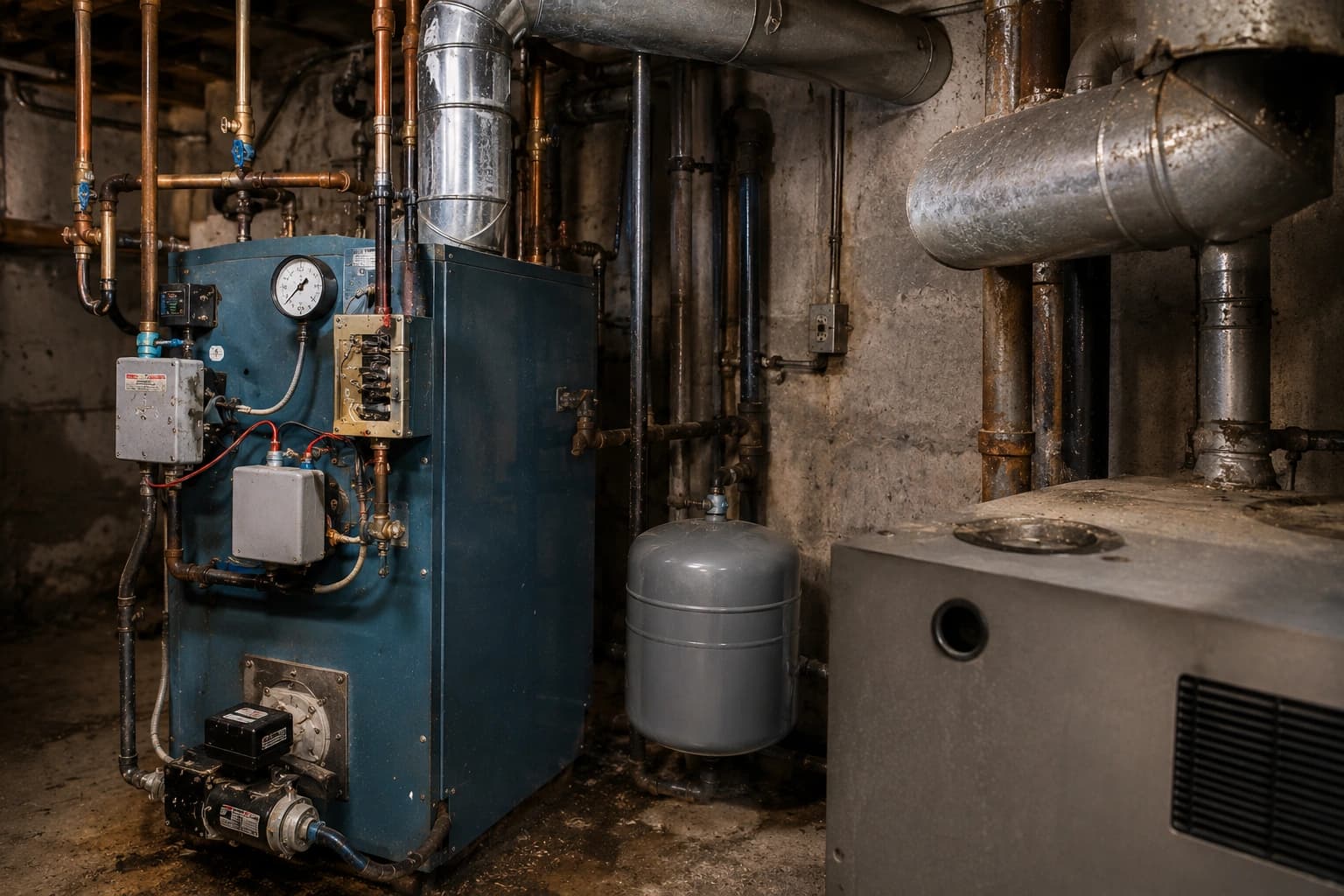
Boiler backdrafting can turn a no-heat call into a combustion-safety problem. In this documented Westford, MA, case, a steam boiler would not stay lit, its low-water cutoff had tripped, and the automatic feeder reportedly was not responding as expected. Draft and spillage testing then showed that combustion products were not moving safely through the chimney path.
The same visit found unsafe spillage at a chimney-vented water heater and heat damage at its three-inch vent connector. No carbon-monoxide reading or completed repair from that visit is reported here. Boiler backdrafting creates a serious CO-exposure risk, but the measured evidence should never be overstated.
Quick Answer: What Did the Boiler Backdrafting Test Show?
Quick answer: The Westford boiler backdrafting test indicated an unsafe obstruction or inability to establish proper chimney draft at the steam boiler, with a separate unsafe result at the water heater. Combustion products and heat were spilling instead of moving reliably outdoors. The affected appliances needed to stay off while the chimney, vent connectors, combustion, and safety controls were evaluated.
A draft result is not a complete chimney diagnosis. It shows how the vented appliance and flue path performed under the tested conditions, while a chimney contractor determines whether the path needs clearing, repair, relining, resizing, or another remedy. Boiler backdrafting is resolved only after the corrective work and all required appliance tests pass.
Safety First During Suspected Boiler Backdrafting
Carbon monoxide is colorless and odorless. If a CO alarm sounds or anyone may have exposure symptoms, get everyone outside to fresh air and call 911 from outside. Seek medical direction for symptoms and do not re-enter or restart the appliance until fire officials or another responsible authority clears the property.
If you smell gas or suspect a fuel leak, leave immediately without operating switches, phones, appliances, windows, shutoffs, plugs, or flames inside. From outside, call 911 and the gas utility or propane provider, then stay out until officials say the property is safe. Active smoke, flame, or fire also means leaving and calling 911.
Melted venting, soot, visible spillage, or recurring safety shutdowns without an active alarm are still stop-use conditions. Do not relight, reset, open, or test the equipment yourself. After official clearance when required, the Westford emergency-plumbing guide explains how to report the remaining no-heat condition and confirm service availability by phone.
The Documented Westford Boiler Backdrafting Case
I arrived to evaluate a steam boiler that would not stay lit. The low-water cutoff had tripped, and the automatic feeder was reported not to be supplying water as expected. Those were important findings, but the cutoff activation and the venting condition had to be investigated as separate safety questions instead of assigning one cause to every symptom.
Draft and spillage testing indicated that the chimney path could not establish safe draft for the boiler under the tested conditions. The working finding was an obstructed or blocked chimney path. Boiler backdrafting here means the demonstrated unsafe performance, not a completed structural chimney diagnosis.
The water heater also showed unsafe spillage during its check. Its three-inch vent connector had visible heat damage or melting, evidence that the system was not venting as designed. Whether the two appliances shared one flue is not established here, so each appliance and every applicable venting combination still requires its own documented evaluation.
Why a Boiler That Will Not Stay Lit Needs Differential Diagnosis
A steam boiler can shut down for low water, ignition or flame-proving trouble, fuel supply, controls, pressure limits, venting, combustion, wiring, or another safety input. In this case, the low-water cutoff response was documented, while boiler backdrafting was a separate unsafe finding. The evidence does not show which control ended each burner cycle.
The boiler shutdown diagnosis guide explains why repeated relighting or resetting can erase useful history without correcting a cause. A homeowner can record the thermostat call, gauge-glass level from a safe distance, display or control indicators, and when the shutdown occurs. Do not bypass a control, add jumpers, or keep operating equipment with suspected venting trouble.
For this Westford case, the immediate priority was not forcing another burner cycle. It was separating the water-level condition, feeder response, venting performance, and water-heater spillage so each failure path could be tested. That evidence-first approach is the basis of boiler diagnosis and repair.
What a Professional Draft Test Checks
In a boiler backdrafting investigation, draft is the pressure difference that moves combustion products from the appliance through the vent connector and chimney. A qualified test follows the exact appliance instructions and uses the specified test points and operating conditions. There is no responsible universal draft number for every steam boiler, water heater, chimney, fuel, and connector layout.
A complete boiler backdrafting investigation may combine several related checks:
- Visual vent inspection: connector size, pitch, support, joints, clearances, corrosion, heat damage, and accessible chimney connection
- Draft measurement: pressure at the manufacturer-directed point with an appropriate gauge or manometer
- Spillage observation: whether combustion products escape at a draft hood, relief opening, connector, or another unintended location during the required test
- Combustion analysis: model-appropriate flue-gas and operating measurements compared with the appliance requirements
- Ambient assessment: CO monitoring or other checks appropriate to the safety condition and work procedure
- Connected-appliance testing: when appliances share a vent path, every applicable firing combination and sizing condition belongs in the procedure
These checks answer different questions. A draft gauge does not identify the material blocking a chimney, and a combustion analyzer does not certify the chimney structure. Homeowners should not improvise boiler backdrafting tests with a match, candle, tissue, smoke, or a hand near a hot draft hood.
Draft, Spillage, Combustion, and CO Are Not the Same Measurement
Draft describes the pressure relationship moving flue gas. Spillage describes combustion products escaping at an unintended opening. Combustion analysis evaluates how the appliance is burning under defined conditions, while ambient CO monitoring checks the surrounding air.
One unsafe result can require shutdown even when another number has not yet been recorded. In this case, draft and spillage testing supported the boiler backdrafting finding; no CO ppm or combustion-analyzer values are reported here. This article therefore identifies a CO-exposure risk without claiming that a specific indoor concentration was measured.
Odor is not a CO test because CO has no smell. Soot, scorching, melted venting, condensation, or an exhaust-like odor can be reasons to stop and investigate, but none states a CO concentration. The instrument, sample point, operating condition, and test method belong in the written record.
Chimney Remediation After Boiler Backdrafting
Unsafe draft does not make a liner the automatic answer. A chimney contractor needs to determine whether the problem is an obstruction, damaged flue, unsuitable liner, sizing issue, structural condition, or another defect. The appliance inputs, vent connectors, chimney height and condition, fuel, and any shared-vent arrangement all affect the remedy.
Jeneral Plumbing's licensed scope can include the boiler and water-heater diagnosis, appliance vent-connector work, safety controls, and required return-to-service testing. Chimney clearing, structural inspection, repair, and liner work belong to the chimney contractor. Chimney relining, stainless (by chimney contractor): $2,400 – $6,500.
The chimney price is not a boiler-repair quote or proof that this case needed a liner. It is current scope context if inspection supports stainless relining. Repair and installation work is priced at a flat rate, with the total price and any applicable fees disclosed for approval before work begins.
After chimney work, boiler backdrafting cannot be considered resolved from a contractor's completion note alone. The appliance vent connectors, combustion air, draft, spillage, combustion, controls, and every applicable connected-appliance condition must be rechecked under the governing procedures before normal operation.
The Separate Water-Heater Venting Finding
During this boiler backdrafting case, the heat-damaged three-inch water-heater connector was a separate stop-use finding. Replacing a melted section without correcting the draft, chimney, clearance, sizing, support, or combustion condition could repeat the damage. The connector material and routing must match the exact appliance listing, manufacturer instructions, and applicable requirements.
A boiler backdrafting call can expose risks at another chimney-vented appliance because each connected load affects the venting review. That does not prove these two appliances shared a flue. The Westford water-heating guide covers model-specific water-heater assessment and safe replacement planning.
Before the water heater returns to service, its connector, chimney path, draft and spillage, combustion, safeties, and surrounding condition require the applicable checks. Heat-damaged material is evidence to investigate, not evidence of which person caused the problem.
What the Steam Low-Water Cutoff Did
The low-water finding ran alongside the boiler backdrafting evidence but answered a different safety question. A steam boiler's low-water cutoff is designed to stop burner operation when the water level falls below its sensing point. In this case, the documented trip shows that the control issued a low-water shutdown; it does not prove the actual boiler level, the feeder cause, or that the cutoff itself failed. A replacement recommendation alone is not a confirmed diagnosis without the separate control test.
The automatic feeder and low-water cutoff have related but different jobs. The cutoff is a burner safety, while the feeder adds makeup water when its control sequence calls for it. An automatic feeder is not a substitute for a working cutoff, and a cutoff trip does not prove that the feeder is the only cause.
I would inspect the gauge-glass indication, water supply, feeder valve and strainer where applicable, wiring, controls, probe or float chamber, boiler leakage, returns, and the exact device instructions. Float-type and probe-type controls have different testing and maintenance procedures, so there is no universal homeowner blowdown or reset instruction. Never bypass a cutoff or feed cold water into a hot boiler that may be dry.
The water-level diagnosis remains part of the Westford heating-system assessment, but it does not replace the chimney work. Both paths must be closed before a steam system can be returned to normal operation after boiler backdrafting.
Where Carbon-Monoxide Alarms Belong
CO alarms are an essential warning layer, not permission to operate unsafe equipment. As of August 2026, Massachusetts smoke and carbon-monoxide alarm guidance calls for approved CO alarms on every level, including habitable portions of basements and attics in most residences, and within 10 feet of bedroom doors on sleeping levels. Property type and current requirements still need to be confirmed.
Follow the listed alarm manufacturer's instructions for wall or ceiling position, mounting height, fuel-appliance clearance, power, interconnection, testing, end-of-life signals, and replacement. A basement alarm near the boiler level does not replace alarms outside sleeping areas. An alarm outside a bedroom does not replace draft and combustion testing at the appliance.
If an alarm sounds, leave first and call 911 from outside. Do not silence it and remain inside to search for boiler backdrafting. Re-enter only after officials clear the property and keep the affected equipment off until the cause has been diagnosed and corrected.
Warning Signs That Require a Steam-Boiler Safety Review
Boiler backdrafting is confirmed with testing, not a visual checklist. Still, the following observations justify stopping operation or arranging prompt diagnosis according to their severity:
- A CO alarm or possible exposure symptoms
- Visible combustion-product spillage, soot, or scorching around a draft hood or connector
- Melted, discolored, loose, corroded, or separated vent-connector material
- A burner or pilot that will not remain on, especially with repeated safety indications
- An unexpectedly low gauge-glass level or recurring low-water cutoff activation
- Water where it can reach burner, wiring, controls, or hot surfaces
- Smoke, flame, or active fire near the appliance or chimney connection
A symptom may have more than one cause. Do not identify CO by smell, judge combustion from flame color alone, or assume a reset makes the system safe. Preserve the observations and leave the equipment off while the condition is evaluated.
The Recommended Scope in This Boiler Backdrafting Case
This article covers the recommendations, not completed work. The safe scope began with keeping the affected appliances off, arranging chimney evaluation, assessing ambient CO as appropriate, diagnosing the water-level controls and feeder, cleaning and inspecting the boiler as the model and condition required, and correcting damaged or unsuitable vent connections.
The final chimney remedy depended on the chimney contractor's findings. The final low-water cutoff or feeder decision depended on device testing, not on the trip alone. The final boiler backdrafting resolution depended on successful post-work draft, spillage, combustion, control, and safety checks.
No finished chimney clearing, liner, control replacement, vent redesign, combustion result, or return-to-service outcome is documented. That means this article can explain the decision path but cannot claim the Westford system was repaired or that one recommended component solved it.
Professional Installation Means Pre-Evaluation and Post-Testing
For a chimney-vented appliance, installation begins with evaluating whether the proposed vent path can serve the selected equipment and connected loads. Appliance input, fuel, combustion air, connector size and route, chimney condition, clearances, controls, and service access belong in the design. A replacement cabinet does not make an existing chimney suitable.
After connection, commissioning verifies the installed system under the manufacturer procedure. Draft, spillage, combustion, safeties, water level, pressure controls, feeder operation, thermostat call, and applicable connected-appliance conditions are documented before handoff. The boiler-installation planning guide explains why the complete system matters more than a model-number swap.
Professional work does not mean blaming an earlier contractor without the original scope and test record. It means documenting the conditions found now, assigning chimney and appliance responsibilities correctly, correcting confirmed defects, and proving the repaired or replaced system passes its required checks. That is how a boiler backdrafting concern moves from shutdown to a supportable return-to-service decision.
Maintenance After a Boiler Backdrafting Repair
Maintenance cannot guarantee that a chimney will remain clear or that a safety control will never fail. It can document changing vent connections, soot, corrosion, water level, gauge-glass condition, feeder response, low-water cutoff operation, leaks, pressure controls, and combustion performance before some conditions become urgent. The exact appliance, chimney, and control instructions set the tasks and intervals.
The heating and plumbing service-plan guide can organize recurring boiler care, while a chimney contractor handles the chimney scope. A service visit does not replace CO alarms or homeowner attention between appointments. New shutdowns, visible damage, water-level changes, or alarm events deserve a fresh assessment rather than waiting for the next scheduled visit.
Westford Service Context for Boiler Backdrafting
Jeneral Plumbing is owner-operated by a Licensed Master Plumber (MA #9628831-PL-M) with 20+ years in the trade, including seven years with a gas utility. From my Westford, MA, base, I serve the 26-town core across Middlesex & Worcester County and southern New Hampshire, including Westford, Chelmsford, Acton, Littleton, Groton, Carlisle, and Billerica. I confirm the appliance, fuel, chimney arrangement, and service fit at the address instead of assuming one town predicts the system.
The Lunenburg article linked above is educational cluster support, not a service-area claim; Lunenburg is outside the 26-town core. The documented boiler backdrafting case itself occurred in Westford. Timing, safety clearance, and service availability are confirmed by phone without a response-time promise.
Key Takeaways From the Boiler Backdrafting Case
- The Westford steam boiler would not stay lit, its low-water cutoff had tripped, and its automatic feeder reportedly was not responding as expected.
- Draft and spillage testing indicated unsafe chimney performance at the boiler and a separate unsafe result at the water heater.
- No CO concentration, exact draft pressure, obstruction cause, shared-flue layout, completed repair, or return-to-service result is documented.
- A tripped low-water cutoff shows a safety response; it does not prove that the cutoff failed or that the feeder was the only cause.
- Chimney inspection, clearing, repair, and relining belong to a chimney contractor; appliance and vent-connector work require their own licensed scope and tests.
- CO alarms belong on every required level and outside sleeping areas, but they do not replace draft, spillage, combustion, or safety-control testing.
Frequently Asked Questions
What is boiler backdrafting?
Boiler backdrafting is an unsafe condition in which combustion products do not move reliably through the intended vent and chimney path. They may spill at a draft hood, relief opening, connector, or another unintended location. A qualified test uses the appliance procedure, appropriate instruments, and observed operating conditions. A visual clue alone does not establish the cause or a CO concentration.
What should I do if a CO alarm sounds near my boiler?
Get everyone outside to fresh air and call 911 from outside. Do not remain inside to locate the source, silence the alarm, or operate the boiler. Seek medical direction if anyone may have symptoms. Stay out until officials clear the property, then keep the equipment off until licensed diagnosis and required testing are complete.
Can I perform a boiler draft test myself?
No homeowner experiment can establish safe draft. The procedure depends on the appliance, test point, operating condition, chimney, fuel, and connected venting, and it may require a draft gauge, combustion analyzer, and ambient monitoring. Matches, smoke, candles, or a hand near the hood can expose you to hot surfaces and combustion products. Record symptoms and leave the test to a qualified professional.
Does a blocked chimney always need a stainless liner?
No. A chimney contractor first determines whether the issue is an obstruction, damaged flue, unsuitable liner, sizing problem, structural defect, or another condition. Clearing, repair, relining, resizing, or abandoning the path are different remedies. After chimney work, the appliance still needs its required draft, spillage, combustion, and safety tests.
What do the low-water cutoff and automatic feeder do?
The low-water cutoff stops burner operation when water falls below its sensing point. The automatic feeder adds makeup water when its control sequence calls, but it does not replace the cutoff. A trip can involve low water, slow returns, leakage, feeder trouble, wiring, a sensing issue, or another condition. Do not bypass the control, force repeated resets, or add water to a hot boiler that may be dry.
Where should carbon-monoxide alarms be installed?
Massachusetts guidance calls for approved CO alarms on every required level and within 10 feet of bedroom doors on sleeping levels in most residences. Follow the listed manufacturer's instructions for exact mounting, clearance, power, testing, and replacement. A basement alarm is useful on the boiler level but does not replace alarms near sleeping areas. If any CO alarm sounds, leave and call 911 from outside.
Close the Safety Loop After Boiler Backdrafting
Boiler backdrafting is not resolved by clearing a code, replacing a melted connector, or completing chimney work in isolation. The water-level controls, appliance vent connections, chimney path, combustion, draft, spillage, safeties, and connected appliances all need the tests that apply to the installed system. I document what failed, who owns each corrective scope, and what must pass before normal operation.
Call Jeneral Plumbing at (978) 392-7789 to discuss a Westford steam-boiler assessment after any active gas, CO, smoke, or fire emergency has been cleared.
Written by Jeneral Plumbing.
This article was drafted with AI writing tools and edited before publication. AI tools did not inspect any job or validate technical conclusions.
Last updated .