
Combi boiler service within 20 miles of Westford
Combi Boiler Assessment & Service in Westford, MA
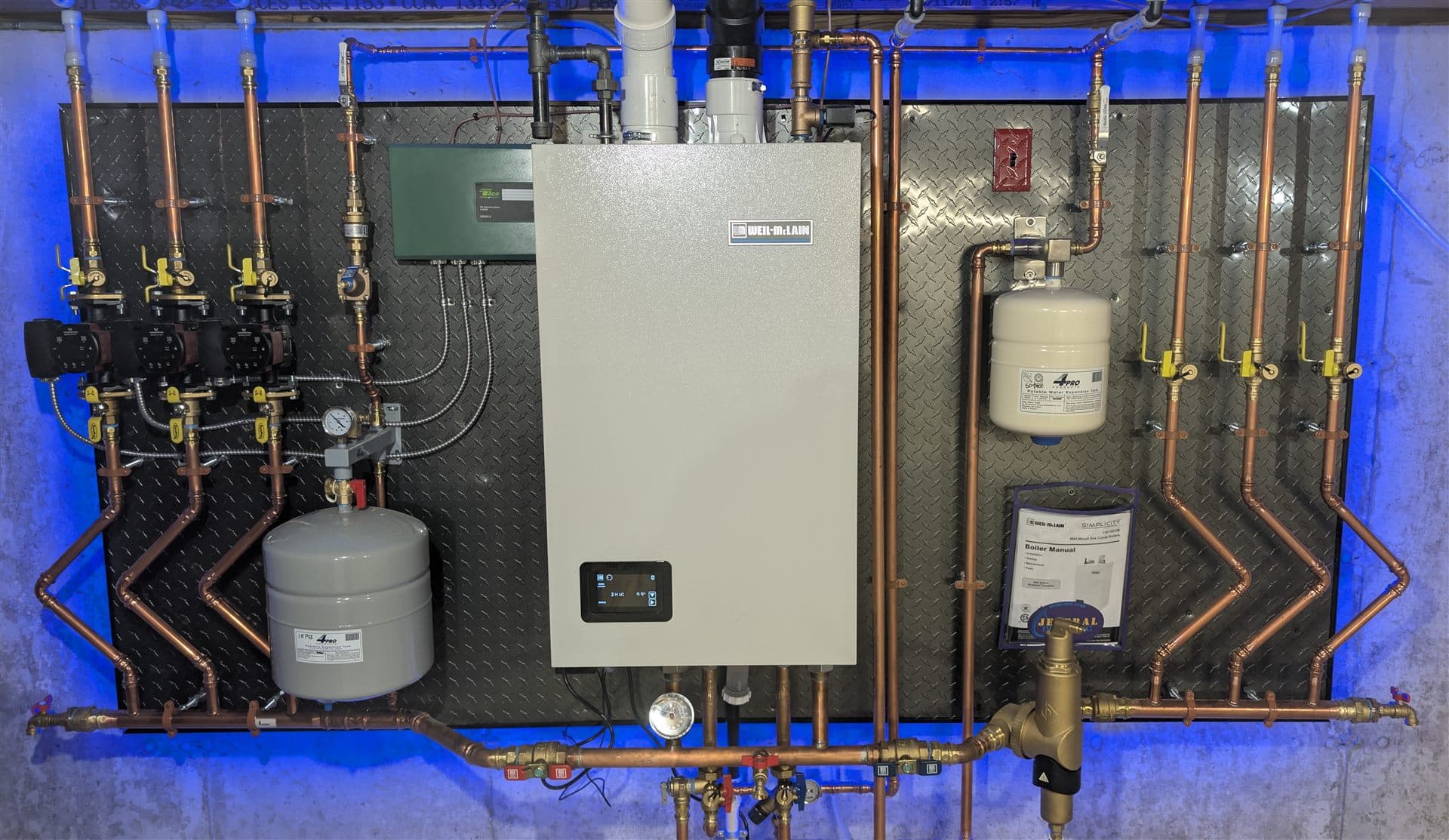
A combi boiler heats your home and makes your hot water from one compact appliance. That can save space — but one fault can cost you heat, hot water, or both. Jeneral Plumbing repairs and services combi boilers for homes within 20 miles of Westford, MA. When you’re considering a new one, we look at your heating load and hot-water use together before recommending a model.
Clear scope before work begins
A Service Visit Built Around Your Home
Measure both demands
We look at how much heat your house needs on the coldest days and how much hot water you use at your busiest times, because either one can drive the equipment choice.
Check the connected system
Fuel supply, venting, condensate drainage, water quality, the water temperature your baseboard or radiators need, controls, access, and service clearance all affect fit.
Confirm the equipment fits
You get a written scope that says what the proposed equipment can handle, which connected work is included, and what still needs confirmation.
One appliance, two jobs
How a Combi Boiler Heats the Home and Domestic Water
A combi boiler warms the water that circulates through your baseboard or radiators and also heats tap water on demand, without a separate storage tank. When a faucet or shower opens, the controls give hot water priority. The heating zones wait until that demand ends, then get the boiler’s output back.
That can free up floor space, but it ties two daily needs to one appliance. For a combi to feel dependable, its winter hot-water flow, the home’s heating load, the way heat is distributed, the controls, and your household’s habits all have to line up.
- Hydronic space heating and domestic hot water in one cabinet
- No separate storage tank in the standard combi arrangement
- Hot-water priority controlled by the appliance
- Output limited by model capacity and real winter conditions
Compatibility before equipment selection
Combi Boiler Installation Planning Starts with Two Loads
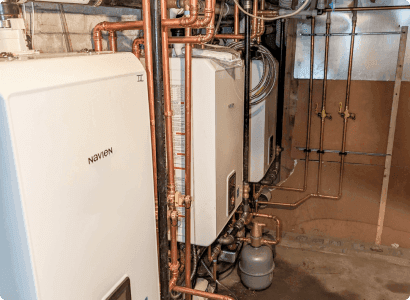
Combi installation planning starts with a heating-load review and a realistic picture of your household’s busiest hot-water use. Then come the details: household size, fixtures running at the same time, a large tub, incoming-water temperature, the hot-water temperature you want, the existing radiators or baseboard and the water temperature they need, fuel capacity, venting, condensate, controls, and service access. Any one of them can rule a combi in or out.
Here’s how the numbers work together. Say your household needs 4.0 gallons per minute of hot water, the incoming water measures 40°F in winter, and the target temperature leaving the boiler is 120°F. The combi has to deliver that full flow across an 80°F temperature rise. Flow at a mixed shower is a separate measurement, because the shower valve can blend in cold water. These figures show the method; they aren’t a promised flow rate or a model recommendation.
Jeneral Plumbing checks those conditions in person and lays out whether a combi, and the work connected to it, fits your property. Not every Westford home suits a combi, and we’ll tell you if yours doesn’t.
For a planned project, send a combi boiler assessment request and tell us about your current equipment, the rooms involved, and your hot-water needs. We’ll confirm the next step before anything is scheduled.
Temperature rise changes available flow
Sizing for Cold Massachusetts Groundwater
In a Middlesex County winter, the water coming into your home can be much colder than the mild-inlet example in a manufacturer’s literature. The colder that water, the more the combi has to heat it to reach a comfortable shower or faucet temperature — and the less hot-water flow a given model can deliver.
That’s why the hot water needed for fixtures running at the same time often sets the size of a combi, even in a house with a modest heating load. Before recommending equipment, we compare the measured or documented winter inlet temperature, your target hot-water temperature, and fixture flow against the manufacturer’s performance table.
Fit beats a universal ranking
Choosing the Best Combi Boiler for the Actual System
There’s no single best combi boiler — only the best fit for your house. The right model covers your heating and hot-water needs, suits your fuel and vent route, works with your heating system and controls, leaves room for service, and has parts support and a warranty that match your goals.
We work with combi models from Navien, Rinnai, Viessmann, and Weil-McLain, and we recommend one only when it fits the home. Jeneral Plumbing is owner-operated by a Licensed Master Plumber who is factory trained by Navien, Rinnai, and Weil-McLain and holds Navien Service Specialist (NSS) certification. Viessmann is a heating partner.
A bigger unit won’t fix every hot-water shortfall, and oversizing can create operating problems of its own. We choose the model after the load and hot-water numbers are in, checking the manufacturer’s performance data at realistic New England conditions rather than the headline maximum.
Compare the full arrangement
Combi Boiler vs. Conventional Boiler Systems
A combi handles heat and on-demand hot water in one appliance. A conventional setup can pair the boiler with separate water-heating equipment, such as an indirect tank the boiler heats. That takes more room, but it separates hot-water storage, recovery time, and service decisions from the heating side.
Neither layout wins on paper. For your home, the comparison comes down to peak hot-water demand, available space, heating load, system water temperatures, how you feel about maintenance, how much redundancy you want, the equipment already in place, and the total connected work.
| Decision point | Combi consideration | Conventional consideration |
|---|---|---|
| Domestic hot water | Produced on demand within the unit’s flow and temperature-rise limits | Often stored or produced by separate equipment with its own capacity and recovery |
| Equipment footprint | One compact appliance can reduce floor-space use | Separate components need more room but can separate functions |
| Venting and condensate | The selected combi needs a compliant vent route, combustion air, and condensate disposal | The boiler and separate water heater each keep their applicable venting and drainage requirements |
| DHW recovery and peak use | Hot water is produced continuously within the model’s temperature-rise and flow limits | Stored hot water can serve a short peak, then recovery depends on tank and heat-source capacity |
| Service impact | One appliance affects both heating and hot water when it is offline | Separate equipment can isolate some failures but adds components |
| Service items | One cabinet concentrates combustion, condensate, controls, heat exchangers, filters, and domestic-water service points | The boiler and water heater have separate controls, safety devices, and maintenance tasks |
| Selection basis | Both heating and peak hot-water loads must fit one appliance | Each component can be sized around its assigned function |
Compact is not the same as universal
Where a Combi Boiler Doesn’t Fit
A combi may be the wrong choice if you fill a large soaking tub, have three or more bathrooms that are often in use at the same time, or draw more hot water at your busiest moment than the selected model can deliver in winter. In those homes, a separate storage arrangement can be the better match, even though it takes up more space.
If a carbon monoxide alarm sounds or you smell gas, get everyone out, call 911 from outside, and stay out until the fire department or gas utility says it’s safe. Call a plumber only after that. For a planned combi installation in Massachusetts, the gas supply can limit the equipment choice. If the meter, regulator or customer-owned piping cannot carry the connected load, review gas-line sizing and installation planning for the piping work and any utility coordination. We handle combi gas connections and gas venting in Massachusetts only; we do not offer New Hampshire fuel-gas work.
The combi boilers on this page supply hot-water heat, not steam. If your home heats with steam radiators, start with a steam-boiler replacement assessment rather than assuming a combi can replace the steam boiler directly.
Two functions can share one symptom
Combi Boiler Problems and Complete Service
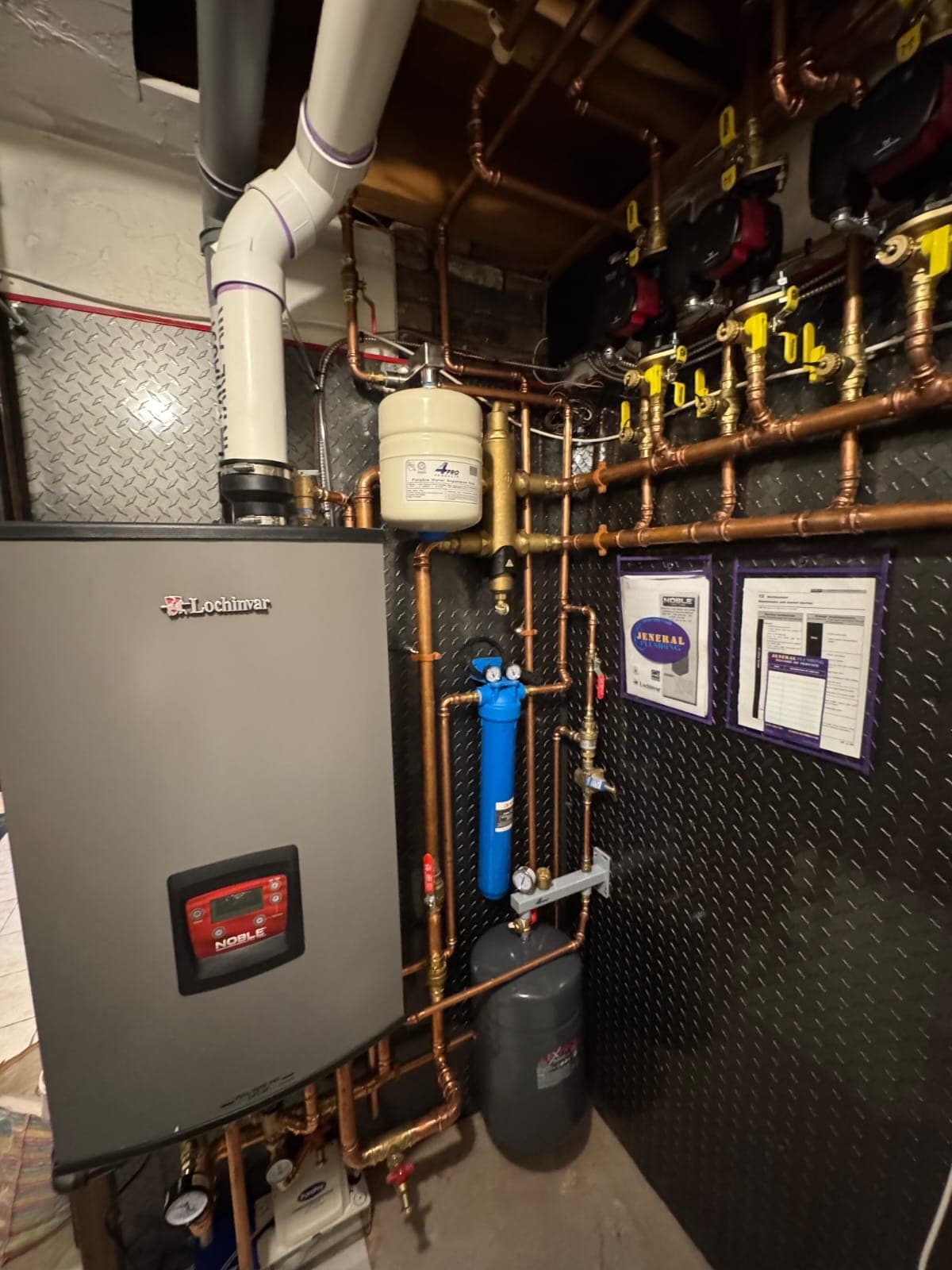
Combi trouble can look like no heat, no hot water, or both. You might also notice temperatures that swing, pressure that climbs or drops, repeated shutdowns, a fault code, noise, a leak, or poor circulation, sometimes on only one side of the appliance. The cause could be controls, sensors, ignition, combustion, a heat exchanger, a pump, a diverter valve that switches output between heat and hot water, venting, condensate, water quality, or the heating system connected to the boiler.
Jeneral Plumbing’s Combi Boiler Complete Service covers both the heating and hot-water sides with checks suited to your model. A fault code tells us where to start testing; it does not identify a replacement part on its own.
For a shutdown, a water leak, or loss of heat, start with the boiler diagnosis and repair guide and call us with the model, the code on the display, and whether heating, hot water, or both are affected.
Care for both functions each year
Annual Combi Maintenance Checklist
Combi boiler maintenance has to cover both sides of the appliance. A yearly visit follows your model’s service instructions and what we find that day, and we look at the heating and domestic-hot-water sides together, because scale, restricted flow, condensate trouble, or a combustion problem can affect each side differently — steady heat, for example, with lukewarm showers.
If your Service Plan includes a waived dispatch fee, that benefit is separate from the maintenance work itself. What the visit covers, and any repair we recommend, depends on your equipment’s condition and the manufacturer’s requirements.
- Inspect the venting, combustion-air path, burner, and model-specific combustion results
- Check the condensate trap, drain route, neutralizer where installed, and signs of leakage or blockage
- Clean or inspect system and domestic-water filters or strainers as the model requires
- Evaluate water quality and descale the domestic heat exchanger when condition and manufacturer guidance call for it
- Review pressure, expansion control, pumps, diverter operation, safety controls, and visible piping
- Record fault history, operating findings, and repair recommendations
No useful price without a defined scope
How Much Does a Combi Boiler Cost?
What a combi costs depends on the equipment you choose and the work needed to connect it to your home. Heating load, hot-water demand, fuel capacity, venting and combustion air, condensate, water quality, piping, system water temperatures, controls, electrical work, access, removal of the old equipment, permits, and commissioning can all change the scope of service or installation work.
An equipment-only Navien combi boiler price excludes the work needed to connect it to your home. The installed total changes with the model and output your home needs, the vent route, the gas supply from the meter to the unit, and any water treatment the manufacturer’s manual calls for on the hot-water side. The same is true of any brand. We define the connected work and set your written flat-rate price after seeing the home, and you approve that price before any work begins.
Jeneral Plumbing is based in Westford, MA, and serves homes across Middlesex & Worcester County. We check combi fit the same way in Chelmsford, Acton, Littleton, Groton, Carlisle, Tyngsborough, Dunstable, and the rest of our service area.
Helpful next steps
Plan the Connected Work
Jeneral Plumbing
Local facts, clear expectations
- Jeneral Plumbing is owner-operated by a Licensed Master Plumber (MA #9628831-PL-M), with more than 20 years in the trade, seven years with a gas utility, Navien Service Specialist (NSS) certification, and factory training from Navien, Lochinvar, Rinnai, Weil-McLain, and Noritz.
- 5 Westford Hills Rd, Unit 5119, Westford, MA 01886 · office@jeneral-plumbing.com
- Mon–Fri 7:00 AM – 5:00 PM · Sat 8:00 AM – 3:30 PM · Sun Closed · 24/7 emergency — confirmed by phone
- (978) 392-7789For regular-hours visits, the cost is an $80 dispatch fee — the cost of the visit, waived when you hire us for the work. Off-hours, holiday, and Sunday dispatch has a $599 emergency callout fee — non-refundable, non-negotiable, collected prior to dispatch, covers the dispatch only and is never applied to repair work.Personal-loan offers through Hearth may include up to $250,000 with terms up to 12 years, subject to lender approval. Separate credit-card offers may include 0% introductory APR for qualified applicants. Rates, fees, terms, and eligibility depend on the applicant, lender, and offer. Funding timing depends on the lender and completed approval. Confirm it before scheduling work. See financing options and the lender disclosure.Jeneral Plumbing offers separate senior and church community discounts. Eligibility and the discount are confirmed with the approved project scope and price.
Straight answers
Frequently Asked Questions
Is a combi boiler right for my home?
It can be, if one appliance can cover both your heating load and your busiest winter hot-water use, and your fuel supply, venting, condensate route, heating distribution, controls, and service space all support the model. Large simultaneous hot-water demand, steam radiators, or incompatible system conditions can point to a different arrangement. We check those limits at your home before a model is chosen.
What affects combi boiler cost?
Combi boiler cost depends on the equipment and the connected work: venting, fuel supply, piping, controls, permits, and commissioning. Two homes can need different installations even with the same appliance. Jeneral Plumbing provides a written flat-rate scope after seeing the property, so you can review the full project before approving it. During regular hours, that assessment visit carries an $80 dispatch fee — the cost of the visit, waived when you hire us for the work.
How does a combi boiler compare with a conventional boiler?
A combi can save space by doing both jobs in one appliance. But when it’s down, you can lose heat and hot water together, and its hot-water flow is capped by the model. A conventional boiler with separate water-heating equipment takes more room but can store hot water for a short peak. Your space, peak demand, redundancy goals, existing equipment, and connected work decide which layout fits.
What are common combi boiler problems?
Common signs include losing heat, hot water, or both, along with unstable temperatures, pressure changes, shutdowns, fault codes, noise, or a leak. Controls, sensors, ignition, a heat exchanger, a pump, the diverter valve, venting, condensate, water quality, or the connected system can be responsible. A code shows where to start looking; it doesn’t prove which part failed.
How often should a combi boiler be serviced?
Most residential combis benefit from professional service once a year, with the manufacturer’s instructions and the unit’s condition setting the exact tasks and timing. A complete service visit looks at both the heating and hot-water sides, including venting, condensate, combustion, controls, and water-side checks suited to the model. Regular service tells you where the equipment stands, but it can’t guarantee a part won’t fail later.
What size combi boiler do I need for a 3-bedroom home?
Bedroom count alone won’t tell you. Sizing starts with the home’s heating load, how many fixtures run at once and at what flow, the measured or documented winter incoming-water temperature, your target hot-water temperature, and available fuel capacity. A three-bedroom home where showers rarely overlap can need a different hot-water output than a similar home with several showers running together or a large tub. Jeneral Plumbing checks those demands against manufacturer performance data before recommending a model.
Assess the Combi Boiler Fit Before Choosing Equipment
Book a visit and we’ll look at your heating load, hot-water use, connected work, and service needs together. Then we’ll lay out in writing what a combi would involve before you choose equipment.
Serving Homes Within 20 Miles of Westford
See our related local service page for Westford, in Middlesex County:
Combi Boiler Assessment & Service Across Westford & Middlesex County
Based in Westford, Massachusetts, Jeneral Plumbing serves homes within 20 miles. Our directory lists 26 towns across Middlesex & Worcester County and southern New Hampshire. Find local plumbing help in the towns nearest us:
Plumbing Tips From Our Blog
All ArticlesRepair or Replace a Combi Boiler? A Westford Decision Guide
Repair or replace a combi boiler after weighing age, repeat faults, warranty, and combustion results. A six-year-old Noritz case shows the decision.
Read Article Emergency ServicesNavien Combi Boiler Running Constantly? Westford Guide
Navien combi boiler running constantly? This Westford guide covers heat calls, outdoor reset, error 351, vent settings, thermostat signals, and commissioning.
Read Article HeatingBoiler Combustion Test: What a Lowell Noritz Case Showed
A Lowell Noritz case shows why orange flame and blown fuses need a boiler combustion test plus separate electrical diagnosis before return to service.
Read Article