Navien Error Code 110 in Westford, MA: Safe Next Steps

Navien Error Code 110 in Westford, MA: Safe Next Steps

Jeneral Plumbing

Water Heating

Navien error code 110 points the diagnosis toward abnormal air pressure or the combustion-air and exhaust pathway on applicable tankless models. It is not a flame-loss code, and it does not prove that the heat exchanger has failed. I first confirm the exact model and manual, then separate an intake, exhaust, termination, fan, air-pressure-sensing, condensate, or configuration problem from any corrosion or component damage found during inspection.

This Westford, MA, guide uses an observed Hudson case to show why that separation matters. The Hudson visit occurred outside Jeneral Plumbing’s current 23-town core and is included as an educational case, not a promise of routine Hudson coverage. The source documents Navien error code 110, intermittent hot water, visible deposits, venting conditions, and the start of a warranty-documentation process, but it does not preserve the complete test record or a completed repair.

Quick Answer: What Does Navien Error Code 110 Mean?

Quick answer: On applicable Navien tankless water heaters, Navien error code 110 identifies an abnormal air-pressure or intake-exhaust-path condition. Navien’s legacy NPE user manual labels E110 “Abnormal air pressure.” Possible branches include an obstructed termination, snow or debris, an intake and exhaust arrangement that recirculates combustion products, model-incompatible vent material or geometry, excessive equivalent length, a fan or air-pressure-sensing problem, condensate or icing conditions, wiring, or configuration. The exact model manual controls the tests.

Navien error code 110 does not identify one failed part. It does not, by itself, prove poor combustion, a gas-supply problem, heat-exchanger failure, installer fault, or warranty eligibility. A qualified diagnosis verifies the air path and operating evidence before a repair or replacement scope is approved.

When an Airflow Fault Becomes a Safety Stop

A Navien error code 110 display without escaping flame, smoke, fire, gas odor or a suspected fuel leak, a sounding carbon-monoxide alarm, or possible exposure symptoms is not automatically an emergency. Still, a repeating airflow-related fault is a reason to stop repeated resets and arrange model-specific service. Running a unit while its intake or exhaust is restricted can create unsafe operation and further damage.

If you smell gas or suspect a fuel leak, get everyone outside immediately. From outside, call 911 and, as applicable, the gas utility or propane provider; do not plug in or unplug anything, and do not operate lights, switches, phones, appliances, windows, shutoffs, or flames inside. Stay out until the fire department, gas utility, or propane provider clears the property.

Carbon monoxide has no smell. If a CO alarm sounds, anyone has possible exposure symptoms, or flame, smoke, or fire is present, leave immediately and call 911 from outside. Stay out until officials clear the property, and seek medical direction for possible exposure symptoms. An alarm does not make a tankless water heater safe to keep operating.

The Observed Hudson Tankless Case

The Hudson record behind this Navien error code 110 guide describes a family that had moved into a Massachusetts home and found inconsistent hot water. The Navien NPE-A series unit reportedly cycled on and off, and a later source note identifies it as a 2019 NPE-240A. The record does not preserve the full display, subcode, exact installation date, registration evidence, combustion readings, or prior service history.

This is what happens when they fail.

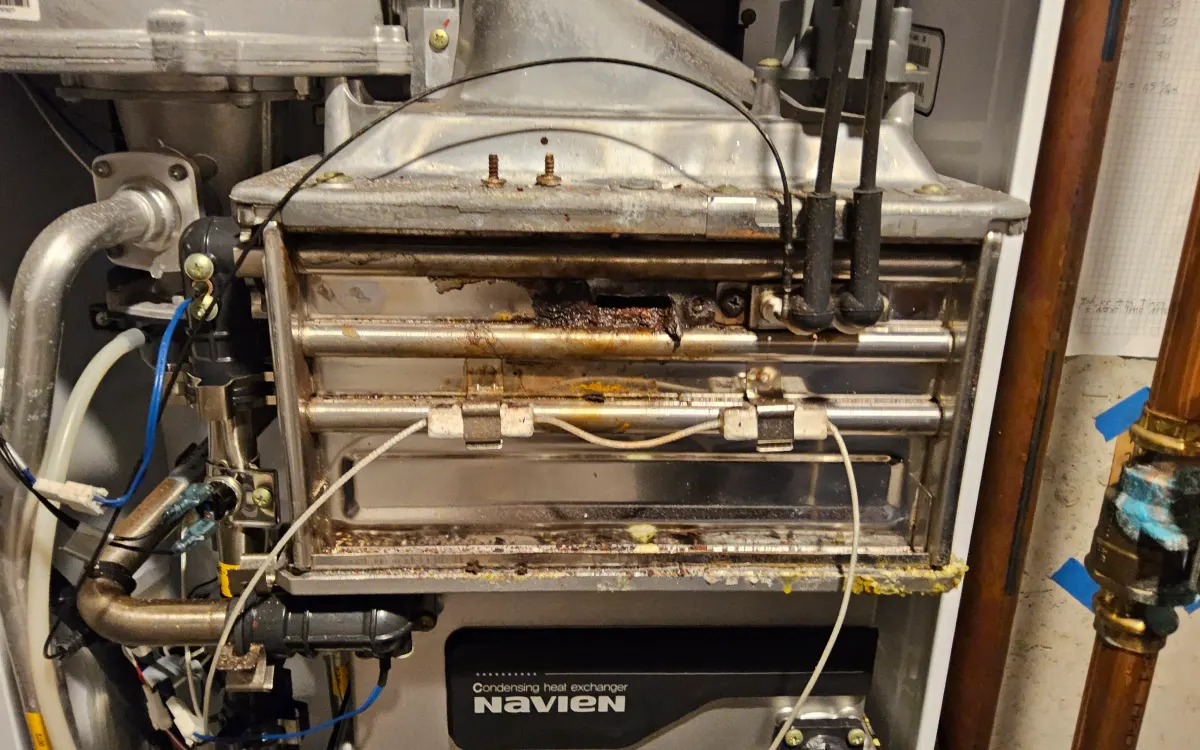
Inspection notes describe white or chalky deposits and corrosion around the sight-glass and ignition area. Those are meaningful observations, but appearance alone does not prove years of overheating, failed maintenance, a leaking heat exchanger, or one venting cause. Residue can involve water leakage, condensate, seals, combustion conditions, or another nearby source, so I trace where it starts and test the affected system.

The record says heat-exchanger replacement and a Navien warranty claim were pursued. It does not preserve a teardown finding, Navien’s written approval, part delivery, completed replacement, corrected venting, return-to-service results, or long-term outcome. The case therefore shows why Navien error code 110 can lead to a broader inspection; it cannot establish that E110 automatically means the exchanger needs replacement.

How Navien error code 110 evidence should be separated before a repair decision
Evidence or branchWhat it can directWhat it does not proveSafe next step
Displayed E110Model-specific abnormal air-pressure, intake, or exhaust diagnosisA failed heat exchanger, ignition component, or gas valveRecord the full display and confirm the exact model manual
Exterior termination conditionChecks for visible snow, ice, leaves, debris, damage, or recirculation riskThat the entire concealed vent run is correctObserve from ground level without touching or disassembling the termination
Vent route and materialsDiameter, approved material, equivalent length, elbows, slope, supports, joints, and clearancesThat one universal separation or length fits every modelCompare the complete installed path with the exact listing and current requirements
Fan and air-pressure controlsFan operation, sensing tubes or devices, wiring, power, control response, and model procedureWhich component failed without measurementsHave a qualified professional follow the model-specific electrical and operating test procedure
Corrosion or white residueLeak tracing, condensate review, seals, exchanger inspection, and combustion evidenceThat Navien error code 110 caused the damageFind the source and full damage boundary before ordering an exchanger
Warranty historyModel, serial, application, install documentation, registration, maintenance, and current termsAutomatic part approval, labor coverage, or a completed repairSubmit the required evidence and wait for Navien’s determination

The table is a diagnostic map, not a homeowner repair procedure. Navien model generations can label and test conditions differently, so the rating plate and exact manual come before a parts conclusion. Navien error code 110 narrows the search; it does not replace measurements. Navien error code 110 should stay tied to recorded airflow evidence until testing proves a narrower fault.

What a Model-Specific Airflow Diagnosis Checks

For Navien error code 110, I begin by documenting whether the code is active or stored, what demand was present, and whether the unit was firing, attempting ignition, running a fan, or stopping during a particular sequence. I record the exact model and serial number, vent material and diameter, visible termination conditions, and any other codes. A single successful reset does not show that the air path is sound.

Next, I compare the intake and exhaust with the appliance instructions: developed or equivalent length after elbows, approved materials and transitions, diameter, slope, supports, joint assembly, termination layout, clearances, and any common-vent provisions. I also inspect the condensate path and freeze exposure where they can affect airflow or drainage. The selected model, not a generic online diagram, sets the limits.

The operating branch can include fan command and speed, air-pressure sensing, tubing or ports where the model uses them, wiring, power, control response, gas conditions, ignition, and combustion evidence. I follow the manufacturer procedure rather than bypassing a switch or substituting a part from the code alone. If Navien error code 110 returns, the reason must be demonstrated under the conditions that reproduce it.

Where corrosion, leakage, heat damage, or unusual residue is present, I trace that condition independently. I inspect accessible exchanger and seal areas, water and condensate paths, ignition components, and surrounding damage without assuming the code created it. That separation keeps an airflow repair from overlooking a leak and keeps visible residue from turning into an unsupported heat-exchanger diagnosis.

Venting Conditions That Can Trigger E110

Because Navien error code 110 can arise from an air-path condition, tankless venting must be treated as part of the listed appliance system. Intake and exhaust cannot be judged by pipe color or one terminal measurement. Each project must account for the exact model, fuel, material, diameter, fittings, total equivalent length, vertical and horizontal sections, supports, slope, condensate, termination geometry, snow line, openings, grade, corners, soffits, and occupied outdoor areas.

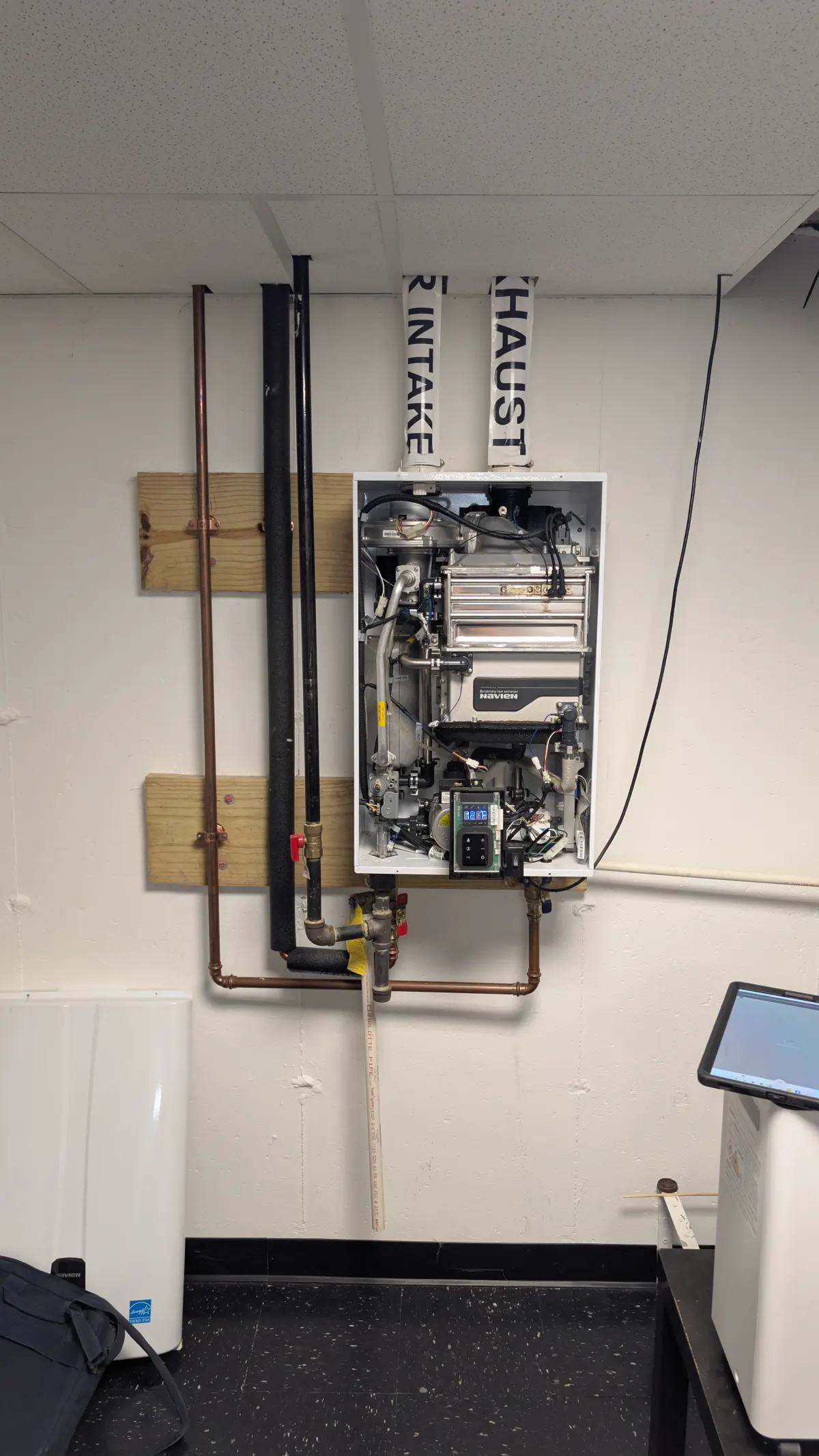
In the Hudson record, the intake and exhaust were reported about 12 inches apart, with the exhaust terminating below or near a porch. That observation did not prove compliance or noncompliance because the complete model table, opening clearances, porch geometry, prevailing conditions, and measured combustion evidence are absent. It did identify a termination condition that required review before returning the unit to normal use.

Process Photo

The same record describes both pipes running roughly 18 feet vertically in a 16-inch bay. Neither figure proves that the route was acceptable or excessive. Elbows, pipe size, material, support, slope, total equivalent length, terminations, and the exact NPE-240A instructions would be needed, and the source does not preserve the final vent correction.

Exhaust recirculation beneath or around a porch was a diagnostic possibility, not a measured cause of exchanger damage. Wind and pressure zones around corners, overhangs, fences, vegetation, snow, and nearby openings can change how a termination behaves. I look for physical evidence and test operation instead of assigning causation from a photograph.

Venting Mistakes to Rule Out Before Heat-Exchanger Work

Common venting mistakes can produce airflow faults, intermittent operation, condensate trouble, or unsafe combustion. They do not all produce Navien error code 110, and the code does not identify which one is present. The exact manual and installed conditions decide which checks apply.

  • Blocked or vulnerable terminations: snow, ice, leaves, nests, debris, landscaping, or a termination placed where routine accumulation is likely.
  • Intake and exhaust interaction: geometry that lets exhaust enter the combustion-air intake under certain wind or pressure conditions.
  • Wrong material or diameter: pipe, fittings, adapters, or transitions that are not approved for the model and configuration.
  • Excessive equivalent length: a run that ignores elbow penalties, reducers, vertical allowances, or the manufacturer’s complete calculation.
  • Poor slope, support, or joint assembly: sagging, trapped condensate, separation, leakage, or stress at the appliance and termination.
  • Clearance conflicts: terminations too close to grade, openings, meters, corners, soffits, porches, walkways, or occupied areas under the applicable instructions and code.
  • Unlisted screens or guards: an aftermarket restriction added without approval for the exact unit and climate conditions.
  • Settings that do not match the vent system: installer parameters changed without identifying the exact material, application, and model requirements.

A visible exterior pipe does not reveal the full concealed route. I do not use smoke, tissue, incense, or a homeowner airflow test at the termination. Navien error code 110 diagnosis belongs with the appliance operating under its specified procedure and the vent system evaluated as a whole.

Safe Homeowner Steps After E110

After Navien error code 110 appears, homeowners can preserve useful evidence without opening the appliance or altering a safety system:

  • Photograph the entire display, including any subcode, operating icon, and other stored codes.
  • Record the model and serial number from an accessible rating label without removing a cabinet panel.
  • Note whether Navien error code 110 appears during hot-water demand, at a certain flow, in wind, after snow, or during freezing weather.
  • From ground level only, look for obvious snow, ice, leaves, debris, damage, or a blocked exterior termination.
  • Stop repeated resets. If the exact homeowner manual allows one reset, follow that user-level instruction only when there is no gas odor or suspected fuel leak, no sounding CO alarm or possible exposure symptoms, no escaping flame, smoke, or fire, and no visible damage or blockage; if the code returns, leave the unit off.
  • Keep the cabinet, vent joints, gas controls, wiring, sensors, and installer settings untouched.

Do not climb, reach into a termination, remove a screen, add a guard, disconnect venting, bypass a pressure device, or try to clear a concealed obstruction. Do not keep demanding hot water to see whether the fault goes away. A repeating Navien error code 110 needs a documented air-path diagnosis.

Why E110 Does Not Prove Exchanger Failure

A heat exchanger transfers burner heat into the water path, while Navien error code 110 begins with abnormal air-pressure or intake-exhaust evidence on applicable models. The systems interact during combustion, but interaction is not proof of failure. A restricted air path can affect operation without damaging the exchanger, and an exchanger or seal can leak without being the cause of the airflow code. That distinction is central to a Navien error code 110 diagnosis.

In the observed case, deposits near the sight glass and ignition area justified a close leak, condensate, seal, combustion, and exchanger inspection. Replacement should follow confirmation of the damage boundary, parts availability, warranty status, and correction of the contributing condition. Installing a new exchanger without correcting a vent, water, condensate, gas, or control problem can leave the root issue in place.

I also compare repair with complete replacement when damage extends beyond a serviceable exchanger, critical parts are unavailable, the vent system needs major redesign, connected gas or water conditions remain unsuitable, or the full correction is poor value. The decision is property-specific and age alone does not decide it. The tankless-water-heater guide explains sizing, venting, maintenance, and replacement inputs without turning Code 110 into an automatic sales trigger.

Navien’s legacy NPE-A warranty table lists a 15-year heat-exchanger term for qualifying residential standard or controlled-recirculation applications. Other applications and configurations can carry shorter terms. Eligibility still depends on the exact model and application, serial number, installation date, registration or proof requirements, installation, maintenance, water conditions, and the current written terms; Navien decides whether a claim qualifies.

The Hudson source says Navien technical support was contacted and documentation was started for the 2019 NPE-240A. Requested evidence reportedly included photos of the observed corrosion and exterior venting. That supports a claim-initiation statement, not a claim approval or completed heat-exchanger replacement.

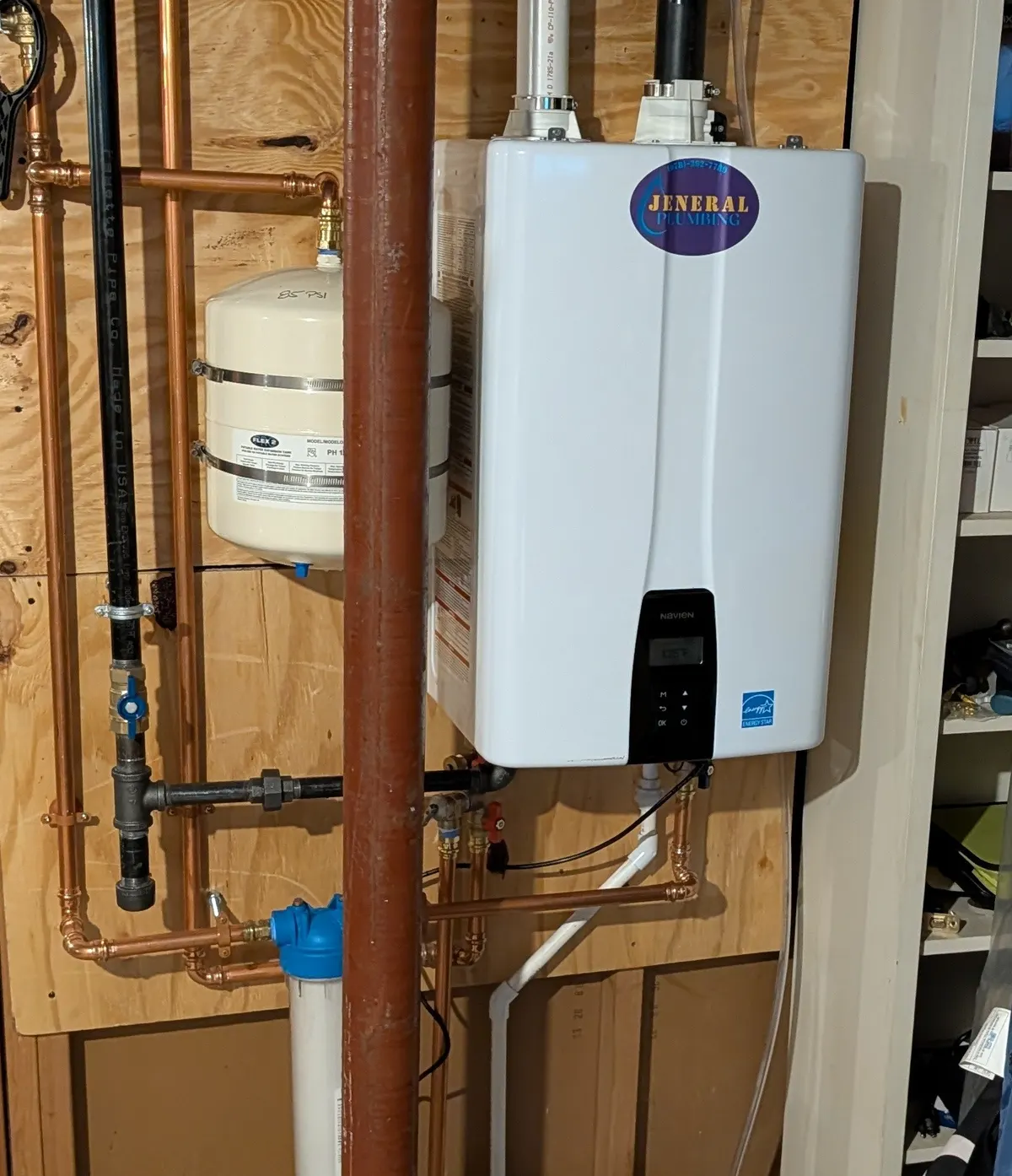
Completed Photo

The third photograph alone is not proof of completed work. The source does not preserve a manufacturer authorization, part shipment, installed exchanger, vent correction, combustion test, restored hot water, or final invoice. I keep those boundaries explicit rather than treating a photograph as a service outcome.

A heat-exchanger term is not automatically a whole-unit warranty. Diagnosis, labor, shipping, access, seals, ignition parts, water treatment, venting corrections, permits, and connected work may be separate under the applicable terms. Navien error code 110 also does not establish eligibility; the claim decision follows the documented failure and the written warranty.

A defensible claim package can include:

  • Exact model, serial number, application, installation information, and customer documentation
  • Complete code history and model-specific diagnostic results
  • Photos that show the failure area and the full installation context
  • Vent material, diameter, equivalent length, route, terminations, and clearances
  • Water, pressure, maintenance, and installation information required by the current terms
  • A written separation between the covered component request and labor or corrective work

The Tyngsborough replacement case follows a documented exchanger job through its decision points. The Lowell replacement-procedure guide explains what happens after an exchanger is approved. Both begin after the code and damage are verified; neither changes the diagnostic meaning of E110.

The separate Westford warranty-claim case shows another documentation path. It does not establish eligibility for the Hudson unit or replace Navien’s review of the exact model, application, and written terms.

Water Testing Is a Separate Equipment Question

The Hudson source mentions a pressure reading above 60 psi and concludes that water quality was not involved. Pressure is not water chemistry, and the record does not preserve hardness, pH, iron, TDS, chlorine, alkalinity, test method, or laboratory results. I will not use an incoming-pressure observation to rule water conditions in or out.

When deposits, scale, corrosion, or repeated exchanger work raise a water question, I begin with property-specific water testing. Field screening and certified-laboratory health testing serve different purposes. Treatment and maintenance frequency follow the measured result, the exact Navien instructions, source water, service history, and what inspection finds.

Hard water, acidic or low-buffer water, disinfectant conditions, sediment, and other factors can affect equipment in different ways. A town name does not predict the sample at a house. Navien error code 110 remains an airflow-path code even when a separate water finding also needs correction.

Maintenance After an Airflow Diagnosis

Maintenance can document vent condition, filters, condensate, error history, water-side scale, leaks, controls, combustion, and safety operation before a symptom becomes severe. It cannot guarantee that Navien error code 110 will not return or that a heat exchanger will reach a particular age. The interval follows the model instructions, water evidence, vent exposure, and observed condition.

A consistent maintenance record can track intake and exhaust condition, condensate drainage, inlet filtration, error history, water readings where relevant, leaks, combustion evidence, and completed corrections. The exact tankless scope should be confirmed before service. “Annual” is not a substitute for doing the model-specific work, and descaling alone cannot correct a fan, vent, air-pressure, gas, wiring, or safety problem.

Different symptoms need different diagnostic paths. A boiler that stays on after a thermostat call belongs with the Navien combi-controls guide, while codes 003 and 515 belong with the 003-to-515 communication guide.

If testing confirms exchanger work, the Tyngsborough case provides a documented replacement example, the Lowell guide explains the service sequence, and the Westford guide focuses on warranty-claim documentation. Those next steps begin after the cause and damage boundary are established. Navien error code 110 does not turn any of them into an automatic replacement path.

Service Context for Westford and Nearby Towns

Jeneral Plumbing is owner-operated by a Licensed Master Plumber (MA #9628831-PL-M) with 20+ years in the trade, including 7 years with a gas utility. I am factory trained by Navien and Navien Service Specialist (NSS) certified. Those credentials support model-specific diagnosis; they do not make me Navien’s warranty decision-maker or turn a code into a guaranteed repair outcome.

I serve Westford first, then nearby Chelmsford, Acton, Littleton, Groton, Billerica, Carlisle, and the rest of Jeneral Plumbing’s 23-town core across Middlesex & Essex County. The Westford water-heating page provides the local service handoff. The observed Hudson case remains outside that core and is not a Hudson service-area claim.

Key Takeaways for Navien Error Code 110

  • Navien error code 110 points toward abnormal air pressure or the intake-exhaust pathway on applicable models.
  • The code is not a flame-loss definition and does not prove a failed heat exchanger.
  • Termination, vent-route, fan, sensing, condensate, wiring, and configuration branches require exact-model testing.
  • Visible corrosion or residue is a separate finding whose source and damage boundary must be traced.
  • The Hudson record documents claim initiation, not approval, completed exchanger work, or successful return to service.
  • Navien’s 15-year heat-exchanger term applies only to qualifying residential NPE-A applications under the exact documentation, conditions, and current written terms.
  • Homeowners can record evidence and observe an exterior termination from safe ground level, but should not open, alter, or repeatedly reset the unit.

For broader system choices, the water-heating guide compares storage, hybrid, and tankless paths. A code diagnosis comes first so any repair or replacement scope addresses the confirmed condition.

Frequently Asked Questions

What does Navien error code 110 mean?

On applicable Navien tankless models, Navien error code 110 indicates abnormal air pressure or an intake-exhaust-path problem. The exact wording and test sequence depend on the model and manual. Possible branches include a blocked termination, vent configuration, fan, air-pressure sensing, condensate or icing, wiring, or control condition. It does not identify a failed part by itself.

Is Navien error code 110 an emergency?

The code alone is not automatically an emergency, but repeated operation around a blocked or damaged air path is unsafe. If flame, smoke, fire, a CO alarm, possible CO symptoms, gas odor, or a suspected fuel leak is present, everyone must leave immediately and call 911 from outside. Stay out until officials clear the property; for suspected gas, also call the applicable gas utility or propane provider from outside and operate nothing inside. Without those hazards, stop repeated resets and arrange model-specific diagnosis.

Can I reset Navien error code 110?

Follow only the user-level reset instruction in the exact model’s homeowner manual, and only when there is no gas odor or suspected fuel leak, no sounding CO alarm or possible exposure symptoms, no escaping flame, smoke, or fire, and no visible damage or blockage. Do not reset repeatedly. If Navien error code 110 returns, leave the unit off and preserve the display for service. Never open the cabinet, alter venting, reach into a termination, or bypass a control.

Does Navien error code 110 prove heat-exchanger failure?

No. E110 begins with abnormal air-pressure or intake-exhaust evidence on applicable models. A case may also contain corrosion, leakage, deposits, or exchanger damage, but those findings require their own inspection and tests. Replacement becomes supportable only after the damage and contributing conditions are confirmed.

What should be tested before heat-exchanger replacement?

The diagnosis should confirm the model, code history, intake and exhaust, equivalent vent length, material, diameter, slope, supports, terminations, fan and air-pressure path, condensate, gas conditions, combustion, and the source of any leakage or residue. Water and pressure conditions are checked separately where relevant. The full damage boundary and root correction should be clear before a part is ordered. Return-to-service testing must follow the manufacturer procedure after work is completed.

Does Navien’s warranty cover a heat exchanger?

Navien’s legacy NPE-A table lists a 15-year heat-exchanger term for qualifying residential standard or controlled-recirculation applications. The exact model, application, installation date, registration or documentation, maintenance, water conditions, and current written terms govern, and Navien decides eligibility. Part coverage does not automatically include diagnosis, labor, shipping, access, adjacent components, vent correction, or connected work. Navien error code 110 alone does not establish a claim.

Schedule a Model-Specific Tankless Diagnosis

If Navien error code 110 returns at a Westford-area home, record the display and stop repeated resets. I will compare the installed intake and exhaust with the exact model literature, test the applicable air-pressure and operating branches, trace any corrosion or leakage separately, and explain what the evidence supports.

Call Jeneral Plumbing at (978) 392-7789. Availability and scope are confirmed by phone. If there is gas odor or a suspected fuel leak, a sounding CO alarm or possible exposure symptoms, escaping flame, smoke, or fire, leave immediately, call 911 from outside, call the gas utility or propane provider as applicable for a suspected fuel leak, and stay out until officials clear the property.

Written by Jeneral Plumbing.

This article was drafted with AI writing tools from Jeneral Plumbing job notes and source materials, then edited before publication. AI tools did not inspect the job or validate technical conclusions.

Last updated .

Related Topics:emergency serviceplumbing companies near me24 hour plumber near mejeneral plumbing water testingjeneral plumbing maintenance plans or service agreements

Jeneral Plumbing is owner-operated by a Licensed Master Plumber (MA #9628831-PL-M) serving Westford and 26 towns across Middlesex & Worcester County and southern New Hampshire. Call (978) 392-7789 to schedule.

Dealing with this in your home? We can help.