

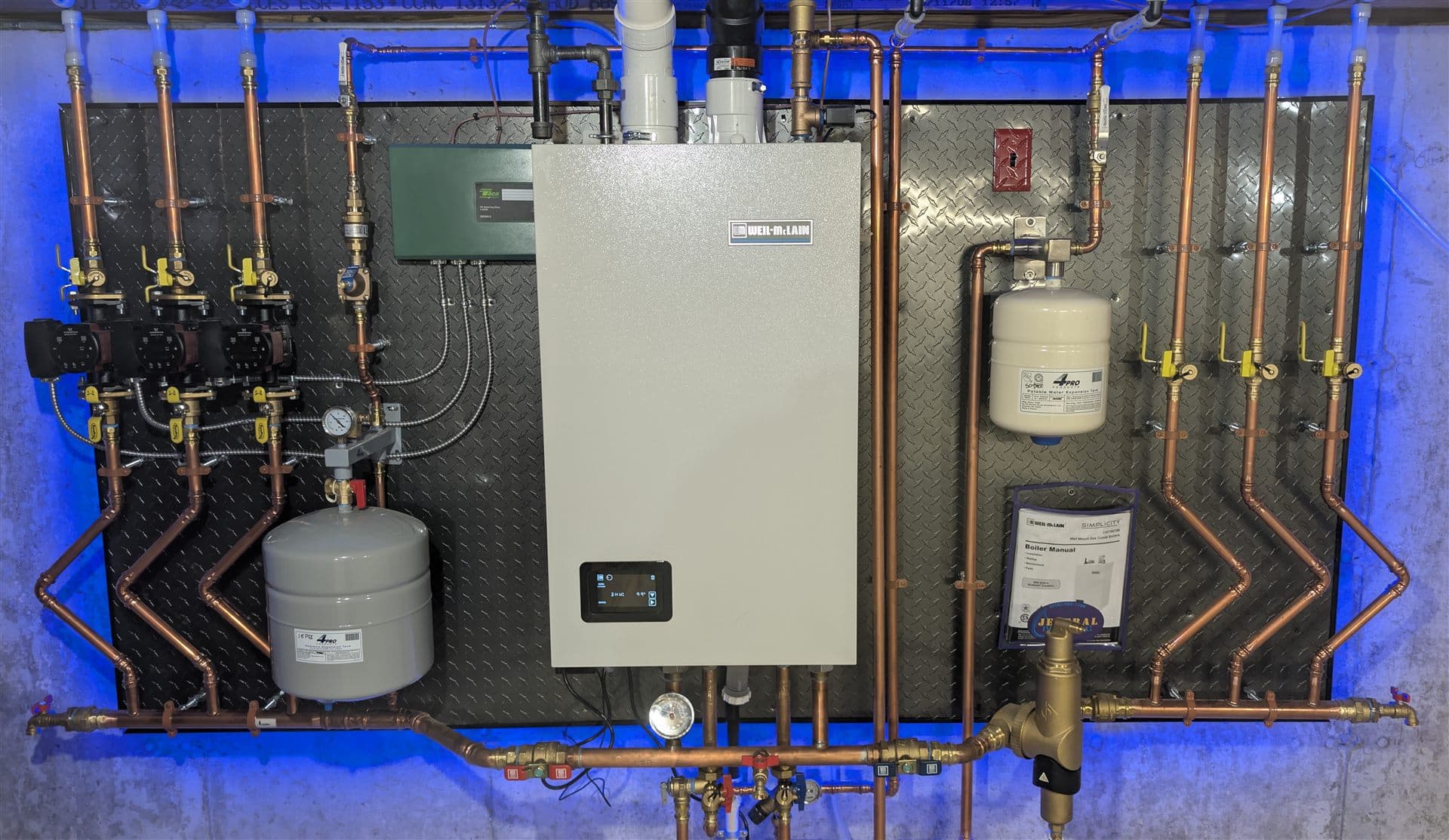
The first cold night of fall is when most people think about their boiler. The thermostat goes up, and you listen for something to happen in the basement. If your rooms have radiators or hot-water baseboards and no floor or ceiling vents, a boiler most likely makes your heat. Knowing how it works makes it easier to spot trouble early, talk through a repair and plan a replacement without guessing.
What is a boiler?
A boiler is heating equipment that heats water, or turns it into steam, and sends that heat through pipes to radiators, baseboard or tubing in the floor. Despite the name, a hot water boiler is designed to heat water without boiling it; a steam boiler produces steam on purpose. Some boilers also make your household hot water. That can happen in a separate indirect tank, in a tankless coil built into many older boilers, or inside a combi boiler that does both jobs.
A boiler isn't a furnace, which heats air and pushes it through ducts. Boilers and hydronic heat are Jeneral Plumbing's core heating line. Furnace work is limited to conditions that fit our licensed plumbing and gas scope, and we don't offer central air conditioning.
How does a boiler work?
A hot water system is a closed loop: the boiler heats the water, a circulator pump carries it to each baseboard or radiator, and the cooled water comes back to be heated again. The main parts:
- Burner or elements. Gas, oil or electricity supplies the heat.
- Heat exchanger. Moves heat from the flame into the water. The water and the combustion gases never touch.
- Circulators and zone valves. A circulator is a small pump that moves hot water through the pipes. Zone valves, or a circulator for each zone, send it only where a thermostat is calling.
- Expansion tank. Water expands as it heats, and the tank gives it room so pressure stays in a safe range.
- Controls and safeties. The thermostat and the boiler's control start and stop the burner, while a relief valve and other safety devices shut things down or release pressure if something isn't right.
- Venting. Carries combustion gases outside through a chimney or a dedicated vent pipe.
A steam system works differently. The boiler makes steam that rises through the pipes to the radiators, gives up its heat, condenses back to water and drains back to the boiler, usually without a circulator.
Hot water boiler or steam boiler?
It's worth knowing which you have before you call anyone, because the parts and fixes differ. A few clues:
| Where to look | Hot water boiler | Steam boiler |
|---|---|---|
| Near the boiler | A circulator pump and an expansion tank | A glass sight tube showing the water level |
| At each radiator | Two pipe connections, often with a small bleed valve near the top | Often a single pipe, with a vent on the side that hisses as heat comes up |
| Fin-tube baseboard | Common | Rare |
If you're still unsure, a photo of the boiler and its rating label helps us tell over the phone. We work on both: residential steam and hot water systems are part of our boiler repair and installation work.
Condensing vs. non-condensing boilers
The other big split is efficiency. A condensing boiler pulls extra heat from its exhaust by cooling it until the water vapor in it condenses. That only happens when the water coming back from the house is cool enough, so your radiators, controls and heat loss decide how much of the rated efficiency you'll see.
| Condensing | Non-condensing | |
|---|---|---|
| Venting | Vent material listed by the manufacturer, often plastic and often through a side wall | Usually a chimney or metal vent |
| Condensate | Acidic condensate that needs a drain route, often through a neutralizer | Not designed to produce it in normal operation |
For the full comparison, see our guide to condensing vs. non-condensing boilers and our page on high-efficiency boilers.
How to turn on a boiler after summer
If your boiler also makes your hot water, it has probably run all summer, and the first cold night mostly tests the heating side. If it was shut off for the season, these checks cover what you can safely do:
- Thermostat. Set it to heat and a few degrees above room temperature. Replace the batteries if it uses them.
- Service switch and breaker. Many boilers have an on/off switch nearby, often at the top of the basement stairs or on the unit itself. Make sure it and the breaker are on.
- Pressure or water level. On a hot water system, compare the gauge with the range on the boiler's label or in its manual; if it reads low, call rather than topping it off, because a drop over the summer can mean water is leaving the system. On a steam boiler, the sight glass should show water. If it looks empty, leave the boiler off and call.
- Condensate line. On a condensing boiler, look for an obvious kink or blockage in the drain line.
- Time. Some boilers run through a short startup sequence before the burner lights.
Don't open the burner compartment, touch the gas valve or try to relight a pilot. If the display shows a code or the boiler locks out, write the code down instead of resetting it again and again; repeated resets can hide the pattern a technician needs to see. If you smell gas or a carbon monoxide alarm sounds, leave the building and call 911 from outside.
It's worth running these checks on a mild day in early fall, so any problem can be fixed before the first freezing night.
When it still won't heat
Common causes include an ignition lockout, pressure loss, a frozen condensate line on a condensing boiler, a circulator that has stopped, and a thermostat or zone fault that leaves one area cold. Each needs a diagnosis before parts get replaced. Our boiler repair page describes what we check.
Jeneral Plumbing is owner-operated by a Licensed Master Plumber (MA #9628831-PL-M) with 20+ years in the trade, including seven with a gas utility. That training includes factory programs from Navien, Lochinvar, Rinnai, Weil-McLain and Noritz, and Navien Service Specialist (NSS) certification. We're based in Westford, MA, and serve homes within 20 miles across Middlesex & Worcester County; we confirm your address, the equipment and scheduling when you call.
During regular hours, a visit carries an $80 dispatch fee — the cost of the visit, waived when you hire us for the work. A no-heat call off-hours, on a Sunday or on a holiday carries a separate $599 emergency callout fee instead. It's collected prior to dispatch, non-refundable and non-negotiable, and it covers the dispatch only; it's never applied to repair work. Call (978) 392-7789 with the boiler's make, any code on the display and which rooms are cold.
Questions homeowners ask
What does a boiler do in a zoned home?
It heats water for the whole house, and the zones decide where that water goes. When a thermostat calls for heat, its zone valve opens or its circulator starts, and hot water flows only through that zone's baseboard or radiators. One cold zone while the rest of the house heats normally often points to that zone's thermostat, valve, circulator or wiring rather than the boiler.
How much is a new boiler?
It depends on the house as much as the boiler. The main cost drivers are the boiler's type and size (from a heat-loss calculation, not the old nameplate), venting (a chimney liner or a new vent), fuel piping, the piping near the boiler, controls and zoning, any indirect water heater, removing the old unit, and the permit. We give you a written flat-rate quote after an on-site assessment, so the total and any fees are clear before work starts. Our boiler installation page explains how that scope is built.
Should I repair or replace an old boiler?
Age alone doesn't decide it. A repair often makes sense when the heat exchanger is sound and the failure is in a control, circulator, valve or accessible pipe. Replacement is worth discussing when the heat exchanger is failing, parts are no longer available, failures keep repeating or the boiler is a poor match for the house. Where possible, restore the heat first, then make the replacement decision without a cold house pushing you.
Written by Jeneral Plumbing.
This article was drafted with AI writing tools and edited before publication. AI tools did not inspect any job or validate technical conclusions.
Last updated .