

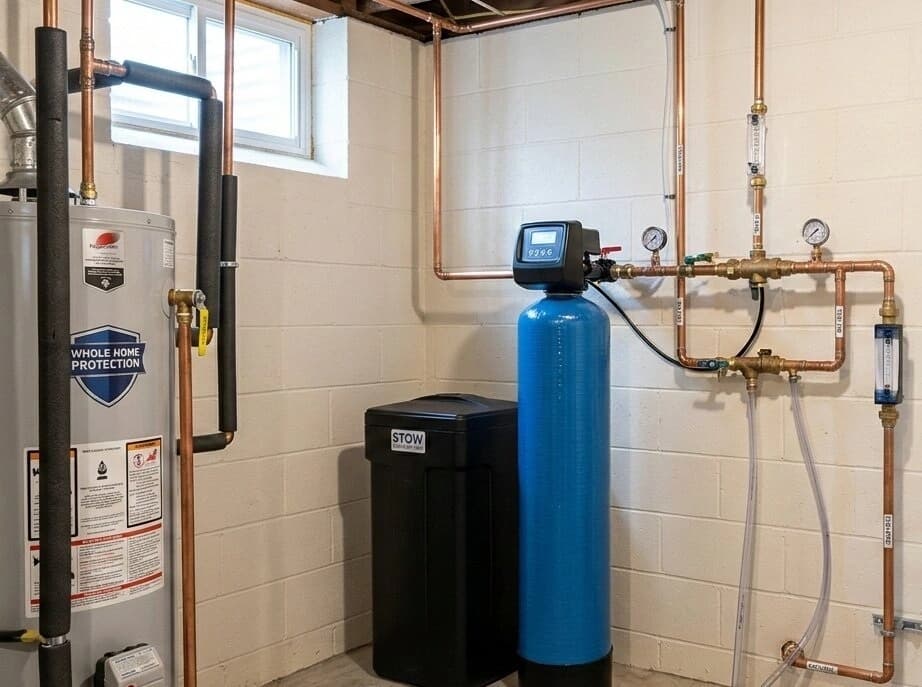
PFAS water filtration options should follow a current water report, a properly collected sample, and a clearly defined treatment goal. A townwide result can help frame the question, but it cannot tell me what is happening at one Billerica faucet or whether a specific product fits that home. I start with evidence, then compare the technology, exact-model certification, installation conditions, maintenance, and follow-up testing.
That sequence keeps PFAS water filtration options from turning into a brand-shopping exercise. Depending on the results and how the household uses water, the answer may be activated carbon, reverse osmosis, ion exchange, another technology for a separate measured condition, more testing, a plumbing correction, or no treatment at all. No equipment earns a place merely because PFAS appears in an article title.
Jeneral Plumbing is based in Westford, MA and is owner-operated by a Licensed Master Plumber (MA #9628831-PL-M). I treat this guide to PFAS water filtration options as an educational resource, not a diagnosis for your property. The current Billerica report, your sample, the home’s plumbing, household demand, and the certification carried by the exact model all matter.
PFAS Water Filtration Options Start With Billerica’s Current Report
As reviewed on August 21, 2026, Billerica’s current official report is the 2025 Billerica Water Quality Report. It covers testing performed from January 1 through December 31, 2025, and identifies the Concord River as the public system’s source. Those system-level facts provide context for PFAS water filtration options, but they do not replace a sample from your address.
The 2025 Billerica CCR reports PFAS6 at 12.1 parts per trillion, with a range of 2.65–12.1 parts per trillion. The same 2025 table gives the enforceable Massachusetts PFAS6 maximum contaminant level as 20 parts per trillion and marks the result “No” for violation. That is the narrow compliance finding the report supports; it is not a result from a particular kitchen tap.
The report needs careful reading beside the newer federal rule. Billerica’s 2025 UCMR5 table lists PFOA at 5.5 parts per trillion, with a range from not detected to 5.5 parts per trillion. The EPA’s 2024 final PFAS rule sets the enforceable federal PFOA maximum contaminant level at 4.0 parts per trillion and says compliance is determined by running annual averages at the sampling point. The Billerica CCR values alone therefore do not establish federal PFOA compliance, and the report does not provide a federal violation finding for that UCMR5 entry.
PFAS results are reported in parts per trillion, abbreviated ppt, not parts per million. Unit accuracy matters because switching between those units changes the meaning of a result. I compare a reported number only with an enforceable limit that applies to the same contaminant or regulated group, rather than with a voluntary guideline or a different chemical. That discipline keeps PFAS water filtration options tied to like-for-like evidence.
About this water information
Utility reports summarize testing across a public water system; they are not a test of the water at your specific faucet. EWG health guidelines may be lower than enforceable federal or state limits. Homes on private wells are not represented by municipal utility data. Treatment recommendations should be based on the current utility report, household plumbing conditions, and a properly collected water sample.
Reviewed by: Jeneral Plumbing — August 21, 2026. Official water information: Billerica’s 2025 Consumer Confidence Report.
Test Before Comparing PFAS Water Filtration Options
A CCR describes the public system; a household sample answers a property question. My test-first water testing service begins by identifying the water source, sample location, reason for testing, and laboratory method. PFAS analysis belongs with an appropriate certified laboratory using its containers and collection protocol. A general field meter, taste observation, or total-dissolved-solids reading cannot measure PFAS.
Careful collection matters because PFAS testing can be sensitive to materials used around the sample. Follow the laboratory’s written instructions, do not substitute containers, and record whether the sample came from untreated water or a treated tap. If the goal is to evaluate existing equipment, the laboratory may call for paired sample points or another specific plan. The testing plan should be settled before PFAS water filtration options are selected.
I also inspect the plumbing conditions that can change the scope without changing the laboratory result. Available pressure, service flow, pipe size, bypass layout, drain access, electrical needs, installation space, and the condition of existing treatment all affect what can be installed and maintained. Reliable PFAS water filtration options account for those site conditions. A test result identifies the concern; it does not size a system by itself.
How the Main Technology Classes Differ
PFAS water filtration options are technology classes with different applications, not interchangeable boxes. Activated carbon, reverse osmosis, and certain ion-exchange designs may be evaluated for PFAS-related goals. Oxidation and filtration or UV may belong in a treatment plan for other confirmed conditions, but neither class should be assigned a PFAS claim without exact-model evidence. No treatment at all remains an explicit option after the results are reviewed.
Activated Carbon
Activated carbon works through adsorption, and performance depends on the carbon type, bed or cartridge design, flow, contact time, incoming water, capacity, and replacement schedule. For PFAS water filtration options, the category name alone proves nothing about a contaminant claim. I look for a current third-party certification that identifies the exact model and the exact PFAS reduction claim, then check that the certified operating conditions fit the home.
A small drinking-water carbon cartridge and a large entry-point carbon vessel have different flow and maintenance demands. More media does not automatically establish a certified claim, and an old certificate or a claim attached to a different model is not transferable. Sampling and maintenance still matter after installation.
Reverse Osmosis
Reverse osmosis uses pretreatment and a membrane, usually supplies a dedicated drinking-water tap, stores treated water, and sends a concentrate stream to a drain. Among PFAS water filtration options, it can be considered when the exact model carries the exact current third-party certification required for the stated PFAS claim. Pressure, production rate, storage, sanitation, drainage, cartridge changes, and membrane service must fit the installation.
Reverse osmosis is not automatically a whole-house answer. A point-of-use layout may focus treatment on drinking and cooking water while avoiding the added equipment and maintenance of treating every fixture. The choice belongs to the test result and household goal, not a blanket rule.
Ion Exchange
Ion exchange is a broad class, and resin selection is application-specific. A conventional hardness softener should not be assumed to address PFAS merely because it uses ion exchange. If an ion-exchange model is proposed among PFAS water filtration options, its exact media, current third-party certification for the exact contaminant claim, capacity, competing water chemistry, flow, regeneration or replacement method, and disposal requirements all need review.
Oxidation and Filtration
Oxidation and filtration can be appropriate when testing confirms another condition that fits that process, such as certain iron, manganese, or odor concerns under suitable chemistry. It should not be added to PFAS water filtration options as though every filter media has the same job. When a home has more than one measured concern, each treatment stage must have a defined purpose and compatible operating conditions.
Ultraviolet Treatment
UV is a technology considered for an appropriate microbial treatment goal after laboratory testing and system design. It does not become a PFAS reduction device because it is installed beside a filter. Flow, water clarity, lamp output, sleeve condition, power, alarms, and required pretreatment govern a UV application. Its place in a treatment train must be tied to a separate measured need.
No Treatment at All
No treatment at all can be the correct result of a test-first review. The evidence may support continued monitoring, a new sample, maintenance on existing equipment, a plumbing repair, or no change. Listing that outcome beside PFAS water filtration options prevents the equipment decision from getting ahead of the evidence.
Certification Controls Every PFAS Reduction Claim
A product may make a PFAS reduction claim only when that exact model carries that exact current third-party certification. A certification on another product in the same family, a general reference to a technology class, or a retailer’s summary does not satisfy that rule. My water quality and safety review keeps laboratory evidence, model documentation, and the proposed claim tied together.
Before comparing PFAS water filtration options, verify the complete model number in the certifier’s current directory and read the scope of the claim. Then check rated flow, capacity, replacement conditions, pressure, temperature, and any required pretreatment against the proposed installation. Certification does not excuse missed maintenance or a layout outside the listed conditions.
I do not publish a universal performance number. Performance language must match the exact certified claim and its conditions, and follow-up testing may be needed to confirm the household objective. That conservative rule protects the distinction between a tested product claim and a broad promise about an entire category.
Point-of-Use or Whole-House Treatment?
The right treatment location depends on the sample, exposure question, household priorities, and maintenance capacity. Point-of-use PFAS water filtration options focus on selected drinking and cooking fixtures. Entry-point treatment handles water before it branches through the home, which increases the required service flow, media or equipment capacity, space, plumbing scope, and maintenance responsibility.
A whole-house label is not evidence that the exact model is certified for the exact PFAS claim. It also does not answer whether treating every fixture is necessary for the household’s defined goal. My test-led water treatment planning compares the narrowest suitable scope with broader entry-point treatment after the evidence is available.
Other measured conditions can change the sequence. Sediment, hardness, iron, manganese, disinfectant residual, pH, and microbial concerns can affect equipment selection or pretreatment, but no symptom should be used to guess a PFAS result. If separate treatment is justified, every stage needs its own job, operating limits, and maintenance plan.
Installation and Verification Are Part of the Decision
Good PFAS water filtration options need a buildable plumbing plan. I identify the raw-water sample point, proposed treated-water outlet, shutoffs, bypass, pipe size, pressure, peak flow, drain, power, mounting space, sanitation procedure, and access for future cartridge or media service. The filtration and softener installation service turns the selected exact model into a defined flat-rate scope.
Commissioning follows the manufacturer’s instructions for flushing, sanitation, startup, and control settings. I check accessible connections, confirm the intended flow path, record the exact model and consumables, and explain the maintenance triggers. When the treatment goal calls for laboratory confirmation, the follow-up sample needs the correct tap, timing, container, and method.
Maintenance should be planned before equipment is approved. Cartridge capacity, media life, membrane service, pressure change, sanitation, household water use, incoming concentration, and manufacturer instructions can all affect service needs. There is no universal replacement calendar for PFAS water filtration options.
A water monitor or automatic shutoff addresses leak detection, not contaminant reduction. Filtration does not replace leak protection, and leak protection does not treat the water. If both goals are in scope, I keep the water monitoring and automatic shutoff work separate in the written plan.
Flat-Rate Pricing Follows the Test and Site Review
I do not publish a universal equipment range for PFAS water filtration options because the test, certified model, treatment location, service flow, plumbing changes, drainage, power, startup, and verification create different scopes. A responsible comparison of PFAS water filtration options includes future consumables and service. Jeneral Plumbing prices repair and installation work at a flat rate, with the total price and any applicable fees disclosed for approval before work begins. The proposal should identify the equipment, installation boundaries, startup, exclusions, maintenance responsibilities, and any planned follow-up sampling.
As of August 21, 2026, a regular-hours visit starts with an $80 dispatch fee — the cost of the visit, waived when you hire us for the work. That visit can establish the plumbing conditions and testing path, but it does not turn an unverified product into a treatment recommendation.
Local, Owner-Operated Water Treatment Planning
I use the same evidence-first process in Westford, Chelmsford, Littleton, Billerica, Tewksbury, and Lowell, serving homeowners across Middlesex County. Utility systems, private sources, plumbing materials, and household goals differ, so PFAS water filtration options remain property-specific in every town. I fix the cause, not just the symptoms, and I will say when the evidence supports no new treatment.
Bring the current report, laboratory results, sample notes, existing equipment labels, and maintenance records. Then call (978) 392-7789 to discuss a testing or installation scope with Jeneral Plumbing. I will separate what the utility report says, what your sample says, and what the exact model is certified to claim before preparing a flat-rate proposal.
Billerica PFAS Water Filtration Questions
Does Billerica’s current report mean my home needs PFAS treatment?
No. Billerica’s 2025 CCR provides system-level context, while a properly collected sample and the household’s goal determine whether treatment should be considered at a specific property. PFAS water filtration options should not be prescribed from a town name or one table alone. The result may support treatment, monitoring, another sample, or no treatment at all.
Is PFAS measured in ppm or ppt?
PFAS drinking-water results are reported in parts per trillion, or ppt. Parts per million is the wrong unit for the Billerica PFAS figures discussed in this article. Always keep the contaminant, unit, sample date, and applicable enforceable limit together when reading a result.
Which filter technology should I choose for PFAS?
Choose only after testing and exact-model verification. Activated carbon, reverse osmosis, and certain ion-exchange designs may be evaluated, but PFAS water filtration options do not carry automatic category-wide claims. The exact model must have current third-party certification for the exact PFAS claim, and its rated conditions must fit the home. Oxidation and filtration or UV may serve other measured goals but should not be assigned a PFAS claim without exact-model evidence.
Do I need whole-house PFAS treatment?
Not automatically. Point-of-use PFAS water filtration options may focus on drinking and cooking water, while entry-point equipment treats water before it branches to fixtures and requires greater flow, capacity, space, and maintenance. The sample, household objective, plumbing, and exact-model certification determine which location is appropriate. A whole-house marketing label is not a substitute for that review.
How do I verify a PFAS filter claim?
Match the full model number to the independent certifier’s current directory and confirm that the listing names the exact PFAS claim. Read the rated flow, capacity, replacement schedule, pressure, temperature, and pretreatment conditions. Install and maintain the model within those conditions. When the treatment objective requires it, use appropriately planned follow-up laboratory sampling rather than assuming performance from the technology name.
How much do PFAS water filtration options cost in Billerica?
The responsible price follows testing and a site-specific scope. A dedicated drinking-water system and an entry-point treatment layout differ in certified equipment, capacity, plumbing, drainage, power, startup, maintenance, and verification. Jeneral Plumbing provides a flat-rate price with the total and applicable fees disclosed before work begins. I do not use a generic range as a quote for an untested property.
Written by Kris Record, Licensed Master Plumber (MA #9628831-PL-M).
Last updated .