

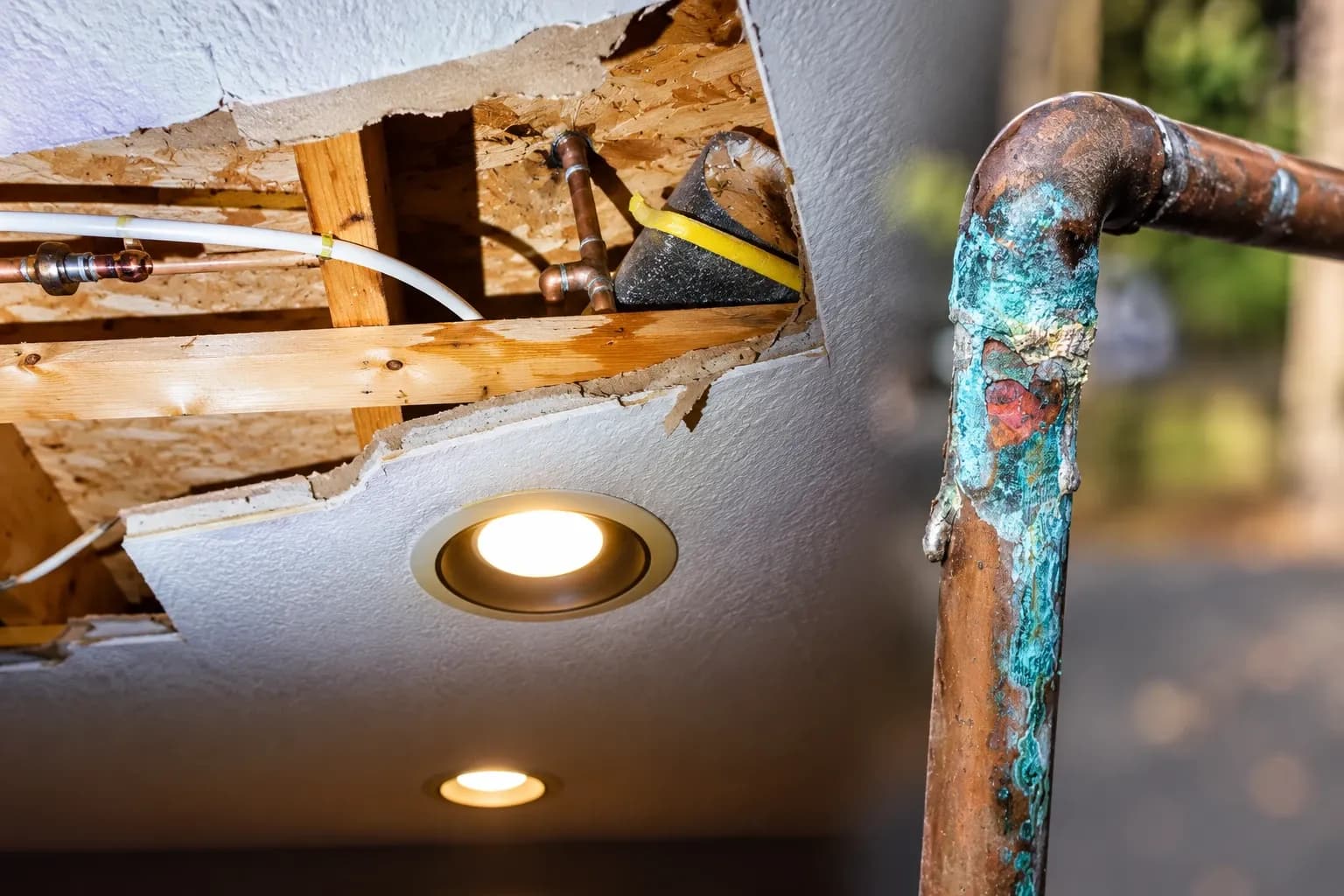
If you're on a private well in Hudson, MA and you've discovered a pinhole leak dripping through your kitchen or bathroom ceiling, you're not alone — and you shouldn't assume it's a one-time fluke. We recently worked a very similar call, and what we found is a pattern we see in homes on well water throughout the area: a hot water copper line that's turned green with corrosion, a ceiling that's already been patched once before, and homeowners who've never had their water tested. Before we talk about fixing the pipe, let's talk about why testing the water first can save you from an expensive, repeating headache.
Safety First: This Is Not a DIY Repair
Cutting into a wall or ceiling to access a leaking hot water supply line, shutting off water at the heater, and re-soldering or replacing copper piping is licensed plumbing work. Massachusetts law requires a licensed plumber for this kind of repair, and there are real hazards involved — from scalding hot water to hidden electrical wiring near the leak site to structural damage from water intrusion that's gone unnoticed for years. If you find a leak like this, shut off the water at the nearest valve you can safely access and call a professional. Don't attempt to trace or open the wall yourself.
How This Job Started: A Ceiling Leak With a History
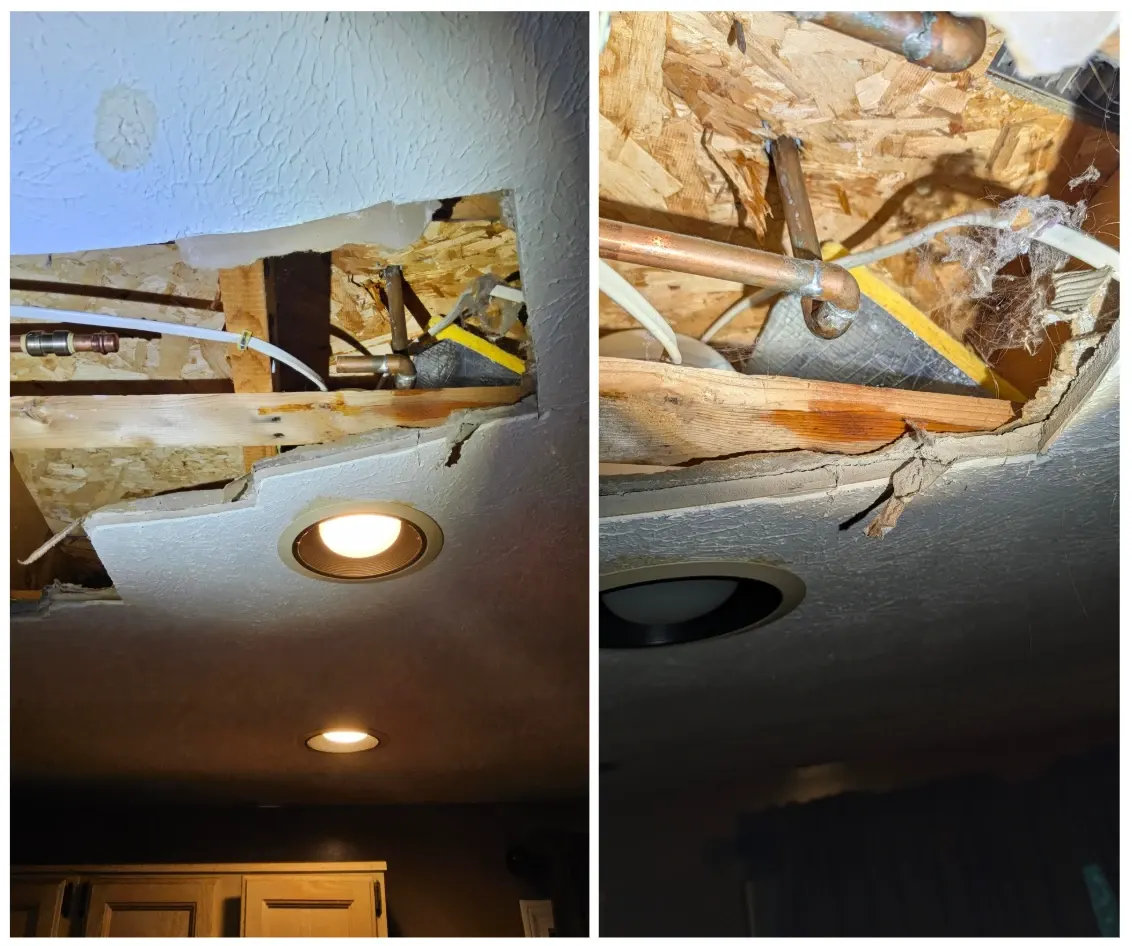
On this call in Hudson, MA, the homeowners had already pulled down some ceiling material themselves trying to find the source of a drip. By the time our technician arrived, they'd narrowed it to a corner where water was visibly dripping — but they weren't sure whether it was coming from a joint, an elbow, or further up the line. Once the water heater was shut off, the dripping stopped, confirming it was the hot water supply line, not the cold.
Working with limited visibility in a tight cavity, our technician was able to see the pipe was coated green — a telltale sign of copper corrosion — and could hear water still moving in the wall even after isolating the heater. That kind of corrosion doesn't happen overnight, and it's rarely limited to just one spot.
The Real Question: Why Is the Copper Corroding?
Here's the important part. The homeowners mentioned they were on a well, and that a previous treatment system — an aerosparge unit installed for radon — had been bypassed and shut down for years. They had point-of-use arsenic filtration under a couple of sinks, but nothing addressing the water's overall chemistry.
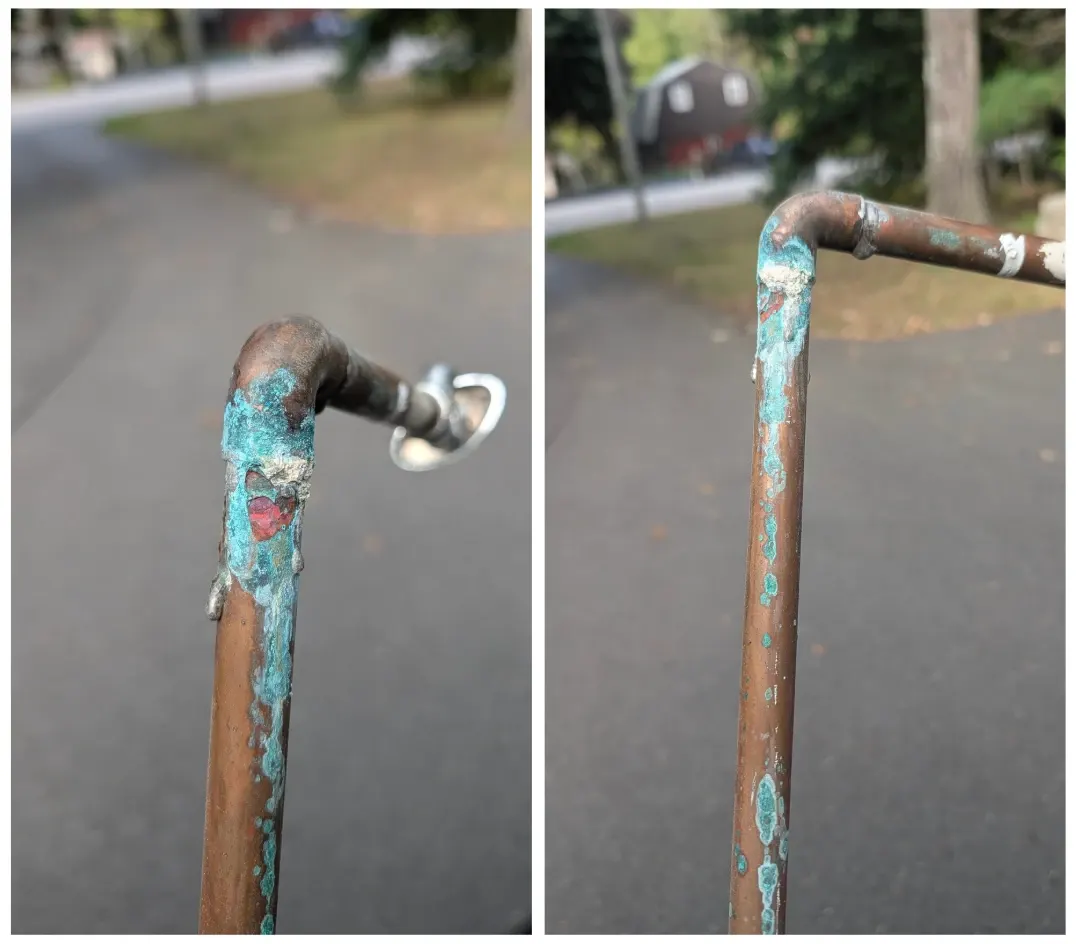
That's a red flag. Acidic well water — meaning low pH — can contribute to corrosion of copper piping from the inside out. Over months and years, this can cause pinhole leaks, often in multiple spots, not just the one you happen to find first.
Our technician had actually just come from another job that day with a similar issue: acidic well water that had caused multiple leaks in ceilings and walls over the years, with plumbers repeatedly patching individual leaks without addressing the underlying cause.
In this Hudson home, there was even evidence of a prior leak — a large patched section of ceiling from before the current owners bought the house nearly twenty years ago. Whether it was the same issue or something else, nobody knows, because no one had ever tested the water.
Why We Test the Water Before We Repair the Plumbing
Whenever we're called out for a leak in a home on well water, we don't just cut open the wall and solder a new piece of pipe. We run a water test on the spot — it only takes a couple of minutes — checking for pH, hardness, iron, copper, nitrates, and nitrites.
This test won't catch bacteria or viruses, but it gives us baseline chemistry data to help evaluate the condition of the plumbing. If the pH is low and the water is acidic, repairing one leak without addressing the water itself could mean you're back in the same spot later, with another leak showing up somewhere else in the system — behind a toilet tank, under a sink, or inside another wall cavity.
That's the whole point of testing first: we'd rather give you the full picture up front than have you call us back months later with another mystery leak.
PFAS and Other Contaminants: Know What's in Your Well
During this visit, the conversation also turned to PFAS and PFOS testing, since these contaminants can be a concern for some Massachusetts properties. Massachusetts residents on private wells may have access to water-testing resources depending on their location and circumstances.
It's important to understand that water treatment systems are designed to reduce contaminant levels based on actual test results. The appropriate treatment depends on what's found in the water, which is exactly why testing comes first.
The Repair Itself
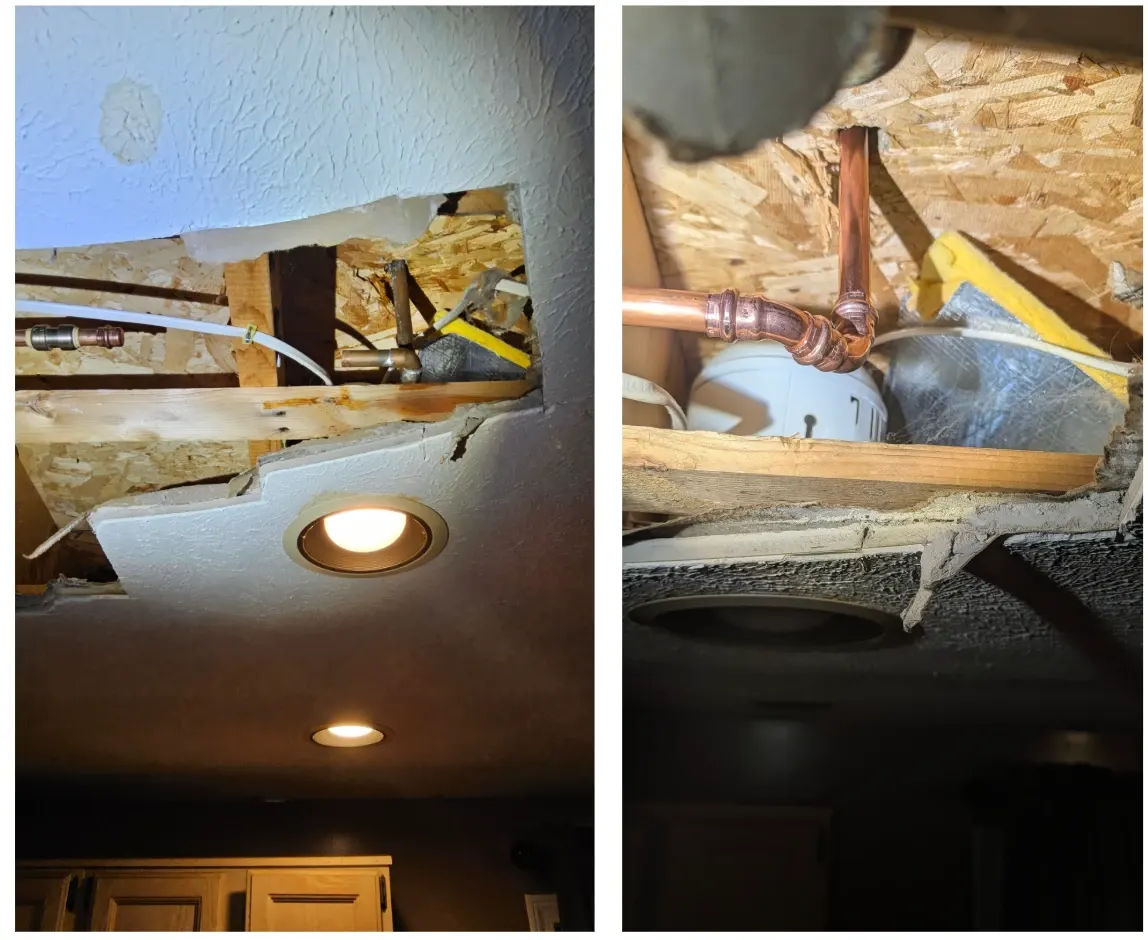
Once the water chemistry is understood, the physical repair in a case like this is typically straightforward: cut into the back of the cabinet or wall cavity to access the damaged section, confirm the extent of the corrosion, and replace the affected piece of copper line.
How much needs to be opened depends on how far the corrosion has spread — which is exactly why tracing the leak carefully before cutting matters. We'd rather open one clean section than chase pinholes through multiple walls over multiple visits.
What This Means for Homeowners in Hudson, Chelmsford, and Littleton
We see similar plumbing concerns in homes throughout the area, including Hudson, Chelmsford, and Littleton. If your home is on well water and you've never had it tested for pH, hardness, or corrosivity, and you're noticing recurring leaks, stained fixtures, or greenish residue on copper pipe, it's worth getting ahead of the problem rather than waiting for the next ceiling stain to appear.
Key Takeaways
A dripping hot water line with green corrosion on copper pipe can be a sign of water-related corrosion, not simply a single bad joint.
Repairing one leak without testing the water can mean repeat leaks in other parts of the plumbing system.
A basic water test checks pH, hardness, iron, copper, nitrates, and nitrites.
Low-pH water can contribute to copper pipe corrosion over time.
Water treatment should be selected based on actual water test results.
Cutting into walls or ceilings and repairing supply lines should be handled by a licensed professional.
Frequently Asked Questions
My toilet is leaking at the base — could this be related to acidic water too?
It can be a factor. While a toilet leaking at the base is often caused by a worn wax ring or a loose connection to the flange, water chemistry can contribute to corrosion in supply lines and fittings feeding the toilet tank as well. If you're on well water and dealing with recurring leaks in multiple fixtures, it's worth having your water tested at the same time you address the toilet repair.
How do I turn off the water to a toilet if I notice a leak?
There is typically a shutoff valve on the wall or floor behind the toilet, near the base of the tank. Turning this valve clockwise will stop water flow to that fixture. If you can't locate one, or if it doesn't fully stop the leak, shutting off the main water supply to the house is the next step.
Do I need a plumber to install a toilet, or can I do it myself?
We recommend a licensed plumber to install toilet fixtures, especially in older homes or homes on well water where supply line corrosion may already be present. What looks like a simple swap can turn into a bigger repair if the shutoff valve or supply line behind the wall is also compromised.
Why does my plumber want to test my water before fixing a pipe leak?
If your home is on a well and the leak involves copper piping, low pH water may be an underlying factor. Fixing the visible leak without checking the water chemistry can mean treating the symptom while the underlying water condition continues to affect the plumbing system.
What if my water test shows contamination like PFAS or arsenic?
Treatment options may be available to reduce levels of contaminants like PFAS or arsenic based on your specific test results. The appropriate system depends on what's actually found in your water, which is why testing should come before recommending treatment.
Get Your Well Water Tested and Your Leak Repaired the Right Way
If you're in Hudson, Chelmsford, Littleton, or the surrounding area and dealing with a mystery leak, corroded copper pipe, or you're overdue for a water test, don't wait for the next ceiling patch.
Our technicians can test your water and give you a clearer picture before repair or water-treatment work begins. Learn more about our approach to water treatment, or if you're dealing with an active leak right now, our emergency plumbing team answers calls 24/7. For fixture issues like a leaking toilet tank or worn supply lines, our fixture repair services can help too.
Call Jeneral Plumbing at (978) 392-7789 to schedule a water test or repair. Regular-hours visits come with an $80 dispatch fee — the cost of the visit, waived when you hire us for the work.
This post is for informational purposes only and is not a substitute for an on-site evaluation by a licensed plumber. Plumbing and water treatment needs vary by home; always consult a professional before making repair or treatment decisions.
Written by Sierra Sorongon.
This article was drafted with AI writing tools from Jeneral Plumbing job notes and source materials, then edited before publication. AI tools did not inspect the job or validate technical conclusions.
Last updated .