


Once a bathroom is opened to the studs, you have access you won't have again until the next remodel. That's when leaks are cheapest to find and easiest to prevent. It's also when decisions about permits, valves and new outlets need to be settled, because tile and wallboard make every later change harder.
We saw this in a Lowell bathroom that was already mid-renovation. The soaking tub and its tile surround had been removed, which exposed an exterior wall. The old tub drain had been capped. The existing shower valve hadn't been evaluated, and it wasn't clear who was responsible for the permits. No hidden leak or completed repair was documented. The job was to inspect, test and define the plumbing scope before the room closed up again.
Leak detection happens at four points in a remodel
| Stage | What gets checked | What it can't tell you |
|---|---|---|
| Before demolition | How each fixture behaves: drips, a toilet that refills on its own, slow drains, active staining, shutoff condition | The condition of piping still hidden in the wall |
| While the wall is open | Pipe materials and routes, accessible joints, supports, capped lines, the valve body | How new piping will hold up under its test |
| Before the wall closes | The required test on new or altered piping, and the rough inspection | How the finished trim and fixtures will perform |
| After trim-out | Every control, outlet, drain and overflow under real use | Whether a part will fail years from now |
Record the starting point before anyone disconnects anything. Photograph the valve, trim, supplies, shutoffs and any piping visible from below, and label anything that was already leaking or shut off, so a pre-existing problem isn't blamed on the demolition or overlooked. If a symptom points to a concealed leak rather than a remodel question, our guide to hidden water leak signs and how they're diagnosed covers meter checks, isolation and the limits of thermal and acoustic readings.
Sorting out the Lowell bathroom
Who pulls the permits
The homeowner had been told plumbing and electrical work were handled in-house, while the project paperwork put permit responsibility on the client. Neither statement proves anything was unlicensed. The practical step is to identify the licensed plumber and electrician by name and ask each one which permits they are pulling. In Massachusetts, plumbing permits are issued to appropriately licensed plumbers under 248 CMR 3.00, and a homeowner's building permit doesn't stand in for one. Lowell's building and plumbing officials decide what the project needs and when inspections happen.
The open exterior wall and the capped drain
Removing the tub opened an exterior wall, and the building department had become involved. That didn't mean the plumbing had leaked. It meant the open conditions had to stay visible while responsibilities were settled. On the plumbing side, that means documenting supply materials and supports, the capped tub drain with the drain and vent routing around it, and where service access will go. An old cap shouldn't be treated as permanent or reusable until its material, connection and role in the new layout are understood. Insulation, framing, fireblocking and waterproofing belong to other trades; we flag where a plumbing penetration affects them rather than taking on the whole wall.
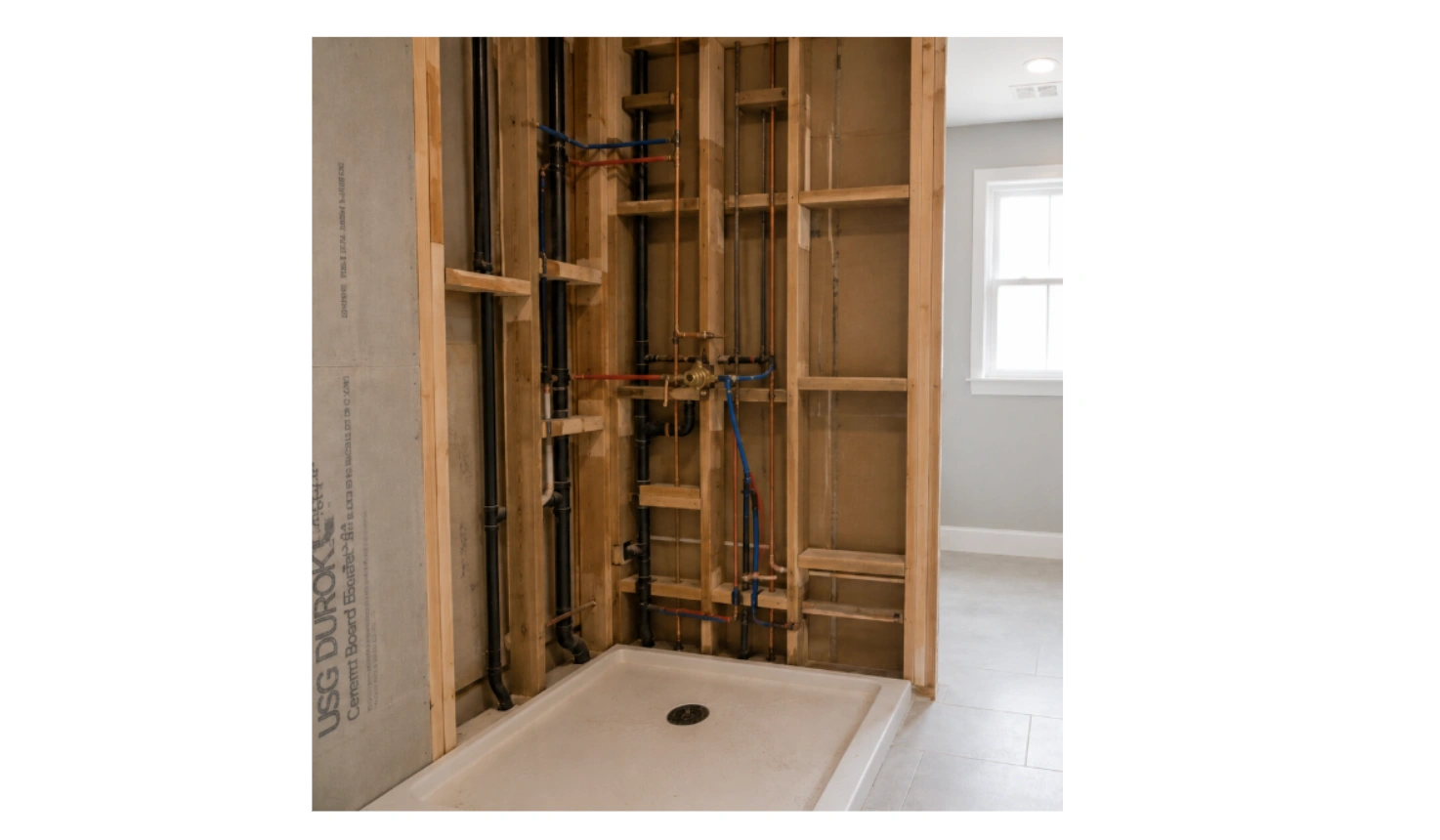
An open wall shows the valve body, supply lines, drain and vent before finishes hide them.
Keeping the old shower valve
A trim-only update was possible, but only if the concealed valve body could be identified, found sound and supported, set at a depth that works with the finished wall, and matched to trim the manufacturer documents as compatible. Similar looks or the same brand name don't prove fit, because valve generations use different cartridges, mounting and trim. If the body or its connections needed replacing, that becomes shower valve installation work, and the access had to be planned before tile.
The valve they planned to buy
A proposed replacement valve didn't have a confirmed Massachusetts approval record for that exact model. Product acceptance here is checked by manufacturer, model and intended use, not by brand, so the valve needed verification before anyone bought it. The local inspector still decides whether the product and its installation fit the permitted project.
A handheld for washing the dog
The homeowner wanted a shower that made washing a dog and cleaning the walls easier. That could mean an integrated handheld, a separately piped outlet or a diverter. The right choice depends on the valve, how many outlets run at once, available flow and hot water, and where supports and access go. A separate outlet or diverter changes the plumbing scope, so settle the layout with the plumber and the inspector before ordering parts.
Before the wall closes
Don't let wallboard, waterproofing or tile go up until you can answer these:
- Does the written plumbing scope match the fixtures and the piping you can see?
- Are the exact models of valve, trim, drain and controls documented and compatible?
- Has the required test on new or altered piping been done and recorded?
- Has the rough inspection happened, and are any corrections still open?
- Will valves and connections that need service stay reachable?
- Who owns waterproofing, insulation, framing, electrical work and finish repair?
Photos with fixed reference points, product labels and valve depths make any future diagnosis far less destructive. They don't replace a test or an inspection.
After trim-out
Run every hot and cold control, switch diverter positions, use each outlet, fill and drain the tub or shower, and check below the room when you can. Water outside a shower can come from a plumbing connection, but it can also come from the door, curtain, sealant or waterproofing. We determine what the plumbing evidence supports and point you to the right trade when the cause is elsewhere. If something shows up, keep it accessible until it's understood, even if that pauses the schedule.
If your remodel is already under way
If the walls are open and questions are piling up, pause any work that would cover the affected areas. Gather the contract and product information, identify the licensed trades, and call Lowell's inspection office to ask what must stay open and which inspection comes next. Then put those answers into one written sequence. Our complete plumbing design service can map fixture connections, routing, shutoffs, access and trade handoffs before work resumes. A supply-pipe problem confirmed in the open wall becomes a defined accessible pipe repair before anything covers it.
Planning the plumbing side of your remodel
Jeneral Plumbing is based in Westford, MA, and serves Lowell and other Middlesex County towns, confirming the address, the work and availability before booking. We handle the plumbing scope only. Framing, waterproofing, tile, electrical and finish work stay with the trades responsible for them; our written scope notes where plumbing access or penetrations affect their work. A regular-hours consultation carries an $80 dispatch fee — the cost of the visit, waived when you hire us for the work. Approved plumbing work is priced at a flat rate, with the total disclosed before work begins.
Call (978) 392-7789 while the walls are still open.
Written by Jeneral Plumbing.
This article was drafted with AI writing tools and edited before publication. AI tools did not inspect any job or validate technical conclusions.
Last updated .