


A homeowner in Maynard who had recently moved in called us about replacing a corroded, worn-out kitchen faucet. They also wanted to know whether they needed water filtration or reverse osmosis. The visit turned into two useful lessons: why a shutoff valve you can't turn is a real problem, and how to read your town's water data before you spend money on treatment.
Choosing the faucet
The homeowner hadn't picked a new faucet yet and was weighing a pull-out style against a gooseneck, with questions about touchless models. Style doesn't change much about installation. Our price to install a faucet is generally the same across styles, except that hands-free or touchless models usually cost more because of the added components. Before any new faucet could go in, though, we needed to know the water could be shut off safely.
Three valves under the sink, two of them seized
There were three shutoff valves under the sink: hot and cold for the faucet, plus one for the dishwasher. The two red-handled faucet valves were fully seized. The dishwasher valve, which had a rubber washer, moved a little but wasn't trustworthy either.
That matters more than it sounds. Shutoff valves are emergency valves. If a supply line bursts and you can't close the valve by hand, you're hunting for pliers while water runs into the cabinet. Our rule of thumb: if a shutoff can't be turned by hand, it needs replacing. Don't force it with pliers. A seized valve can snap at the handle or crack a fitting and turn a small job into a flood. While you're under there, find your main shutoff too, so you know where to go if a valve ever fails.
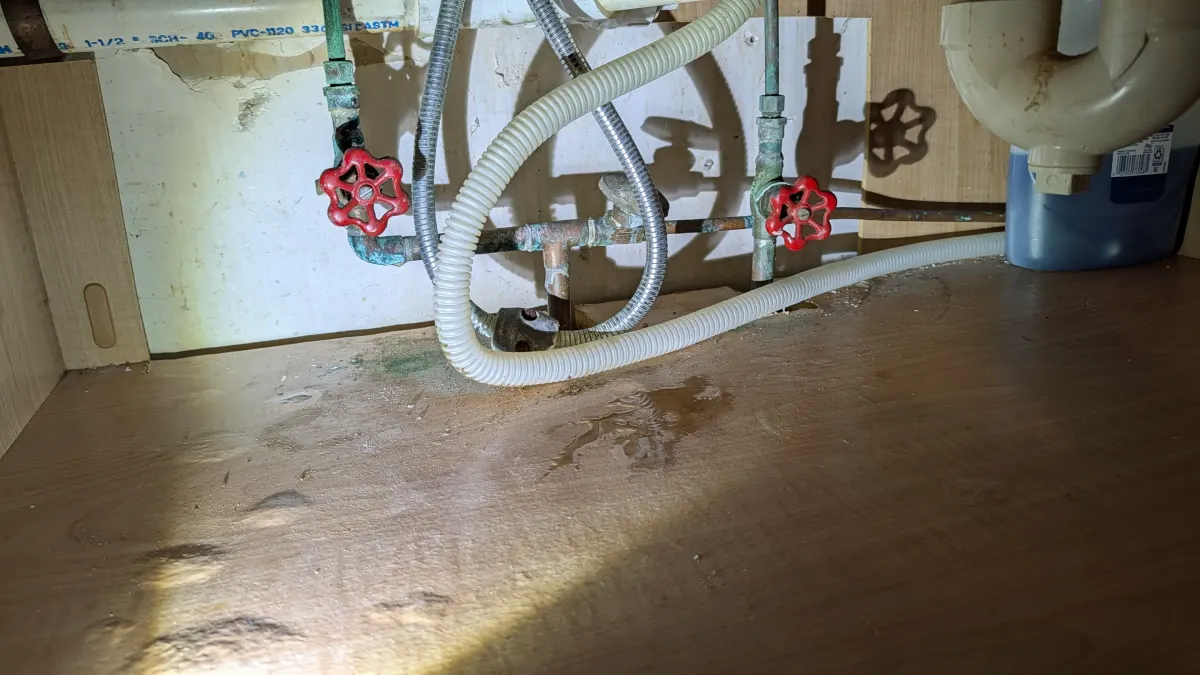
The homeowner mentioned that a previous plumber had replaced bathroom valves after a sink drip. They weren't sure the fix had worked because water came out of the pipe after the valve was closed and the faucet removed. Closing a shutoff stops new water from entering the faucet line; it doesn't instantly empty the water already on the faucet side. A brief drain-off doesn't prove the valve failed. Continued flow can mean the shutoff is still passing water, so we'd check it before disconnecting more plumbing.
Our recommendation was straightforward: replace all three valves before installing the new faucet, so whatever faucet the homeowner chooses, the water under it can be controlled. Our fixture repair service covers faucets, valves and the connections under them.
Before you buy a filter, read the numbers correctly
Because we were already on site, we ran a water test instead of guessing. An on-site test covers everyday measures of the water. PFAS, the "forever chemicals," are different: they require a sample sent to a certified laboratory.
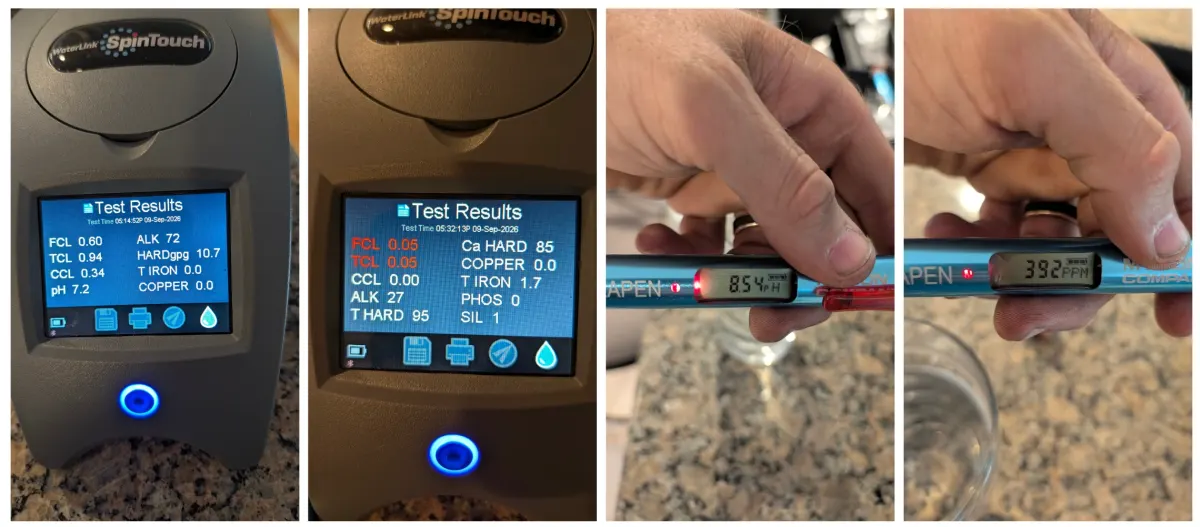
Maynard's public water comes from more than one source, so town-wide averages don't necessarily describe your tap. The town's 2025 water quality report is the place to start. Online comparison sites are useful, but many report a result as a multiple of their own health guideline rather than the enforceable limit. A big multiple can sound alarming even when the water meets the legal standard. The useful comparison is your utility's actual number against the limit that applies to it.
Here's how the PFAS benchmarks compare, as of October 2026:
| Benchmark | Level | What it is |
|---|---|---|
| EWG Tap Water Database guideline | PFOA 0.09 parts per trillion | A nonprofit's research benchmark, not a legal limit |
| EPA's 2024 drinking water rule | PFOA and PFOS, 4.0 parts per trillion each | Federal limits; check EPA's page for the current compliance timeline |
| Massachusetts limit | Six PFAS combined (PFAS6), 20 parts per trillion | The state's enforceable standard |
| Maynard's 2025 water quality report | PFAS6 average of 12.60 parts per trillion | The PFAS6 row lists no violation |
Water isn't simply good or bad, and there's no normal baseline that fits every town. A result under the legal limit can still be worth attention, and a scary headline number can still be legal. The goal is to base any treatment decision on your actual results.
Testing tips
Test cold water, not hot. Hot water pulls more metal from pipes and fittings, which can skew the results toward your plumbing rather than your water source. Follow the sampling instructions from the lab or kit exactly: some tests want the first water out of the tap and others want it run first, and doing it the wrong way changes the answer.
When treatment makes sense
If a test shows something worth treating, the right equipment depends on what was found. That might be reverse osmosis at the kitchen sink for drinking water, or a whole-home system for problems that affect every tap. A treatment claim should match the specific contaminant in the specific product's certification, not a general promise. Our water treatment service starts from test results. It's not something to install because a neighbor has one.
Two common questions
Do I need reverse osmosis if my town's water report looks bad online?
Not necessarily. Many comparison tools use thresholds far stricter than the legal limits. Look at the actual number against the enforceable limit, then test your own water. If your results show something worth reducing, choose a system certified for that contaminant.
My bathroom faucet is dripping. Is that a valve problem?
It depends on where the water shows up. A drip from the spout usually comes from the faucet's own cartridge or washer. Water under the sink points to the shutoff valves, supply lines or fittings. It's worth checking both while someone is there.
Book a visit
Jeneral Plumbing is based in Westford, MA, and serves Maynard and nearby Middlesex County communities. If you have seized shutoff valves, a faucet that's falling apart, or questions about your water before buying a system, call (978) 392-7789 so we can confirm your address and plan the right visit. A regular-hours visit carries an $80 dispatch fee — the cost of the visit, waived when you hire us for the work.
Written by Jeneral Plumbing.
This article was drafted with AI writing tools and edited before publication. AI tools did not inspect any job or validate technical conclusions.
Last updated .