

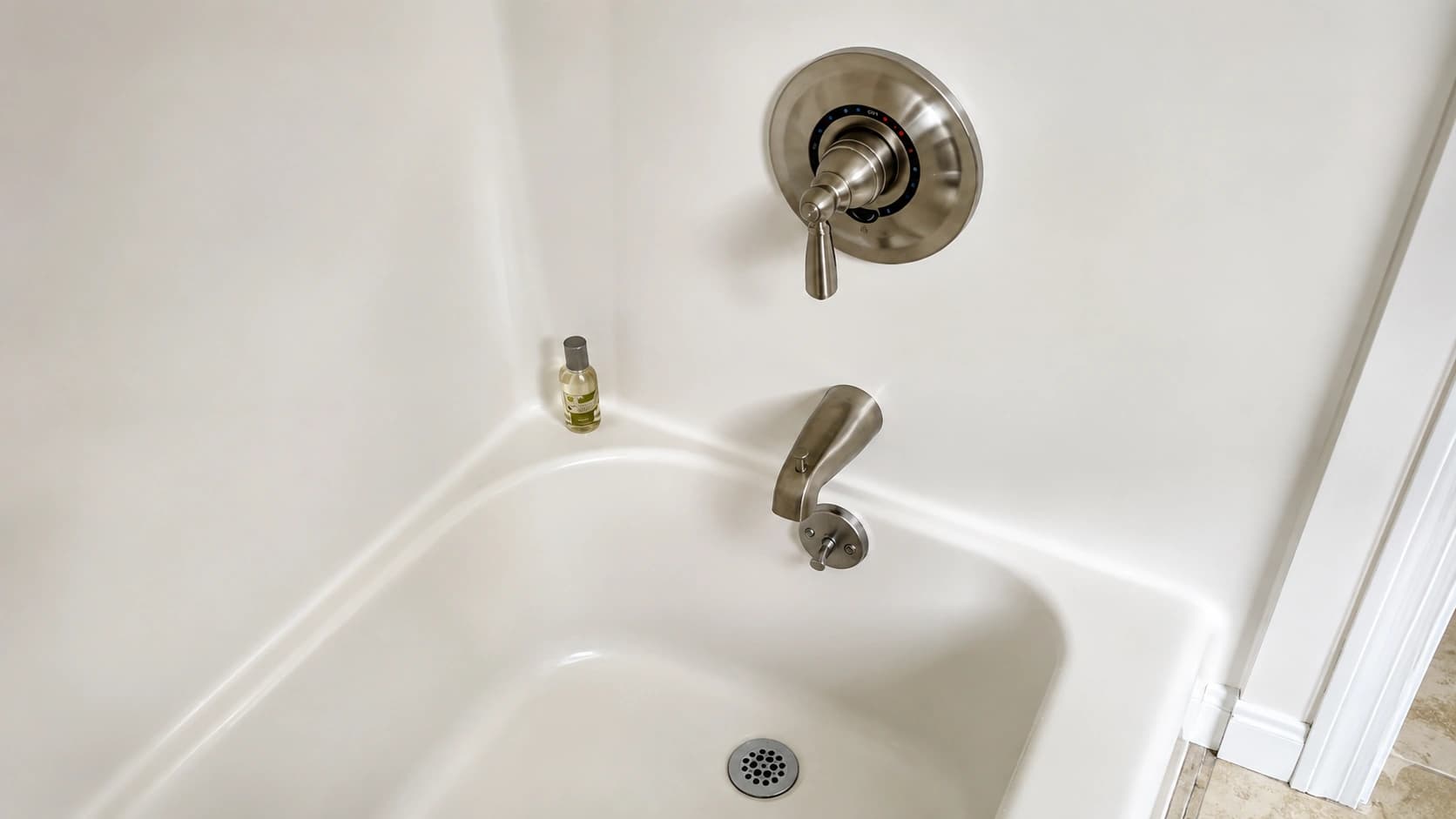
You set the shower where you want it, step away for a minute, and come back to find the water noticeably hotter than you left it. Nobody touched the handle. That is a drifting shower handle, and in a Groton home I worked on recently it turned out to be one of the more satisfying kinds of plumbing problem — a real safety issue with a genuinely small cause.
Why a drifting shower handle is worth taking seriously
It is easy to file this under annoyance rather than hazard. I would not. A handle that drifts toward hot on its own is a scald exposure that arrives without warning, and the people least able to react quickly are the ones most likely to be caught by it — young children, older adults, anyone with reduced mobility or sensation.
The reason a drifting shower handle deserves attention is not that the valve is about to fail catastrophically. Usually it is not. It is that the failure mode points in the dangerous direction, and it does so while you are standing in the water.
Shower valve work is licensed work, not a DIY project
Before the mechanics, the boundary. Shower valve and trim work should be handled by a licensed plumber. Even something that reads like tightening one nut means working around live water lines, valve stems, and internal components that damage easily and fail inside a wall where you cannot see them. Massachusetts requires licensed plumbers for this work, and the reason is exactly this class of repair — the two-minute version and the wall-opening version look identical right up until something goes wrong.
Jeneral Plumbing is owner-operated by a Licensed Master Plumber (MA #9628831-PL-M). If your shower handle is drifting, sticking, or behaving in a way it did not used to, the safe move is a call rather than a screwdriver.
What happened on the Groton call
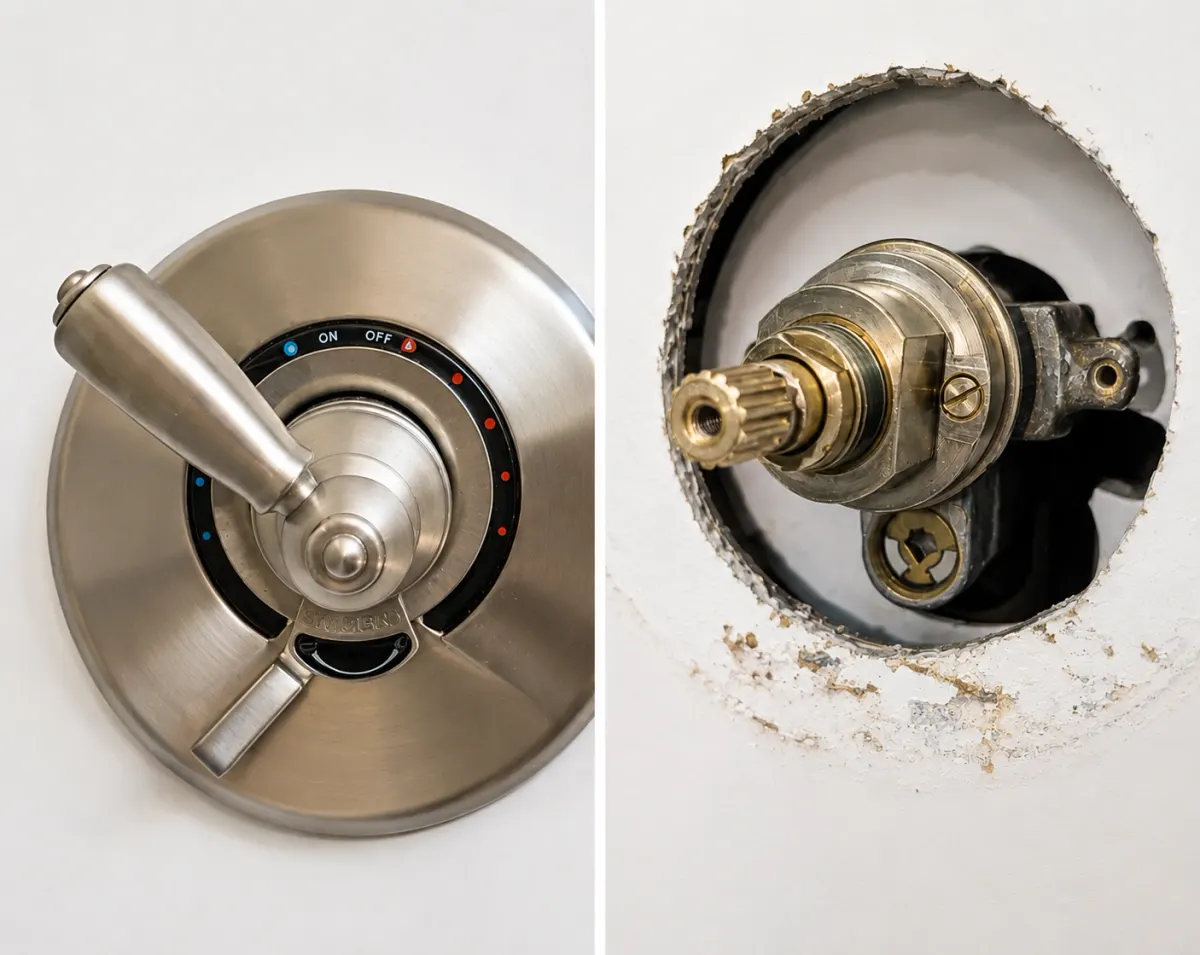
I had been at this Groton home the day before to rebuild a shower valve and install new trim. The homeowner called back to report that since the rebuild, the handle would slowly start moving on its own. Set it partway toward hot, and over a minute or two it would keep working its way hotter without anyone in the room.
A drifting shower handle showing up immediately after a valve has been serviced is unsettling if you do not know what it means. It reads like the rebuild went wrong. It usually means something much smaller, and on this particular valve design it is a known and quickly corrected adjustment.
The mechanism behind a drifting shower handle
The handle mounts onto a stem that runs into the valve body, seating on a star-shaped pattern in the middle of that stem. Around the stem sits a component called the packing nut. Its job is to form a tight seal where the stem passes out of the valve, and a side effect of that seal is friction — the packing nut is what determines how freely the stem, and therefore the handle, is able to turn.
When the packing nut is not tightened enough after a rebuild, the stem turns too easily. Add water pressure pushing against the internals and the simple weight of the handle hanging off the stem, and the assembly will slowly rotate on its own. That is the whole explanation for most cases of a drifting shower handle following recent valve service: not a defective valve, not a failed cartridge, just insufficient tension at one seal.
The fix, and why callbacks like this are normal
The correction is to tighten the packing nut, which raises the tension around the stem enough that the handle holds its position while still turning normally when someone actually wants to change the temperature. That balance is the craft of it — too loose and it drifts, too tight and the homeowner is fighting the handle every morning. I made that adjustment on site and the drifting shower handle stopped.
This is a good illustration of why callbacks exist and why they are not an admission that something was botched. When a valve gets new internal parts and new trim, occasionally it needs one follow-up adjustment once it has been under pressure and in real use. A plumber who treats that as a normal part of the work will come back and correct it. That is the standard I hold myself to.
What this means for older Groton bathrooms
I see valves of this vintage across Groton and in neighbouring towns including Westford, Littleton, Chelmsford, and Ayer. A great many homes in this part of Middlesex County have shower valves that have been in service for decades, and when one of those is rebuilt or fitted with new trim, a packing nut adjustment is sometimes part of getting it right.
Worth separating two different situations, because they call for different responses. A drifting shower handle immediately after service is almost always the adjustment described above. A handle that has started drifting on a valve nobody has touched in years is a different conversation — that points toward wear in the packing or the stem itself, and it is the case where a rebuild rather than an adjustment is likely to be the honest answer.
Either way, temperature that moves on its own in a household with children or older adults is worth resolving rather than living around.
What a visit costs
Repair work is priced at a flat rate, with the total price and any applicable fees disclosed for approval before work begins. I do not bill this work hourly. During regular business hours, a visit begins with an $80 dispatch fee — the cost of the visit, waived when you hire us for the work.
If the drifting shower handle is on a valve I recently serviced, that is a callback and it is handled as one. Say so when you call, and it gets treated accordingly rather than as a new job.
Questions about drifting shower handles
Why does my shower handle keep turning hotter by itself?
On most valves the cause is a packing nut that is not tight enough, which lets the stem the handle mounts to turn more freely than it should. Water pressure and the weight of the handle then do the rest, and the handle rotates on its own. A plumber tightens the packing nut to restore the correct resistance. If the valve has not been serviced recently, the same symptom can point to wear in the packing or stem, which is a rebuild rather than an adjustment.
Is a drifting shower handle actually dangerous?
It can be, and the direction of the drift is what matters. A handle that creeps toward scalding water while someone is in the shower is a genuine burn risk, and it is worst for the people least able to move quickly out of the stream. I would not keep using a shower that does this while waiting for a convenient time to address it.
Can I just tighten the packing nut myself?
Please do not. The nut sits at the point where the stem passes out of a live water line, and the adjustment window between drifting and seized is narrower than it looks. Over-tightening damages the packing and turns a small adjustment into a rebuild, and a slip here means water inside a finished wall. This is licensed work in Massachusetts for exactly these reasons.
Should I replace the whole valve instead of repairing it?
Not automatically. Many older valves are well built and fully rebuildable, and rebuilding a sound valve body is usually the better value than replacing it — a replacement often means opening the wall, which changes the project entirely. The decision comes down to the condition of the valve body, whether parts are available for it, and whether the current configuration meets today's requirements. I evaluate that at the property rather than guessing from the model name.
My handle drifts colder instead of hotter. Same cause?
Usually yes — the stem is turning freely and gravity and pressure decide which way it goes. It is less alarming than drifting hot, since the failure direction is uncomfortable rather than hazardous, but it is the same underlying looseness and the same fix.
How long does this repair take?
A packing nut adjustment on an accessible valve is quick work. A full rebuild takes longer and depends on the valve, parts availability, and what is found once the trim comes off. I confirm which situation you are in before quoting the work, because the two are genuinely different jobs and I would rather tell you that at the door than after.
Shower valve and fixture repair across Groton and Middlesex County
Whether it is a drifting shower handle, a valve due for a rebuild, or a second opinion on recent work, Jeneral Plumbing serves homeowners throughout Groton, Westford, Littleton, Chelmsford, and the surrounding Middlesex County towns. Family-owned and operated, with upfront pricing and no hidden fees.
Related reading: fixture repair covers valve and trim work in detail, fixture repair in Westford covers the local specifics, fixture installation explains when replacement is the better path, and plumbing service plans describe ongoing maintenance coverage. For an active leak or a fixture failure that cannot wait, see emergency plumbing.
Call Jeneral Plumbing at (978) 392-7789 to describe what the handle is doing and confirm current availability.
This article is general information, not a substitute for a licensed plumber's assessment of your specific fixture.
Written by Kris Record, Massachusetts Master Plumber, License #9628831-PL-M.
This article was drafted with AI writing tools and edited before publication. AI tools did not inspect any job or validate technical conclusions.
Last updated .