
Home Gas System Design: From Gas Line Sizing to Tankless Water Heater Maintenance

Home Gas System Design: From Gas Line Sizing to Tankless Water Heater Maintenance

Jeneral Plumbing

Gas Systems

Before you add a gas fireplace, a bigger range, or a tankless water heater, one question decides whether the project works: can your gas line actually feed it? That question is answered with gas line sizing — a calculation, not a guess — and this post walks through a real one, from a consultation at a home here in Westford, MA. Jeneral Plumbing is owner-operated by a Licensed Master Plumber (MA #9628831-PL-M) with 20+ years in the trade, including seven with a gas utility, serving 23 towns across Middlesex & Essex County.

Read this as an educational resource, not a diagnosis. Every real gas decision follows a licensed on-site evaluation, a load calculation for your specific home, and the permit and inspection path for your town.

Smell Gas? Leave the Building First

Before any talk of BTUs: if you smell gas or suspect a leak, leave the building immediately with everyone in the home, then call 911 and your gas utility from outside. Do not operate lights, switches, phones, or appliances; do not light a flame; and do not try to shut off the gas. Stay outside until the fire department or gas utility says the property is safe.

Licensed repair on customer-owned piping starts only after that clearance. Our gas line repair service, which begins after utility clearance, explains how that sequence works. Everything below is about planned, unhurried gas work — the kind you schedule, not the kind you evacuate for.

One Westford Home, Four Gas Appliances

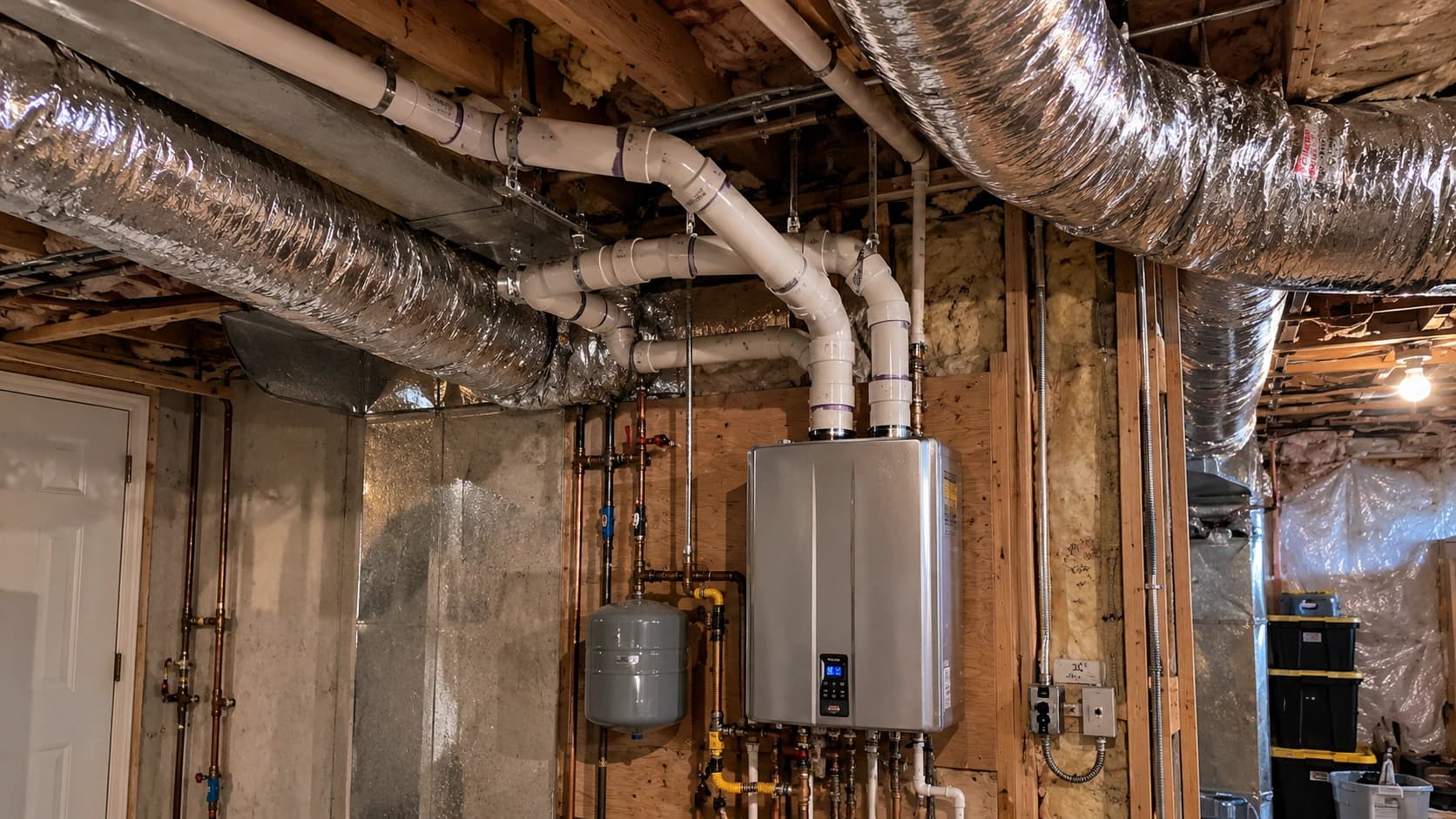
The walkthrough that anchors this post came from a Westford homeowner with a familiar setup: a gas furnace, a gas range, and a high-end condensing tankless water heater, plus plans to add a gas fireplace insert. Multi-appliance homes like this are common across Westford, Chelmsford, Acton, Littleton, and Groton — and every appliance added over the years quietly draws from the same pipe.

That is the part homeowners rarely see. The gas system behind your walls was sized for a specific load on a specific day, and each new appliance spends a little more of that capacity. A fireplace insert is a modest project on its own; a fireplace insert on a line already feeding a 199,000 BTU tankless unit is a math problem. So before anyone talked pipe or price, I took out a tape measure.

Gas Line Sizing: How the Math Actually Works

Gas line sizing comes down to two numbers: the total connected BTU load, and the distance from the gas meter to the farthest appliance. In this home, the measurements ran:

  • 35 feet from the meter to the kitchen range
  • 26 feet to the proposed fireplace location
  • Additional runs to the furnace and the tankless water heater

Then the loads, taken from each appliance’s rating plate:

  • Furnace: 60,000 BTUs
  • Tankless water heater: 199,000 BTUs
  • Range: approximately 60,000 BTUs
  • Proposed fireplace insert: to be determined by the model chosen

With those numbers, the fuel-gas code’s sizing tables do the rest. Natural gas carries roughly 1,000 BTUs per cubic foot, and a pipe of a given size, length, and pressure can move only so many cubic feet per hour. The table row for the longest run governs the whole system — that is why the measurement starts at the meter and ends at the farthest fixture, not at whichever appliance is closest.

This home had one more wrinkle worth mentioning: a ¾-inch service line from the gas company stepping up to 1-inch piping inside the house. That is an unusual configuration, but an effective one — the larger interior pipe reduces pressure drop across the branches and gives multiple high-demand appliances room to run at once. It is also exactly the kind of detail a load calculation catches and a visual guess misses. Planned new piping — a fireplace branch, a range hookup, a generator run — starts with this same sequence on our gas line installation service page: load, route, permit, pressure test, inspection.

How Many BTUs Is Your House Using?

You can rough out your own load in ten minutes. The authority is always the rating plate on each appliance — usually a metal or foil label near the burner compartment or on the cabinet side — but trade-typical ranges give you a feel for the arithmetic:

  • Gas range: roughly 50,000–65,000 BTUs with all burners and the oven combined
  • Gas furnace: commonly 60,000–120,000 BTUs depending on the size of the home
  • Gas boiler: commonly 70,000–150,000 BTUs for residential hydronic systems
  • Condensing tankless water heater: commonly 150,000–199,000 BTUs — often the largest single load in the house
  • Tank-style gas water heater: roughly 30,000–50,000 BTUs
  • Gas dryer: roughly 20,000–35,000 BTUs
  • Gas fireplace insert: commonly 20,000–40,000 BTUs
  • Standby generator: varies widely by size; use the listed maximum fuel demand, which can rival everything else combined

Add up what you have, note what you plan to add, and you are holding the first half of a gas line sizing calculation. The second half — pipe sizes, developed lengths, operating pressure, and meter capacity — is the licensed half, and it is the half that decides whether your project needs new pipe or already has room.

Signs Your Gas Line Is Undersized

An undersized line does not announce itself with a leak or an odor. It shows up as appliance starvation — equipment that misbehaves only when other equipment is running, because the pipe cannot deliver full volume to everything at once. Watch for:

  • Range burner flames that shrink or flutter when the tankless water heater or furnace fires
  • A tankless unit that throttles back, delivers lukewarm water, or throws ignition and flame-failure codes when the heat is running
  • A furnace that short-cycles or struggles to ignite while other gas appliances are in use
  • A new appliance that never seems to reach its rated output, even though it checks out on its own
  • Symptoms that appear only in winter — the one season when every gas appliance in the house runs at the same time

Any one of these can have other causes, which is why the diagnosis is a measurement and not a guess. But if the symptoms track with simultaneous use, the pipe is a prime suspect. Problems on existing piping — including sections that were never sized for the load they now carry — follow the repair path on our gas line repair page, and our full guide to gas line installation and repair explains how the repair and installation paths differ from the first phone call on.

What a Tankless Error Code Taught Us

The same Westford visit included a lesson in why gas sizing and equipment maintenance belong in the same conversation. The home’s tankless unit was displaying an error code indicating “flue blockage detected during startup due to insufficient combustion air.” The cause turned out to be ordinary: the combustion-air intake had accumulated enough dirt and debris to restrict airflow, and the unit was protecting itself by refusing to run.

Two details from that diagnosis are worth carrying with you. First, error codes are model-specific — codes vary by manufacturer, model, and software version, and they do not translate one-for-one between brands, so the right move is to photograph the display and note what was running rather than searching a generic code list. We are factory trained by Navien, Rinnai, and Noritz on the tankless side, which is what turns a cryptic code into a specific next step. Second, the same visit surfaced a waterlogged expansion tank: a 199,000 BTU tankless unit heats only about a gallon and a half of water at a time, which creates real thermal expansion, and the tank that absorbs it had lost its air charge. Expansion tanks commonly ship factory pre-charged around 40 PSI and must be adjusted to match the home’s actual water pressure — a step that is often skipped and quietly shortens the tank’s life.

This page’s focus is the gas side, so I will leave the maintenance depth where it lives: our tankless water heater service page covers descaling, brand-by-brand warranty terms, and error-code diagnosis in full.

Annual Tankless Maintenance, In Brief

A tankless water heater is serviceable equipment, not a maintenance-free appliance. The annual visit is short but specific:

  • Clean the combustion-air intake screens
  • Check the expansion tank’s air charge against house pressure
  • Inspect gas connections and venting
  • Descale the heat exchanger as the water calls for it

On descaling frequency: most manufacturers call for annual service, homes with softened or naturally soft water can often stretch the interval, and homes on hard well water sometimes need it more often. Let a water test set your schedule — hardness varies house to house across our area, by supply, by season, and by property. The tankless service page covers what each maintenance step involves and when a symptom means repair instead.

Planning a Gas System Upgrade in Massachusetts

Whether the project is a fireplace insert, a tankless conversion, or a whole-kitchen renovation, the planning sequence is the same. Total the existing and planned loads. Confirm the service line and meter can carry them. Plan routes that keep runs short — the Westford home’s range line took a circuitous path that could have been simplified during a past kitchen renovation, and while it works, it is more pipe than the job needed. Think one appliance ahead: if a generator or pool heater is on the five-year wish list, say so while the line is being sized, because capacity is cheap to plan and expensive to retrofit.

Then there is the legal frame. Massachusetts assigns fuel-gas piping work to licensed plumbers and gas fitters — there is no homeowner do-it-yourself lane for gas piping. The license holder files the permit, the installed work gets a documented pressure test, and an inspection follows before gas flows. In Westford the Building Department is the local starting point, and the details differ town by town in Chelmsford, Acton, Littleton, and Groton, which is why the permit path is confirmed rather than assumed. The sizing tables are not suggestions; they are the engineering that keeps every appliance fed under worst-case demand, and the inspection exists to verify them.

One honest aside from the same visit: the evaluation also flagged a humidifier on the HVAC system with a failing solenoid valve — trying to fill, never completing the cycle. That is equipment for an HVAC contractor, so we documented it for the homeowner rather than pretending it was ours to fix. A whole-home evaluation is worth having even when some findings belong to another trade.

Gas Line Sizing Questions Homeowners Ask

Is my gas line big enough for a new appliance?

Only a load calculation can answer that — a pipe running near your project is not proof of available capacity. The check compares the new appliance’s listed input plus everything already connected against the line’s size, its developed length, the operating pressure, and the meter’s capacity. If the numbers come up short, the fix may be a new branch, a resized section, or a utility review rather than a whole-house repipe. We run the calculation before quoting, so the answer is confirmed rather than assumed.

Can I add a gas fireplace to my existing gas line?

Often yes, but it depends on your current connected load and line capacity, not on whether a pipe passes nearby. A fireplace insert commonly adds roughly 20,000 to 40,000 BTUs, and the exact figure comes from the rating plate of the model you choose. In the Westford home above, the 26-foot run to the proposed fireplace location was measured as part of the whole-house calculation before any pipe was planned. A licensed assessment tells you whether the existing infrastructure supports the added demand or whether a section needs to be upsized first.

Why does my tankless water heater show an error code?

An error code is the unit reporting a specific condition, and many point to maintenance rather than major failure — the code in the story above traced to a dirty combustion-air intake. Codes vary by manufacturer, model, and software version, and numbers do not translate one-for-one between brands. Photograph the full display and note what was running when the code appeared; repeated resets can clear useful history without correcting the condition. If a code returns after a reset, have the unit serviced rather than living with the reset button.

How often should a tankless water heater be descaled?

Most manufacturers call for annual descaling, though homes with softened or naturally soft water can often stretch to every two years, and homes on hard well water sometimes need service more often than annually. Water hardness is the single biggest variable, and it differs house to house across Westford, Chelmsford, Littleton, and Groton — by supply, by season, and by property. Let a water test set the interval rather than a guess. Skipped descaling shows up later as lost efficiency and, eventually, heat-exchanger damage.

Who does gas line load calculations in Massachusetts?

Licensed plumbers and gas fitters — Massachusetts assigns fuel-gas piping work to license holders, with no do-it-yourself lane the way some trades allow. The license holder files the permit, the installed work is pressure-tested, and an inspection follows before gas flows. A load calculation is the first step of that sequence, not an optional extra. Jeneral Plumbing runs the calculation on site and puts the result in a written scope before any work is authorized.

What should I do if I smell gas in my house?

Leave the building immediately with everyone in the home, then call 911 and your gas utility from outside. Do not operate switches, phones, or appliances; do not light a flame; and do not try to shut off the gas yourself. Stay outside until the fire department or utility says the property is safe. Repair on customer-owned piping is arranged only after that clearance — never as a substitute for it.

Get the Load Calculation Before the Project

The Westford walkthrough above ended the way good gas projects should: with numbers on paper before pipe in hand. If you are planning a gas appliance — or living with one that seems starved — call Jeneral Plumbing at (978) 392-7789 to schedule a load and route evaluation. For a regular-hours visit there is an $80 dispatch fee — the cost of the visit, waived when you hire us for the work. We serve Westford, Chelmsford, Acton, Littleton, Groton, Carlisle, Tyngsborough, and communities across Middlesex & Essex County; the full service area town list shows everywhere we go.

Written by Jeneral Plumbing.

This article was drafted with AI writing tools from Jeneral Plumbing job notes and source materials, then edited before publication. AI tools did not inspect the job or validate technical conclusions.

Last updated .

Related Topics:tanklesssystemproperexpansionmaintenanceplanningsizingservice

Dealing with this in your home? We can help.