

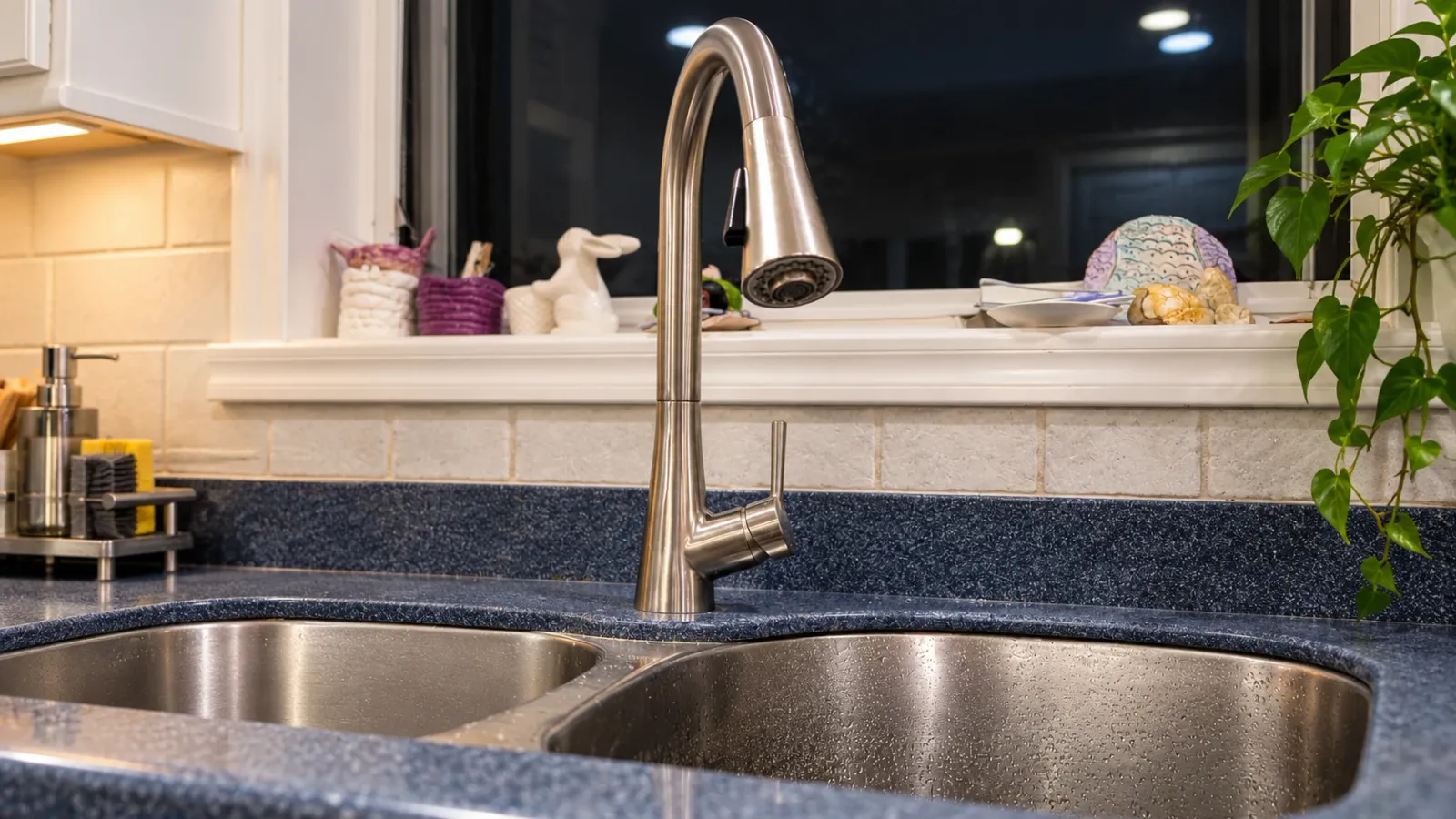
During a recent kitchen faucet replacement in Westford, our technician was called out to a home on well water where the kitchen sprayer hose had snapped clean off — and the shut-off valves underneath the sink wouldn't turn at all. What started as a simple kitchen faucet swap turned into a great teaching moment about hard water, iron, and pressure tanks, and it's the kind of visit we see often in homes around Westford, Chelmsford, and Groton.
What We Found Under the Sink
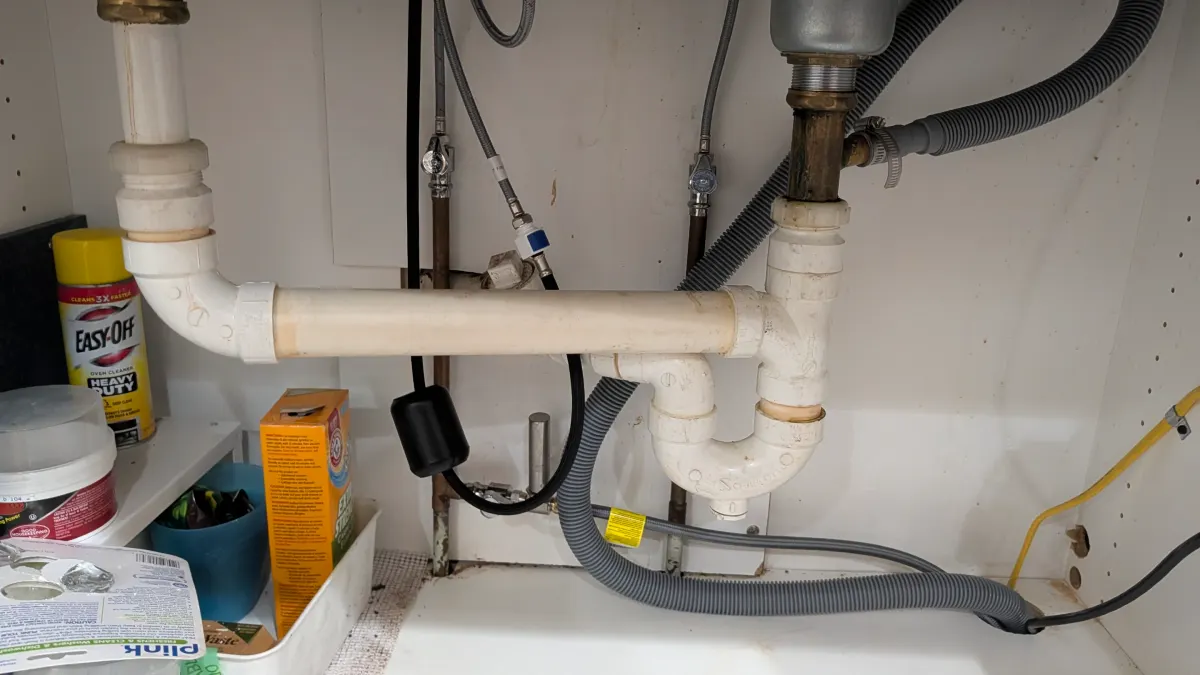
The homeowners had a broken pull-down sprayer hose that separated with a clean break at the faucet base. Before installing a replacement, our technician tried to isolate the water supply and discovered the existing shut-off valves under the sink had seized — they simply wouldn't turn. This is one of the most common issues we run into during a bathroom faucet replacement or kitchen faucet replacement in older homes: the valves haven't been touched in years, and mineral buildup from hard water locks the ball inside the valve in place.
Westford has hard water on both the municipal supply and private wells, so this isn't unusual. Once a valve seizes, there's no way to shut off water to just that fixture — which is a problem the next time something needs fixing, or in an emergency where every second counts.
Bathroom Faucet Replacement Starts With the Shut-Offs
Whether you're doing a full bathroom faucet replacement or just swapping a kitchen faucet, the shut-off valves underneath matter as much as the fixture itself. In this case, our technician recommended replacing all three valves under the kitchen sink — one for the dishwasher line, and the hot and cold supply valves for the faucet.
Because the home has a whole-house water treatment system, our technician recommended quarter-turn valves. These are stainless steel, turn on and off with a simple quarter twist instead of several full rotations, and typically last around twenty years. The tradeoff is that quarter-turn valves can't be rebuilt if they fail — they get replaced outright. The multi-turn style already in the house can be rebuilt roughly every ten years if hardness becomes an issue again, which is why our technician walked the homeowners through both options rather than assuming one was automatically better.
Understanding Ferrous vs. Ferric Iron in Well Water
While checking the mechanical room, our technician noticed the sediment filter had a distinct reddish tint. The homeowners explained that before they installed a sediment filter, they'd get brown water every time it rained — and the filter cleared it up. That reddish-brown staining is iron, and it's extremely common in well water throughout Westford and surrounding towns.
There are two types worth knowing about:
Ferric iron — the solid, particulate form. This is what was likely staining their water brown, and it's exactly what a sediment filter is designed to catch.
Ferrous iron — a dissolved form that doesn't show up the same way and typically requires different treatment to address.
The home also had a radon mitigation component built into the water treatment setup, in addition to the sediment filtration. Our technician confirmed the sediment filter was doing its job and didn't need to be replaced — just noted for the homeowners so they understood what each component in their system was actually doing.
Checking the Pressure Tank
Further down the line, our technician inspected the pressure tank for the well system. These tanks have a rubber diaphragm inside, with water on one side and air on the other. Tapping the tank should produce a hollow sound where the air is — if it doesn't, the air charge has likely dropped and needs to be topped off to match the house's water pressure, which in this case was around 60 pounds against a tank that ships pre-charged at 40 pounds.
FauceOur technician planned to check this once the system was drained for the valve replacement — draining the tank makes it possible to unscrew the valve stem, check the air charge, and add air if needed, all without replacing the tank itself. It's a quick check that often gets missed, but a tank running low on air pressure can cause a well pump to short-cycle and wear out faster than it should.
The Faucet Itself
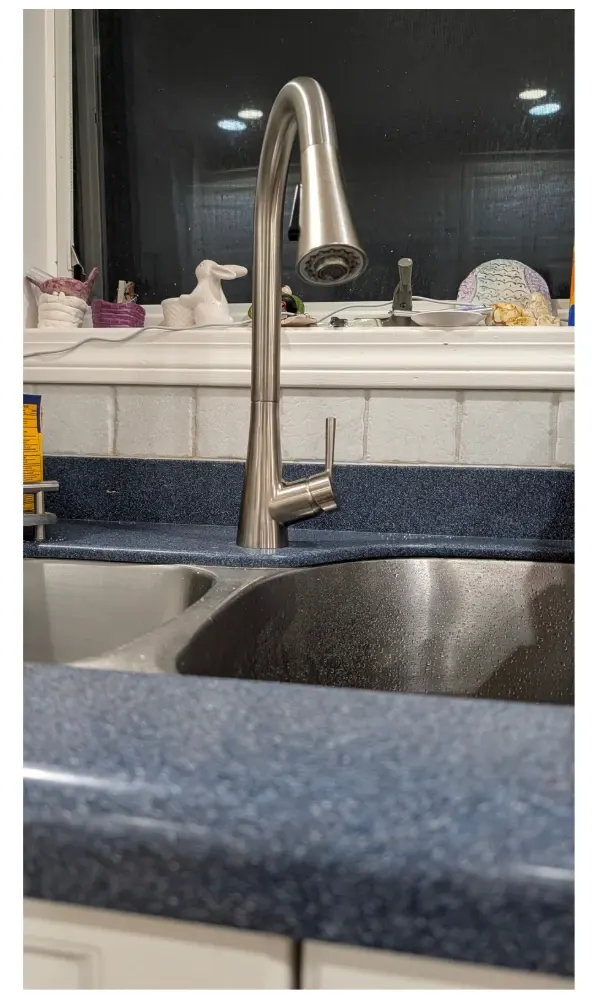
For the actual kitchen faucet replacement, the homeowners wanted to match their existing gooseneck-style faucet — a design where the spout arcs up higher than a standard faucet. Our technician walked them through the pricing structure: faucets can either be customer-supplied, where the quote only covers labor, or selected from options our technician carries, where the price includes both the faucet and the labor to install it, broken out separately so homeowners can see exactly what they're paying for.
Blocked Kitchen Sink? Don't Ignore Seized Valves
One thing worth flagging for any Westford homeowner: if you ever deal with a blocked kitchen sink or a leak under the cabinet and can't find a shut-off valve that actually turns, that's a sign your valves may be in the same shape these were. Seized valves turn a five-minute fix into an emergency, because the only way to stop the water is to shut off the main. If you're not sure where your main shut-off is or whether it still works, it's worth having a plumber check — we talk more about that kind of preparedness on our emergency plumbing page.
Key Takeaways
Hard water in Westford — on both well and municipal supply — causes shut-off valves to seize over time, which is one of the most common issues found during a kitchen or bathroom faucet replacement.
Quarter-turn valves are easier to operate and last longer, but can't be rebuilt; standard multi-turn valves can typically be rebuilt roughly every ten years.
Ferric iron (solid particles) causes the brownish tint often seen in well water and is captured by sediment filtration; ferrous iron is dissolved and needs different treatment.
Pressure tanks should have an air charge that matches your home's water pressure — checking this during other plumbing work is a smart, low-effort step.
Faucet quotes should clearly separate valve replacement, faucet material cost, and labor so homeowners know exactly what they're paying for.
Frequently Asked Questions
What is the cost to replace a kitchen faucet?
Cost depends on whether you supply your own faucet or choose one from your plumber's inventory, plus how many shut-off valves need to be replaced at the same time. Ask your plumber for an itemized quote showing valve replacement, faucet material, and labor separately, as our technician did in this visit.
How do I know if I need a bathroom faucet replacement or just a repair?
If the faucet body, hose, or internal parts have physically broken — like a snapped sprayer hose — replacement is usually the more reliable option, especially if the shut-off valves feeding it are also seized from mineral buildup.
Why won't my shut-off valve turn?
In homes with hard water, sediment and mineral buildup coat the ball inside older valves over time, causing them to seize. This is extremely common in Westford and nearby Chelmsford and Groton, especially in valves that haven't been operated in years.
What's the difference between ferrous and ferric iron in well water?
Ferric iron is the solid, particulate form that causes visible brown or reddish staining and is captured by sediment filters. Ferrous iron is dissolved in the water and isn't removed the same way, often requiring additional treatment depending on test results.
Should I shut off my main water valve before a faucet repair?
If the fixture's own shut-off valves are seized or missing, shutting off the main is the only safe way to stop water flow before any repair. This is exactly the situation that made this Westford job more involved than a simple faucet swap.
Get Your Faucets and Valves Checked Before Winter
If you're in Westford, Chelmsford, or Groton and dealing with a stuck shut-off valve, a broken faucet, or discolored well water, it's worth having a licensed plumber take a look before winter sets in. Jeneral Plumbing offers an "$80 dispatch fee — the cost of the visit, waived when you hire us for the work". Off-hours, Sunday, and holiday dispatch is $599. We answer emergency calls 24/7. Call us today at (978) 392-7789 to schedule a visit.
This post is for informational purposes only and does not substitute for an in-person evaluation by a licensed plumber. Water treatment, pressure tank, and plumbing repairs should always be performed by a qualified professional.
Written by Sierra Sorongon.
This article was drafted with AI writing tools from Jeneral Plumbing job notes and source materials, then edited before publication. AI tools did not inspect the job or validate technical conclusions.
Last updated .