

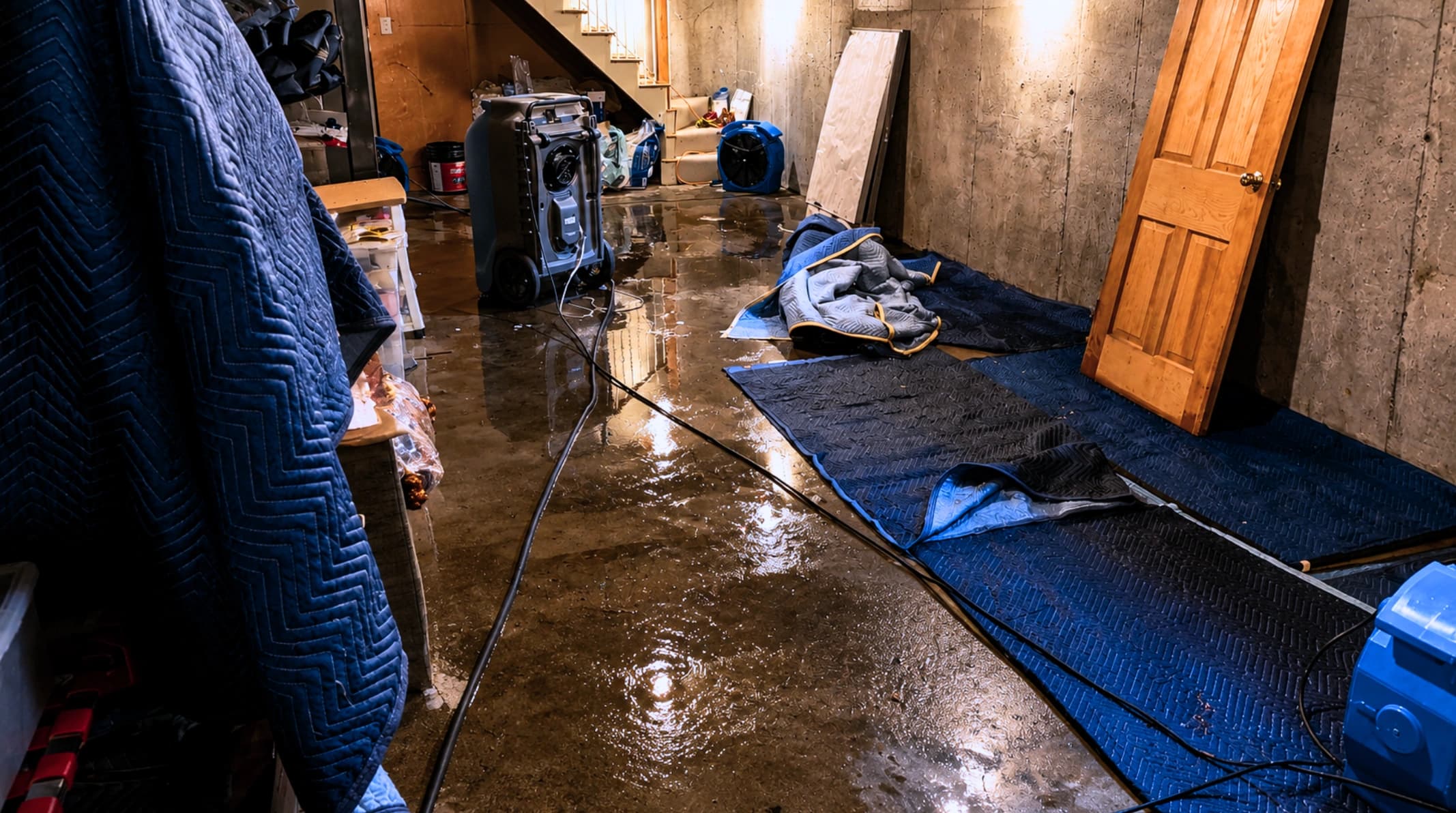
Water heater failure can turn a planned replacement into a basement-water response, temporary hot-water work, and separate drying or restoration decisions. A documented Westford, MA, service case shows a storage tank that had been flagged for dripping on two visits before it later failed and flooded the basement. The case is useful because it separates the known plumbing facts from costs and outcomes that remain unknown.
Safety First During an Active Leak
Quick answer: Keep people out of standing water when energized equipment, outlets, wiring, or a wet electrical panel may be involved. Stay clear of hot water and a temperature-and-pressure relief discharge. If there is no gas odor or suspected fuel leak, no CO alarm or possible exposure symptoms, and the heater's cold-water valve or main shutoff is reachable from a dry, safe location, close that valve; otherwise wait for trained help.
Do not enter water to reach a breaker, appliance control, or shutoff. For an electric water heater, switch off its breaker only when both the path and panel are dry; for a gas unit, turn its appliance control to Off only when it is safely accessible and there is no gas odor or suspected fuel leak. Otherwise, leave the energy controls for responders. Do not drain or restart the heater, remove a cover, or lift, cap, plug, or manipulate the relief valve. If there is an electrical or fire hazard, leave the affected area and call 911.
If you smell gas or suspect a fuel leak, get everyone outside immediately. From outside, use a phone to call 911 and, as applicable, the gas utility or propane provider. Before leaving, do not operate switches, phones, appliances, windows, shutoffs, or flames. Stay out until officials clear the property. Carbon monoxide has no smell, so a CO alarm or possible exposure symptoms mean leaving and calling 911 from outside.
Once the location is safe, the Westford water-heating service guide explains the local assessment and replacement path. This article is educational context, not a remote diagnosis of an active leak.
What Water Heater Failure Looked Like in This Westford Case
Replacement was recommended on two separate visits after dripping was observed. The work was not authorized before the later water heater failure. That sequence shows the exposure created by leaving a deteriorating tank in service, but it does not prove that every drip leads to a rupture or establish an exact countdown.
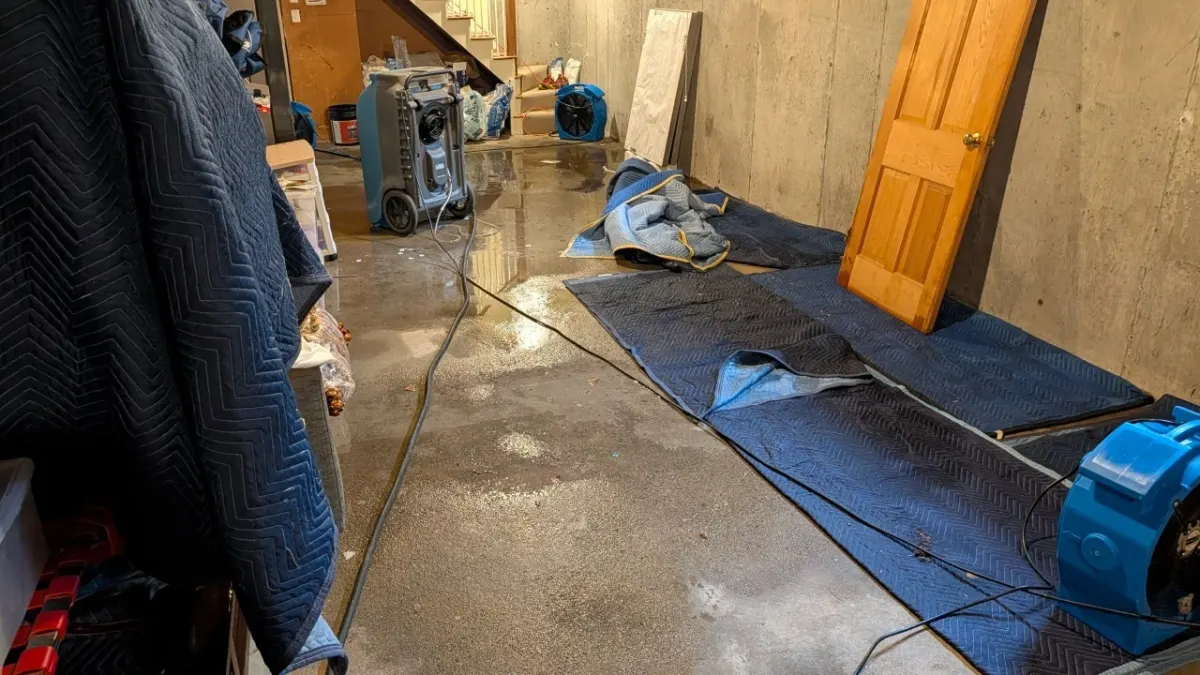
When the later water heater failure occurred, water spread through the basement. Pumps and fans were used during the response, and a separate mitigation or remediation contractor became involved. The final drying invoice, any mold finding, the damaged-content total, any insurance decision, and the restoration cost are not reported here.
A temporary 120-volt, 20-gallon electric heater was also installed to provide limited hot water while a permanent option was planned. That was a historical step in this case, not a promise that the same interim equipment or timing fits another home. Available hot water from a small temporary unit depends on inlet temperature, setpoint, flow, and recovery.
What Failed in the Tank
Two conditions were recorded at the response: the temperature-and-pressure relief valve had discharged, and a separate leak was found at the bottom of the tank. An incoming-pressure reading of about 85 psi was also noted. Those findings do not show the pressure or temperature at the moment of discharge, a peak pressure, which event happened first, or the final condition of the expansion controls.
A relief valve can discharge because of excessive pressure, excessive temperature, or a valve-related condition. Thermal expansion in a closed water system can raise pressure during a heating cycle, but diagnosis still has to check supply pressure, regulation, expansion control, temperature and burner or element controls, the valve, and its discharge piping. A failure should not be reduced to “replace the valve” without those checks.
Water found at a tank base does not prove a failed tank shell in every home because a fitting, drain valve, relief discharge, or nearby pipe can send water down the jacket. In this Westford case, the bottom leak was described as separate from the relief discharge. A confirmed tank-body leak requires replacement; some connected-component leaks may be repairable after their cause and surrounding condition are established.
Never obstruct a temperature-and-pressure relief outlet. Its discharge path must remain separate from a water-heater pan drain and follow the listed valve, equipment instructions, and applicable requirements. A valve that has discharged may reseat or may continue leaking, so the underlying condition still needs evaluation.
The Interim Hot-Water Response
After the documented failure, the compromised storage tank could not remain the permanent source of hot water. The small electric interim unit restored limited function while I planned the permanent system with the household. Its role was stabilization, not a finished replacement sized for normal household demand.
The flood also created work outside the water-heating installation. Water extraction, air movement, moisture evaluation, demolition, restoration, and mold assessment or remediation belong to the appropriate mitigation and restoration specialists. Jeneral Plumbing can document plumbing findings and completed plumbing work, but I do not diagnose mold or price restoration scope.
That boundary matters in planned-versus-flood math. Once water reaches building materials or contents, the plumbing replacement is no longer the only cost category. The final gross loss and homeowner out-of-pocket amount depend on facts outside the plumbing work, such as restoration invoices and the insurer's decision.
The Planned Tankless Conversion
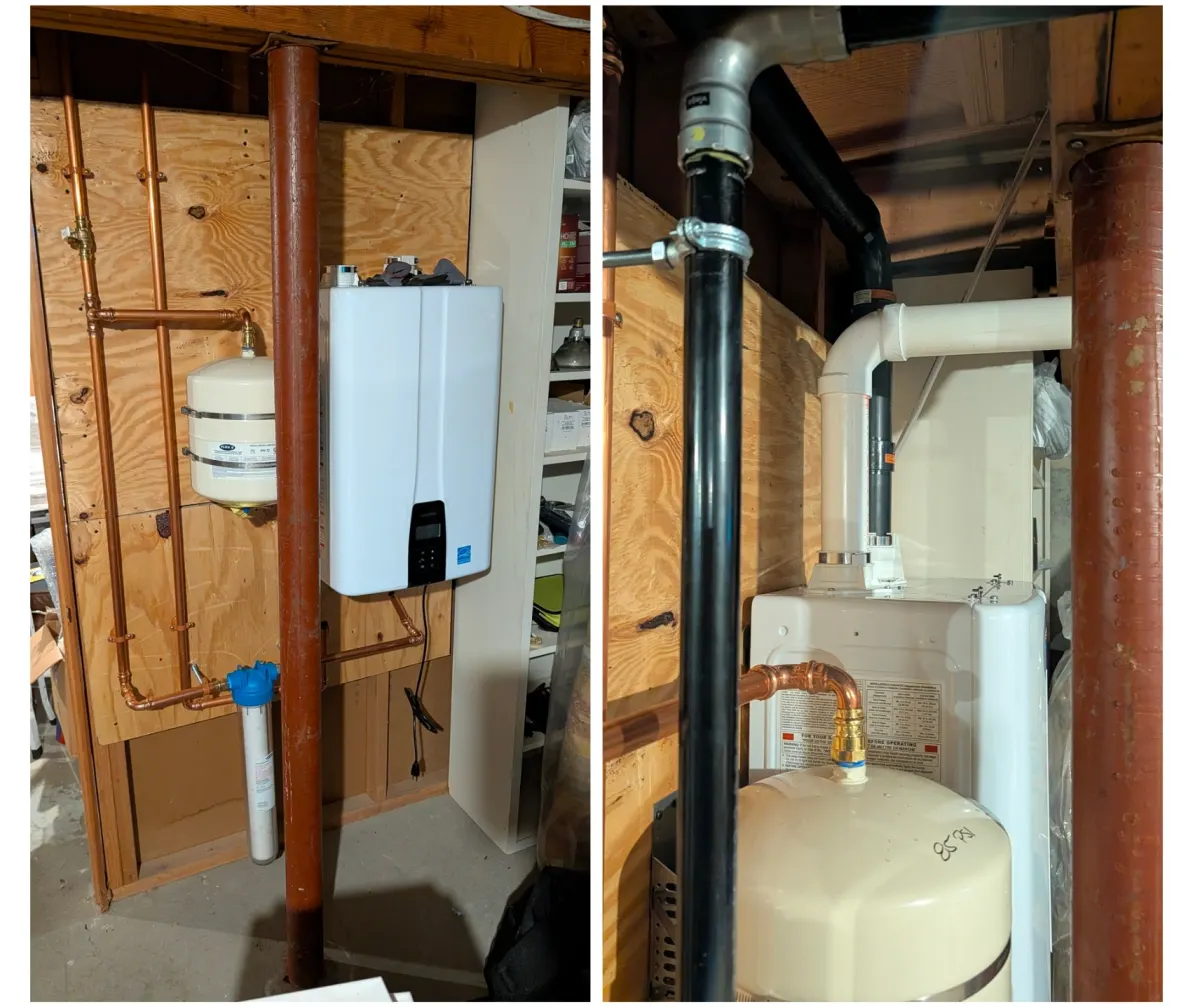
The permanent plan after the water heater failure was a tank-to-tankless conversion. Gas capacity and new vent routing still needed design, so it was treated as separate planned work rather than an equipment exchange. Whether the installation was completed, which model was selected, and the final project price are not covered here.
Removing a storage tank removes that stored-water vessel and its tank-body failure mode. It does not make the plumbing leak-proof: tankless equipment still has pressurized water connections, relief protection, service valves, condensate components on condensing models, and maintenance requirements. The tankless water-heater planning guide covers winter output, gas capacity, venting, condensate, water chemistry, maintenance, installed pricing, and lifecycle tradeoffs.
Equipment choice should be made from the household's demand and the property's conditions, not from the flood alone. A storage, hybrid, or tankless replacement can each be appropriate. The flood changes the urgency of stabilization; it does not eliminate the need for sizing and a complete written scope.
Warning Signs Before a Tank Fails
Water heater failure does not always give a long warning, but recurring moisture and repeat service findings deserve prompt assessment. A single puddle still needs its source identified because condensation, a nearby pipe, a drain valve, a relief discharge, and a leaking tank can look similar on the floor. Age is context, not a remote diagnosis.
- Recurring dripping or moisture: Document where it starts and whether it returns after the area is dried.
- Water at a tank seam or base: Rule out connected fittings and tracked water; a confirmed tank-body leak is replacement territory.
- A wet relief-discharge pipe: Do not cap or operate the valve. Pressure, temperature, expansion, controls, valve condition, and piping need evaluation.
- Corrosion or staining: Rust at seams, fittings, valves, or the jacket can identify an active or past moisture path.
- New rumbling or popping: Sound can relate to sediment, scale, controls, or another condition; it does not predict a rupture by itself.
- Reduced or erratic hot water: Recovery, temperature, fuel, controls, elements, dip tubes, and demand all belong in the diagnosis.
- Pressure or expansion findings: Repeat relief discharge, pressure swings, or an expansion-control concern should not be treated as normal.
- An unknown installation date: Confirm model and serial information, prior invoices, condition, and service history instead of guessing from appearance.
Storage tanks commonly serve about 8–12 years, but water chemistry, pressure, installation, duty, environment, and maintenance can shorten or extend that range. A newer tank can leak, and an older dry tank is not condemned by age alone. Replacement decisions follow confirmed condition and risk.
The Real Math: Planned Replacement Versus a Flood
The planned-versus-flood comparison starts with non-overlapping categories rather than an invented flood total. Let P represent the complete confirmed flat-rate permanent replacement scope, including applicable equipment, connected site work, removal, permits, inspection, and commissioning. A planned project's gross total is P.
Planned replacement path
A planned project allows me to confirm the equipment, fuel or electrical needs, venting, drainage, access, permit, inspection, removal, and commissioning scope before authorization. The homeowner can compare options and decide whether a pan, point sensor, or main-line monitor belongs in the project. Planned replacement does not guarantee that no future leak will occur, but it removes a known deteriorating tank on an organized schedule.
- Planned gross total: P
- P boundary: the complete authorized permanent-installation scope, including its documented connected work
- Optional prevention: a compatible pan, sensor, or main-line monitor included only when the authorized scope lists it
Failure-event path
For this documented water heater failure with a tank-body leak, the permanent replacement scope remained necessary; a repairable control, element, fitting, or valve fault would not make every water heater failure a replacement. Let E represent only event-related expenses supported by actual bills, kept separate from P and from one another. The documented-case comparison is P + E.
After a failure, E may include temporary hot-water stabilization, extraction and drying or a broader mitigation and restoration invoice, and damaged finishes or contents when the records support them. Those labels can overlap: extraction may be part of mitigation, while restoration may include finishes, so the same charge must not be added twice. There is no supportable event subtotal until the invoice scopes are known.
In this case, the known categories were an interim heater, pumps and fans, and a mitigation or remediation contractor. Without the final invoices and the insurer's decision, no exact flood total can be stated.
Insurance does not reduce the gross loss calculation. Homeowner out-of-pocket depends on covered loss, policy limits and exclusions, settlement, deductible, required mitigation, and costs that remain uncovered. Only the carrier and adjuster decide those issues.
Current Replacement Pricing
When a failure forces the decision, the figures below are Jeneral Plumbing's current installed-price context, not an old quote or invoice from the Westford case. Where a replacement lands depends on capacity, venting, fuel or electrical changes, drainage, access, permits, inspection, and connected work. Repair and installation work is priced at a flat rate, with the total price and any applicable fees disclosed for approval before work begins.
- Standard electric resistance tank: from $2,300
- Gas storage, all vent types: $2,900 – $6,500; see the gas water-heater planning guide for vent and fuel scope.
- Hybrid heat pump water heater: up to $7,800 before the $750 Mass Save discount available as of August 21, 2026. The official program page lists the per-unit discount for qualifying ENERGY STAR equipment and eligible customers. Confirm the current equipment, utility, replacement, distributor, installation, and participation requirements before purchase.
- Condensing tankless: $8,500 – $11,000+.
The water-heater replacement comparison explains how storage, hybrid, and tankless systems differ. For the hybrid option, the heat pump water-heater guide covers room volume, ambient temperature, condensate, electrical capacity, recovery, current incentive rules, and household fit. A program amount should not be subtracted until eligibility is confirmed.
A failure can pressure a household to choose quickly, but installed price alone does not decide equipment fit. Domestic-hot-water demand, fuel availability, electrical capacity, venting, drainage, space, operating conditions, and maintenance should still be reviewed. The written scope should distinguish plumbing work, utility responsibilities, electrical work, restoration, and permit or inspection steps.
Drain Pans, Point Sensors, and Phyn
When a failure prompts a prevention review, layered protection can improve awareness and limit some incoming-water events, but no pan or monitor guarantees a dry basement. A rapid tank release, continuous supply, relief discharge, placement issue, power loss, connection problem, or event outside the device's criteria can still cause damage. This section is prevention guidance, not a claim about what would have stopped the Westford flood.
Drain pan with an approved drain
A correctly sized pan routed to an approved receptor may catch and direct limited leakage where installation conditions allow it. It is not sized to contain every full-tank release or continuous incoming flow. The pan drain and the temperature-and-pressure relief discharge are separate paths; the relief discharge must not be routed or obstructed as though it were a pan drain.
Point leak sensor
A point sensor placed in or near the pan can alert after water reaches that selected spot. It may miss water that travels elsewhere, and it does not close the main unless paired and configured with compatible valve control. Placement, battery or power, connection, notification settings, and a reachable response contact determine how useful the alert becomes.
Phyn Plus monitoring and automatic shutoff
Phyn is Jeneral Plumbing's water-monitor partner. Phyn Plus monitors pressure and flow at the main, can send app alerts, and can close its integrated valve after qualifying events when automatic shutoff is enabled. Compatibility depends on accessible main piping and shutoff, power, Wi-Fi, settings, and connected-equipment review.
Phyn Plus cannot see every leak, guarantee a shutoff, or prevent all damage. Even a successful main shutoff does not remove water already stored in a tank or downstream piping. The Phyn Plus and smart leak-protection guide explains the difference between a point sensor, main-line monitoring, and automatic valve control.
Maintenance Records and Replacement Decisions
This water heater failure case shows why recurring findings should be documented and revisited. A maintenance visit can identify dripping, corrosion, relief discharge, pressure concerns, control problems, or changing performance, but maintenance cannot promise that a tank will not fail. A recommendation should state the observed condition, risk, repairability, and replacement path clearly.
The Jeneral Plumbing service-plan guide describes recurring inspection and water-heater care options. A plan can organize follow-up, but it does not replace homeowner attention between visits. If a pan contains water, a sensor alerts, or a known drip changes, report the new condition rather than waiting for the next scheduled check.
Photos, dates, model and serial information, pressure findings, service recommendations, and authorization decisions create a useful record. They help compare whether a condition is stable, worsening, repairable, or ready for replacement. They may also help an insurer understand the timeline, although the insurer controls the policy interpretation and claim decision.
Westford Service Area
Jeneral Plumbing is owner-operated by a Licensed Master Plumber (MA #9628831-PL-M) with more than 20 years in the trade, including seven years with a gas utility. From my Westford, MA base, I serve the 26-town core across Middlesex & Worcester County and southern New Hampshire, including Westford, Chelmsford, Acton, Littleton, Groton, Carlisle, and Billerica. I apply the same condition-first method without assuming one town predicts tank age, water pressure, water chemistry, or flood risk.
A planned Westford water-heater visit can address equipment fit, installed scope, warning signs, pressure and expansion findings, access, drainage, permits, and prevention options. An active flood starts with personal safety and water control only when safe. Timing and availability are confirmed by phone after the immediate conditions are understood.
Key Takeaways
- The Westford case had two prior drip findings before the later basement flood, but that does not establish a universal failure countdown.
- The response found a relief discharge, a separate tank-bottom leak, and an incoming-pressure reading of about 85 psi; the peak conditions and order of events were not established.
- The permanent tankless conversion was planned; completion, model, outcome, and final price are not documented.
- For this confirmed water heater failure case, planned replacement is P and the failure-event comparison is P + E, where E contains only documented, non-overlapping event expenses.
- Current installed pricing is detailed above; the flood-response categories remain separate and cannot be totaled from the plumbing work alone.
- A drain pan, point sensor, and Phyn Plus serve different roles and cannot guarantee prevention of water damage.
Frequently Asked Questions
How long do tank water heaters last?
Storage tanks commonly serve about 8–12 years. Water chemistry, pressure, expansion control, installation, demand, environment, and maintenance can move that range in either direction. Age alone does not diagnose water heater failure. Repeat moisture, corrosion, relief discharge, or a confirmed tank-body leak matters more than the calendar by itself.
How long do I have once my water heater starts leaking?
There is no safe universal countdown. A fitting may be repairable, while a confirmed tank-body leak requires replacement and can worsen without a predictable schedule. Have the source assessed promptly and keep people away from hot discharge or standing water near electricity. Failures can progress differently from one tank and property to another.
Is a dripping water heater an emergency?
Not every drip means a tank is about to rupture, but recurring or active leakage needs prompt assessment. Keep out of standing water when electrical equipment may be involved, and stay clear of hot discharge. Close the heater's cold-water valve or main only if it is reachable from a dry, safe location; use the electric breaker only when the path and panel are dry, or a gas appliance control only when accessible and there is no gas odor or suspected fuel leak. For gas odor or a suspected fuel leak, leave immediately, call 911 and the applicable gas utility or propane provider from outside, and stay out until officials clear the property; do not operate switches, phones, windows, appliances, shutoffs, or flames inside. Do not drain, restart, or operate the relief valve.
Does homeowners insurance cover a water heater flood?
Coverage depends on the policy, confirmed cause, exclusions and limits, deductible, maintenance history, notice, and mitigation duties. The carrier or adjuster decides whether the heater, resulting water damage, drying or remediation, finishes, contents, and code work are covered. Jeneral Plumbing can document observed plumbing conditions and completed plumbing work but cannot interpret a policy, guarantee coverage, or decide a claim. When safe, photograph conditions, report the event promptly, follow the carrier's instructions, and retain invoices.
What does planned water heater replacement cost in Massachusetts?
Jeneral Plumbing's current installed pricing starts at $2,300 for standard electric resistance, runs $2,900 – $6,500 for gas storage across vent types, reaches up to $7,800 for hybrid before the $750 Mass Save discount available as of August 21, 2026, and runs $8,500 – $11,000+ for condensing tankless. The property's capacity, fuel or electrical changes, venting, drainage, access, permits, and connected work determine the written scope. These figures are not the old quote or final invoice from the Westford water heater failure. Current program eligibility must be confirmed before applying the hybrid discount.
Can a drain pan or Phyn Plus prevent a basement flood?
No device prevents every basement flood. A pan may direct limited leakage, a point sensor alerts after water reaches its location, and Phyn Plus can monitor the main and close its integrated valve after qualifying events when compatible and configured. None removes water already stored in the tank or guarantees detection, connectivity, notification, or shutoff. Layered protection may reduce exposure, but visible moisture still requires investigation.
Plan Before a Failure Forces the Decision
If you see water heater failure warning signs such as dripping, recurring moisture, relief-path discharge, or repeat service findings, document the condition and arrange an assessment before the scope expands. I can explain repairability, replacement options, current installed pricing, pressure and expansion findings, and compatible leak-protection layers. Call Jeneral Plumbing at (978) 392-7789 to discuss a Westford water-heater assessment.
Written by Kris Record, Massachusetts Master Plumber, License #9628831-PL-M.
This article was drafted with AI writing tools and edited before publication. AI tools did not inspect any job or validate technical conclusions.
Last updated .