

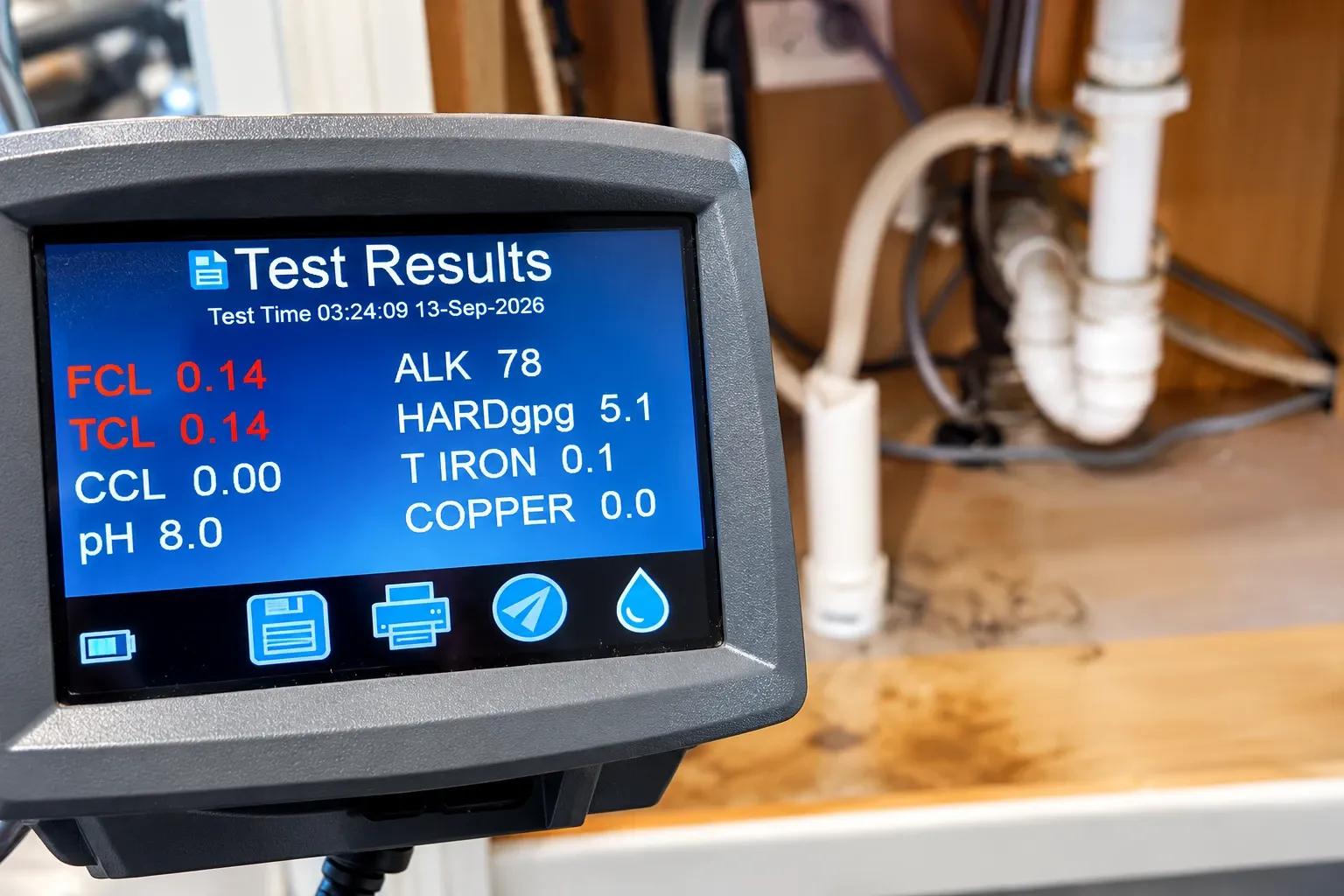
During a recent faucet replacement call on Indigo Lane in Westford, our technician ran a quick on-site water test while diagnosing a leaking kitchen faucet — and the results tell a story that a lot of Westford homeowners will recognize. If you've been searching for water softener repair Westford or wondering why your fixtures wear out faster than they should, the answer often starts with what's actually in your water, not just what's leaking under your sink.
Safety First: Why This Isn't a DIY Job
Before we get into what we found, a note on safety. Plumbing repairs involving shut-off valves, supply lines, and water quality issues should always be handled by a licensed plumber. Massachusetts requires licensed professionals for this kind of work, and mishandling shut-off valves or old compression fittings can lead to flooding or water damage — as this homeowner already discovered with a slow leak that had been dripping into a cabinet for weeks. If you're dealing with a leaking faucet, aging valves, or suspect water quality issues in your home, call a professional rather than attempting repairs yourself.
The Job That Started It All: A Leaking Faucet
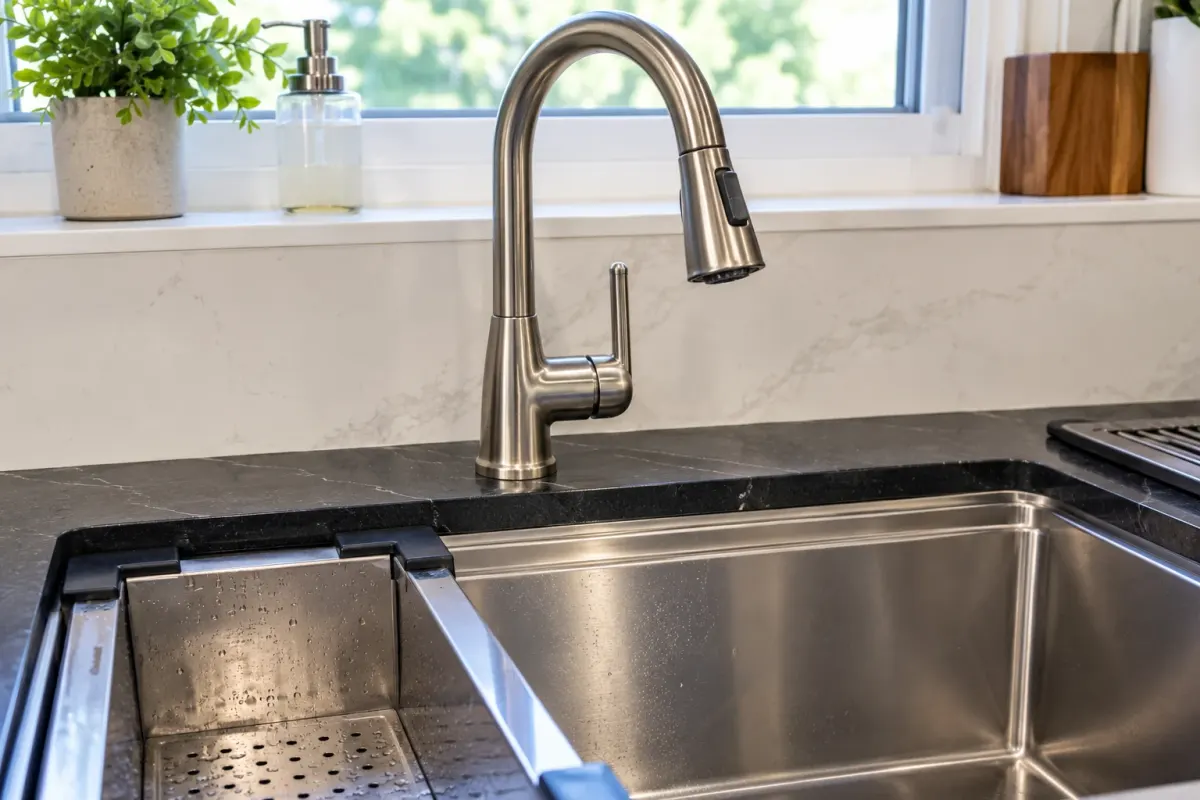
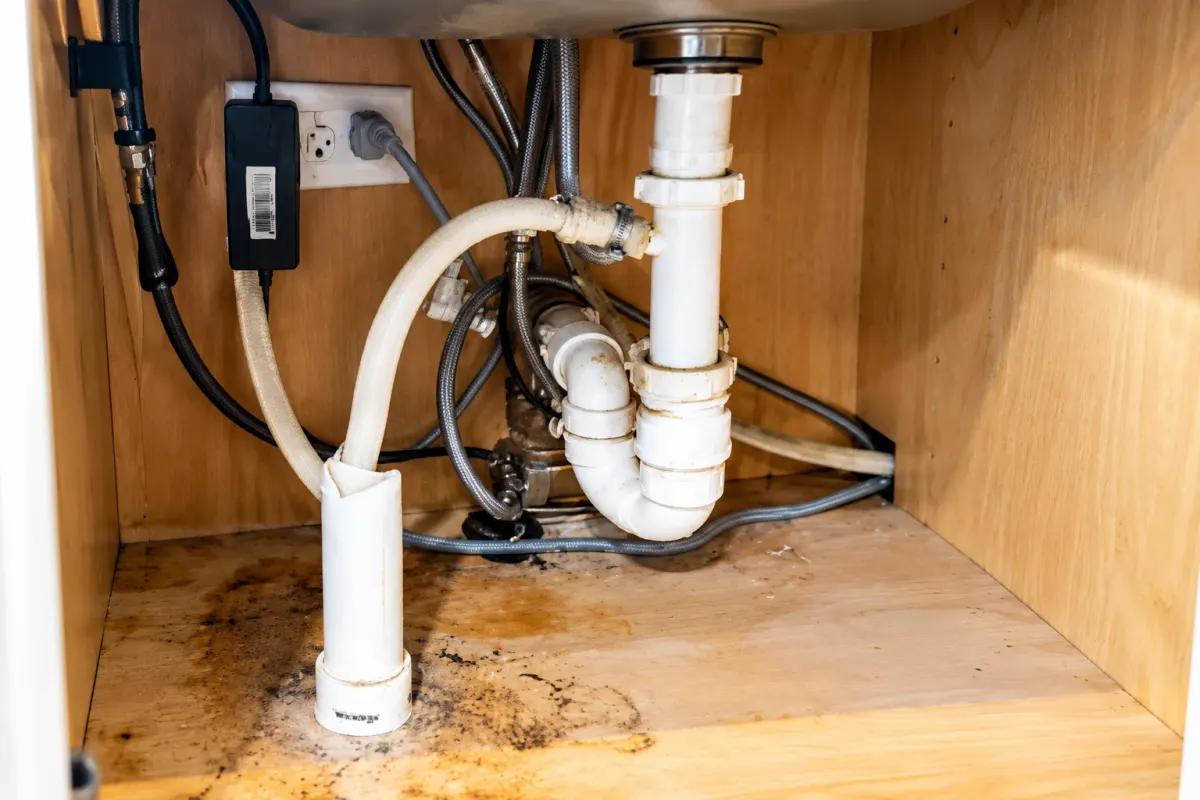
The homeowner called us out for a straightforward faucet replacement. The old faucet — about 10 years old — had been dripping steadily, and worse in the cold position than the hot. They'd already tried replacing the valve underneath, but that didn't solve it. When our technician inspected the cabinet, the leak traced back to where the hot and cold lines met the cartridge inside the faucet body, along with a small push-connect fitting that was visibly weeping.
There was also visible water damage on the basement ceiling below — evidence the leak had been going on for roughly three weeks before anyone noticed the drip pattern.
Why We Recommended Two Separate Shut-Off Valves
The home had a single dual outlet valve feeding both the faucet and the dishwasher — an older style that's no longer up to code for new installations. Current code requires each fixture to have its own isolation valve. Home improvement stores still sell single compression valves, but not always as code-compliant setups for this kind of dual application.
Our technician recommended replacing that single valve with two individual shut-offs: one dedicated to the faucet, one to the dishwasher. That's the kind of detail a general inspection often misses but matters a lot when it's time for the next repair — nobody wants to shut off water to the dishwasher just to fix a faucet.
The Hot Water Valve: A Case for Honesty, Not Upselling
Here's where the visit took an interesting turn. The existing hot water valve was about 30 years old, and the homeowner was nervous about its age and wanted it replaced along with everything else. But when our technician tested it, the valve turned smoothly, sealed properly, and showed none of the grinding resistance that typically signals internal mineral buildup or corrosion.
Instead of replacing a valve that didn't need it, our technician recommended leaving it in place — saving the homeowner a significant portion of the estimate. That's the kind of call we'd rather make than pad a bill: if a valve is doing its job, we say so.
The Water Test: Hard Water Confirmed
Westford is known for hard water, and this home was no exception. Our on-site test measured hardness at 5.1 grains per gallon, along with a total dissolved solids (TDS) reading of 369. We also tested for PFAS levels as part of the same visit. Unlike the town's annual water quality report — which gives a broad, system-wide snapshot — an in-home test measures what's actually coming out of your tap, in your plumbing, on that day.
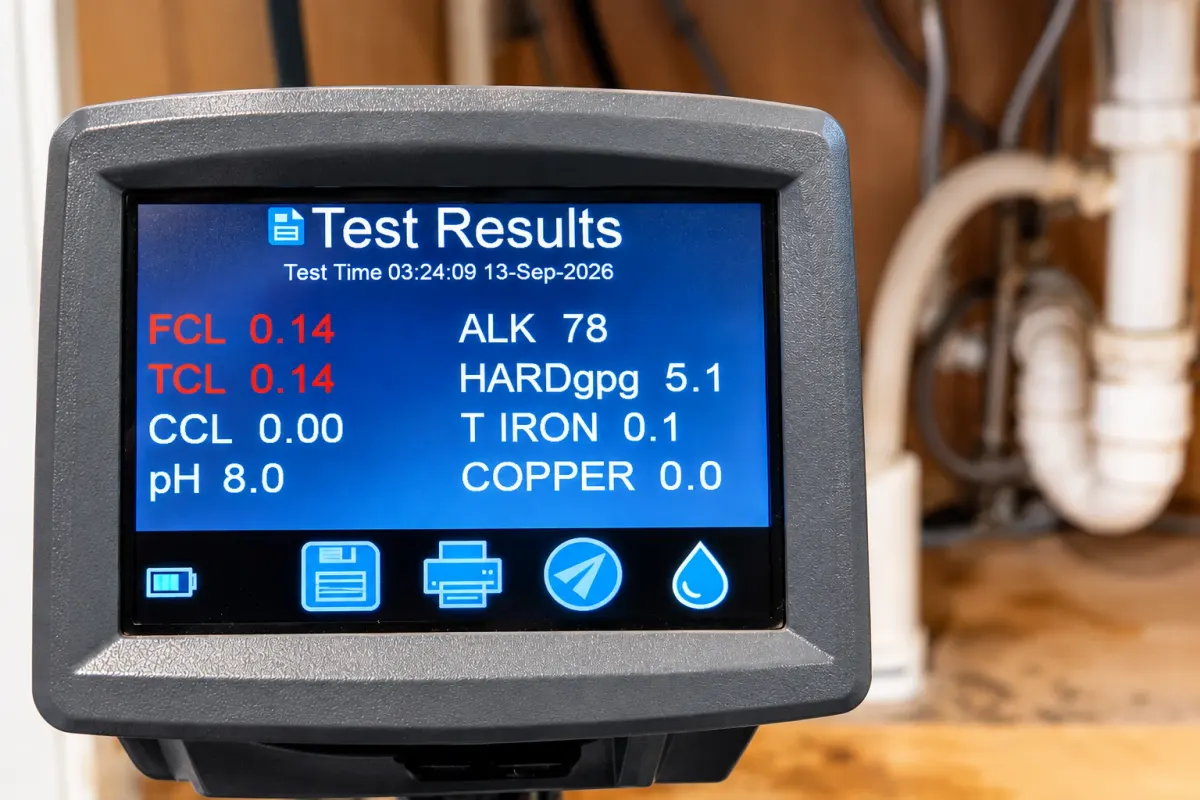
Hardness at this level contributes to the mineral scale that builds up inside valves, faucet cartridges, and water heaters over time. It's part of why fixtures in Westford homes, and in nearby Chelmsford and Littleton, often show wear years before you'd expect. A hard water treatment system is typically how we address this at the whole-house level, reducing scale buildup before it affects appliances, water heaters, and fixtures throughout the home.
For homes with elevated PFAS or TDS readings, a reverse osmosis installation at the kitchen tap can reduce specific contaminants sized to what the test actually finds — never assume, always test first. You can learn more about our approach to water quality on our water treatment services page.
What Got Fixed, and What We're Monitoring
On this visit, our technician:
Replaced the aging faucet with the new unit the homeowner had purchased
Installed two separate quarter-turn shut-off valves in place of the single dual valve — one for the faucet, one for the dishwasher
Left the 30-year-old hot water valve in place after confirming it operated properly
Performed an on-site water test for hardness, TDS, and PFAS
Flagged the water-stained ceiling area below the cabinet as something to monitor for two weeks before any cosmetic repair, to be sure the leak is fully resolved
The whole repair took a couple of hours to complete, factoring in shutting down the water supply, draining the lines, doing the valve and faucet work, refilling the system, and checking every fixture afterward for sediment that can get knocked loose during that process.
Why Testing Matters More Than the Annual Report
Every year, town water reports give residents a general sense of water quality across the whole system. But they don't tell you what's happening in your specific pipes, your specific fixtures, or behind your specific cabinet. A free on-site test gives you real numbers — hardness, TDS, and contaminant levels — from your own tap, which is the only way to know whether a whole-house softener, a point-of-use reverse osmosis system, or no treatment at all is the right call for your home. We see the same hard water patterns in homes throughout Chelmsford and Littleton, not just Westford, so if you're unsure what your water actually looks like, testing is the place to start, not the town's annual summary.
Key Takeaways
Hard water in Westford is measurable and common — this home tested at 5.1 grains per gallon hardness with a TDS of 369.
An on-site water test reveals home-specific conditions that a town-wide annual report can't.
Not every old valve needs replacing — a valve that operates smoothly and seals well can often be left alone.
Code requires separate isolation valves for each fixture; older dual valves should be updated during faucet or sink work.
Leaks behind cabinets can go unnoticed for weeks — regular checks under sinks catch problems early.
Frequently Asked Questions
How do I find water softener repair near me in Westford?
Start with a water test. Before repairing or replacing any softener or treatment system, we test your actual water for hardness, TDS, and other markers so any repair or installation is sized to what your home really needs, not a guess.
Is water softener installation near me worth it if my water tests as moderately hard?
It depends on the numbers. A hardness reading like the 5.1 grains per gallon we found in this Westford home is a common trigger point for homeowners to consider a softener, since mineral buildup accumulates gradually and affects fixtures, valves, and water heaters over time.
What does a water treatment system repair in Westford typically involve?
It starts with diagnosis — testing the water and inspecting the existing system or fixtures for mineral scale, worn cartridges, or valve issues, similar to how we diagnosed this faucet leak by tracing it to the cartridge and a push-connect fitting.
Can a town's annual water report replace an in-home test?
No. The annual report reflects the water utility's broader system averages. An in-home test measures conditions at your actual tap, which can differ based on your home's plumbing, age, and fixtures.
Do I need a reverse osmosis system if PFAS shows up in my test?
If PFAS is detected, a reverse osmosis system sized to your specific results can reduce those levels at the point of use, such as the kitchen tap. We recommend basing any system choice on your actual test numbers rather than assumptions.
This post is for informational purposes only and does not substitute for a professional plumbing inspection. Water quality issues, valve replacement, and fixture repair should always be handled by a licensed plumber.
If you're in Westford, Chelmsford, or Littleton and want to know what's really in your water — or you're dealing with a leaking faucet, aging valves, or signs of hard water buildup — call Jeneral Plumbing at (978) 392-7789. We offer a free on-site water test and honest recommendations, including telling you when a repair isn't needed. You can also check out our fixture repair services or explore our service plans for ongoing peace of mind.
Written by Sierra Sorongon.
This article was drafted with AI writing tools and edited before publication. AI tools did not inspect any job or validate technical conclusions.
Last updated .