Plumbing Vent Failure Symptoms in Arlington, MA

Plumbing Vent Failure Symptoms in Arlington, MA

Jeneral Plumbing

Drains & Water Line

Plumbing vent failure symptoms can point toward a blocked, frozen, damaged, disconnected, or misconfigured vent path, but a sound or odor does not identify the failure by itself. This Arlington, MA guide explains how those modes differ and how evidence narrows the next step. Arlington is outside Jeneral Plumbing’s 23-town core service area, so requests there are considered case by case and availability must be confirmed by phone before a visit is scheduled.

The source material for this article does not document a completed Arlington inspection, measured vent defect, repair, or result. I will not turn a generic example into a local job claim. Instead, this guide separates a homeowner’s report, an accessible observation, a code comparison, a confirmed failure mode, and a repair decision so that plumbing vent failure symptoms are not mistaken for proof.

Jeneral Plumbing is based in Westford, MA and is owner-operated by a Licensed Master Plumber (MA #9628831-PL-M) with 20+ years in the trade, including seven with a gas utility. I evaluate accepted Arlington requests within a written plumbing scope and explain when another provider or trade is needed. The 20+ years belong to the owner-operator’s trade experience, not the age of the company.

Quick Answer: Plumbing Vent Failure Symptoms Need a Failure-Mode Diagnosis

Plumbing vent failure symptoms are patterns that may justify investigation, not a remote diagnosis. Gurgling, changing trap-water levels, sewer-like odor, or a fixture that reacts when another fixture drains can arise from a vent condition, an obstruction, a dry or leaking trap, fixture residue, or a downstream drain or disposal-system problem. The useful question is not merely, “Is the vent bad?” It is, “What observation separates one possible failure mode from the others?”

If your immediate concern is a kitchen sound, start with the homeowner first steps for a gurgling kitchen drain. That guide stays at the symptom level: when the noise occurs, what other fixtures react, and when to stop using water. This article takes plumbing vent failure symptoms one level deeper by showing how a qualified evaluation distinguishes blocked, frozen, damaged, and incorrectly configured vent paths.

A vent system supports pressure balance in the drainage system and helps protect the water seals in traps. It is not an alternate wastewater route, and it does not “suck” a clog away. When pressure cannot balance as designed, the result may be movement of air and water at a trap, but those plumbing vent failure symptoms still do not reveal where the condition is or whether the drain path is restricted.

Start With an Evidence Ladder, Not a Guess

I organize plumbing vent failure symptoms into an evidence ladder. First comes the homeowner report: which fixture made a sound, what other fixture was running, whether water rose or fell, whether an odor was present, and whether the pattern changed with weather. Second comes direct observation of reachable traps, trap arms, drain branches, visible vent connections, supports, joints, and any accessible route toward the stack.

Third comes measurement and mapping. Pipe size, slope where relevant, connection sequence, developed route, fixture relationships, and the visible termination arrangement matter more than the home’s age or town. Those measurements turn plumbing vent failure symptoms into testable questions. Fourth comes comparison with the plumbing method that applies to that specific layout under current Massachusetts requirements; 248 CMR 10.00 governs plumbing work, while the local inspector determines the project-specific permit and inspection path.

Fifth comes a controlled test or the proper specialist referral. One observation rarely proves a mode by itself. A cold-weather pattern does not prove ice, a visible gap does not establish the condition of concealed piping, and a gurgle does not prove either a vent defect or an obstruction. A diagnosis based on plumbing vent failure symptoms should state what was observed, what remains concealed, what was ruled out, what could not be ruled out, and why a proposed next step fits the evidence.

That sequence matters because the same plumbing vent failure symptoms can lead to different work. A reachable separated joint may fit accessible plumbing repair. Suspected debris at a roof termination may require a provider equipped and insured for safe roof access. An uncleared drain obstruction or buried sewer condition belongs with an independently hired drain, sewer, or septic specialist before anyone assigns the sound to a vent.

Blocked Vent Paths: What the Evidence Can Show

A blocked or substantially restricted vent path is one possible source of plumbing vent failure symptoms. Possible materials include debris, animal nesting, construction material, or another physical obstruction, but a list of possibilities is not a finding. The route and termination must be located, the safe inspection boundary established, and the restriction confirmed rather than inferred from a fixture sound.

Timing can narrow plumbing vent failure symptoms. If several connected fixtures react during the same discharge and the behavior is repeatable, that pattern can support examining shared drainage and vent relationships. If only one trap gurgles while every nearby fixture behaves normally, the first inspection stays closer to that fixture and its accessible branch. Neither pattern rules out an obstruction in the waste path, so required clearing remains a separate decision.

Plumbing vent failure symptoms do not make roof work safe for a homeowner. I do not tell anyone to climb onto a roof, reach into a termination, pour hot water into a vent, or probe piping from above. Roof slope, ice, electrical service, fragile roofing, hidden obstructions, and an open drainage-system path create risks. Safe roof access and termination clearing may need a roofing or specialty provider hired directly by the homeowner; it is not converted into Jeneral Plumbing’s accessible drain-repair scope.

When a qualified provider confirms and removes an obstruction, the result addresses that obstruction at that time. It does not certify every concealed joint or prove the drainage system meets every current requirement. If plumbing vent failure symptoms remain afterward, the next evaluation should revisit accessible traps, branches, vent connections, and the possibility of a separate downstream condition.

Frozen Vent Terminations: A Weather Pattern Is Only a Clue

Cold-weather plumbing vent failure symptoms may raise the possibility of frost or ice restricting an exterior termination. Moist drainage-system air can contribute to frost under some conditions, and snow or ice can affect an exposed opening, but Arlington weather alone cannot confirm that mode. The pattern should be tied to actual temperatures, fixture behavior, the termination’s visible condition, and whether the symptom changes when the weather changes.

When plumbing vent failure symptoms disappear during a thaw, the change is useful evidence, yet it still does not identify why the termination iced. Termination configuration, location, size, exposure, building conditions, and the connected plumbing arrangement may all matter. A thaw can also coincide with different household water use, so the observation belongs in the record rather than being treated as final proof.

The repair path for plumbing vent failure symptoms depends on what is confirmed. Removing exterior ice safely is different from correcting an accessible undersupported connection or an improperly configured termination. Roofing, flashing, roof-penetration work, heat-tracing, electrical additions, insulation, and finish restoration are separate scopes unless they are expressly assigned to the responsible trade in writing.

A plumber should not promise that one modification will prevent every future freeze. Current product instructions, the applicable plumbing requirements, roof conditions, and the local inspector’s determination govern the accepted correction. After work, testing documents the repaired accessible section and conditions on that visit; it does not guarantee future weather or the entire concealed vent route.

Damaged, Separated, or Disconnected Vent Piping

Physical damage creates a different diagnostic path from an obstruction. A cracked fitting, separated joint, unsupported section, corrosion at an accessible material transition, or a disconnected vent path may permit drainage-system air to escape at an unintended location. These plumbing vent failure symptoms may include odor near the opening or fixture interactions, but odor source and pipe condition still need confirmation.

Accessible visual evidence carries more weight than generalized plumbing vent failure symptoms. A visible separation, staining at a drainage-system joint, movement where piping lacks support, or an open connection can define a testable repair boundary. Even then, the observation does not establish the condition of the concealed stack above, the drain below, or the exterior termination.

When the failed section is reachable and within Jeneral Plumbing’s accepted scope, I can define a flat-rate repair around compatible fittings, proper support, the applicable permit or inspection step, and a post-repair check. The written scope should say whether wall or ceiling opening, finish restoration, roofing, structural work, or another trade is excluded. An accessible repair should never be described as a whole-house vent replacement unless the verified work truly covers that system.

Damage can also be concealed behind finished walls or in a roof assembly. In that situation, plumbing vent failure symptoms do not authorize exploratory demolition without an agreed access plan. The responsible parties should decide who opens and restores finishes, what observation will justify access, and whether a specialty test or other trade is needed before plumbing work begins.

Improperly Terminated or Misrouted Vent Paths

When plumbing vent failure symptoms raise a termination question, the presence of an exterior pipe does not settle it. Location, height, relationship to openings, protection from weather, pipe size, route, and the method approved for the installation are project-specific. I do not publish one universal clearance or dimension as a diagnosis because roof geometry, the connected system, current code, and local interpretation all matter.

For termination-related plumbing vent failure symptoms, the strongest evidence is a traced route plus measured conditions compared with the provision that applies. A pipe ending in an attic, a path abandoned during renovation, an unapproved mechanical termination, or a connection made at the wrong point may be material observations, but each requires confirmation. A photograph of one pipe or a homeowner’s recollection of prior work cannot establish the full vent design.

Correction may require extending, relocating, reconnecting, or resizing an accessible section through a permitted plan. That plumbing scope can overlap with roofing, flashing, carpentry, fireblocking, insulation, or finish work, and those responsibilities should be assigned before a hole is opened. Jeneral Plumbing’s permitted plumbing installations and upgrades remain limited to accepted, reachable work with clear trade boundaries.

After a confirmed correction, normal fixture operation and any inspector-required test can document the new work at that stage. They cannot prove that no unrelated obstruction or concealed defect exists elsewhere. If plumbing vent failure symptoms continue, the evidence ladder starts again rather than forcing every remaining clue into the original diagnosis.

Wet Venting Is a Method, Not a Failure Mode

Wet venting allows defined piping to serve drainage and venting functions when the arrangement meets the requirements that apply. Its presence is not one of the plumbing vent failure symptoms, and multiple fixtures sharing a route are not automatically wrong. Fixture grouping, pipe size, connection order, developed lengths, fixture units, drainage flow, and the approved method must be evaluated together.

A wet-vent arrangement can fail to perform as intended when it has been altered, disconnected, undersized for the actual configuration, or connected in a way the applicable method does not permit. Connecting plumbing vent failure symptoms to that arrangement requires measurements and a layout comparison, not an assumption based on house age. An existing lawful installation also does not become defective merely because current rules later changed.

The same caution applies to individual vents, common vents, circuit or battery arrangements, and other approved methods. Homeowner terminology for plumbing vent failure symptoms may not match code terminology, and a pipe can be mislabeled in old notes. I identify fixture relationships and the route first, then compare the observed configuration with the method that applies.

If an accessible configuration needs redesign, planning connected plumbing-system corrections helps define the intended route, fixture relationships, access, trade handoffs, and approval sequence. That planning is not a promise that every concealed section can be assessed from one opening. The repair proposal should name the exact accessible section and the evidence supporting it.

Stack Vent and Vent Stack Are Not Interchangeable Labels

Current 248 CMR 10.03 distinguishes the terms: a stack vent is the portion of a soil or waste stack six inches above the flood-level rim of the highest fixture connected to that stack, while a vent stack is a vertical vent pipe installed to provide circulation of air to and from the drainage system. Those definitions help map a system, but the label does not diagnose it. The actual connections, route, size, termination, and approved arrangement determine the pipe’s function.

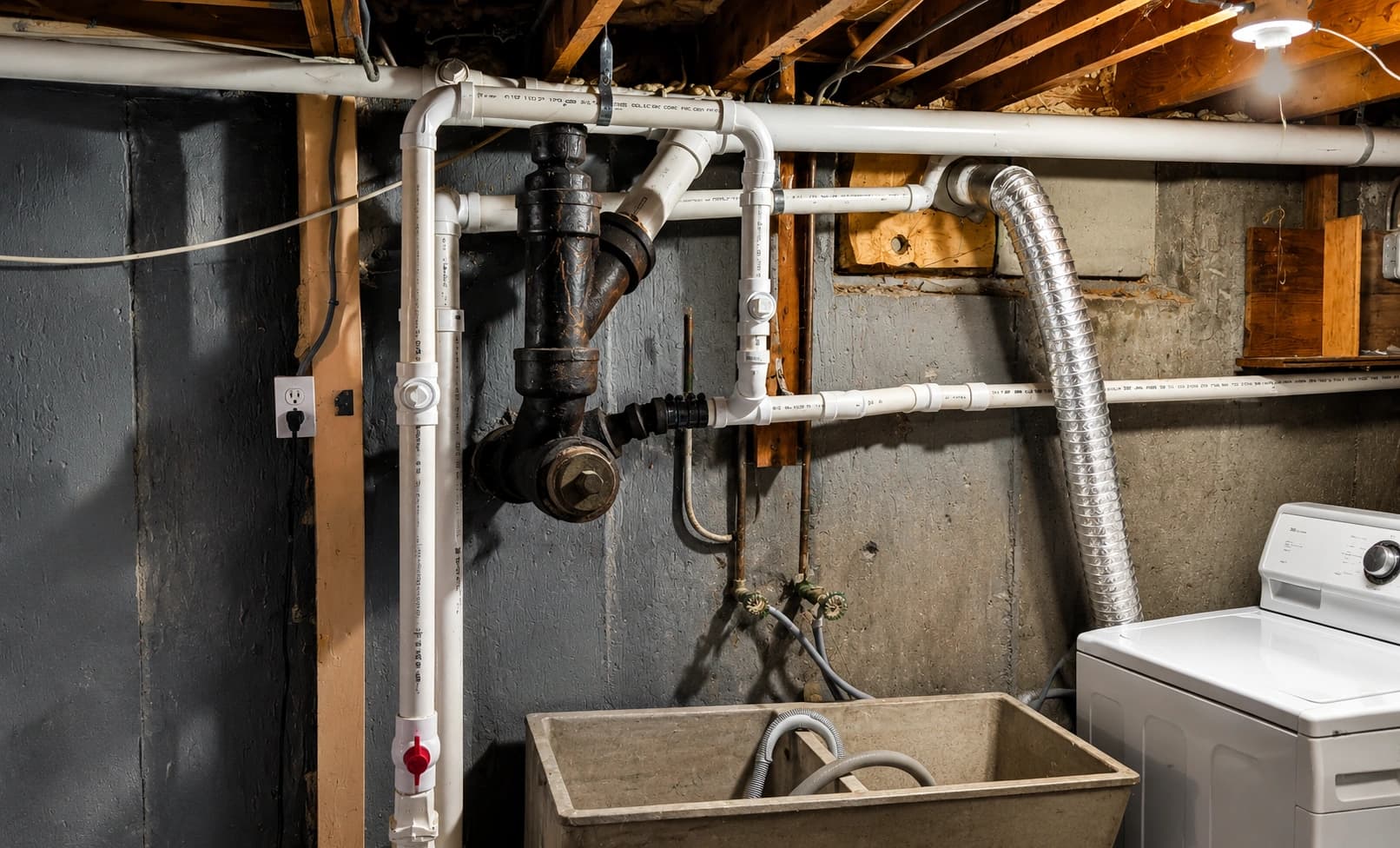
Mislabeling matters because a proposed repair for plumbing vent failure symptoms can otherwise target the wrong section. If someone calls every vertical pipe a “vent stack,” an opening in one wall may be mistaken for proof of the entire route. Good documentation uses sketches or photos, identifies which fixtures connect where, distinguishes what is visible from what is concealed, and records the basis for any conclusion.

That discipline is especially useful after a remodel. A capped connection may be intentional and approved, abandoned but secure, or part of an incomplete alteration; appearance alone does not decide which. Plumbing vent failure symptoms plus a capped pipe justify tracing and document review, not an automatic order to reconnect it.

What Can Mimic Plumbing Vent Failure Symptoms?

An uncleared obstruction in a trap, trap arm, branch, building drain, sewer lateral, or septic path can mimic plumbing vent failure symptoms. So can an empty trap after a fixture sits unused, a leaking trap, residue at a fixture, an appliance connection, or a pressurized-pipe leak that has nothing to do with drainage. Diagnosis improves when the affected fixtures, trigger, water level, odor location, and drainage behavior are recorded precisely.

If several fixtures back up or wastewater rises at a lower fixture when other water runs, stop household drain use. Those are not plumbing vent failure symptoms that should be assigned to a vent without downstream investigation. The pattern can point beyond an accessible vent repair and requires an independently hired drain, sewer, or septic provider. A vent education article is not a promise that Jeneral Plumbing provides sewer service or obstruction removal.

Drain cleaning, snaking, cabling, augering, hydro jetting, sewer camera inspection, root-intrusion work, sewer-main or lateral work, septic service, excavation, trenchless lining, and pipe bursting are outside Jeneral Plumbing’s scope. The homeowner hires and pays the independent provider directly; Jeneral Plumbing does not subcontract, dispatch, invoice, mark up, warranty, or guarantee that work. A specialist’s result may inform a later accessible repair, but it remains that provider’s diagnosis and service.

A camera can sometimes help an independent specialist inspect a cleared, accessible waste path, but it does not see through opaque water or establish every pipe-wall condition. It is not a general test for a concealed vent route, and Jeneral Plumbing does not provide sewer camera inspection. Likewise, specialty smoke testing may reveal where introduced test smoke escapes under controlled conditions, but it does not by itself identify the code cause; an appropriately qualified provider must decide whether that test is suitable and manage occupants, alarms, openings, and safety controls. I do not provide or subcontract either service.

How the Repair Changes With the Confirmed Failure Mode

A useful diagnosis connects plumbing vent failure symptoms to a bounded repair. For a confirmed reachable cracked or separated section, the work may be replacement of that section, compatible connections, support, and a defined test. For a measured accessible layout defect, the work may be a permitted reconnection or reroute. For a roof termination problem, roof access, clearing, flashing, or exterior work may belong to another provider even if an accessible plumbing change is also planned.

Those distinctions keep plumbing vent failure symptoms from becoming a generic sales label. I do not quote a repair based solely on a phone description of gurgling. The accepted scope identifies the failed component or configuration, access, exclusions, permit responsibility, testing, finish responsibilities, and the point at which another provider must complete prerequisite work.

Jeneral Plumbing’s accessible drain-and-vent repair scope covers confirmed reachable fixture connections, traps and trap arms, branch or building-drain sections, and accessible vent connections or layout defects that fit licensed plumbing work. It does not expand into roof work, whole-house concealed-stack inspection, obstruction clearing, buried drainage, sewer, or septic work. If independent clearing is required first, the homeowner arranges it directly before I decide whether an accessible defect remains.

After the approved repair, I test the defined accessible work under the conditions appropriate to that scope and document what was verified. A successful check supports that section on that visit. It does not guarantee every concealed pipe, predict future ice, or eliminate unrelated drainage and sewer conditions.

Code and Safety Consequences Belong After Confirmation

Once a configuration or condition is confirmed, the next question is why it matters. Venting protects pressure balance and trap seals, while permit and inspection requirements govern new or altered work. The linked guide to the code and safety consequences of improper drain venting covers trap siphonage, sewer-like odor pathways, and the Massachusetts code framework without turning a symptom into a violation.

For immediate safety, stop using fixtures if wastewater rises or threatens to overflow, keep people and pets away, and avoid wet electrical equipment. Do not mix drain chemicals, add another product, force a backed-up trap or cleanout, cut a pipe, conduct a homemade smoke test, or climb onto a roof. Tell any provider what product was used and when.

A rotten-egg odor can be associated with drainage-system air, but it can also be confused with odorized fuel gas. If fuel gas may be involved, leave the building without operating switches, flames, phones, or equipment inside, then contact the gas utility or emergency services from a safe location. Do not wait for a plumbing diagnosis before following the utility’s emergency instructions.

Arlington Requests Are Considered Case by Case

Arlington is in Middlesex County but outside Jeneral Plumbing’s preferred 23-town core. I do not describe it as a routinely served town, promise same-day availability, or publish an Arlington service-area route. Call (978) 392-7789 so I can confirm the address, the reported plumbing vent failure symptoms, the accessible scope, and scheduling availability before a visit is accepted.

For an accepted regular-hours visit, there is an $80 dispatch fee — the cost of the visit, waived when you hire us for the work. Any approved repair is priced at a flat rate, with the total and applicable fee disclosed for approval before work begins. A phone call cannot establish that a vent repair fits the property; the first goal is to define the safe diagnostic and access boundary.

Jeneral Plumbing’s core starts with Westford and includes communities such as Chelmsford, Acton, Littleton, Bedford, and Burlington across Middlesex and Essex counties. Arlington’s location does not turn it into a core-town promise, and an accepted request remains specific to that address and date. The same evidence standard applies everywhere: report, observe, measure, compare, confirm, and then repair or refer.

Plumbing Vent Failure Symptoms: Arlington Homeowner FAQs

Do gurgling drains prove that a plumbing vent is blocked?

No, gurgling is one of several possible plumbing vent failure symptoms, but it does not prove a blockage. Air and water can interact around an obstruction, a shared branch, a trap condition, or a vent-layout issue. Note which fixture runs when the sound occurs and whether another fixture’s water level changes. Stop use and seek the right referral if wastewater rises or several fixtures back up.

How can someone distinguish a frozen vent from a damaged vent?

A cold-weather pattern that changes during a thaw can support investigating frost, while a visible crack, open joint, movement, or persistent localized odor can support investigating damage. Neither pattern is conclusive without inspection of the relevant route and safe access. Plumbing vent failure symptoms may overlap, and concealed sections remain unknown until evidence supports access or a qualified specialty test. Homeowners should not climb onto a roof or probe a termination.

Is wet venting automatically improper?

No, wet venting is a recognized plumbing method when the arrangement satisfies the requirements that apply. Pipe size, fixture grouping, connection order, developed length, and the approved design determine whether a specific installation is acceptable. Its presence is not one of the plumbing vent failure symptoms. A measured layout and the applicable code method are needed before proposing a correction.

Does Jeneral Plumbing clean drains or perform sewer camera inspections?

No, I do not provide drain cleaning, snaking, cabling, hydro jetting, sewer camera inspection, root work, sewer service, septic service, excavation, or trenchless replacement. The homeowner hires and pays the appropriate independent provider directly, and that work is not subcontracted or invoiced by Jeneral Plumbing. I may consider a confirmed accessible drain or vent defect for repair after prerequisite clearing or specialty investigation is complete. The independent provider controls its diagnosis, price, availability, warranty, and result.

Will Jeneral Plumbing schedule a vent visit in Arlington?

Arlington is outside the 23-town core, so every request is considered case by case. Call (978) 392-7789 with the address, affected fixtures, timing, weather pattern, odor or backup details, and known access. I will confirm whether the reported plumbing vent failure symptoms and reachable plumbing fit an accepted visit before scheduling. A prior Arlington visit or future availability should not be inferred from this educational guide.

What does an accepted regular-hours diagnostic visit cost?

For an accepted regular-hours visit, there is an $80 dispatch fee — the cost of the visit, waived when you hire us for the work. Repair work is quoted at a flat rate after I identify a confirmed accessible defect and define access, testing, permits, trade handoffs, and exclusions. If the evidence points to cleaning, roof access, concealed investigation, sewer, septic, or another excluded service, I explain the referral boundary instead of selling that work as mine. The visit does not guarantee that a repair can be completed that day or that every plumbing vent failure symptom has one cause.

Written by Jeneral Plumbing.

This article was drafted with AI writing tools from Jeneral Plumbing job notes and source materials, then edited before publication. AI tools did not inspect the job or validate technical conclusions.

Last updated .

Related Topics:systemventingvent systemdrainageplumbingproblemshomeownersarlington

Jeneral Plumbing is owner-operated by a Licensed Master Plumber (MA #9628831-PL-M) serving Westford and 26 towns across Middlesex & Worcester County and southern New Hampshire. Call (978) 392-7789 to schedule.

Dealing with this in your home? We can help.