Cast Iron to PVC Sewer Line Replacement: A Complete Guide for Concord Homeowners

Cast Iron to PVC Sewer Line Replacement: A Complete Guide for Concord Homeowners

Jeneral Plumbing

Drains & Water Line

When the same drain clogs again and again no matter what you pour down it, the pipe is usually the story — not the clog. A cast iron to PVC conversion replaces failing cast iron drain piping with modern PVC, and for a home that has been living on temporary fixes, it is often the permanent one. I saw a textbook case on a service call in Wayland, and the lessons from that basement apply across the older homes Jeneral Plumbing serves from our base in Westford, MA — Concord included. Treat this guide as an educational resource, not a diagnosis: pipe material and condition are property-specific, confirmed on inspection rather than guessed from a town name or a build year.

The Service Call Behind This Guide

The homeowner’s main drain line had clogged three times in two years, despite one temporary fix after another. Walking the basement together, we could see cracks in the cast iron main line that had been developing for years — and those cracks were doing more than looking ugly. Damaged cast iron catches debris, and caught debris becomes the seed of the next blockage.

The homeowner described the cycle in one sentence: “Every time the middle bathroom gets blocked, I put Drano in it, and it feels like it comes here somewhere and clogs again.” That is a compromised cast iron system in a nutshell — a partial blockage in one section creating backups through the connected drain network, while bottle after bottle of chemical cleaner treats the symptom. By the time I was standing in that basement, the homeowner was paying for temporary fixes “every other week.” Costs like that quietly pass the price of a permanent repair.

How to Tell If Your Drain Stack Is Cast Iron

Three quick checks identify cast iron without opening a wall — look, sound, and a magnet.

  • Look. Cast iron drain pipe is dark gray to black, often flaking with rust scale, and typically three to four inches across on a main stack. Sections meet at wide hub — or bell — joints rather than the smooth glued couplings you see on white or cream PVC.
  • Sound. Tap the pipe with a screwdriver handle. Cast iron answers with a dull, heavy thud; PVC gives a hollow plastic knock.
  • Magnet. A refrigerator magnet sticks to cast iron and to galvanized steel, but not to PVC, copper, or brass. The magnet narrows the field; the color and the hub joints settle it.

Age is context, not proof. Many Massachusetts homes built before the mid-1970s still carry their original cast iron stacks, but a town or a build year does not establish what is in your walls — plenty of older homes have been partially or fully repiped. And finding cast iron is not, by itself, a problem: cast iron in good condition can keep working. Condition is what matters, and condition is confirmed by inspection.

Why Cast Iron Pipes Fail Over Time

Cast iron was the residential standard for most of a century, and it has one genuine virtue — it is quiet. But decades of wastewater work on it from the inside. The smooth interior it started with corrodes into rough scale, and rough scale grabs the grease, paper, and debris that glide through smooth pipe. Corrosion also thins the pipe wall unevenly, which is why failures show up as localized problems: a cracked section here, a weeping joint there, a branch connection that has rotted while the pipe a few feet away still tests sound.

That is what the Wayland basement showed — visible cracks in the main line, catching debris and seeding blockage after blockage. Once a cast iron system reaches that stage, each clog is a symptom. Clearing it restores flow for a while; it does not restore the pipe.

Why Drano Makes Cast Iron Clogs Worse

Chemical drain cleaners like Drano are caustic — most work by generating heat and dissolving organic material. In a healthy pipe that drains freely, the chemistry mostly washes through. In compromised cast iron it behaves differently, for two reasons.

First, a partial blockage means the cleaner does not wash through — it sits, pooled against corroded metal, and a caustic solution resting on already-thinned pipe wall can accelerate the corrosion that caused the problem. Second, chemical cleaners cannot remove the hardened scale ridge that is catching the debris, so the clog returns and invites the next bottle. There is a human cost too: whoever eventually opens that line — you or a professional — meets standing caustic water. If a drain clogs repeatedly in a suspected cast iron system, stop treating it chemically and have the pipe evaluated.

Is Hydro Jetting Safe for Old Cast Iron Pipes?

It depends on the pipe’s condition and where the jetting is run from — and this was the hardest-earned lesson of the Wayland call. A previous contractor had hydro jetted the system from inside the basement, and the homeowner described water spraying everywhere: pressure finding every weak point in pipes that were already cracked. As I explained on that job: “When you hydro jet and there’s a backup, it can come out this way.” On older cast iron, jetting should be run from an exterior cleanout, so a backup vents outside rather than into the house — and only after the pipe’s condition justifies putting high-pressure water through it.

To be clear about scope: Jeneral Plumbing does not perform hydro jetting, snaking, or any drain cleaning — that work belongs with drain-cleaning contractors, and we say so before scheduling. The reason to understand jetting anyway is protective. If a contractor proposes jetting an aging cast iron system from inside your basement without assessing its condition first, that is a fair moment to ask questions.

What a Camera Inspection Shows

A sewer camera inspection sends a video head through the line and shows what symptoms cannot: where a blockage sits, whether a section has cracked or shifted, how much scale has built up, and whether the pipe has sagged into a low spot that collects waste. Drain-cleaning and sewer contractors perform and price these inspections — they carry the equipment, and they are the same providers who can clear what the camera finds.

For a suspected cast iron failure, camera findings do something else useful: they sort the work. Damage in an accessible interior section — a basement main line, an exposed stack or branch — is the kind of confirmed defect a licensed plumber repairs. Damage in the buried lateral between the foundation and the street belongs with a sewer contractor. Recurring clogs with no visible cause are exactly the case where paying for a camera run first saves money on everything after.

Partial vs. Full Replacement: When Each Makes Sense

Not every cast iron problem calls for replacing the whole run, and an honest scope starts by admitting that.

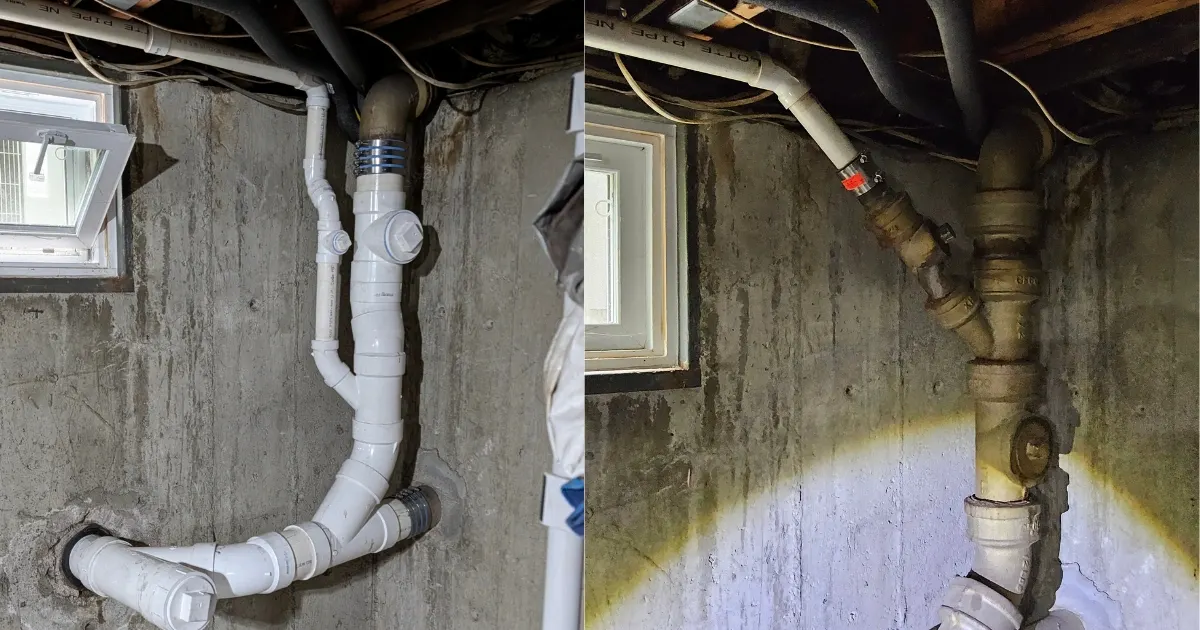
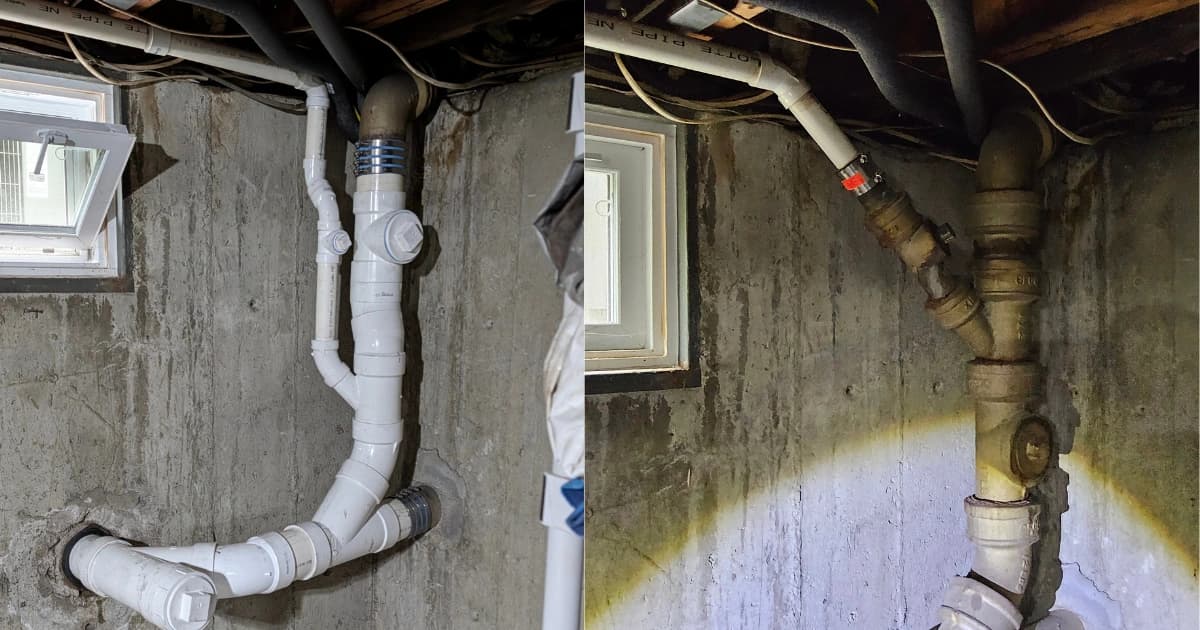
Partial replacement makes sense when inspection confirms one failed section — a cracked length, a rotted branch connection — and the surrounding pipe is still sound. The existing hub joints work in your favor here: on the Wayland job, the bell joints in the cast iron gave clean transition points where new PVC could tie in without extensive demolition. Done with the right transition fittings, a sectional repair is a legitimate, durable fix.

Full replacement of the accessible run makes sense when the problems are no longer local — cracks or corrosion at multiple points, heavy scale throughout, or clogs that migrate from fixture to fixture the way they did in Wayland. Every splice between old and new material is a transition point, and stacking several of them along a failing pipe builds future failure points into the repair. When inspection shows deterioration along the whole run, replacing the accessible piping once usually beats replacing it in installments.

What’s In Scope — and What We Refer Out

This boundary matters more in drain work than almost anywhere else in plumbing, so here it is plainly. Jeneral Plumbing repairs and replaces confirmed defects in accessible fixture, branch, and building-drain piping — which includes the interior cast iron stack and branch replacement this guide describes. We do not provide drain cleaning, hydro jetting, snaking, sewer-main repair or replacement, trenchless lining, or septic service; that work is referred to the appropriate specialist, and we name the boundary before scheduling.

The property line matters too. As I explained on the Wayland job, the commonly applied reading of the plumbing code lets a licensed plumber work to roughly ten feet outside the foundation; beyond that, excavation belongs with a contractor bonded with the town — and the local inspector’s reading governs. One more distinction worth knowing: moisture that keeps appearing while every fixture is off usually is not a drain problem at all. That points to pressurized supply piping, which is pipe leak repair — a separate scope. Our homeowner’s guide to drains, sewers, and water lines maps the whole territory, symptom by symptom.

What a Cast Iron to PVC Conversion Day Looks Like

Process Photo

An interior conversion is careful, sequenced work, and the sequence starts before anything is cut. Cast iron is heavy, and the sections that stay must be supported before the sections that go are removed. Standing under that Wayland main line, I put it this way: “This has to be hung before I remove anything. I’ve got to put a hanger somewhere up here to take that weight.” Skip that step and the remaining pipe can settle — stressing joints, and in a stack that runs to the roof, compromising the roof seal above. That is how a drain repair becomes a roofing problem.

With support set, the day runs in order:

  • Water off and fixtures out of service — every drain in the house feeds the line being cut
  • Hangers and temporary support installed for the cast iron that stays
  • Damaged sections cut out and removed
  • New PVC set with correct slope, supported to spec, and joined to the surviving cast iron at the hub joints with proper transition fittings
  • The whole path tested under normal drainage before the tools leave

Plan for a full day without running water. As I told the homeowner: “This would be close to a full day. That means no running water for the day because it all ends up here.” The practical scheduling advice from that job still holds — a school day, with the family out of the house, keeps the disruption manageable.

What Cast Iron Replacement Costs Depend On

Material is the easy part of this conversation. Cast iron itself is expensive — on the Wayland job I put it plainly: “Ten feet of four-inch cast iron is like three hundred dollars for pipe.” PVC delivers the same function for a fraction of the material cost, resists the corrosion that ends cast iron, and accepts cleanouts wherever future access makes sense. That is why PVC is the default answer for residential drain replacement.

The real cost drivers are specific to your house, which is why an honest number follows an inspection instead of preceding it:

  • Length of the run — one cracked section and a full basement main are different jobs
  • Access — exposed pipe in an unfinished basement versus piping above a finished ceiling, where opening and finish-work responsibility must be agreed before repair
  • Connections — every fixture branch that ties into the replaced run needs a proper reconnection
  • Transitions and support — fittings joining PVC to surviving cast iron, plus the hangers that carry the weight
  • Removal — cast iron comes out heavy, in sections, and has to leave the building

The assessment visit includes an $80 dispatch fee — the cost of the visit, waived when you hire us for the work. What you get for it is a written scope: the confirmed section, access needs, materials, exclusions, and any work that belongs with a referral specialist — all before anything is approved.

When It Can’t Wait

Some symptoms should skip the research phase. Sewage backing up into living space, water actively damaging finishes, several fixtures blocked at once, or a strong sewer odor that will not clear — these are call-first situations, because standing wastewater is a health issue and water finds expensive materials fast. Call (978) 392-7789 and describe what you are seeing; the first minutes of that call sort whether the urgent need is damaged piping we handle, clearing work for a drain contractor, or both. If you are near this story’s corner of Middlesex County, our emergency plumber in Concord page covers what to shut off first and what to expect from the call.

Serving Concord and the Towns Around It

Jeneral Plumbing is based in Westford, MA and serves 23 towns across Middlesex & Essex County — Westford, Chelmsford, Acton, Concord, Carlisle, Bedford, and Maynard among them. This guide grew out of a Wayland service call, but our core service area centers on Westford; the full list of towns we serve is the place to check yours. Many homes across this corridor date to the era when cast iron was standard, which is why the pattern in that basement — recurring clogs, chemical cleaner, a jetting misadventure — repeats across the region. If it sounds like your basement, an inspection settles what a guess cannot.

Frequently Asked Questions

How long does cast iron drain pipe last?

Trade references commonly put cast iron drain service life around 50 to 75 years, with wide variation — water chemistry, usage, and installation quality all move the number. That means homes from the 1950s through the early 1970s are now living through the end of their cast iron’s design life. Age alone does not condemn a stack, and some older systems still test sound. Condition governs, and condition is confirmed by inspection, not by the calendar.

How do I know if my cast iron pipes need replacing?

The pattern to watch is recurrence: the same line clogging repeatedly, slow drains that return after clearing, water staining below a pipe run, flaking rust on the pipe’s surface, or persistent sewer odor near the stack. Any one symptom can have an innocent cause, which is why replacement is never diagnosed from a symptom list. Confirmation comes from looking — visible cracks and corrosion on accessible pipe, or a camera inspection by a drain or sewer contractor for the parts you cannot see. If the evidence shows a failing accessible section, that is when replacement enters the conversation.

Can you replace cast iron drain pipes in sections?

Yes — when inspection confirms the damage is contained, a sectional replacement joined to sound cast iron at existing hub joints is a legitimate repair. The honest caveat is that every old-to-new splice is a transition point, and a pipe failing in several places does not reward patching it one crisis at a time. When deterioration runs the length of the line, replacing the full accessible run once is usually the better spend. The inspection findings, not a preference, should make that call.

How long does PVC drain pipe last?

Properly installed PVC drain systems are commonly rated for 50 to 100 years of service — the material does not corrode, so it avoids the failure mode that ends most cast iron. The smooth interior wall also resists the scale buildup that makes aging cast iron catch debris. Installation quality still matters: correct slope, solvent-welded joints, and adequate support determine whether PVC reaches its potential. Done right, a conversion is a once-in-a-lifetime project for most homeowners.

Can I use my plumbing during the replacement?

No — plan for a full day without running water or working drains. Every fixture in the house eventually feeds the main line being replaced, so nothing can drain while that line is open. Fill water containers the night before, plan bathroom logistics, and if you can schedule the work for a day the house is empty, the disruption barely registers. The goal is same-day restoration, with the system tested under normal drainage before we leave.

Will homeowner’s insurance cover cast iron pipe replacement?

Usually not the pipe itself — insurers generally treat a corroded drain system as wear and tear, which policies exclude. Water damage that results from a sudden failure may be covered even when the pipe that caused it is not. Every policy reads differently, so check with your insurance provider before assuming either way. A written scope and photos from the inspection are useful documentation if you do file a claim.

If your drains keep telling the same story — clog, clear, repeat — the pipe deserves a look before the next bottle of chemical cleaner. Call Jeneral Plumbing at (978) 392-7789 and describe the pattern; we will tell you honestly whether it points to accessible piping we repair or work that belongs with a specialist first.

Written by Jeneral Plumbing.

This article was drafted with AI writing tools from Jeneral Plumbing job notes and source materials, then edited before publication. AI tools did not inspect the job or validate technical conclusions.

Last updated .

Related Topics:cracked pipehydro jettingemergency plumbing24 hour plumber near medrain cleaning service

Jeneral Plumbing is owner-operated by a Licensed Master Plumber (MA #9628831-PL-M) serving Westford and 23 towns across Middlesex & Essex County. Call (978) 392-7789 to schedule.

Dealing with this in your home? We can help.