


A scorch mark on the front of a tankless water heater is easy to write off as cosmetic. It isn't. A burn mark means abnormal heat reached a surface that shouldn't get that hot, and it can go along with flame rollout, where flame shows up outside the unit's intended combustion area. We serve Bedford, MA homeowners from Westford, and this guide uses a documented case from a Westford home to show what a burn mark can lead to and what the repair has to cover.
What to do about a Navien tankless water heater burn mark
If flame is escaping, you see smoke or fire, you smell gas, or a carbon monoxide alarm sounds, get everyone out of the building now and call 911 from outside. Don't touch switches, the heater or the gas valve on your way out, and stay out until officials say it's safe.
If none of that is happening, stop using the heater. Follow the exact owner's manual for shutdown only if you can do so from a safe, dry position without approaching damaged equipment. If you're unsure, keep clear and get qualified help. Don't remove the cover, reset it, relight it or run it to see whether it happens again. Photograph the mark and record the display only if that's safe; a photo isn't worth approaching a damaged unit. A burn mark calls for inspection but doesn't identify the cause.
What the Westford case showed
The homeowner had first found a scorch mark on the cover about two years earlier. Replacing the cover hid the symptom for a while, but it didn't explain why heat was reaching it. When the mark came back, the homeowner removed the cover and saw flame travel sideways. That's the moment to stop, and it's why we ask homeowners to leave the cover on.
By the time we evaluated the unit, the heat exchanger showed severe heat damage and had failed, and the seal around it was compromised. The expansion tank on the water side needed attention as well. A new cover would never have fixed any of that.
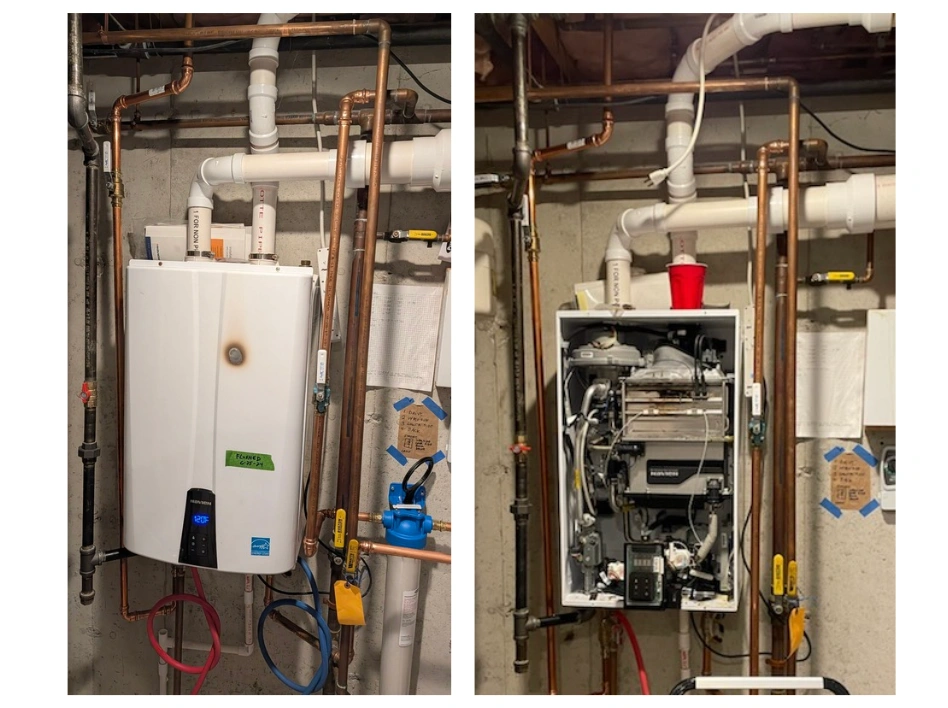
The venting finding
Outside, the unit had a four-inch air-intake pipe and a three-inch exhaust pipe, with the terminations about 15 feet apart. That had to be checked against the instructions for that exact model, because the manual and listing govern the approved pipe material, diameter, adapters, total equivalent length, elbows, slope, supports, termination layout and clearances. Equivalent length counts the fittings as well as the straight pipe, so a run that looks short across a basement can be long on paper.
Vents that look different aren't automatically wrong, and bigger pipe isn't automatically better. Some Navien installations use three-inch pipe, and other approved setups differ. For this unit, the recommendation at the end of the visit was to return the intake to the model's specified three-inch arrangement, address the failed heat exchanger, and then recommission the heater with model-specific operating and combustion checks. We don't have a completed repair or post-repair readings to report, so we won't claim the proposed work solved it.

The water side is a separate finding
The expansion tank read about 20 psi, against incoming water pressure of about 55 psi. That gap called for a proper test and correction. It didn't establish a cause for the flame problem. The expansion tank manages expanding water, so the water-side findings needed assessment alongside the combustion and vent findings.
Whether an expansion tank is needed depends on the plumbing design and applicable requirements. Where one is used, a professional checks its condition and precharge using the tank manufacturer's instructions and the measured water pressure. A gauge reading on a tank still under water pressure doesn't establish its precharge.
Condensate fittings matter too
Condensing tankless heaters produce acidic condensate. At this home, dripping drain fittings had been replaced with brass, and the brass had deteriorated. The drain material, trap, neutralizer, pump and route need to follow the equipment's instructions and applicable requirements. The deteriorated fittings were another finding to correct; the case notes don't establish whether the condensate system contributed to the combustion problem.
Repair, warranty or replacement?
Severe heat damage doesn't make the decision automatic. Flame rollout can affect the heat exchanger, cover, seals, wiring, controls and burner area, and a vent correction adds its own work. We compare the full confirmed scope with the unit's age, service history, parts availability and warranty status. Navien's heat-exchanger coverage depends on the model, application, serial number, installation date, documentation, maintenance and current terms, and Navien approves claims. Part coverage doesn't automatically include labor, vent correction, access or other damaged parts. At this home, checking the serial number and warranty path was part of the recommendation, and the outcome isn't recorded here.
Our Navien heat exchanger replacement walkthrough explains what that repair involves, and our water heater options page compares repair with replacement. Whichever path fits, a flame-rollout repair isn't finished until leak checks, operation across firing conditions, combustion readings and safety controls all pass under the manufacturer's procedure.
Jeneral Plumbing is owner-operated by a Licensed Master Plumber (MA #9628831-PL-M) with 20+ years in the trade, including seven with a gas utility, factory trained by Navien and Navien Service Specialist (NSS) certified. We're based in Westford, MA, and serve Bedford and other homes within 20 miles across Middlesex & Worcester County. Our gas appliance work is Massachusetts-only, and we confirm your address, the work and availability when you call. During regular hours, a visit carries an $80 dispatch fee — the cost of the visit, waived when you hire us for the work. Repairs are priced at a flat rate for your approval before work begins. After any emergency is cleared, call (978) 392-7789 with the symptoms and any safely recorded information, or see our tankless water heater service.
Written by Jeneral Plumbing.
This article was drafted with AI writing tools and edited before publication. AI tools did not inspect any job or validate technical conclusions.
Last updated .