
Why is my tankless water heater not getting hot? When the answer isn't obvious, the pattern usually points the way. No hot water at all is a different problem from hot water that fades in and out, and both differ from water that's only lukewarm when several taps are open. Here are the common causes, what you can safely check, and when to stop and call.
Safety first
If you smell gas, leave the house and call 911 from outside, along with the gas utility or propane provider. Don't operate switches, appliances or valves on the way out. A carbon monoxide alarm, soot around the unit or its vent, smoke, flame or anyone feeling sick also means leave and call 911 from outside. Stay out until officials clear the house. Stop using a scorched, melted or leaking unit. Follow its manual for shutdown only from a safe, dry position; otherwise keep clear and get qualified help.
Start with the pattern
| What happens | Possible explanation | Useful observation |
|---|---|---|
| No hot water anywhere, display dark | Power outage or an electrical/control fault | Whether the rest of the house has power and when the display went dark |
| No hot water anywhere, display on or showing a code | A fuel, ignition, venting or control fault | Photograph the code without opening the unit |
| Hot, then a burst of cold, then hot again | Startup delay, flow changes or another intermittent fault | Whether it follows short on-off use or happens during a steady draw |
| Hot at the shower, cold at a low-flow faucet | Insufficient hot-side flow or a fixture problem | Which fixtures are affected during ordinary use |
| Lukewarm when several fixtures run | Demand above the unit's output, especially in winter | How many fixtures were running |
| Hot water weaker over months | Scale or a clogged inlet filter | When it was last descaled or cleaned |
| Lukewarm at some fixtures only | A faucet or mixing valve blending cold into the hot line | Which fixtures are affected |
Why does my tankless water heater keep going cold?
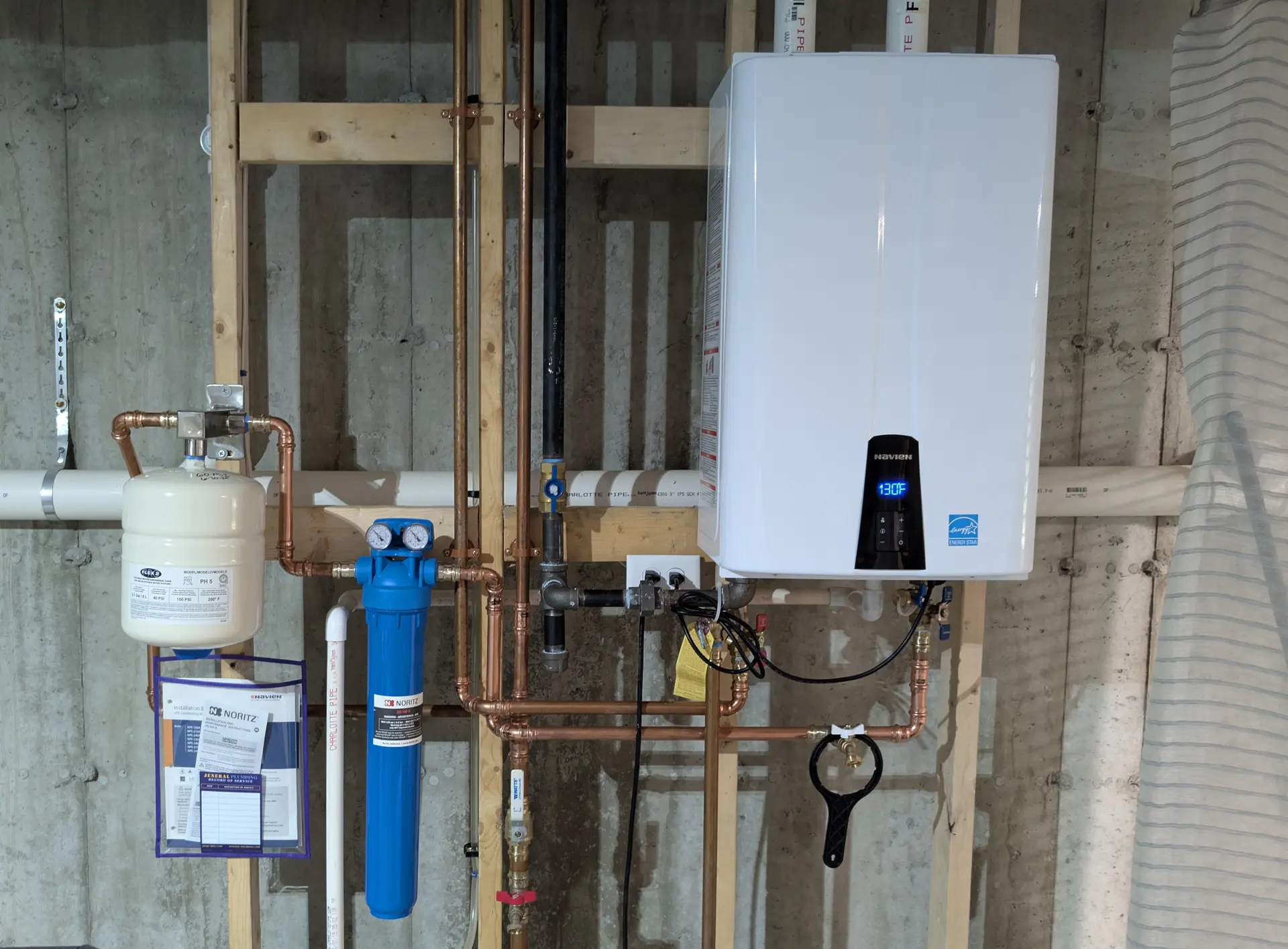
One possibility is a cold-water sandwich: hot water remaining in the pipe reaches the tap first, followed by cooler water before newly heated water arrives. It can happen after short on-off draws, but a temperature swing doesn't establish that explanation or rule out a fault. Some equipment has features intended to reduce it; Navien's NPE-240A2 product information, for example, describes a built-in buffer tank. A recirculation or storage change must fit the installed model and piping.
Minimum operating flow is another possibility. On gas tankless models that require a minimum hot-side flow, a low-flow fixture or heavy mixing with cold water can let flow fall below that threshold. The exact threshold and controls differ by model. Record which fixtures are affected and whether the display changes during normal use. Don't raise the heater setting or turn a shower hotter as a test; the water can suddenly become scalding. A technician can measure flow and check the fixture, piping and controls.
Lukewarm when more than one tap is open
Every tankless unit has a limit on how much water it can heat at once, and the limit depends on the required temperature rise. Colder incoming water can reduce its available hot-water flow. If two showers and the dishwasher run together, the unit may limit flow or fail to maintain the requested temperature, depending on its controls. Record what was running when performance changed. Compare the model's rated output with demand, while also checking for a fault or mixing problem; poor performance alone doesn't prove the unit is undersized.
Scale and the inlet filter
Hardness deposits can interfere with heat transfer or restrict the water passages. A clogged inlet screen can also reduce flow. Changed performance or a maintenance notice is a reason to inspect; it doesn't prove scale is the cause.
The instructions for how to clean tankless water heater inlet filters must match the model. For example, the Navien NPE-2 user manual covers NPE-180A2/210A2/240A2 and NPE-180S2/210S2/240S2; its filter procedure references a separate draining procedure. That isn't interchangeable with instructions for another heater. Record the last service date, locate your manual and leave the filter in place if you cannot follow its complete procedure safely. Don't loosen it on a hot or pressurized unit.
Gas and venting
A gas tankless heater needs the specified fuel supply and venting arrangement. Tell the technician about any fuel-delivery interruption or recent gas work. From the ground, note snow, ice, debris or visible damage at the outdoor vent without reaching into it or removing a screen. Keep clear if exhaust appears to be entering the house and follow the emergency directions above. Don't test gas availability by lighting another appliance, operate gas valves, remove the cover or take vent pipes apart.
The tankless water heater power supply
A gas tankless heater still needs electricity for its controls, fan and ignition. If the display is dark, note whether the rest of the house has power and whether an outage preceded the problem. A dark display can also indicate an equipment fault. Don't reset a tripped breaker as a generic troubleshooting step; have the circuit and appliance assessed, particularly after a leak or electrical damage. Backup power must meet the heater's requirements and be installed with appropriate electrical protection. For a winter outage, check the exact manual's freeze-protection guidance promptly; built-in protection may depend on power and may not protect connected piping.
Troubleshooting tankless water heater problems safely
Safe troubleshooting means observing and recording, not opening things up. Before you call, note:
- whether any hot water comes out at all, and at which fixtures;
- the full display, photographed, including any error code;
- what was running and how many fixtures were open;
- recent power outages, gas work, plumbing work or descaling;
- the model and serial number from the label, without removing the cover.
Codes have to be matched to your exact model's manual, and our guides to Navien error code 515 and Rinnai codes 14, 15 and 22 show how that works. Don't open the cabinet, adjust gas controls, bypass a safety or keep resetting a code that returns.
If the water is lukewarm only at certain fixtures, a worn faucet cartridge or mixing valve can let cold water cross into the hot line. Our article on faucets that run only hot explains how crossovers work, from the other direction.
Does a tankless water heater need to be flushed?
Many tankless models require or recommend flushing or descaling under specified conditions. The method and interval follow the installed model's instructions, water conditions and service history. For the NPE-2 models linked above, Navien describes flushing as a procedure that warrants professional help if any step is uncertain. A water test gives you the hardness number for that maintenance discussion; a flush isn't a substitute for diagnosing an ignition, vent or electrical fault.
When to stop troubleshooting
Arrange tankless hot water heater repair for a recurring code, an unresolved loss of hot water or a persistent change in flow or temperature. Stop using a leaking, scorched or damaged appliance. Gas odor, a CO alarm, smoke or flame calls for leaving and calling 911 from outside, not waiting for a service appointment. Once any emergency is cleared, our tankless water heater service starts from the exact model and recorded symptoms.
Jeneral Plumbing is based in Westford, MA, and owner-operated by a Licensed Master Plumber (MA #9628831-PL-M) who is factory trained by Navien, Rinnai and Noritz and Navien Service Specialist (NSS) certified. We serve homes within 20 miles across Middlesex & Worcester County, confirming the address, the work and availability before booking. Gas appliance work is Massachusetts-only. A regular-hours visit carries an $80 dispatch fee — the cost of the visit, waived when you hire us for the work. Repairs are priced at a flat rate for approval before work begins. If you lose hot water after hours, we take emergency calls 24/7. Off-hours, Sunday and holiday dispatch carries a separate $599 emergency callout fee; it is non-refundable and non-negotiable, collected prior to dispatch, covers the dispatch only and is never applied to repair work.
Call (978) 392-7789 with the pattern you're seeing and a photo of the display.
Written by Jeneral Plumbing.
This article was drafted with AI writing tools and edited before publication. AI tools did not inspect any job or validate technical conclusions.
Last updated .