

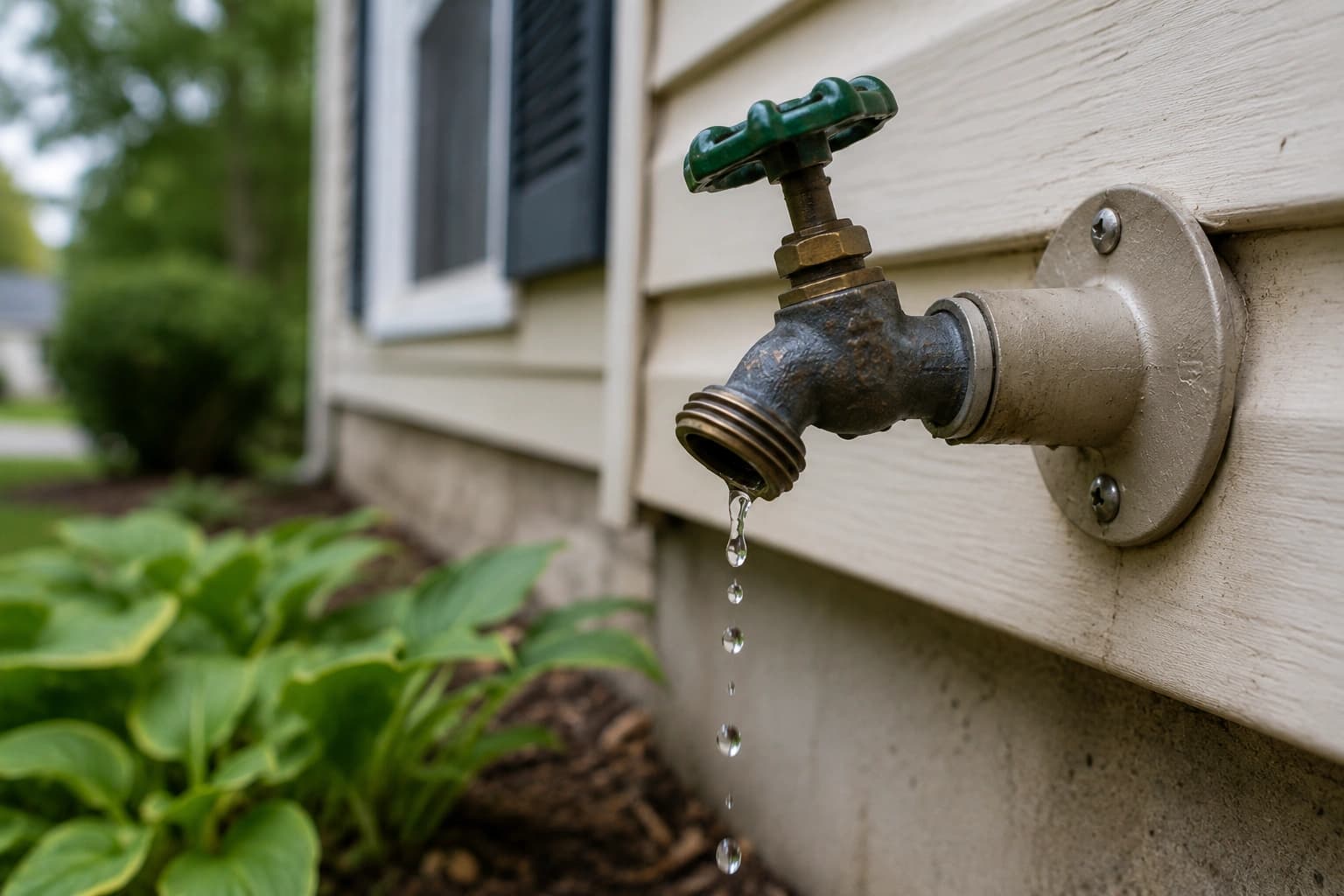
A leaking outdoor spigot usually starts small: a drop you notice while coiling the hose, then a drip you can hear, then a steady run you've stopped seeing. Where the water shows up is the best clue to what's wrong. It also decides whether the fix is a small part at the spout or a repair that means opening a finished wall or ceiling inside.
How a frost-free sillcock works
Many outdoor faucets are frost-free sillcocks. The valve that stops the water isn't at the handle; it sits several inches back, inside the heated part of the house, at the end of a long barrel. The handle you turn outside drives a stem through that barrel to reach it. When you shut it off, the water stops in warm space and the barrel drains out through the spout, as long as nothing blocks the spout and the barrel pitches slightly down toward the outside.
Three parts matter most for leaks: the washer and seat at the inside end, the packing where the stem exits by the handle, and the vacuum breaker at the spout. The vacuum breaker keeps water in a hose from being siphoned back into your household supply if pressure drops, such as a hose lying in a bucket of cleaner or a pool. It's a drinking-water protection device, not a trim piece.
Where the water shows up
At the spout tip or the cap on top
This is the most common spot, and it usually means the vacuum breaker's rubber washer or O-ring has worn out. Sun, temperature swings and years of use break rubber down. On the Hudson, MA call behind this article, that's what we found: a torn washer inside the vacuum breaker, letting water escape at the top of the spout.
Around the handle
Water tracking out where the handle meets the body while the spigot is open points to the stem packing, the seal around the stem where it leaves the valve body.
From the spout with the handle closed
If it keeps dripping after you've shut it off, the washer or seat at the inside end isn't sealing. Cranking the handle harder won't close it, and it can damage parts that could otherwise be repaired.
Inside the house while the spigot runs
Water on a basement wall, on the ceiling below the spigot, or around the rim joist (the framing where the house sits on the foundation) that appears only while the outside faucet is open is the classic sign of a split barrel. The split sits between the inside valve and the spout, so the leak stops when the valve is closed and starts again when it's open. That's how it goes unnoticed. Stop using the spigot until it's repaired.
A spigot that changed after winter
If it worked fine in October and leaks or sprays in April, suspect freeze damage. A split can hide inside the wall while the outside looks normal, so this one deserves an inspection rather than a new washer.
Stopping the leak for now
If the pipe feeding the spigot has its own shutoff valve inside, usually in the basement near where the pipe passes through the wall, closing it stops the leak until the repair. Without one, the main shutoff will stop it, though that also shuts off water to the whole house. Don't force a valve that won't turn; an old valve can break and make the leak worse.
Repair or replace?
The failed part decides it.
| What failed | Usual answer |
|---|---|
| Vacuum breaker washer or O-ring | Repair with parts that match the sillcock's make and model |
| Stem packing | Repair |
| Inside washer or seat | Repair if parts are available and the seat is sound; replace if it can't seal |
| Cracked body or freeze split | Replace, usually with access from inside |
Replacement often means reaching the valve body from inside the house, sometimes through a finished ceiling or wall. That's why the difference between a spout leak and a split barrel matters before anyone prices the job.
A vacuum breaker kit is inexpensive, and when the leak is clearly at the spout end, a homeowner comfortable with basic tools can often replace it. Two cautions. The kit has to match the sillcock. And because the part protects your drinking water, any doubt about whether it's seated and working afterward is worth resolving. Once the water shows up anywhere else, the repair is inside the valve or the wall, and that's plumber work.
Preventing the freeze version
Before the first freeze, disconnect every hose, splitter and shutoff attachment and let the spigot drain. A connected hose keeps water in the barrel, which defeats the frost-free design; the trapped water freezes and can split the barrel. If the same spigot has split more than once, have the pitch checked. A barrel installed without a slight fall toward the outside can hold water, and a new valve set at the same pitch can fail the same way next winter.
In spring, open each spigot and watch it for a minute. Look outside for a drip or water at the handle, and look inside, if you can see where the pipe comes through, for any water at all. A handle that suddenly feels different is worth noting too.
Why it's worth fixing before winter
The water lost through a small drip is real but modest. The bigger cost is where the water goes. A spigot leaking against the foundation, or a split barrel weeping inside the rim joist, soaks building materials instead of only running up the bill. A leaking spigot in September is usually a simpler repair than the same spigot after a freeze.
Getting it looked at
Jeneral Plumbing handles outdoor faucet and valve repair, and our pipe leak repair work covers freeze splits inside the wall. We're based in Westford, MA, and serve homes within 20 miles across Middlesex & Worcester County. The Hudson in our service-area directory is Hudson, New Hampshire; Hudson, Massachusetts does not have a directory page. If your home is in Hudson, MA, call and we'll confirm whether the address is within our service area, whether the work fits and whether we're available before booking.
During regular hours, a visit carries an $80 dispatch fee — the cost of the visit, waived when you hire us for the work. Repairs are priced at a flat rate, with the total disclosed for your approval before work begins. Call (978) 392-7789 and tell us where the water shows up and whether anything changed after winter.
Is a leaking vacuum breaker a health risk?
A leak there isn't evidence that anything has been siphoned into your water. It means the backflow protection may not be working as designed, so it's worth correcting promptly instead of treating it as a cosmetic drip. Until then, avoid leaving the hose sitting in a pool, bucket or anything you wouldn't want in your drinking water.
Written by Jeneral Plumbing.
This article was drafted with AI writing tools and edited before publication. AI tools did not inspect any job or validate technical conclusions.
Last updated .