

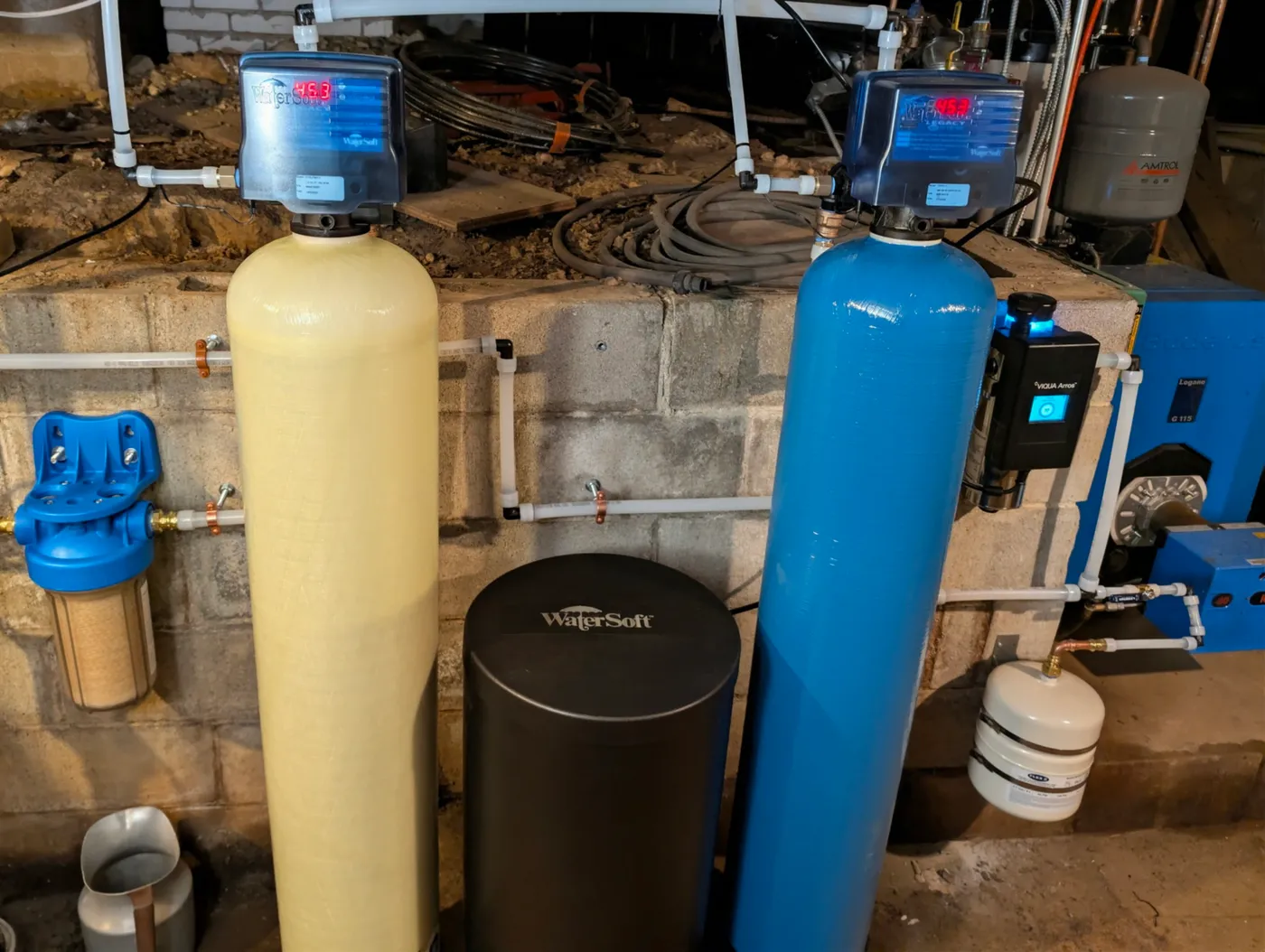
White crust on the faucets, spots on the dishes and poor soap lather can suggest hard water, which contains dissolved calcium and magnesium. A test confirms the hardness level. Start shopping for treatment and you'll find two different approaches sold under similar names: removing hardness or trying to reduce the scale it forms. Knowing the difference helps you choose equipment for the problem you have.
How a home water softener removes hardness
A home water softener removes hardness by ion exchange. Water flows through a tank of resin beads that hold sodium or potassium ions. The resin exchanges those ions for calcium and magnesium, reducing hardness as water passes through. When its usable capacity is reached, the softener regenerates with brine and sends the removed hardness and rinse water to an approved drain. Sizing, settings and maintenance determine whether it keeps delivering soft water at the household's flow and hardness load.
That's why a salt-based softener needs salt, a drain connection and usually an outlet for the control valve. If a softener claims certification to NSF/ANSI 44, the standard for residential ion-exchange softeners described in NSF's overview of treatment standards, look up the exact model to see what its listing covers.
A sodium-chloride softener adds sodium in proportion to the hardness it removes. If anyone has a sodium restriction, ask their clinician about the drinking-water plan. Potassium chloride is an alternative only where the equipment maker permits it, and it is not automatically suitable for every household. Health Canada's guidance identifies concerns for people with kidney conditions or medications affecting potassium handling. Discuss those constraints with the clinician before switching; a separately supplied drinking-water tap may be part of the plumbing plan.
What a salt free water softener does
What's sold as a saltless water softener is generally an antiscaling conditioner. Products use different methods, including media that changes how minerals form deposits. They aim to reduce scale without regenerating an ion-exchange resin with salt. Check the product's actual treatment method and installation requirements; the label alone doesn't tell you its performance or maintenance needs.
The Water Quality Association's scale guidance explains that antiscaling devices leave total calcium and magnesium in the treated water. A test reading can change with the measurement method, but that does not establish removal of the minerals or reliably softened water. Scale-control performance also varies with water conditions and technology. Look for independently certified performance that matches the claim, and compare the exact product's iron, manganese, flow and other operating limits with your test results. Don't assume a scale conditioner will deliver the same soap performance or eliminate dried-water spots.
Side by side
| Salt-based softener (ion exchange) | Salt-free conditioner | |
|---|---|---|
| Removes calcium and magnesium | Yes | No; hardness stays in the water |
| Reduces scale buildup | Reduces hardness-related scale when properly sized and maintained | Intended to reduce scale; performance depends on the product and water |
| Spots and soap performance | Reduces hardness-related soap problems; other dissolved minerals can still leave spots | Soft-water results aren't established by a scale-control claim |
| Salt and brine tank | Yes | No |
| Drain and power | Usually needed | Often not needed |
| Adds sodium | With sodium chloride, in proportion to hardness removed | No sodium exchange; check any media or additives |
| Iron | Some models handle small amounts, within the maker's limits | Often needs pretreatment |
Water softener salt: what to buy and how often to add it
Use the salt type and purity specified by your softener's manufacturer. Sodium chloride is sold as pellets and crystals, but the form alone doesn't establish suitability for every resin or control system. Use block salt, rock salt or additives only when the manual allows them. A change to potassium chloride also needs manufacturer approval and may require different settings; resolve the household's dietary or medical constraints first.
How often you add salt depends on hardness, water use, regeneration settings and brine-tank size. Set a checking schedule that suits that use, and follow the manual's minimum and maximum fill levels. The visible water level changes with the brining design and cycle; it isn't a universal salt-fill mark. Don't add water or change refill settings just because another system looks different.
Two brine-tank problems are worth knowing. A salt bridge is a crust with a hollow space beneath it, which can prevent effective brine production. Mushing describes a sludgy buildup at the bottom that can interfere with brining. A full-looking tank and returning hardness warrant checking the salt condition, controls and regeneration rather than simply adding more salt. Our Water Care plan ($39.99 a month) includes quarterly water treatment service and salt level management.
Choosing and sizing start with a test
The right choice starts with a water test and the result you want. Hardness, iron, manganese, pH, household use and peak flow help determine whether to remove hardness, address scale or treat another problem first. A softener's usable resin capacity and flow rating must fit that load. Iron may require pretreatment or adjustments specifically allowed by the manufacturer; extra resin capacity alone isn't a general iron-treatment solution. Our water testing starts there. Private wells also need appropriate certified laboratory testing for contaminants a basic plumbing test cannot detect.
What's the best water softener system for my house?
The best water softener system for your home is the one sized to your measured hardness, iron and household water use, with a control valve suited to your flow and a certification that matches its claims. Brand comes after sizing. We install equipment from our partner brands, WaterSoft, Halo, Lancaster and iSpring (Jeneral Plumbing is an iSpring authorized dealer), and the test results decide the type and size.
How much is a water softener, installed?
It depends on the unit's capacity, the control valve, whether iron treatment or other pretreatment is needed, and the installation itself: bypass and loop piping, drain access, power and removing old equipment. A salt-free conditioner is a different job from a softener. We don't publish a price range. After testing and seeing the space, we give you a written flat-rate price before work begins. A regular-hours visit carries an $80 dispatch fee — the cost of the visit, waived when you hire us for the work.
Getting the right system in place
Jeneral Plumbing is based in Westford, MA, serves homes within 20 miles across Middlesex & Worcester County, and is a Member, Water Quality Association (WQA). We confirm the address, the work and availability before booking, and our filtration and softener installation work starts from your test results.
Call (978) 392-7789 with any water test you have, your household size and what you're seeing at the taps.
Written by Jeneral Plumbing.
This article was drafted with AI writing tools and edited before publication. AI tools did not inspect any job or validate technical conclusions.
Last updated .