

The salt level hasn't moved in weeks, or there's a drip near the brine tank, or the spots on the dishes are back. None of those automatically means the softener needs replacing. A good record of water softener maintenance helps you tell a routine fix from a real failure, and it starts with knowing what normal looked like.
Start with a baseline, not a calendar
No single service interval fits every softener. The schedule should come from the exact model's instructions, the incoming water, how your household uses water and what each visit finds. The first record is the one every later visit gets compared against:
- The water source, public or private well, and where raw and treated samples can be drawn
- The model, installation date if known, control settings, hardness setting and regeneration history
- The bypass position, drain route, salt type and service history
- Raw and treated hardness results, with the method and units
Photos of the settings and connections help show what changed between visits. Controller numbers such as regeneration count or gallons treated add context, but neither predicts how much life the resin has left.
Routine checks, and signs that can't wait
Between visits, your part is to keep salt at the level the model calls for, keep the area clear and watch for leaks and alarms. A service visit covers the settings, brine draw, valve, bypass and drain, plus a performance test. Some signs shouldn't wait for the next scheduled date:
| What you notice | What it can involve | First step |
|---|---|---|
| Hard water seems to be back | Settings, capacity, a salt bridge, brine draw, valve wear, a bypass leak or resin | Compare raw and treated hardness before assuming the resin or control failed |
| Salt use stops or speeds up | Demand, settings, bridging, brine draw, metering, a leak or regeneration | Note the salt condition and what the controller shows |
| Water stays high in the brine tank | The float, injector, tubing, drain path or settings | Record the display and leave the diagnosis to an inspection |
| The unit keeps cycling | Settings, water use in the house, the drain, or recent power or plumbing changes | Write down what the display shows and when it happens |
| A leak | A fitting, valve, tube, housing, drain connection or nearby pipe | Stop the water if you safely can |
| Taste, odor, staining or cloudiness | A separate water question | Get the right test rather than adjusting the softener |
Bypass or shut off the equipment only the way its instructions describe. Forcing a stuck valve can turn one problem into two.
What one Westford visit showed
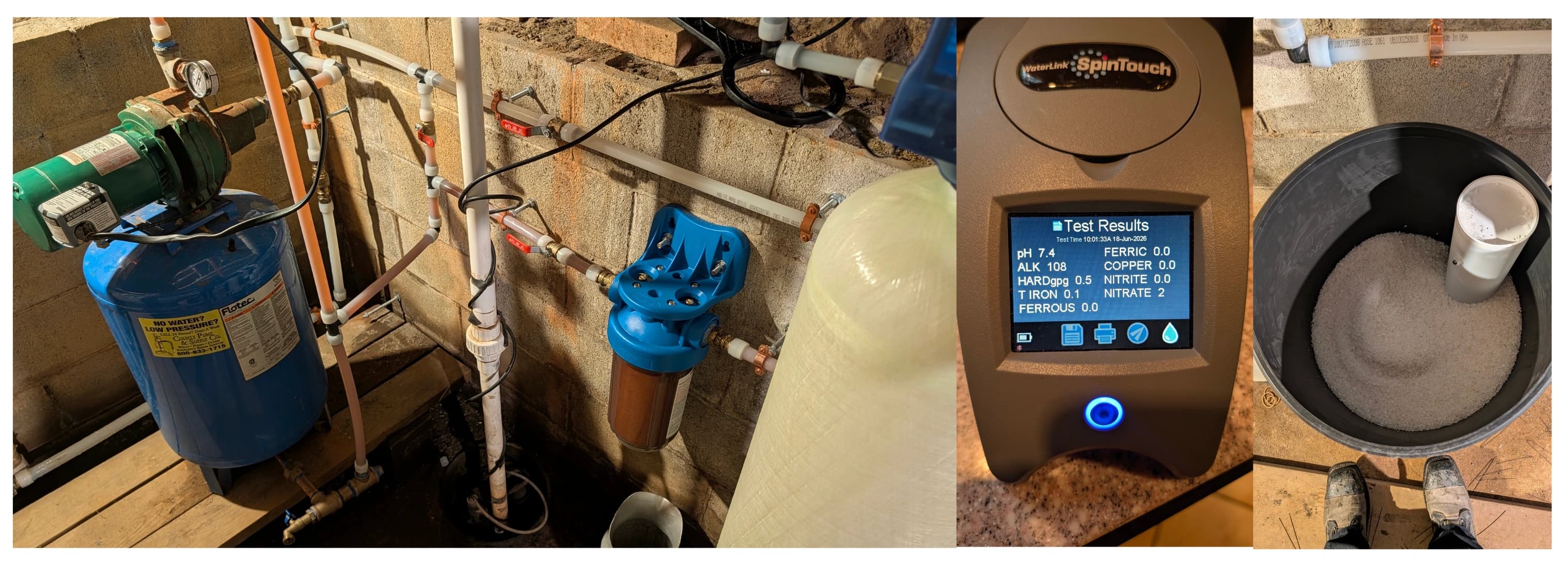
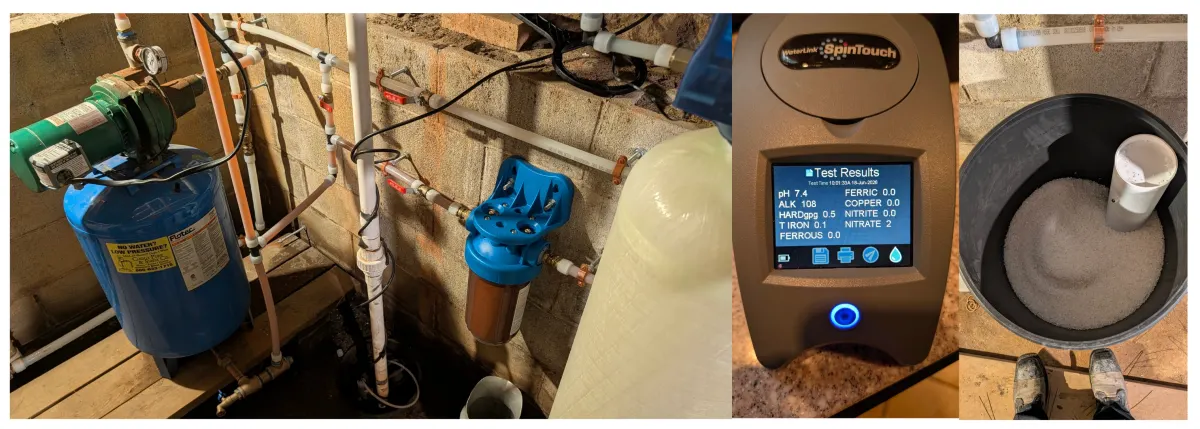
At a Westford service visit, we reviewed the salt level, looked for visible leakage, checked the general condition of the treatment equipment and recorded information from a backwashing filter. Salt was present, and there was an accessible drip above the salt tank area. We also noted an outdoor faucet concern that appeared separate from the softener.
Those facts don't prove the softener was failing, identify which connection was leaking, or establish the home's water chemistry. The drip needed its exact source isolated before any repair, and the outdoor faucet needed its own piping and valve inspection rather than being blamed on the treatment equipment. No completed repair is described here. When a drip turns out to be a house supply connection, our Westford pipe leak repair page covers that work.
Know your water source
The Westford Water Department's 2025 Annual Drinking Water Quality Report states that the public system met applicable state and federal health standards in 2025. That covers the public system for that year. It doesn't establish the quality of a private well, the hardness at your faucet or how well your softener is working. Well owners can start with MassDEP's private-well testing guide and the Westford Health Department's private-well information.
Hardness and TDS field checks describe only those measurements at the sample point used. They don't answer questions about PFAS, lead, arsenic or bacteria. Those concerns need an appropriate certified laboratory, its bottles and its sampling instructions. PFAS is never tested on site.
Repair, maintain or replace
The confirmed condition decides, not the unit's age. A leaking seal, blocked injector, failed meter, control fault, bypass problem, brine-draw issue, damaged tank, unavailable part or exhausted resin each leads to a different scope. Repair fits when the fault is isolated, the parts are right and the rest of the unit is serviceable. Replacement becomes reasonable when condition, compatibility, repeated failures, parts availability or capacity make repair the weaker path.
Then check that the fix did its job. For restored softening, compare suitable raw and treated hardness samples after the unit has completed its operating sequence. For a leak, look at the repaired connection under normal pressure. Ask for a record of any settings or parts changed during service so the next visit starts with that history.
If you're choosing a new system
Choosing a water softener system for home use starts with a hardness result that supports softening, and then with the maintenance you'll actually keep up. A salt-based ion-exchange softener needs salt added, occasional brine tank attention and setting updates when your household changes. Sediment filters, carbon filters and reverse osmosis units each have their own schedules on top of that.
Keep the softener's job in view, too. It exchanges hardness minerals. It isn't a sediment filter, a disinfectant, a PFAS treatment or a purifier. Any contaminant-reduction claim belongs to an exact model with a current third-party certification for that exact contaminant. Our filtration and softener service covers inspection, repair, maintenance and test-based installation, and our test-first water treatment service handles goals that go beyond hardness.
Keeping the schedule
The Water Care plan, at $39.99 a month, includes quarterly water treatment service, salt level management and an annual water quality report. A quarterly visit doesn't mean every cartridge, membrane or part gets replaced each time. The exact model and the conditions found still decide. Repair and installation work is priced at a flat rate, with the total and any fees shown for approval before work begins.
Does every Westford home need a softener?
No. Living in Westford doesn't create a need for softening. Identify your water source, read the current public-system report if it applies, and test your household hardness with a suitable method. The results may point to a softener, another kind of treatment, a plumbing repair or no treatment at all.
Scheduling softener service in Westford
Jeneral Plumbing is based in Westford, MA and provides test-first softener and water treatment work across Middlesex & Worcester County. A regular-hours visit carries an $80 dispatch fee — the cost of the visit, waived when you hire us for the work. Call (978) 392-7789 with the symptom, your equipment model, your water source, any earlier results and the service history. Our Westford water treatment page explains the local process.
Written by Jeneral Plumbing.
This article was drafted with AI writing tools and edited before publication. AI tools did not inspect any job or validate technical conclusions.
Last updated .